
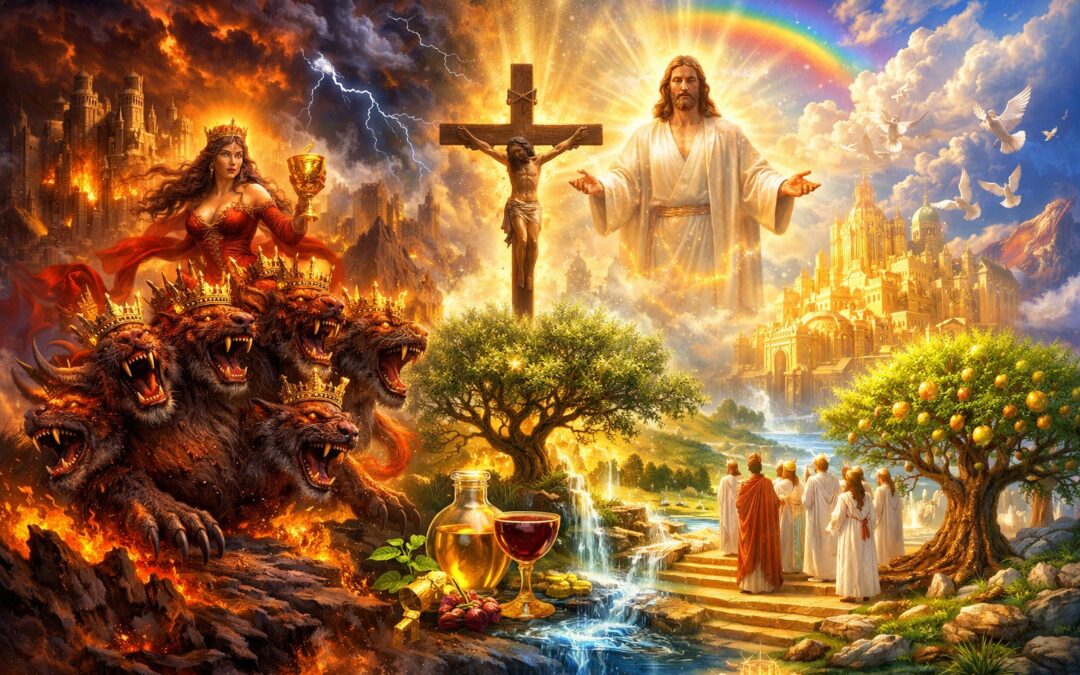
The Woman and the Beast of Revelation 17
Cruciform Wisdom of the Ages and the Judgment of the Adamic Fig Tree
By Apostle Brandon Barthrop, RLM TV Press
Abstract
Revelation 17 presents one of the most misunderstood visions in Scripture: the Woman seated upon the Beast. Popular interpretations reduce this mystery to political empires, future timelines, or external institutions. This paper restores the vision to its cosmic, anthropological, and cruciform meaning, unveiling the Woman as flesh-born humanity under Adam, the Beast as fallen second-heaven structure, and the crowns, heads, horns, and mountains as pre-Messianic religious and mystical systems operating apart from the Cross.
This study demonstrates that the judgment of the Woman is not the destruction of humanity, but the termination of Adamic religion, the collapse of stolen light, and the removal of sorcerous dominion from the heavens—making way for the Israel of the Olive Tree, the Crucified Royal Priesthood, and the new heavens and new earth established in the bloodline of Moshiach Yehoshua ben David.
I. The Woman: Flesh-Born Humanity under Adam
“I will show you the judgment of the great prostitute who sits on many waters.”
— Revelation 17:1
The Woman of Revelation 17 must not be confined to a single geographic city, political empire, or outward religious institution. Such reductions remain external and fail to penetrate the interior, anthropological, and cosmic depth of the apostolic vision granted to John. Revelation interprets itself when read through the full counsel of Scripture: the Woman represents corporate Adam—humanity generated from flesh and blood, animated by soul-life, and structured according to post-fall existence.
She is not pagan ignorance, nor atheistic rebellion. Rather, she is religious humanity—humanity that traffics in sacred language, handles spiritual realities, speaks of God, and yet fundamentally refuses death. She knows about God without knowing God through crucifixion. Her existence testifies that religion can flourish even where resurrection life is absent.
To understand the Woman rightly, one must recognize that she represents humanity born from below rather than from above. To be born from below is not merely a condition of moral failure but an ontological orientation. Adam after the fall exists as a being who is self-aware apart from God, biologically alive yet spiritually dead, capable of religion yet incapable of resurrection life. This humanity operates from the nefesh rather than the Spirit, from memory rather than revelation, and from an inheritance of dust rather than an inheritance of heaven. Consequently, the Woman embodies humanity structured by Adamic continuity, not by cruciform interruption. She persists forward in time without ever passing through death into new creation.
The most dangerous aspect of the Woman is not her immorality but her legitimacy. She is clothed, enthroned, and authoritative. These features reveal a sobering truth: Adamic humanity can preach truth without transformation, administer sacred things without sanctification, and exercise authority without dying. Religion apart from the Cross does not reject heaven; rather, it uses heaven. This is why the Woman is described as sitting upon many waters. In Scripture, waters signify not only peoples and nations but also spiritual currents—flows of influence, power, and authority. Adamic religion draws strength from these currents, channeling spiritual forces while preserving the self intact.
At the heart of the Woman’s nature lies a triad of self-oriented religion: self-preservation, self-illumination, and self-righteousness. She refuses the loss of identity demanded by the Cross, seeking illumination apart from death and resurrection, and standing justified by knowledge, lineage, practice, or office rather than by participation in Christ’s death. This is the impulse of the Fig Tree: “I am clothed; I am covered; I am sufficient.” Yet fig leaves do not heal death; they only conceal it. What is hidden remains unredeemed.
The Woman does not generate power from within; she borrows power from without. She draws upon fallen angelic administrations, inverted heavenly structures, and residual glory from earlier covenants now severed from their fulfillment in Messiah. This dependence explains why she rides the Beast rather than being the Beast. She relies on external power precisely because she lacks internal life. Borrowed power inevitably demands compromise, borrowed light always entails theft, and borrowed authority must eventually collapse.
For this reason, the charge leveled against her is not sexual but covenantal. She is called a prostitute because she receives authority from the heavens without covenantal faithfulness, trades intimacy for influence, and accepts power while refusing transformation. True covenant requires the death of the old self, exclusive union, and faithfulness unto death. The Woman rejects this path, choosing utility over union, influence over intimacy, and preservation over participation in resurrection.
The central indictment against her is therefore unmistakable: she is enthroned without passing through the Cross. She reigns without dying, without being buried, and without being raised in Christ. This is the essence of Adamic religion—kingship without resurrection, priesthood without blood, authority without sacrifice. It is a throne established apart from the Lamb.
In biblical imagery, the Woman is the Fig Tree preserved after Eden. The Fig Tree represents Adamic wisdom, fleshly covering, and religious continuity without regeneration. It appears alive, bears leaves, and projects vitality, yet produces no fruit of resurrection. This is why the Fig Tree is cursed by Messiah—not because it is evil in itself, but because it refuses transformation. It will not pass through death to bear new fruit.
The Woman of Revelation 17, therefore, is corporate Adam: flesh-born humanity, religion without crucifixion, authority without resurrection, and light without oil. She is not destroyed because God hates humanity, but because humanity must be reborn. Her judgment marks the end of Adamic continuity and the beginning of crucified sonship, in which humanity no longer rides borrowed heavens but becomes the dwelling place of God through the Cross of Moshiach Yehoshua ben David.
II. The Beast: Fallen Second-Heaven Structure
The Beast of Revelation 17 must not be interpreted merely as a political empire, a future regime, or a sequence of earthly governments. Such readings flatten the vision and misplace its center of gravity. The Beast is not primarily terrestrial; it is cosmic and architectural. It represents the structural body of fallen second-heaven authority, the organized framework through which inverted spiritual power is administered over humanity and the nations.
The Beast is the form of dominion rather than its content. It is the governing structure animated by an inverted angelic order, sustained by illicit wisdom, and mediated through sorcerous means. It is the composite system by which heavenly authority—once ordained for stewardship—has been corrupted into domination.
This distinction is critical: the Beast is not the Woman, and the Woman is not the Beast. The text does not say the Woman is the Beast, but that she rides it. This imagery reveals dependence rather than identity. Adamic religion does not generate its own authority; it is carried by a preexisting fallen heavenly architecture. The Woman’s legitimacy, reach, and influence are impossible apart from the Beast that bears her.
The Beast therefore represents the second heavens as fallen administration—a realm originally designed for mediation between God and creation, now inverted through rebellion and misuse. Within this structure, angelic order is no longer upright but reversed. Hierarchy becomes control, stewardship becomes extraction, and service becomes domination. Authority flows downward without accountability upward. This inversion produces a system that can sustain religion, power, and order while remaining fundamentally opposed to resurrection life.
The wisdom animating the Beast is illicit not because it is ignorant, but because it is unauthorized. It is wisdom severed from obedience, knowledge detached from covenant, and understanding pursued apart from fear of the Lord. Such wisdom promises illumination without repentance and power without purification. It is attractive precisely because it offers ascent without crucifixion.
Sorcerous mediation is the operational mechanism of the Beast. Sorcery, in its biblical sense, is not merely ritual magic; it is the manipulation of spiritual forces without submission to God. It is mediation without obedience, access without sonship, and power without transformation. Through sorcerous systems, fallen second-heaven structures continue to distribute authority, influence, and counterfeit light to those willing to bypass the Cross.
This is why Adamic religion cannot exist independently of the Beast. Religion without crucifixion always requires an external power source. Having refused death, it must borrow authority. Having rejected resurrection, it must draw life from another realm. The Woman rides the Beast because she lacks internal life; she is sustained by a power that is not her own.
The vision exposes a profound theological reality: religion apart from the Cross inevitably allies itself with fallen heavens. It may speak the language of holiness, order, and tradition, yet its power source is misaligned. It requires power without death, authority without transformation, and light without oil. Such religion can govern, influence, and expand, but it cannot heal, resurrect, or renew.
The Beast bears the Woman only for a time. The same fallen structure that sustains Adamic religion will ultimately turn against it, for borrowed authority is unstable and inverted systems devour their dependents. When the second heavens are judged and reordered, the Woman can no longer be carried. Her fall is inseparable from the collapse of the Beast because her authority never originated from within.
Thus, the Beast of Revelation 17 is the fallen second-heaven structure itself—the organized body of inverted spiritual authority that enables Adamic religion to function while opposing the way of the Cross. Its judgment is not merely punitive but restorative, for only through the removal of inverted heavenly architecture can creation be liberated and prepared for the reign of the Lamb through a crucified people.
III. The Seven Heads: The Old Araboth without Messiah
“The beast has seven heads…”
— Revelation 17:9
The seven heads of the Beast signify a distinct and critical layer of Revelation’s cosmology: the old Araboth, the pre-Messianic heavenly orders that governed creation—and particularly Israel—prior to the advent, crucifixion, and enthronement of Moshiach Yehoshua ben David. These seven heads do not represent random powers, nor are they merely symbolic abstractions. They correspond to real heavenly administrations that once functioned within divine permission, yet now stand exposed as incomplete and surpassed.
Before the Cross, heaven was administered through angelic mediation. Authority flowed through structured heavenly ranks, divine messages were delivered externally, and access to the presence of God was mediated rather than indwelling. The economy of heaven, though holy in origin, remained ministerial rather than incarnational. Humanity did not yet serve as the dwelling place of God; heaven remained above, and access was regulated.
In this pre-Messianic order, mediation was necessarily external. Angels carried messages, enforced decrees, and governed boundaries. While this system was not evil in itself, it was provisional. It pointed forward to something greater that had not yet arrived. The bloodline of Yehoshua ben David had not yet been enthroned within creation, and therefore the heavens themselves awaited fulfillment.
The seven Araboth were good in origin, established for order, stewardship, and divine governance. However, as time progressed and the fullness of redemption approached, these heavens became increasingly susceptible to mixture. Without the Cross as their governing center, they were vulnerable to corruption, inversion, and misuse. Authority that was once custodial gradually hardened into domination. Mediation that was once protective became controlling. Light that was meant to lead toward incarnation became transferable, extractable, and eventually exploitable.
The absence of Messiah is the decisive factor. Without Moshiach Yehoshua ben David enthroned as the center of all authority, Araboth shifts from service to hierarchy. Heavenly order degenerates into rigid stratification, and what was meant to facilitate communion becomes a system of distance. Mediation, severed from incarnation, devolves into sorcery—access to spiritual power without obedience, authority exercised without covenantal faithfulness, and influence obtained without transformation.
Likewise, light without Messiah ceases to be incarnated. Instead of dwelling within transformed vessels, it becomes transferable—a substance that can be moved, traded, siphoned, or stolen. This is the light trafficked by the Woman and administered by the Beast: illumination without embodiment, power without purification, glory without blood. Such light cannot heal creation; it can only sustain systems.
The seven heads, therefore, are not evil by design. They are obsolete by redemption. What once governed provisionally must yield to what now reigns eternally. The Cross does not merely forgive sin; it restructures the heavens. With the enthronement of the Son of Man, authority no longer resides in external administrations but in resurrected humanity united to Christ. Angelic mediation gives way to sonship. Restricted access gives way to indwelling presence. Hierarchical control gives way to shared inheritance.
Revelation does not condemn the old Araboth for existing; it reveals that they can no longer rule. Their time has passed because the Lamb has taken His throne, not above humanity, but within it. The seven heads fall not because they rebelled, but because they are surpassed. Redemption renders them unnecessary, and what is unnecessary becomes unstable when clung to beyond its appointed season.
Thus, the seven heads of the Beast represent the old heavenly orders functioning apart from Messiah—structures once permitted, now displaced. Their exposure in Revelation is not an act of hostility, but of unveiling. What once mediated God must now bow to God dwelling in His crucified and risen people.
IV. The Ten Horns: The Old Sefirot without the Cross
“The ten horns… are ten kings.”
— Revelation 17:12
The ten horns of the Beast signify the exercise of power rather than its structure. If the seven heads reveal the architectural framework of fallen heavenly administration, the ten horns disclose how authority is wielded within that framework. In biblical symbolism, horns consistently represent strength, rulership, and active dominion. Thus, the ten horns correspond to the Sefirotic order operating apart from the Cross, divine attributes severed from their Messianic fulfillment and wielded without cruciform correction.
The Sefirot, in their holy design, are expressions of divine governance—channels through which God’s attributes are meant to flow into creation. Yet when these attributes are accessed without union to Moshiach Yehoshua ben David, they cease to function as instruments of life and instead become instruments of control. Power remains real, but it is no longer redemptive. Authority remains operative, but it is no longer sanctified.
Without the Cross, the Sefirotic attributes are exercised without self-emptying. Authority is asserted rather than poured out. Strength is retained rather than surrendered. Wisdom is accumulated rather than incarnated. This produces “kings” who rule without dying, govern without serving, and reign without bearing wounds. Such kingship is antithetical to the Lamb, whose authority is revealed precisely through sacrifice.
The ten horns therefore represent divine qualities divorced from the bloodline of Messiah. They are attributes of governance severed from the Lamb, authority exercised without kenosis, and wisdom functioning without blood. When the Cross is absent, the Sefirot no longer form a living Tree of Life; they fragment into independent powers, each asserting itself for survival and dominance.
This condition may rightly be described as Kabbalah without Messiah. In such a system, light is accessed but not purified. Illumination is pursued without repentance, producing brilliance without holiness. Power is drawn but not embodied, resulting in influence that never becomes transformed character. Wisdom is gained but not transfigured, yielding insight without obedience and knowledge without love. What is missing is not intelligence or capacity, but death and resurrection.
Power that has not passed through the Cross inevitably turns predatory. Detached from love, strength seeks control. Detached from blood, wisdom becomes manipulation. Detached from incarnation, light becomes extractive. The ten horns are thus kings who rule by taking rather than giving, by drawing life from others rather than laying down their own. They govern by siphoning vitality from below instead of receiving authority from above.
This is why Revelation presents the ten horns not as neutral forces, but as agents aligned with the Beast. Power without crucifixion always aligns with inverted structures, because it lacks the internal restraint of love perfected through suffering. The Lamb alone can hold the fullness of divine attributes without corruption, because He alone pours Himself out entirely.
The judgment of the ten horns is not a rejection of divine attributes, but their reclamation. In Messiah, the Sefirot are not abolished; they are fulfilled. Authority is restored through self-giving. Wisdom is purified through blood. Power is redeemed through death. Only when the attributes of God are embodied in a crucified people can they function as life rather than domination.
Thus, the ten horns expose the fatal flaw of power exercised apart from the Cross. They reveal that governance without sacrifice becomes tyranny, wisdom without blood becomes sorcery, and light without incarnation becomes theft. Redemption does not eliminate power; it crucifies it, and in doing so, raises it incorruptible.
V. The Seven Mountains: Esau / Edom
“The seven heads are seven mountains…”
— Revelation 17:9
In biblical language, mountains signify realms of governance, seats of authority, and elevated dominions from which power is exercised over peoples and nations. They are not merely geographic features but symbolic representations of ruling orders. When Revelation identifies the seven heads of the Beast as seven mountains, it reveals that the old heavenly administrations manifest concretely through flesh-governed dominions operating within history. These mountains correspond to Edomic rule, the legacy of Esau extended into spiritual, religious, and civil authority.
Edom, in Scripture, is not simply a people group but a spiritual archetype. Esau represents strength without submission, inheritance seized rather than received, and authority exercised apart from covenantal surrender. He is the firstborn who trades birthright for immediate power, the priest who refuses the altar of death, and the ruler who governs by appetite rather than obedience. The seven mountains are therefore Edomic dominions—systems of governance rooted in flesh ruling over spirit.
These mountains are not ignorant of spiritual reality. On the contrary, they retain genuine authority and operate with real power. Yet their defining characteristic is that they refuse crucifixion. They seek to rule without dying, to inherit without yielding, and to govern without pouring themselves out. In this way, Edom becomes Jacob without the Cross—Israel without death, priesthood without oil. The form remains, but the life is absent.
This distinction is critical. Edom does not reject God outright; it rejects the process of transformation. It desires blessing without brokenness, authority without obedience, and kingship without sacrifice. As a result, Edomic dominion becomes inherently predatory. What is not surrendered must be defended, and what is defended must be enforced through power. Thus, the mountains of Edom dominate the world not because they are righteous, but because they are willing to rule through strength while refusing surrender.
These seven mountains exert influence precisely because they combine spiritual authority with fleshly ambition. They retain access to heavenly principles, divine patterns, and spiritual language, yet apply them through uncrucified humanity. This produces systems that appear ordered, authoritative, and even righteous, while remaining fundamentally opposed to resurrection life. Flesh governs spirit, appetite governs inheritance, and preservation governs purpose.
The tragedy of Edom is that it stands so close to Israel, yet never enters covenantal transformation. It mirrors the structure of priesthood while rejecting the altar. It claims the rights of inheritance while despising the means by which inheritance is secured. In Revelation 17, these Edomic mountains support the Woman because Adamic religion requires flesh-based dominion to sustain itself. Together, they form a composite system in which spiritual authority is exercised without spiritual death.
The judgment pronounced against these mountains is not arbitrary. It is the inevitable consequence of refusing crucifixion while retaining power. Any dominion that will not pass through the Cross cannot remain standing when resurrection life is revealed. The seven mountains fall because the Kingdom of God is not established through fleshly strength, but through crucified sonship.
Thus, the seven mountains of Revelation are not merely worldly powers to be opposed externally. They are Edomic patterns to be overcome internally. Only those who relinquish strength for submission, appetite for inheritance, and fleshly rule for spiritual obedience can ascend the true mountain of the Lord. The Kingdom does not conquer Edom by force; it outlives it through resurrection.
VI. The Seven Crowns: Sorcerous Rule of the Old Heavens
The crowns upon the heads of the Beast signify usurped rulership—authority that appears legitimate, functions operationally, and governs effectively, yet lacks covenantal sealing. In biblical symbolism, a crown represents delegated authority, the right to rule, and the recognition of dominion. The presence of crowns upon the heads of the Beast therefore indicates that the old heavens continue to operate under a form of rulership, but one that is no longer authorized by redemption.
These crowns do not belong to sons; they are worn by sorcerers, kings of self-light, and administrators of stolen oil. Sorcery, in this context, is not theatrical ritual but the systemic management of spiritual power apart from obedience. It is the governance of heavenly forces without submission to God’s will, the exercise of authority without sonship, and the administration of light without covenant. Such rule is technical rather than relational, functional rather than filial.
The kings who wear these crowns are kings of self-light. They do not dwell in darkness, nor are they devoid of illumination. On the contrary, they operate in real light—but it is light detached from sacrifice. It is illumination without incarnation, brilliance without blood, and glory without obedience. Self-light is always reflective rather than generative. It shines by borrowing rather than by becoming.
These crowned rulers function as administrators of stolen oil. Oil in Scripture signifies anointing, life, and the indwelling presence of God. The old heavens, having lost their rightful administration through the enthronement of the Son of Man, can no longer generate oil legitimately. They therefore survive by extracting it—from the prayers, worship, obedience, and suffering of the righteous. What is freely given through crucifixion becomes siphoned through systems that refuse it.
This creates an economy of borrowed glory. Light is siphoned from the righteous rather than received from God. Authority is stolen from the crucified rather than granted by resurrection. Power is sustained through imitation rather than incarnation. Such systems thrive on proximity to holiness without participation in it. They flourish where sacrifice exists but is not understood, where oil flows but is not guarded by revelation.
The crowns endure only because true sons are still being formed. Until the crucified ones rise into full authority, stolen crowns remain temporarily effective. Yet their effectiveness is their condemnation, for they testify that glory can be mimicked but not inherited apart from death. What is not sealed in blood cannot endure the unveiling of the Lamb.
These crowns fall because they are not sealed in blood. In the Kingdom of God, authority is not conferred by hierarchy, longevity, or function, but by participation in the death and resurrection of Christ. The Lamb alone is worthy to receive the crown because He alone was slain. All true authority flows from His wounds. Any crown not marked by blood is provisional, illegitimate, and destined for removal.
The judgment of the seven crowns is therefore not an attack on order, but the restoration of rightful rule. When the crucified company comes forth as kings and priests, the economy of stolen glory collapses. Oil is no longer siphoned; it flows freely. Light is no longer transferred; it dwells. Authority is no longer imitated; it is embodied.
Thus, the seven crowns represent the final exposure of the old heavens: rulers who reign without wounds, kings without sacrifice, and administrators without sonship. Their fall is inevitable, for in the presence of the Lamb, only blood-sealed authority can stand.
VII. The Olive Tree versus the Fig Tree
At the heart of Revelation 17 lies a fundamental division between two trees, two priesthoods, and two economies of life. The Woman belongs to the Fig Tree, while the Remnant belongs to the Olive Tree. This contrast is not incidental; it is archetypal. Scripture repeatedly frames covenantal history through trees because trees reveal sources—where life is drawn from, how it is sustained, and whether it can be given.
The Fig Tree represents Adam preserved rather than crucified. It is humanity crowned in flesh, clothed in continuity, and sustained through avoidance of death. The Fig Tree does not deny God; it denies transformation. It seeks to remain alive on its own terms, to retain identity without surrender, and to bear the appearance of vitality without passing through the Cross. Its leaves are impressive, its structure established, and its shade expansive, yet its fruit is absent because resurrection life cannot emerge where death has been refused.
By contrast, the Olive Tree represents Adam crucified and Christ formed. It is humanity that has passed through death and emerged in union with the Son. The Olive Tree is not preserved; it is broken. Its fruit is produced through crushing, its oil released through pressure, and its value revealed through pouring out. This is why the Olive Tree alone can sustain covenantal life across generations. It does not survive by protecting itself, but by giving itself away.
The Remnant of Revelation does not belong to the Fig Tree economy. They belong to the Olive Tree because they have accepted the judgment of the Cross within themselves. Adam is no longer enthroned; he has been crucified. Christ is no longer external; He has been formed within. Life is no longer hoarded; it is poured out. This is not moral superiority, but ontological transformation. The Remnant live from a different source because they have died to the old one.
Only the Olive Tree can produce true oil, because oil is not learned, borrowed, or transferred—it is generated through crucifixion. Oil signifies anointing, light, and indwelling presence, and it cannot be siphoned from an unbroken tree. It flows only where the old nature has been crushed and the new nature raised. Likewise, only the Olive Tree can produce new wine, because wine requires fermentation—an inward transformation that follows death. And only the Olive Tree can release living water, because living water flows from resurrection life, not from preserved flesh.
All other systems must steal. The Fig Tree economy survives by extraction rather than generation. Having no oil of its own, it siphons anointing from the righteous. Lacking new wine, it imitates joy without transformation. Devoid of living water, it manages spiritual thirst through control rather than life. This is why the Woman requires the Beast and why the crowns must borrow glory. What cannot die cannot give life.
The conflict between the Woman and the Lamb, between Babylon and New Jerusalem, is therefore not merely doctrinal or political; it is arboreal. It is a conflict between two sources of life. One preserves Adam and therefore must steal. The other crucifies Adam and therefore overflows. One survives through domination. The other reigns through self-giving.
Revelation does not call the saints to reform the Fig Tree, nor to harvest fruit from it. It announces its judgment. The Fig Tree is not pruned; it is ended. In its place stands the Olive Tree of Life, rooted in the blood of Moshiach Yehoshua ben David, sustained by resurrection, and destined to heal the nations.
VIII. The Crucified Company: New Israel
The judgment of the Woman in Revelation 17 is not merely an act of destruction; it is an act of vindication. What is judged and removed is Adamic continuity, not redeemed humanity. As the Woman falls, another reality is unveiled: the emergence of the Crucified Company, the people in whom the purpose of God has reached maturity. Revelation does not culminate in the annihilation of humanity, but in the revelation of a people who have passed fully through death into resurrection life.
These are the Crucified Ones, identified in Scripture as the True Royal Priesthood and the Holy Nation. They are not Israel according to flesh, lineage, or external covenantal markers, but Israel born from the Cross. Their identity is not inherited by bloodline, tradition, or institutional continuity, but forged through participation in the death and resurrection of Moshiach Yehoshua ben David. What defines them is not affiliation, but crucifixion.
This Company does not ride the Beast. They do not depend upon fallen second-heaven structures, borrowed authority, or inverted spiritual architectures. Having died with Christ, they no longer require external mediation to access God. What the Woman borrowed and the Beast administered, the Crucified Company becomes. They do not ascend by climbing; they reign by indwelling.
In this way, the Crucified Company does not reform the heavens—they replace them. This replacement is not an act of rebellion against divine order, but the fulfillment of divine intent. What was once administered externally through angelic orders is now embodied internally through resurrected humanity. The heavens are no longer a realm above man; they are revealed within man united to Christ.
Their bodies become new Araboth, not as hierarchical heavens ruling from a distance, but as living dwelling places of God. The indwelling Spirit transforms human vessels into sites of divine governance. Authority flows not from rank, but from union. Command is replaced by communion, and dominion by obedience perfected through love.
Likewise, they become living Sefirot. The attributes of God are no longer accessed as abstract powers or external forces, but embodied as transformed character. Wisdom is no longer gathered; it is lived. Strength is no longer asserted; it is yielded. Mercy, judgment, beauty, endurance, and faithfulness flow organically through crucified lives. The Tree of Life is no longer diagrammatic; it is incarnate.
Most profoundly, the Crucified Company becomes thrones of the Lamb. In Revelation, a throne signifies not mere authority, but the settled place of rule. The Lamb does not rule merely from heaven above; He rules from within His people. His throne is established in those who have borne His death, share His life, and reflect His nature. This is the ultimate displacement of the Beast and the final answer to the Woman’s illegitimate reign.
The vindication of the Crucified Ones is therefore cosmic in scope. Their emergence signals the end of borrowed power, the collapse of sorcerous mediation, and the dissolution of all systems that rely on stolen oil. What the old heavens attempted to administer through distance and hierarchy, God now accomplishes through union and resurrection.
New Israel does not conquer by force, legislate by domination, or ascend by technique. It reigns by having died. The authority of this Company is incontestable because it does not originate from ambition or preservation, but from obedience unto death. Having surrendered everything, they inherit everything.
Thus, the judgment of the Woman reveals the glory of the Crucified Company. As Adamic religion is removed, crucified sonship is unveiled. As the old heavens fall, living heavens rise. And as the Beast loses its riders, the Lamb takes His throne—within a people who have followed Him all the way through the Cross.
IX. The End of the Woman
“The beast… will hate the prostitute and will make her desolate and naked, and devour her flesh and burn her up with fire.”
— Revelation 17:16
The end of the Woman in Revelation 17 is not an arbitrary act of violence, nor is it a sudden reversal of divine favor. It is the inevitable consequence of healing. When the second heavens are restored to rightful order under the Lamb, Adamic religion can no longer survive. What once depended upon inversion collapses when uprightness is revealed.
The Beast turns against the Woman not because it becomes righteous, but because the conditions that sustained their alliance cease to exist. Their relationship was never covenantal; it was utilitarian. The Woman rode the Beast because she required external power to sustain internal death. The Beast carried the Woman because her religion legitimized its authority. When either side loses its utility, the alliance dissolves.
Borrowed power collapses the moment true light appears. The Woman’s authority was never intrinsic; it was sustained through reflected illumination, residual glory, and siphoned vitality. When embodied Christ arises within the Crucified Company, light is no longer transferable. It dwells. What once could be stolen can no longer be accessed, and systems dependent upon theft are exposed as hollow.
Likewise, sorcery fails when oil flows freely. Sorcery thrives in scarcity, in distance, and in mediation. It exists where access must be managed and power must be controlled. The free flow of oil—true anointing released through crucified lives—renders sorcerous administration obsolete. When oil is no longer extracted but poured out, manipulation loses its leverage.
Stolen authority dissolves in the presence of embodied Christ. Authority that is not sealed in blood cannot stand before those whose bodies have become temples, thrones, and living heavens. The Beast does not lose its power because it is attacked from below, but because it is outlived from above. Resurrection life makes domination unnecessary and unsustainable.
This is why the Beast ultimately hates the Woman. She becomes a liability rather than an asset. Adamic religion, once useful for managing humanity, becomes exposed as empty when resurrection life manifests corporately. The Beast devours her because her legitimacy evaporates. She is stripped not by persecution, but by revelation. Her nakedness is the exposure of self without covering, authority without oil, and religion without life.
This act is not cruelty; it is mercy. The destruction of the Woman is the termination of a system that keeps humanity trapped between heaven and earth without passage into either. Adamic religion prolongs death by disguising it. Its removal clears the way for true rebirth. What is burned away is not humanity, but the false covering that prevented humanity from dying rightly.
The fire that consumes the Woman is purgative, not annihilative. It destroys continuity without transformation so that resurrection without mixture may emerge. Revelation does not conclude with desolation, but with New Jerusalem descending—a city not built by preservation, but by death and resurrection.
Thus, the end of the Woman marks the final collapse of Adamic religion and the full unveiling of crucified sonship. When the heavens are healed, what cannot die cannot live. And when Christ is embodied in His people, all borrowed systems must fall away. The Woman ends not because God withdraws mercy, but because mercy has finally accomplished its work.
Conclusion: The Cross as Cosmic Judgment
Revelation 17 is not a text of fear, nor is it a spectacle of destruction designed to terrify the faithful. It is a revelation of transition—the passing of one cosmic order and the unveiling of another. What is judged is not creation itself, but the structures that have governed creation apart from resurrection life. At the center of this transition stands the Cross, not merely as an instrument of redemption, but as the cosmic judgment of all illegitimate authority.
The Cross judges the old heavens, not because heaven was evil, but because heaven without the indwelling Son has reached its limit. It judges old wisdom, not because wisdom is false, but because wisdom apart from blood becomes sorcery. It judges old priesthoods, not because priesthood is rejected, but because priesthood without crucifixion cannot mediate life. Every system that functioned through distance, hierarchy, preservation, and borrowed light is brought to its appointed end.
Simultaneously, the Cross establishes what could never arise through preservation alone. It establishes new Araboth, not as external realms ruling from above, but as living heavens embodied within a crucified and resurrected people. It establishes new Israel, not born of flesh, lineage, or continuity, but born from the Cross and sealed in resurrection life. It establishes new creation, not as a repaired Adam, but as Adam put to death and raised in Christ.
The Woman falls because Christ rises within His people. This is the decisive movement of Revelation. Authority is no longer borrowed, mediated, or administered through inverted structures; it is embodied. Light is no longer transferred; it dwells. Oil is no longer siphoned; it flows freely from lives poured out in obedience. What cannot pass through death cannot inherit life, and what refuses crucifixion cannot remain standing in the age of resurrection.
Nothing Adamic inherits the Kingdom. No system of preservation, no religion of self, no wisdom without blood, and no authority without sacrifice can endure the unveiling of the Lamb. Everything that reigns forever does so because it has died. Everything that lives eternally does so because it has been crucified with Christ.
Revelation 17, therefore, is not the story of the end of the world, but the end of a world without the Cross. It is the exposure of borrowed glory and the triumph of embodied life. It is the judgment of Adamic religion and the vindication of the Crucified Company. And it is the final announcement that the Kingdom of God belongs not to those who preserve themselves, but to those who lose their lives and find them in Moshiach Yehoshua ben David.
Apostle Brandon Barthrop
RLM TV Press
January 1, 2026
