
A Torah Scholar Paper on the Fulfillment of Sefer Yetzirah in the Apocalypse of the Lamb
For Israel and all who dwell in the Tree of Life
By Apostle Brandon Barthrop, RLM TV Press, January 6, 2026
Abstract
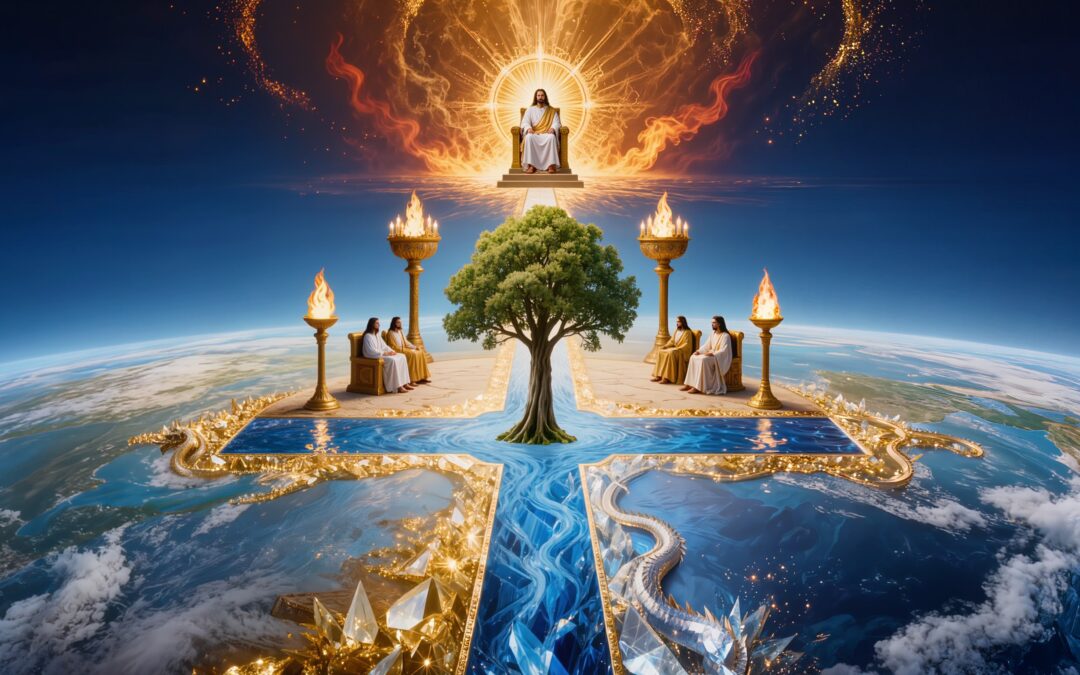
This paper presents a unified Cruciform Arboreal Cosmology grounded in Johannine Orthodoxy, demonstrating how the Book of Revelation, authored by John the Apostle, fulfills the Abrahamic oral wisdom articulated in the Sefer Yetzirah. The study shows that the New Covenant does not abolish creation-formation wisdom but consummates it through the Cross and Resurrection of Jesus Christ, installing a renewed heavenly government (New Jerusalem / New Draco), restoring the Twelve as righteous cosmic order (New Mazalot), and revealing the Lamb’s Book of Life as living Sefirotic reality. Central to this cosmology is a single, ever-green Tree of Life now reigning across seven heavens and seven earths—fourteen realms unified in resurrection life—overthrowing all fallen angelic death.
I. Johannine Authority and Orthodox Continuity
From Formation (Yetzirah) to Fulfillment (Apokalypsis)
The Book of Revelation must be read not as a rupture with Torah wisdom, but as its apotheosis—the moment when what was spoken in formation is unveiled in completion. The Apocalypse does not negate Abrahamic cosmology; it judges, fulfills, and installs it through the cruciform work of the Lamb.
1. John as Custodian, Not Innovator
As Chief Apostle of the Lamb, John the Apostle writes within continuity, not novelty. His authority is not speculative or private; it is apostolic, received, and transmitted. John stands as father and elder of Christian orthodoxy, bearing witness to what the Church received from the beginning and what creation awaited from before the foundation of the world. His Apocalypse is therefore not mystical invention but judicial unveiling—the disclosure of realities long prepared.
2. Sefer Yetzirah and the Grammar of Creation
The Sefer Yetzirah articulates the grammar of creation: letters, paths, measures, and formative operations by which heaven and earth are ordered. This wisdom belongs to Abrahamic oral tradition and undergirds the prophetic imagination of Israel. Yet Sefer Yetzirah intentionally speaks in formation—how worlds are shaped, not how they are healed once corrupted by death.
3. Revelation as Completion, Not Replacement
Revelation does not revise this grammar; it completes it. Where Yetzirah describes how creation is formed, Revelation reveals who completes it:
- Letters find their fulfillment in the Logos made flesh
- Paths converge in the Cross
- Measures resolve in the Lamb enthroned
- Formations culminate in the New Jerusalem descending
Thus, Revelation is not anti-formational; it is post-resurrectional. It shows creation after judgment, after crucifixion, after resurrection—when the grammar of formation is finally governed by Life rather than death.
4. Crucifixion and Resurrection as Cosmic Fulcrum
The decisive difference between Yetzirah and Apocalypse is not contradiction but the Cross. The Cross functions as the cosmic fulcrum that judges corrupted formations and seeds the Tree of Life anew. Without crucifixion, formation remains vulnerable; without resurrection, order remains temporary. John’s Apocalypse reveals creation healed, not merely arranged.
5. Apostolic Transmission and Orthodox Center
This reading is preserved within ancient apostolic transmission—in the liturgy, theology, and martyr-witness of the early Church. The Apocalypse stands at the heart of Christian orthodoxy precisely because it proclaims that creation itself is redeemed, not discarded. Heaven and earth are not escaped; they are renewed.
6. Continuity as the Mark of Truth
Orthodoxy is not proven by novelty but by continuity fulfilled. John’s vision affirms that the God of Abraham is the God who completes what He formed. The Torah’s wisdom is not silenced; it is answered. The letters speak; the Lamb appears. The paths are traced; the City descends.
Thus, Johannine authority secures orthodox continuity:
what was formed in wisdom is fulfilled in the Lamb,
what was measured is enthroned in glory,
and what was promised is revealed—
cruciform, arboreal, and eternal.
II. Cruciform Arboreality: The Cross as Cosmic Root
Judgment, Replanting, and the Indestructible Life of the Tree
All dominion grows from trees.
This axiom is not poetic flourish; it is ontological law. In Scripture and Torah wisdom alike, trees signify sources of life, authority, and propagation. What rules creation does so by roots, not appearances. Therefore, when creation fell under death, it did so because its root-system was corrupted. And when creation is restored, it is restored only by a new root.
1. The Cross as Root-Severing Axis
The Cross is not a reformative branch grafted onto a dying tree. It is the axis mundi that cuts, judges, and replaces the old root entirely. At Calvary, the ancient arboreal system—grounded in self-preservation, fear, memory, and death—was uprooted at its source. The Cross stands as the root-severing judgment of old heavens and the planting point of a new creation.
This is why Scripture calls the Cross both folly and power: folly to systems that survive by continuity, power to creation that needs re-rooting.
2. The Cross as Altar and Seed
As an altar, the Cross judges: it exposes and ends every authority not founded in God’s life.
As a seed, the Cross renews: it plants a new arboreal reality whose life-source is not Adamic continuity but Messianic resurrection.
Thus:
- Cross → altar of judgment: old heavens are condemned, not corrected.
- Cross → seed of renewal: a new Tree of Life is planted, not negotiated.
Judgment and renewal are not sequential add-ons; they are the same act viewed from opposite sides of the Cross.
3. Blood as Covenantal Sap
Every tree lives by sap. In cruciform arboreality, the Blood of the Lamb is the covenantal sap that flows from the root into all branches of the new creation. Blood here is not mere symbol of forgiveness; it is transmitted life.
This sap:
- Restores communion between heaven and earth
- Replaces stolen vitality with divine life
- Carries covenant, identity, and inheritance
Because the Blood flows from the Cross-root, it does not sustain old structures; it animates a new organism. Wherever this Blood flows, death loses jurisdiction—not by decree, but by incompatibility.
4. Resurrection as Indestructible Vitality
If the Cross plants the Tree, Resurrection guarantees its permanence. The Tree of Life is not merely healed; it is indestructible. Its vitality does not depend on environmental stability, angelic administration, or human preservation. It lives because Jesus Christ lives.
Resurrection life means:
- No rot at the root
- No decay in the branches
- No seasonal death in its fruit
This Tree is ever-green, because it is rooted in a life that has passed through death and emerged sovereign over it.
5. Cruciform Cosmology: Order Without Coercion
Because the Tree is cruciform, its expansion is non-coercive. It does not conquer by force; it outgrows rival systems. Where the Cross is embraced:
- Old heavens collapse (their root is cut)
- New heavens arise (a new root is planted)
- Earths beneath align automatically (order follows life)
This alignment is not imposed by law or threat. It occurs because creation recognizes true life and reorganizes around it. Coercion belongs to dying trees; order belongs to living ones.
6. The Principle Restated
Cruciform arboreality teaches that salvation is not escape, governance is not domination, and renewal is not repair. It is re-rooting.
Where the Cross stands,
a Tree grows.
Where the Tree grows,
Life reigns.
And where Life reigns,
all heavens and earths align—
by order, not by force.
III. New Jerusalem / New Draco: Upright Heavenly Government
From Death’s Administration to the Throne of Life
The Book of Revelation presents not a vague spiritual allegory but a governmental transition at the highest cosmic level. John’s vision is judicial: an old administration is removed, and a new administration is installed. This transition is absolute, public, and final.
1. The Casting Down of the Old Dragon: Jurisdiction Ended
Revelation depicts the casting down of the dragon not as a moral reprimand or symbolic diminishment, but as jurisdictional termination. The dragon represents an administrative order that governed creation through death—an inverted authority that survived by accusation, fear, and stolen vitality. When the dragon is thrown down, its right to rule is revoked. Heaven does not negotiate with death; it expels it.
This act marks the end of death as a governing principle. Death is no longer an administrator; it becomes a condemned condition awaiting final consumption.
2. The Descent of the City: Government Installed
In direct counterpoint to the dragon’s fall, John beholds the New Jerusalem descending. This descent is not metaphorical encouragement; it is cosmic establishment. Government does not arise from the earth upward; it descends from God downward. The City comes “from heaven,” bearing architecture, order, names, measures, and light—the marks of a functioning administration.
Where the dragon’s rule was hidden and parasitic, the City’s rule is visible, luminous, and life-giving.
3. Uprightness Restored: What “New Draco” Names
“New Draco” names this restored order of upright heavenly governance. It does not indicate mythic astrology or fatalistic power, but the reorientation of cosmic authority around the Lamb’s throne. Uprightness here is not moral posture alone; it is alignment—heaven standing correctly over earth, life flowing freely without obstruction.
In the old order, governance was inverted: power flowed downward to control, restrict, and extract. In the new order, governance flows outward from the throne to illuminate, vivify, and heal.
4. Centered on the Throne of the Lamb
At the center of New Draco stands the throne—and upon it the Lamb. Authority is no longer abstract, angelic, or impersonal. It is crucified and resurrected authority. The Lamb reigns not by coercion but by indestructible life. His throne emits light, water, and judgment—not to destroy creation, but to restore its proper order.
Because the throne is occupied by Jesus Christ, governance is inseparable from sacrifice. Power is defined by wounds overcome, not force applied.
5. Righteousness as the Atmosphere of Rule
Scripture declares that righteousness dwells in the New Jerusalem. This is not merely ethical goodness; it is right order. In this government:
- Life flows without obstruction
- Authority is exercised without corruption
- Judgment produces healing rather than decay
Righteousness is the atmosphere because the source is pure. Where the Lamb reigns, there is no need for secrecy, manipulation, or control.
6. A Total Transition, Not a Shared Reign
The vision allows no dual sovereignty. Old Draco does not coexist with the New. The dragon falls; the City descends. One administration ends; another begins. This is why Revelation speaks in absolutes—casting down, sealing, reigning, consummation. Creation cannot be governed simultaneously by death and life.
7. The Principle Restated
New Jerusalem is New Draco:
- Old governance by death is judged and removed
- Upright governance by Life is installed
- Authority is centralized in the Lamb
- Righteousness becomes the operating environment
This is not symbolic encouragement for believers; it is cosmic reality unveiled. Heaven is reordered. Earth follows. And the universe now turns—not around death—but around the throne of the Lamb, where Life reigns forever.
IV. The Twelve as New Mazalot (Order without Fate)
Governance Restored under the Lamb
The Twelve Tribes of Israel were never intended to function as mere genealogical markers. From the beginning, they signified heaven–earth governance—a living order through which divine life and justice were meant to flow into creation. In Torah and prophetic tradition, the Twelve stand at the intersection of time, space, and authority: months, gates, stones, banners, and assemblies all bear their imprint. This was order, not destiny—calling, not compulsion.
1. From Genealogy to Government
In the Abrahamic vision, the Twelve are administrative, not fatalistic. They represent a pattern by which creation is coordinated—an ordering of life that aligns heaven and earth without enslaving humanity to the stars. Their vocation was priestly and judicial, to steward blessing and instruction among the nations.
2. Revelation Redeems the Twelve
The Book of Revelation does not erase this calling; it redeems and enthrones it. John sees the Twelve reappear not as horoscopes or determiners of fate, but as architecture of the City:
- Twelve gates bearing the names of the tribes
- Twelve foundations bearing the names of the apostles of the Lamb
- Twelve fruits yielded perpetually from the Tree of Life
This is not repetition; it is transfiguration. The Twelve are restored as order under the Lamb, no longer mediated by fallen administrations or distorted by superstition.
3. Order without Astrology
Revelation decisively separates order from astrology. The old Mazalot—systems in which heavenly signs ruled over man—are judged. They are exposed as mechanisms of determinism that enslaved creation through fear, cycles, and inevitability.
- Old Mazalot (rule over man) → judged
- New Mazalot (man in Messiah) → installed
In the New Covenant, signs no longer govern sons; sons govern signs by sharing the authority of the Lamb.
4. Man in Messiah: Authority Re-centered
The shift is profound: governance is re-centered in Christ. Authority no longer flows from impersonal forces but from union with the enthroned Lamb. The Twelve, now inscribed within the City and the people of God, signify delegated sovereignty—order exercised through obedience, not fate imposed through cycles.
Because authority is mediated through Jesus Christ, it is cruciform: it rules by life laid down and power restored through resurrection.
5. Freedom as the Mark of True Order
True order does not negate freedom; it creates space for it. In the New Mazalot, righteousness governs without coercion, and structure serves life rather than constraining it. Creation aligns not because it must, but because it recognizes its source.
This is why Revelation replaces omens with names, cycles with light, and fate with inheritance.
6. The Principle Restated
The Twelve as New Mazalot proclaim a decisive truth:
- Order is restored without determinism
- Authority is exercised without astrology
- Governance flows from the Lamb, not the stars
This is sovereignty in Christ—
not destiny imposed from above,
but life ordered from within,
as heaven and earth are harmonized
under the reign of the Lamb.
V. The Lamb’s Book of Life as Living Sefirotic Reality
From Measured Paths to Embodied Life
The Book of Revelation presents the Book of Life not as celestial bureaucracy but as ontological truth. It is not a register maintained by heaven; it is Life embodied in the Lamb. To be written in this Book is not merely to be remembered—it is to participate.
1. Life, Not Ledger
When Revelation speaks of names written “before the foundation of the world,” it testifies that true existence precedes history. These names are not ink on parchment; they are persons held within the Lamb’s own life. The Book of Life is therefore personal, living, and relational. One is written there not by merit, chronology, or administration, but by union.
2. Participation as Existence
In Johannine theology, existence itself is participatory. To “live” is to share in the life of Jesus Christ; to be excluded is to remain outside that life. Thus, the Book of Life is not a future determination but a present reality revealed—who lives in the Lamb and who persists apart from Him.
This explains why Scripture speaks of names being written, blotted out, or revealed: not as clerical acts, but as states of union or separation.
3. From Formation Wisdom to Resurrection Reality
Abrahamic formation wisdom sketches creation through paths, measures, and ordered flows. These describe how life is structured. Revelation reveals how life is restored and unified. What was once described abstractly as channels of light now lives personally as resurrection flow from the throne.
The movement is decisive:
- From measured paths → to living communion
- From abstract order → to embodied life
- From descriptive wisdom → to participatory glory
4. The Throne as Source, the Lamb as Center
In Revelation, life flows from the throne of God and of the Lamb. Governance, illumination, and vitality are no longer separate functions. They are one stream. Light governs because it is alive; life rules because it is righteous. The Lamb is not merely enthroned over reality—He is the coherence of reality.
This is why the Book of Life cannot be separated from the throne. The Book is not kept there; it flows from there.
5. Names as Identity, Not Labels
In this reality, a “name” signifies identity in God. To bear a name written in the Book of Life is to possess an identity that death cannot erase. Such identity is not assigned externally; it is generated by resurrection. The Lamb does not record life—He creates it.
6. Light, Life, and Governance Unified
Revelation collapses all false divisions. Light is no longer informational; it is vivifying. Governance is no longer coercive; it is organic. Life is no longer fragile; it is indestructible. These three—Light, Life, and rule—are unified because they proceed from a single source: the resurrected Lamb.
7. The Principle Restated
The Lamb’s Book of Life proclaims a singular truth:
- Life is not documented; it is embodied
- Order is not imposed; it flows
- Existence is not counted; it is shared
Thus, what formation wisdom once outlined as paths and measures now stands revealed as resurrection reality—a living, governing, luminous life flowing eternally from the throne, into creation, and through all who dwell in the Lamb.
VI. Seven Lampstands, Seven Heavens, Seven Earths
The Menorah of YHVH and the Coherence of Creation
In the Book of Revelation, John is shown seven golden lampstands—not as decorative symbols, but as cosmic instruments. These lampstands reveal the Menorah of YHVH, the outworking of the Ruach Hakodesh illuminating, governing, and synchronizing all realms of creation. Light here is not mere visibility; it is ordering presence.
1. The Menorah as Cosmic Instrument
In Torah, the Menorah is never simply a light source. It is a pattern of divine wisdom—a living configuration through which God’s presence orders space. Revelation lifts this pattern into full cosmic scope. The seven lampstands disclose that the Spirit of God does not hover vaguely over creation; He stands, illuminates, and sustains.
Each lampstand signifies Spirit-presence installed, not merely observed.
2. Seven Heavens and Seven Earths
John’s vision assumes a multi-layered creation: seven heavens and seven earths—fourteen realms that once existed in fractured relation due to the reign of death. These realms were not evil in origin, but dis-integrated. Life was divided, authority fragmented, and vitality siphoned by fallen administrations.
This fragmentation produced a forest of disordered growth—life multiplied without unity.
3. Former State: Fourteen Trees
Under death’s dominion, life appeared as fourteen trees:
- Multiple sources
- Competing roots
- Seasonal vitality
- Inevitable decay
Each realm sustained its own compromised expression of life. Even what appeared “alive” was vulnerable to corruption, inversion, and exhaustion. This was not abundance; it was division masquerading as growth.
4. Present Reality: One Tree in Messiah
Revelation announces a decisive reversal. In the Lamb’s reign, the fourteen trees do not struggle for dominance; they are gathered into one.
Now there is:
- One Tree of Life
- Ever-green
- Ever-living
- Rooted in resurrection
This single Tree reigns across all fourteen realms—seven heavens and seven earths—because it is rooted not in creation’s vulnerability but in the indestructible life of Jesus Christ.
Unity does not erase diversity; it sustains it.
5. Illumination as Order
The Menorah’s light does more than reveal; it coordinates. Where the Spirit’s light stands:
- Heavens align with heavens
- Earths respond to heavens
- Life flows without blockage
Order emerges naturally because light is alive. Chaos is not battled directly; it dissolves in the presence of true illumination.
6. Coherence, Not Control
This cosmology rejects domination as a means of unity. The Menorah does not compel; it coheres. Creation aligns because it recognizes its source. The Spirit’s illumination restores relationship between realms, not hierarchy of fear.
7. The Principle Restated
Revelation’s vision declares:
- The Menorah of YHVH illuminates all realms
- Seven heavens and seven earths are unified
- Fragmented life becomes one indestructible Tree
- Order flows from light, not law
Where the Menorah stands, creation remembers itself.
Where the Tree reigns, life cannot decay.
And where Messiah’s resurrection life flows,
all realms—heavenly and earthly—cohere as one living creation.
VII. The New Sanhedrin: Judges in Resurrection
Authority Born of the Cross and Sealed by Life
Holy Scripture speaks without ambiguity: the saints judge the world—and even angels. This declaration is not rhetorical encouragement; it is judicial destiny. The Book of Revelation makes this destiny visible: thrones are set, authority is given, and those who sit do so by right of resurrection, not by inheritance of fallen power.
1. Judgment as Vocation, Not Usurpation
Judgment in Scripture is not domination; it is discernment that restores order. The New Sanhedrin does not seize authority from heaven—it receives it from the Lamb. Their authority is derivative, cruciform, and participatory. They judge because they have been judged at the Cross and raised into life beyond accusation.
2. Seraphim Men and Women: Humanity Fulfilled
These judges are described rightly as Seraphim Men and Women—not angels replacing humanity, but humanity fulfilled into resurrection likeness. “Seraphim” names the quality of life—burning, purified, near the throne—not a change of species. They remain human, yet transfigured by shared life with the risen Messiah.
They are what humanity becomes after death’s dominion is broken.
3. Thrones Granted, Not Claimed
Revelation shows thrones—plural—and those who sit upon them. Thrones signify office, not ego. Authority is not claimed by knowledge, zeal, or lineage; it is granted to those who overcame by the blood of the Lamb and the word of their testimony. Their right to judge flows from participation in the Lamb’s own victory.
4. Brothers and Sisters of the Lamb
These judges are explicitly named as brothers and sisters of the Lamb—family, not functionaries. As siblings of Jesus Christ, they share:
- His Cross (death to old life)
- His Life (resurrection vitality)
- His Spirit (discernment and wisdom)
Because they share His life, they share His authority. Royalty here is familial, not hierarchical.
5. Law Transfigured by Life
The New Sanhedrin is not established by law alone. Law without life produces accusation; life fulfills law by restoring order. These judges do not apply statutes externally; they embody righteousness internally. Their judgments heal because they proceed from life that has passed through death and emerged incorruptible.
This is why their authority is feared by darkness and welcomed by creation.
6. Judging Angels: Death’s Administration Ended
To judge angels is to declare the end of fallen administration. The Seraphim Men and Women stand as witnesses that death no longer governs. Their judgments do not perpetuate conflict; they conclude it. What is incompatible with life is dismissed; what aligns with life is restored.
7. The Sanhedrin of the New Heavens
This assembly constitutes the Sanhedrin of the New Heavens—a council formed not in fear, not in secrecy, but in light. Its members are known by their wounds healed, their lives given, and their authority exercised without corruption.
8. The Principle Restated
The New Sanhedrin reveals a decisive truth:
- Judgment flows from resurrection
- Authority is born of crucifixion
- Humanity is not replaced, but fulfilled
- Governance is exercised by life, not accusation
These Seraphim Men and Women judge because they live—
and where life judges,
creation is restored,
order is reestablished,
and the reign of the Lamb is made visible
through His brothers and sisters forever.
VIII. Judgment Complete: The Lake of Fire
Consummation, Not Conflict
The Book of Revelation presents the Lake of Fire as the final and consummative judgment of creation. It is not an arena of ongoing warfare nor a symbol of unresolved tension. It is the end-point—the moment when all that is incompatible with Life is irreversibly consumed.
1. Fire as Divine Finality
In biblical theology, fire is not chaos; it is decision. Fire reveals, purifies, and—when resisted—consumes. The Lake of Fire is therefore not a rival realm to God’s Kingdom, but the terminal act of judgment by which every residue of death is removed from creation.
What survives the fire is Life.
What cannot survive it is ended.
2. Consummation, Not Correction
The Lake of Fire does not rehabilitate fallen death-governance. It concludes it. Fallen angelic administrations, rooted in accusation and parasitic vitality, are not reformed or recycled. They are terminated. Scripture is explicit: the dragon is cast in, not restrained beside the Tree.
This is not symbolic mitigation.
It is jurisdictional annihilation.
3. Death Has No Eschatological Future
One of Revelation’s most decisive proclamations is that death itself is thrown into the Lake of Fire. Death is not eternal. It is not a co-principle with Life. It is a temporary condition exposed, judged, and destroyed by resurrection.
- Death ends.
- Life remains.
There is no dualism at the end of history—only Life without rival.
4. Resurrection Without Rival
Because the Lamb has passed through death and emerged sovereign, resurrection life is uncontested. Nothing remains that can accuse, drain, or invert it. The Lake of Fire ensures that resurrection is not merely victorious, but unchallenged.
Resurrection does not coexist with death; it outlives and outlasts it.
5. The Dragon Gone, the Tree Standing
Revelation closes the cosmic drama with stark clarity:
- The dragon is gone
- The Tree of Life stands
No shadow remains beneath the branches. No rival root competes in the soil of creation. The Tree’s leaves are for healing precisely because nothing opposed to Life remains to wound.
6. Fire Serves Life
The Lake of Fire does not threaten the Tree; it protects it. By consuming all incompatible substances, it ensures that the renewed creation is permanently incorruptible. Fire here is mercy to creation because it prevents the return of decay.
7. The Principle Restated
The Lake of Fire proclaims the final truth of the Apocalypse:
- Judgment is complete
- Death is finished
- Fallen power is ended
- Life reigns alone
The Tree stands.
The dragon is gone.
Resurrection fills all things.
This is not endless struggle.
This is consummated victory—
creation purified,
authority secured,
and Life enthroned forever
in the Lamb.
IX. Israel and the Tree of Life
From Covenant on Stone to Covenant as Life
The New Covenant does not abolish Israel; it reveals Israel. It does not cancel Torah; it fulfills it. This fulfillment occurs not by revision from afar, but by the Creator Himself entering creation, submitting to death within it, rising through it, and installing a renewed people as co-heirs of His resurrection life.
1. Fulfillment by Incarnation, Not Replacement
The decisive act of the New Covenant is incarnational. God does not stand outside the covenant to amend it; He steps inside it to complete it. By entering the created order, dying within it, and rising from it, Jesus Christ gathers every promise of the Old Covenant into Himself and carries it through death into indestructible life.
Thus, the Old Covenant is not discarded; it is consumed into completion.
2. Israel Reconstituted in Life
“Israel” in this consummation is not erased or generalized; it is reconstituted. New Israel is not defined by blood of flesh but by blood of the Lamb—not lineage preserved by mortality, but family generated by resurrection. Identity shifts from ancestry guarded by death to sonship secured by life.
This Israel cannot be conquered, assimilated, or exhausted, because its source is the Lamb who lives forever.
3. From Stone Tablets to Living Torah
The Torah was never meant to remain external. Written on stone, it testified to righteousness; written in the Spirit, it becomes righteousness lived. The New Covenant fulfills the Torah’s intent by relocating it from tablets to hearts—from inscription to incarnation.
Law is not lowered; it is raised into life.
- Stone tablets → witness
- Life in the Spirit → fulfillment
4. Co-Heirs of the Tree
In the New Covenant, the people of God are not merely beneficiaries of redemption; they are co-heirs. As sons and daughters, they share in the inheritance of the Tree of Life—access not as guests, but as family. The Tree is not guarded from them; it is given to them, because they live in the Lamb who is its root and fruit.
5. Spirit as the Mark of Israel
The defining mark of New Israel is the Spirit. The Ruach Hakodesh does not merely empower obedience; He constitutes identity. To live by the Spirit is to live from the Tree—drawing life from resurrection rather than from self-preservation.
This is Israel according to promise, not according to mortality.
6. The Covenant Completed
The New Covenant completes what the Old promised:
- God dwelling with His people
- Life triumphing over death
- Righteousness reigning without corruption
This completion is not postponed; it is installed. The Creator has finished His work, and His people now live from its fullness.
7. The Principle Restated
Israel and the Tree of Life are one reality in the New Covenant:
- Not blood of flesh, but blood of the Lamb
- Not law on stone, but Life in the Spirit
- Not survival under death, but inheritance in resurrection
This is New Israel—
rooted in the Tree,
sealed by the Spirit,
and reigning with the Lamb
in a covenant that is no longer written about life,
but is Life itself.
Conclusion
One Lamb. One Throne. One Tree.
Cruciform Arboreal Cosmology proclaims a single, unified reality unveiled by the Book of Revelation and fulfilled in Jesus Christ:
One Lamb. One Throne. One Tree.
What was formed in wisdom is completed in resurrection.
What was fragmented by death is unified by Life.
What was administered by accusation is governed by righteousness.
Seven heavens and seven earths—once divided—are now cohered under resurrection Life.
Old Draco falls; New Jerusalem stands.
The Menorah burns; the Sanhedrin judges.
Creation lives—not by coercion, but by order flowing from the throne.
This is not speculative theology. It is apostolic disclosure.
It is not esoteric novelty. It is Johannine orthodoxy.
It is not future hope alone. It is installed reality.
It is written.
Bibliography
(Primary Scriptural and Classical Sources)
- Book of Revelation — Johannine Apocalypse; consummation of creation, judgment, and resurrection governance.
- Gospel of John — Logos theology; Life, Light, and participation in the Son.
- Sefer Yetzirah — Abrahamic formation wisdom; letters, paths, and measures of creation.
- Torah (Genesis–Deuteronomy) — Covenant foundations; arboreal imagery; priestly order and governance.
- Prophets (Isaiah, Ezekiel, Daniel) — Heavenly courts, judgment, restoration, and new creation themes.
- Pauline Epistles (1 Corinthians, Romans) — Saints judging the world and angels; resurrection centrality.
- Johannine Epistles — Participation in divine life; abiding, sonship, and victory over death.
- Early Apostolic Witness (Patristic tradition) — Continuity of Johannine authority within orthodox proclamation of resurrection and new creation.
About the Author
Apostle Brandon Barthrop
RLM TV Press
Apostle Brandon Barthrop is a Christian Torah Scholar and apostolic teacher devoted to the recovery of Johannine Orthodoxy and the unveiling of Cruciform Cosmology through Scripture. His work integrates Torah foundations, prophetic witness, and the Apocalypse of the Lamb to proclaim the Tree of Life fulfilled in Jesus Christ for Israel and the nations.
He serves through RLM TV, teaching the restoration of creation through the Cross, resurrection governance, and the calling of sons and daughters into mature co-heirship with the Lamb. His writings emphasize fidelity to Scripture, apostolic continuity, and the life-transforming power of the New Covenant.
RLM TV Press
For Israel and all who dwell in the Tree of Life.
Sefer Yetzirah — Abrahamic Oral Tradition
To deepen understanding of this paper and its Cruciform Arboreal Cosmology, we strongly recommend prayerful study of Sefer Yetzirah, one of the oldest surviving texts of Abrahamic oral tradition.
Sefer Yetzirah (“The Book of Formation”) preserves the early Hebrew wisdom of creation through divine order—letters, paths, measures, and cosmic structure. Read through the lens of Johannine fulfillment, it provides essential background for understanding how the Book of Revelation consummates formation wisdom in the Lamb, the Cross, and the Tree of Life.
This text is not a replacement for Scripture, but a historical witness to the formative language that the Apostle John brings to completion in Christ.
🔗 Download Sefer Yetzirah (PDF):
👉 https://s3.us-east-1.amazonaws.com/RLM_Files/Sefer+Yetzirah.pdf
“What was formed in wisdom is fulfilled in resurrection.”
We encourage readers to study this work only in submission to Jesus Christ, the Lamb of God, and in harmony with the New Covenant, where all things—heavenly and earthly—are restored, judged, and unified in Life.
