
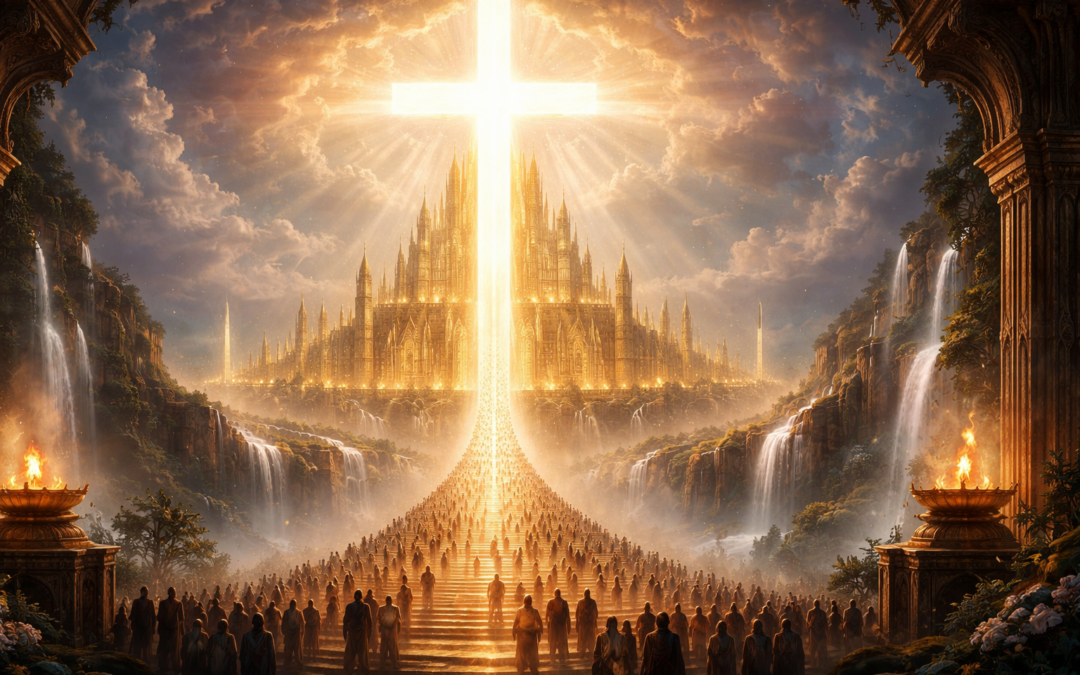
The Tower of the Cross
The Only Ascent into the City of the Living God
Introduction: Kingdoms Do Not Exist Without Architecture
No kingdom exists in abstraction.
A kingdom requires structure, location, and ascent.
From the earliest strata of biblical and kabbalistic wisdom, dominion is never presented as a diffuse spiritual idea. Authority must be housed. Rule must be situated. Power must be embodied. For this reason, all true kingdoms are revealed through cities, and all true cities require a tower—a vertical axis by which governance descends and allegiance ascends.
The Zohar affirms this cosmological axiom: a kingdom is only established where there is a city, and a city only stands where there is a tower that unites above and below. Without such an axis, there is no continuity of rule, no transmission of authority, and no habitation of glory.
Yet when the final vision of Scripture is unveiled in the Book of Revelation, something astonishing occurs. The New Jerusalem descends in breathtaking detail—its gates, foundations, dimensions, radiance, and river of life carefully described—but no tower is named.
This omission is not an absence.
It is a revelation.
I. The Zoharic Principle: City, Kingdom, and Tower
In classical Zoharic cosmology, Malkut—the realm of kingship—cannot function in isolation. Kingship must be gathered into a city (ir), for the city is the collective vessel of order, law, and dwelling. But even a city remains inert without a tower (migdal), which serves as the vertical conduit through which the upper worlds sustain the lower.
The tower is not merely architectural; it is ontological.
It establishes alignment between heaven and earth.
It determines who ascends and by what authority.
Thus, the Zohar distinguishes sharply between holy towers and fallen towers. A holy tower is given from above and receives its form by obedience. A fallen tower is constructed from below and seeks to seize ascent by force.
This distinction is decisive for understanding all of redemptive history.
II. Babylon: The Counterfeit Tower
The Tower of Babel was not humanity’s first tower—it was humanity’s first unauthorized tower.
Its sin was not height, ambition, or engineering. Its sin was self-generated ascent. “Let us make a name for ourselves” reveals the essential rebellion: ascent without permission, glory without sacrifice, unity without obedience.
The Zohar describes Babel as a tower that attempted to invert the flow of light, drawing power downward without submission upward. This inversion fractured language, divided consciousness, and shattered human unity—not as punishment, but as consequence. A tower built without heaven cannot sustain a city, and a city without heaven cannot sustain a kingdom.
Babylon therefore becomes the archetype of all false cosmologies: systems that promise ascent while severing the soul from divine authority.
III. Jerusalem: The True City Always Awaited a Tower
Jerusalem, by contrast, is the city God Himself chose. Yet even Jerusalem, in all its earthly glory, was never complete.
The Temple stood. The throne of David stood. The sacrifices flowed. Yet the prophets consistently spoke of a future Jerusalem, one not made by hands, one that would be established from above, not expanded from below.
Why?
Because Jerusalem required a tower not yet revealed.
The Zohar hints that the final tower would not be stone, wood, or metal. It would be a living structure, capable of bearing infinite light without collapse. It would not be climbed by priests alone but opened to all nations—yet only by a single path.
That tower is not named in the Zohar, because it could not be named until it was manifested in history.
IV. The Gospel of John: The Revelation of the True Tower
The Gospel of John is not merely a biography of Jesus Christ. It is a cosmological unveiling.
“In the beginning was the Word.”
John does not begin in Bethlehem. He begins before creation, before stars, before heavens, before cosmic architecture itself. He reveals that the Logos is the structural principle of all worlds.
When the Word becomes flesh, something unprecedented occurs:
The tower descends.
Jesus Himself declares this in unmistakable terms:
“Destroy this temple, and in three days I will raise it up.”
He is not speaking metaphorically. He is revealing that His body is the new axis of ascent, the meeting place of heaven and earth, the living tower through which all communion now flows.
Jacob’s ladder was no longer a vision.
It became a Person.
V. The Cross as the Tower
The Cross is not an instrument of execution alone.
It is cosmic architecture.
Vertically, it unites the highest heaven with the lowest earth.
Horizontally, it reconciles Jew and Gentile, heaven and earth, God and man.
Where Babel rose from the earth to seize heaven, the Cross descends from heaven to lift the earth. Where Babylon’s tower multiplied tongues, the Cross births a single Word. Where false towers scatter humanity, the Cross gathers it into one Body.
This is why the Book of Revelation does not name a tower in the New Jerusalem.
The tower has already been revealed—and crucified.
VI. Revelation’s Silence Is Its Loudest Declaration
Revelation meticulously describes the city:
- Twelve gates
- Twelve foundations
- The throne of God and of the Lamb
- The river of life
- The tree of life
- The uncreated light that replaces sun and moon
Yet no tower is listed among its features.
Why?
Because the Cross is not a feature of the city.
It is the means of entrance into it.
The city does not need to display the tower, because all who stand within its walls have already ascended it.
“There shall be no temple in it, for the Lord God Almighty and the Lamb are its temple.”
The city itself has become habitation because the Cross has already completed the ascent.
VII. The Second Heavens Made New
This cruciform ascent does not repair the old heavens—it replaces their governing order.
The Cross does not rehabilitate stellar rule.
It abolishes it.
The second heavens, once governed by angelic principalities and cosmic hierarchies, are reconstituted under the direct reign of the Lamb. Authority is no longer mediated through constellations, cycles, or intermediaries. It flows through resurrection life.
This is why the New Jerusalem has no sun or moon. Not because light is absent, but because mediation is obsolete. The city is illuminated from within by uncreated glory.
VIII. Conclusion: The Only Ascent That Remains
There is only one tower that leads into the City of God.
Not knowledge.
Not mysticism.
Not stars.
Not angels.
Not ladders of human invention.
Only the Cross.
The Cross is the tower that heaven built.
The tower that death could not collapse.
The tower that carries flesh into glory without corruption.
Those who attempt to climb any other tower build Babylon again.
Those who ascend the Cross enter Jerusalem forever.
The New Heavens are not reached by height.
They are entered by crucifixion.
And the City of Uncreated Light stands open—
not to the ambitious,
but to the crucified.
By Apostle Brandon Barthrop
RLM TV Press
January, 2026
