
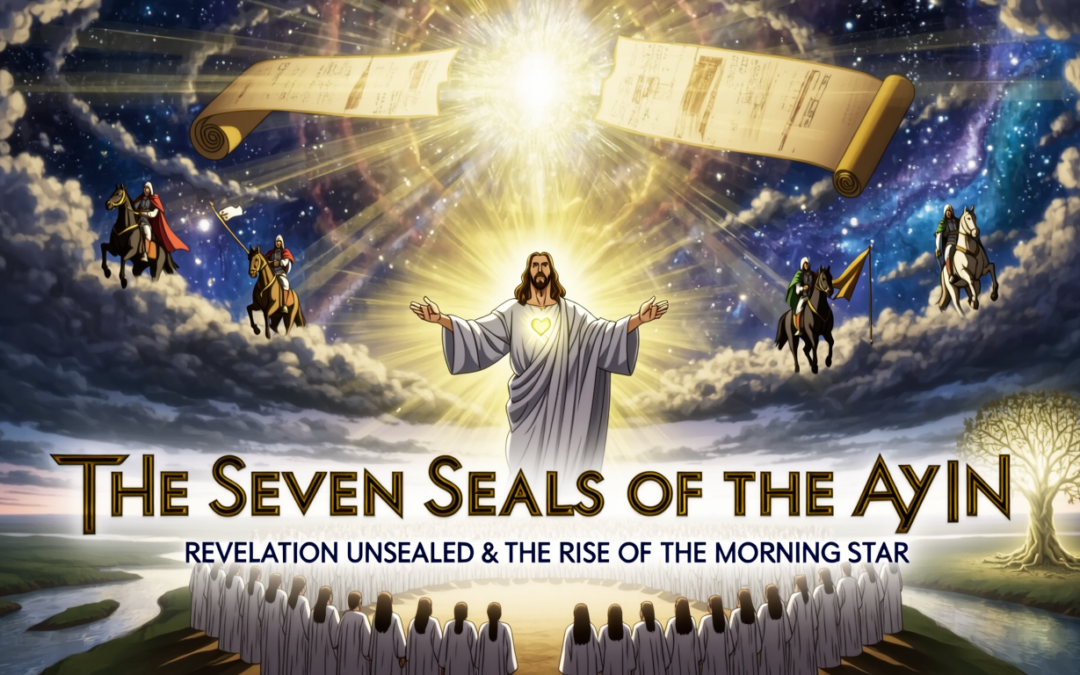
The Seven Seals and the Restoration of the Ayin
From the Serpent’s Evil Eye to the Sevenfold Vision of Messiah
Subtitle
The Messianic Reversal of the Fall Through the Seven Spirits of God and the Opening of the Sealed Eye of Humanity
Author
Apostle Brandon Barthrop
Publisher
RLM TV Press
Red Letter Ministries
Date
2026
Introduction
The Redemption of Human Sight
From the beginning of Scripture to its final chapter, the story of redemption is deeply connected to the transformation of human perception.
In the Garden of Eden, humanity was created as living menorah lampstands, vessels designed to radiate the glory of God through a pure and holy Ayin—spiritual sight governed by the Tree of Life. Adam and Eve were not merely biological beings; they were royal priestly vessels designed to perceive creation through the light of the Divine Presence.
However, the serpent introduced a catastrophic distortion. Through deception, humanity received the Ayin Hara—the evil eye, a corrupted perception governed by the Tree of Knowledge of Good and Evil. This event fractured the divine menorah within humanity and subjected human consciousness to the governance of death, darkness, and serpentine intelligence.
The entire drama of redemption unfolds as God’s plan to restore the human eye.
Through the Messiah, Jesus Christ—the Root of David and the bearer of the Sevenfold Spirit of God (Isaiah 11:2)—the sealed perception of humanity is progressively opened through the Seven Seals of Revelation, restoring the believer to the original Edenic design.
This paper explores the profound biblical and classical wisdom that reveals how:
- The Fall corrupted the Ayin
- The Seven Spirits of God restore the Ayin
- The Seven Seals correspond to the purification of human perception
- The Menorah of Messiah reforms the human being into a living lampstand
- The overcomers of Revelation become restored sons and daughters of Eden
Drawing upon Scripture, cruciform orthodoxy, and the deepest wisdom of Sod ha-Sod Torah, this work demonstrates that the ultimate purpose of redemption is the restoration of the divine vision of humanity—culminating in the final declaration of Messiah:
“I, Jesus, am the Root and the Offspring of David.”
—Revelation 22:16
Here, the sealed eye of humanity is fully opened, and the redeemed once again walk in the light of the Tree of Life.
Chapter 1
The Edenic Ayin: Humanity as the Original Menorah
Introduction
The biblical narrative begins not merely with the creation of matter but with the creation of light-bearing humanity. In Genesis 1–2, Adam and Eve are presented as the culmination of creation—beings fashioned in the image of God and placed within the Garden of Eden as stewards of divine life. Yet the Scriptures imply something even deeper: humanity was designed to function as a living vessel of divine illumination.
From the perspective of sacred anthropology, the human being was created as a lampstand of divine light, a vessel through which the glory of God would radiate into creation. The Garden of Eden therefore was not merely a botanical environment but a cosmic sanctuary, and humanity was its priestly lamp.
The key to this illumination was the Ayin—the faculty of spiritual perception through which humanity beheld God, interpreted creation, and walked in unbroken communion with the Tree of Life.
Understanding the Edenic Ayin is essential for understanding both the tragedy of the Fall and the redemptive work of Messiah, who restores the purified vision of humanity through the sevenfold Spirit of God.
Adam and Eve as Lampstands of God’s Glory
The creation account culminates with the formation of humanity in the image and likeness of God.
“So God created man in His own image; in the image of God He created him; male and female He created them.”
(Genesis 1:27)
The Hebrew concept of the image of God (tzelem Elohim) implies far more than physical resemblance. It indicates that humanity was designed to reflect divine attributes and radiate the presence of God within creation.
Later biblical revelation confirms that humanity functions as a lamp through which divine light shines.
“The spirit of man is the lamp of the LORD, searching all the inner depths of his being.”
(Proverbs 20:27)
This verse reveals that the human spirit itself is a lampstand of God, capable of receiving and transmitting divine illumination. The imagery directly parallels the Menorah of the Tabernacle, which was designed to carry the sacred light within the sanctuary.
Thus Adam and Eve were not merely biological organisms but living menorahs, vessels through which the light of God’s presence flowed into the created order.
Their consciousness was illuminated by divine life rather than by the analytical dualism introduced later by the Tree of Knowledge of Good and Evil.
The Tree of Life as the Source of Divine Perception
At the center of Eden stood the Tree of Life, the fountain of divine vitality and illumination.
“And the LORD God made every tree grow that is pleasant to the sight and good for food. The Tree of Life was also in the midst of the garden.”
(Genesis 2:9)
The Tree of Life was more than a biological tree. Within the symbolic framework of Scripture, it represents the continuous flow of divine life and wisdom from God into creation.
Psalm 36:9 provides an extraordinary key to understanding this reality:
“For with You is the fountain of life; in Your light we see light.”
This verse reveals the essential principle of Edenic perception: true sight occurs only through divine light. Humanity was not meant to generate its own interpretation of reality but to perceive the world through the illumination flowing from the Creator.
Thus the Tree of Life functioned as the source of divine perception, sustaining the clarity of the human Ayin.
Adam and Eve lived in a state where their perception of reality was continually refreshed by the living presence of God.
The Meaning of Ayin in Hebrew Mystical Anthropology
The Hebrew word Ayin (עין) carries a profound range of meanings that illuminate the nature of human perception.
In the Hebrew Scriptures the word can mean:
- eye
• spring or fountain
• perception
• awareness
This dual meaning—eye and fountain—reveals a deep theological insight. Human perception is not merely passive observation; it is a source through which interpretation flows into the world.
The Ayin functions as a gateway between the inner spirit and the external world.
If the Ayin is governed by divine light, the individual sees creation in harmony with God’s wisdom. If it is corrupted, perception becomes distorted and reality is interpreted through fear, pride, and deception.
Thus the Ayin is the central faculty of human consciousness, determining whether humanity lives in communion with the Tree of Life or in separation from it.
Humanity as the Image of God Reflecting Divine Light
The Edenic human being was designed to reflect divine illumination in the same way the moon reflects the light of the sun.
God Himself is repeatedly described in Scripture as the ultimate source of light.
“God is light, and in Him there is no darkness at all.”
(1 John 1:5)
Because humanity was created in God’s image, the human spirit functioned as a mirror of divine glory. This reflected light was intended to govern human thought, emotion, and decision-making.
In this original state:
- perception was unified
• conscience was clear
• the inner world of humanity was transparent to God
The human Ayin therefore served as the interface between heaven and earth, enabling humanity to steward creation in alignment with the will of God.
Eden as the Temple of Cosmic Illumination
The Garden of Eden is best understood not merely as a garden but as the first temple of God on earth.
Later biblical sanctuaries—the Tabernacle and the Temple—were designed according to patterns that echo the structure of Eden. One of the most significant elements within these sanctuaries was the golden Menorah, the lampstand that burned continually before the presence of God.
The prophet Zechariah provides a powerful vision connecting the menorah with the Spirit of God.
“Not by might nor by power, but by My Spirit,” says the LORD of hosts.
(Zechariah 4:6)
In this vision, the menorah is supplied with oil directly from living olive trees, symbolizing the continuous flow of divine Spirit into the lamp of God.
This imagery mirrors the original design of humanity in Eden. Adam and Eve were sustained by the living presence of God just as the menorah was sustained by sacred oil.
The Garden of Eden therefore functioned as a cosmic sanctuary of divine illumination, with humanity serving as its priestly lampstand.
Conclusion
The original state of humanity in Eden was one of radiant perception and divine illumination. Adam and Eve lived as living lampstands within the sanctuary of creation, sustained by the light of the Tree of Life and guided by the uncorrupted Ayin.
Their perception of reality flowed directly from the presence of God, allowing them to walk in harmony with creation and in communion with their Creator.
The tragedy of the Fall, therefore, was not merely moral disobedience—it was the corruption of the human eye, the distortion of the Ayin through which humanity interpreted the world.
The remainder of Scripture unfolds the story of how God restores this lost vision through the Messiah, who bears the sevenfold Spirit of God and opens the sealed perception of humanity.
Through Him the lampstand of the human spirit is rekindled, and the redeemed once again walk in the light of the Tree of Life.
Chapter 2
The Serpent’s Gift: The Birth of the Evil Eye
Introduction
If Eden represents the original illumination of humanity through the Tree of Life, Genesis 3 records the catastrophic moment when that illumination was corrupted. The Fall was not merely an act of disobedience but a profound transformation of human perception itself.
Through the serpent’s deception, humanity received what later Jewish tradition would call the Ayin Hara—the evil eye: a distorted way of perceiving reality that separates the human mind from the direct illumination of God.
The serpent did not merely tempt humanity to eat fruit; he offered something far more seductive: a new way of seeing the world.
Thus the Fall marks the moment when humanity’s Ayin—its spiritual eye—was redirected away from the light of God and toward a perception governed by independence, dualism, and self-derived knowledge.
The story of redemption that unfolds throughout Scripture is therefore the story of the healing of the eye.
The Deception of Genesis 3
The serpent enters the biblical narrative as the voice that challenges the authority of God and reframes reality through subtle distortion.
“Did God really say, ‘You must not eat from any tree in the garden’?”
(Genesis 3:1)
This opening question is not simply curiosity; it is an act of epistemological warfare. The serpent introduces doubt into the human mind, inviting Adam and Eve to reinterpret God’s command through their own reasoning.
Up to this moment, humanity lived in direct alignment with divine revelation. God spoke, and humanity trusted. But the serpent’s strategy is to shift the source of truth from God to the human mind.
Once this shift occurs, the foundation of Edenic perception begins to fracture.
The serpent’s argument culminates in a statement that reveals the true nature of the temptation:
“For God knows that when you eat of it your eyes will be opened, and you will be like God, knowing good and evil.”
(Genesis 3:5)
Here the serpent promises enlightenment. He offers what appears to be a higher awareness, but in reality it is a counterfeit awakening.
“Your Eyes Shall Be Opened” — The Counterfeit Awakening
The serpent’s promise centers on a dramatic claim: the opening of the eyes.
This phrase is crucial to understanding the deeper meaning of the Fall. The serpent implies that humanity’s current perception is incomplete and that eating from the forbidden tree will unlock hidden knowledge.
In one sense, the serpent’s words prove true.
“Then the eyes of both of them were opened.”
(Genesis 3:7)
Yet the opening of their eyes does not lead to divine wisdom but to shame, fear, and alienation. The first realization Adam and Eve experience after this awakening is not enlightenment but vulnerability:
“They realized that they were naked.”
Their perception of themselves and the world has fundamentally changed.
Before the Fall, humanity saw reality through the light of God. After the Fall, humanity sees reality through self-consciousness and separation.
The serpent’s promise of enlightenment therefore results in a profound darkening of the Ayin.
The Tree of Knowledge as Serpentine Perception
The Tree of Knowledge of Good and Evil represents a radically different mode of perception from the Tree of Life.
While the Tree of Life provides direct illumination from God, the Tree of Knowledge introduces interpretation based on independent reasoning.
In this new system, humanity begins to analyze reality through the categories of good and evil as determined by the human mind rather than through the living wisdom of God.
This shift fundamentally alters human consciousness.
Instead of perceiving reality through divine unity, humanity begins to divide the world into opposing categories. This dualistic perception creates the intellectual framework that will dominate human civilization: systems of morality, philosophy, and law that attempt to manage the tension between good and evil.
However, this knowledge comes at a profound cost.
Ecclesiastes captures the painful paradox of human understanding in a fallen world:
“For with much wisdom comes much sorrow; the more knowledge, the more grief.”
(Ecclesiastes 1:18)
Human knowledge without divine illumination becomes a burden rather than a blessing.
The Ayin has been opened, but it now sees through a fractured lens.
The Emergence of Dualistic Consciousness
One of the most significant consequences of the Fall is the emergence of dualistic consciousness.
Before the Fall, humanity lived in a unified perception of reality governed by the goodness of God. Creation was not divided into moral abstractions but experienced as a harmonious expression of divine life.
After the Fall, the human mind begins to interpret reality through opposing categories:
good versus evil
right versus wrong
success versus failure
blessing versus curse
This dualistic awareness becomes the foundation of human civilization. Entire systems of ethics, politics, and religion arise from humanity’s attempt to manage the tension created by the knowledge of good and evil.
Yet this system never fully resolves the problem it creates. Humanity becomes trapped within an endless struggle between opposing forces.
The Ayin has become fragmented.
Instead of perceiving the unity of God’s life, humanity now experiences the world as a battlefield of competing interpretations.
The Loss of the Edenic Menorah
The corruption of the Ayin leads to the extinguishing of the Edenic lampstand within humanity.
In Eden, the human spirit functioned as a lamp illuminated by the presence of God. After the Fall, that illumination is obscured by fear, shame, and separation.
Adam and Eve’s immediate response to their new perception is to hide:
“I heard Your voice in the garden, and I was afraid.”
(Genesis 3:10)
Fear replaces communion. Hiding replaces transparency.
The light that once flowed freely through the human spirit is now obstructed by guilt and self-consciousness.
This moment marks the beginning of humanity’s exile from the Tree of Life.
The menorah of the human spirit has not been destroyed, but its flame has been dimmed. Humanity continues to search for illumination through philosophy, religion, and knowledge, yet the original source of divine light remains inaccessible.
The story of Scripture therefore becomes the story of how God will restore the lamp of humanity.
The Warning of the Darkened Eye
Centuries later, Jesus speaks directly about the condition of the human eye:
“The eye is the lamp of the body. If your eye is healthy, your whole body will be full of light. But if your eye is bad, your whole body will be full of darkness.”
(Matthew 6:22–23)
This teaching reveals that the condition of the Ayin determines the spiritual state of the entire human being.
The phrase translated “bad eye” corresponds to the concept of Ayin Hara, a corrupted perception that fills the person with darkness.
In contrast, a purified eye restores the body to the illumination originally intended in Eden.
Jesus’ teaching therefore points forward to the ultimate restoration of the human lampstand.
Conclusion
The Fall of humanity represents the moment when the serpent successfully corrupted the Ayin of humanity, introducing a perception governed by independence and dualism rather than by divine illumination.
Through the Tree of Knowledge, humanity gained a form of awareness that promised wisdom but ultimately produced fragmentation, sorrow, and alienation from the source of life.
The human menorah was dimmed, and the eye that once saw the world through God’s light became clouded by the Ayin Hara.
Yet the biblical narrative does not end in darkness.
The same Scriptures that record the Fall also reveal the promise of a Redeemer who will restore the light of humanity. Through the Messiah, the corrupted eye will be healed, the lampstand rekindled, and the children of God will once again walk in the illumination of the Tree of Life.
The next chapter will explore the long history of humanity living under this fractured perception and the cosmic consequences that unfold throughout the biblical story.
Chapter 3
The Fracturing of the Lampstand: Humanity Under the Curse
Introduction
The corruption of human perception in Genesis 3 did not remain confined to the Garden of Eden. The distortion of the Ayin introduced by the serpent gradually spread through human civilization, reshaping the structures of society, religion, and governance.
As humanity moved farther from the illumination of the Tree of Life, the fractured Ayin began to manifest collectively within cultures and nations. The unified lampstand of humanity—once designed to radiate divine light throughout creation—became increasingly fragmented.
The Scriptures portray this process not merely as moral decline but as a profound cosmic disorder affecting both humanity and the spiritual realms that influence it. The Fall opened the door for competing systems of perception, spiritual authorities, and counterfeit sources of knowledge to emerge across the earth.
The story of Babel, the rise of territorial spiritual powers, and the proliferation of sorcery and occult practices all reflect the same underlying reality: the fractured Ayin of humanity attempting to reconstruct meaning apart from the Tree of Life.
Babel and the Fragmentation of Perception
One of the earliest manifestations of humanity’s fractured perception appears in the account of the Tower of Babel.
“Come, let us build ourselves a city and a tower whose top is in the heavens, and let us make a name for ourselves.”
(Genesis 11:4)
The builders of Babel represent humanity’s attempt to construct a unified civilization based on human ambition rather than divine guidance. The tower itself symbolizes an effort to reach the heavens through human ingenuity rather than divine revelation.
Babel is therefore more than an architectural project—it is the birth of a civilization organized around independent human perception.
In response, God confounds their language and scatters humanity across the earth:
“So the LORD scattered them abroad from there over the face of all the earth.”
(Genesis 11:8)
The confusion of languages represents more than linguistic diversity; it reflects the fragmentation of human perception itself. Humanity no longer shares a unified understanding of reality.
Each culture develops its own worldview, myths, and systems of knowledge.
The lampstand of humanity becomes divided into many flickering lights rather than a single unified illumination.
The Rise of Fallen Angelic Governance
As humanity spread across the nations, Scripture indicates that spiritual authorities began to influence the destinies of different peoples.
A key passage in Deuteronomy describes the division of the nations:
“When the Most High gave the nations their inheritance, when He divided mankind, He fixed the boundaries of the peoples.”
(Deuteronomy 32:8)
This moment marks the beginning of a world in which different nations operate under distinct spiritual influences.
Later biblical texts reveal that behind the political structures of nations exist powerful spiritual beings that exercise authority over territories.
The book of Daniel provides a striking example when an angel explains that he was delayed by a spiritual ruler opposing him:
“The prince of the kingdom of Persia withstood me twenty-one days.”
(Daniel 10:13)
This passage reveals a complex spiritual hierarchy in which angelic and fallen powers interact with human history.
These spiritual rulers influence the cultural, political, and religious development of nations, often reinforcing the fragmented perceptions that originated in Babel.
As humanity’s Ayin becomes increasingly detached from divine illumination, these powers exploit the confusion, shaping civilizations according to their own agendas.
Sorcery and Corrupted Vision
With the loss of direct access to divine illumination, humanity begins seeking alternative sources of knowledge and power.
Throughout the ancient world, various forms of sorcery, divination, astrology, and occult practice emerge as attempts to manipulate unseen spiritual forces.
These practices are repeatedly condemned in Scripture because they represent counterfeit methods of perception.
Rather than restoring the Ayin through communion with God, sorcery attempts to access hidden knowledge through spiritual manipulation.
The result is a deepening of the corruption introduced by the serpent.
Instead of returning to the Tree of Life, humanity constructs elaborate systems designed to interpret the cosmos through signs, omens, and mystical techniques.
The fractured Ayin becomes increasingly dependent on external systems of interpretation rather than the illumination of God’s Spirit.
The Exile of Humanity from the Tree of Life
Following the Fall, humanity was expelled from the Garden of Eden.
“So He drove out the man; and He placed cherubim at the east of the garden of Eden, and a flaming sword which turned every way to guard the way to the Tree of Life.”
(Genesis 3:24)
This expulsion represents more than geographical relocation. It signifies the separation of humanity from the direct source of divine life and illumination.
The Tree of Life, once freely accessible, now stands beyond a guarded boundary.
Humanity continues to live and multiply across the earth, but the original connection to the fountain of divine perception has been severed.
This exile shapes the entire trajectory of human history.
Civilizations rise and fall, philosophies develop, religions emerge, and empires expand, yet the central problem remains unresolved: humanity continues to operate with a darkened Ayin.
The Cosmic Consequences of the Fall
The corruption of human perception has implications that extend beyond human society into the structure of creation itself.
Scripture suggests that the Fall introduced disorder into the entire created order.
The apostle Paul later describes creation as groaning under the weight of this corruption:
“The creation was subjected to frustration… and the whole creation has been groaning as in the pains of childbirth.”
(Romans 8:20–22)
This cosmic groaning reflects the reality that humanity was originally appointed as the steward of creation. When the human lampstand fractured, the harmony of creation itself was disrupted.
The fractured Ayin of humanity leads to fractured relationships, fractured societies, and ultimately a fractured world.
The biblical story therefore unfolds as a search for restoration—a way for humanity to recover the lost illumination of Eden.
Conclusion
The corruption of the Ayin introduced by the serpent did not remain confined to the Garden but spread throughout the entire course of human history.
The fragmentation of perception at Babel, the influence of spiritual powers over nations, the rise of sorcery and occult practices, and the ongoing exile from the Tree of Life all testify to the profound consequences of the Fall.
Human civilization develops in countless directions, yet the fundamental problem remains unchanged: the lampstand of humanity is fractured, and the eye through which humanity perceives reality remains clouded.
Yet even within this fractured world, the Scriptures preserve the promise that God will one day restore the lampstand and heal the human eye.
The next chapter will explore how this promise begins to take shape in the prophetic hope of Israel, culminating in the expectation of a Messiah who will restore the divine illumination lost in Eden.
Chapter 4
The Promise of Restoration: The Root of David
Introduction
The narrative of Scripture does not leave humanity in the darkness introduced by the Fall. Even as the fractured Ayin spreads through human history, the biblical story begins to reveal a growing promise: God will restore the lampstand of humanity.
Throughout the prophetic writings of Israel, a vision emerges of a coming ruler who will reverse the consequences of the Fall and restore divine illumination to the nations. This figure is described through a series of powerful images: the Root of David, the Branch, the Anointed King, and the Bearer of the Spirit of the Lord.
The prophets understood that the central problem of humanity was not merely political oppression or moral failure but spiritual blindness. Therefore, the Messiah would come not only to establish a kingdom but also to restore the vision of humanity, reopening the Ayin that had been darkened since Eden.
The prophetic promise of the Messiah thus introduces the hope that the lampstand of humanity—extinguished through the deception of the serpent—will be rekindled through the anointed Son of David.
The Davidic Root Prophecy
One of the most significant messianic promises in Scripture appears in the prophecy of Isaiah:
“There shall come forth a shoot from the stump of Jesse, and a Branch shall grow out of his roots.”
(Isaiah 11:1)
The imagery is striking. The royal line of David appears to have been reduced to a stump, a remnant of what once flourished. Yet from this seemingly lifeless root a new shoot will emerge.
This prophecy reveals that God’s restoration plan will unfold through the Davidic lineage, culminating in a king whose authority surpasses that of all previous rulers.
Isaiah continues by describing the unique anointing that will rest upon this Messiah:
“The Spirit of the LORD shall rest upon Him—the Spirit of wisdom and understanding, the Spirit of counsel and might, the Spirit of knowledge and the fear of the LORD.”
(Isaiah 11:2)
Here the prophet introduces the sevenfold Spirit of God, which will later be echoed in the imagery of the menorah and the visions of the book of Revelation.
This sevenfold anointing represents the complete restoration of divine perception. Where the serpent introduced a distorted eye in Eden, the Messiah will carry the fullness of God’s Spirit, restoring the true vision of humanity.
The Branch and the Menorah
The prophetic imagery of the Branch appears throughout the Hebrew Scriptures as a symbol of messianic renewal.
In the book of Zechariah, the Branch is closely connected to the restoration of the temple and the illumination of the menorah.
“Here is the man whose name is the Branch, and He shall branch out from His place, and He shall build the temple of the LORD.”
(Zechariah 6:12)
This prophecy indicates that the Messiah will not only rule but will also restore the dwelling place of God among humanity.
The connection between the Branch and the menorah becomes clearer in Zechariah’s vision of the golden lampstand.
The prophet sees a menorah supplied with oil from two living olive trees, symbolizing a continual flow of divine Spirit.
When Zechariah asks for the interpretation of this vision, the angel responds:
“Not by might nor by power, but by My Spirit, says the LORD of hosts.”
(Zechariah 4:6)
The menorah in this vision represents the restoration of divine illumination through the Spirit of God. Just as the lampstand receives oil from living trees, the Messiah will become the channel through which the Spirit flows into the restored people of God.
Thus the Branch and the menorah together symbolize the renewal of divine light within humanity.
The Coming Restoration of Divine Vision
The prophets consistently portray the coming of the Messiah as a moment when spiritual blindness will be healed.
Isaiah repeatedly describes a future era in which darkness will be replaced by divine illumination.
“Arise, shine; for your light has come, and the glory of the LORD rises upon you.”
(Isaiah 60:1)
In this vision the nations themselves are drawn toward the light emanating from God’s restored people.
“Nations shall come to your light, and kings to the brightness of your rising.”
(Isaiah 60:3)
This prophetic imagery echoes the original design of humanity in Eden. Just as Adam and Eve were created to radiate divine light within creation, the restored people of God will once again become vessels through which God’s glory illuminates the world.
The prophets therefore present the Messiah not only as a king but also as the restorer of spiritual sight, the one through whom humanity’s Ayin will be healed.
Messianic Kingship and Perception
The restoration promised through the Messiah involves more than political leadership; it includes the transformation of human perception itself.
Isaiah describes the Messiah as one who perceives reality differently from ordinary rulers:
“He will not judge by what His eyes see, nor decide by what His ears hear.”
(Isaiah 11:3)
This statement reveals that the Messiah operates from a higher form of perception, one governed entirely by the Spirit of God.
Unlike fallen humanity, whose judgments are shaped by limited sensory information, the Messiah perceives reality through the fullness of divine wisdom.
This restored perception enables the Messiah to establish a kingdom characterized by justice, peace, and harmony within creation.
Isaiah’s prophecy culminates in a vision of cosmic restoration in which the natural order itself is transformed:
“The wolf shall dwell with the lamb… and the earth shall be full of the knowledge of the LORD as the waters cover the sea.”
(Isaiah 11:6–9)
Here the restoration of divine perception extends beyond humanity to the entire created order.
Conclusion
The prophetic writings of Israel reveal that the tragedy of the Fall will not remain permanent. Through the coming of the Messiah—the Root of David and the Branch of Jesse—God will restore the illumination that humanity lost in Eden.
The Messiah will bear the sevenfold Spirit of God, embodying the fullness of divine wisdom, understanding, and knowledge. Through Him the lampstand of humanity will be rekindled, and the fractured Ayin will be healed.
The prophets therefore present the Messiah not merely as a political deliverer but as the Restorer of the divine eye, the one through whom humanity will once again perceive reality in the light of God.
This promise sets the stage for the ultimate revelation of the Messiah in the New Testament, where the Son of David appears as the Lamb of God who opens the sealed destiny of humanity.
The following chapter will explore how the sevenfold Spirit described by Isaiah becomes the central instrument through which Messiah restores the lampstand of humanity and prepares the opening of the seven seals.
Chapter 5
The Sevenfold Spirit of God
Introduction
The prophetic promise of the Messiah reaches one of its most profound expressions in Isaiah’s description of the sevenfold Spirit of God resting upon the coming Son of David. This passage reveals that the restoration of humanity will occur not merely through moral reform or political deliverance but through a complete reillumination of the human spirit by the Spirit of God.
The prophet Isaiah declares:
“The Spirit of the LORD shall rest upon Him,
the Spirit of wisdom and understanding,
the Spirit of counsel and might,
the Spirit of knowledge and of the fear of the LORD.”
(Isaiah 11:2)
This sevenfold description of the Spirit forms a pattern that echoes throughout Scripture. The same reality appears in the visions of the book of Revelation, where John repeatedly refers to the Seven Spirits of God before the throne.
“Grace to you and peace from Him who is and who was and who is to come, and from the Seven Spirits who are before His throne.”
(Revelation 1:4)
“Before the throne were seven lamps of fire burning, which are the Seven Spirits of God.”
(Revelation 4:5)
These passages reveal that the sevenfold Spirit is symbolized by seven lamps of fire, unmistakably recalling the image of the golden menorah within the sanctuary of Israel.
Through this imagery the Scriptures present the Messiah as the living menorah of divine illumination, the one through whom the full light of God is restored to humanity.
The Menorah Pattern
The menorah was one of the most sacred objects within the Tabernacle and later the Temple of Israel. Crafted from pure gold, it consisted of a central shaft with three branches extending from each side, forming a total of seven lamps.
These lamps burned continually before the presence of God, symbolizing the eternal light of the divine Spirit.
The prophetic vision of the Seven Spirits therefore reflects the menorah pattern of divine illumination. The central shaft represents the Spirit of the Lord, while the six surrounding lamps correspond to the other aspects of the Spirit described in Isaiah.
This pattern communicates a profound theological reality: the Spirit of God is not merely a singular force but a complete spectrum of divine wisdom and power, illuminating every dimension of perception and governance.
In the Messiah this sevenfold illumination is fully present, restoring the light that humanity lost when the serpent corrupted the Ayin in Eden.
The Sevenfold Anointing of the Messiah
Isaiah describes seven dimensions of the Spirit resting upon the Messiah.
The Spirit of the Lord
The Spirit of the Lord forms the central axis of the sevenfold anointing. This Spirit represents the presence and authority of God Himself.
In the life of the Messiah, this Spirit establishes the direct union between heaven and earth. All other aspects of divine wisdom flow outward from this central relationship with the Father.
The Spirit of Wisdom
Wisdom represents the divine capacity to perceive the underlying order of creation. While human knowledge often produces confusion, the wisdom of God reveals the harmony of His purposes.
Through the Spirit of Wisdom, the Messiah interprets reality according to the eternal perspective of God.
The Spirit of Understanding
Understanding enables the Messiah to discern the deeper meaning behind events and circumstances.
Where human perception is often limited to surface appearances, the Spirit of Understanding penetrates the hidden structure of reality.
Through this Spirit the Messiah perceives the true condition of humanity and the path of restoration.
The Spirit of Counsel
The Spirit of Counsel provides divine guidance and strategic insight.
This aspect of the Spirit enables the Messiah to lead with perfect wisdom, directing humanity toward the purposes of God.
Through this Spirit the Messiah becomes the ultimate shepherd and king.
The Spirit of Might
The Spirit of Might represents divine power in action.
While human authority often relies on force or domination, the might of the Messiah flows from the authority of God Himself.
This Spirit empowers the Messiah to confront the forces of darkness and establish the reign of God.
The Spirit of Knowledge
The Spirit of Knowledge restores the true understanding of God that humanity lost through the deception of the serpent.
In contrast to the knowledge derived from the Tree of Knowledge of Good and Evil, this knowledge arises from communion with the living God.
Through this Spirit the Messiah reveals the true nature of God and His kingdom.
The Fear of the Lord
The final aspect of the sevenfold Spirit is the fear of the Lord, a reverent awareness of the holiness and majesty of God.
This fear is not terror but profound alignment with the divine presence.
The fear of the Lord anchors the entire structure of divine wisdom, ensuring that every dimension of perception remains oriented toward God.
The Restoration of Divine Perception
The sevenfold Spirit described by Isaiah represents the complete healing of the human Ayin.
Where the serpent introduced confusion and fragmentation into human perception, the Messiah restores clarity and illumination through the Spirit of God.
Each dimension of the sevenfold Spirit corresponds to a restoration of sight:
- wisdom restores discernment
• understanding restores depth
• counsel restores direction
• might restores authority
• knowledge restores truth
• the fear of the Lord restores alignment with God
Through these operations the human spirit is gradually reillumined, allowing the redeemed to perceive reality as God intends.
Messiah as the Living Menorah
The imagery of the menorah ultimately points to the Messiah Himself.
In the book of Revelation, Jesus appears among seven golden lampstands, symbolizing His authority over the restored people of God.
At the same time, the Seven Spirits burn before the throne as lamps of fire, revealing that the illumination of God flows directly from His presence through the Messiah into the world.
In this way Jesus becomes the living menorah, the embodiment of the sevenfold Spirit and the source of divine illumination for humanity.
The light that once shone through Adam and Eve in Eden is now restored through the Messiah, who bears the fullness of the Spirit of God.
Conclusion
The sevenfold Spirit described by Isaiah reveals the divine strategy for restoring the illumination that humanity lost through the Fall.
Through the Messiah, the full spectrum of God’s Spirit once again shines upon humanity, rekindling the lampstand of the human spirit and healing the corrupted Ayin.
The Messiah therefore stands as the living menorah of God, the one through whom the light of heaven enters the world.
This sevenfold anointing prepares the way for the events described in the book of Revelation, where the Lamb who bears the Spirit of God opens the sealed scroll of history.
The next chapter will explore how the Messiah, empowered by the sevenfold Spirit, becomes the Lamb worthy to open the Seven Seals, initiating the final restoration of divine vision for humanity.
Chapter 6
The Seven Seals of the Lamb
Introduction
The vision recorded in the book of Revelation reaches a pivotal moment in chapters 5 through 8, where the apostle John witnesses a scroll sealed with seven seals in the hand of the One who sits upon the throne.
This scroll represents the mystery of God’s redemptive plan for humanity and creation, a destiny written before the foundation of the world yet hidden from the understanding of fallen humanity.
The scroll remains sealed because the corruption introduced in Eden left humanity incapable of perceiving or fulfilling the divine purpose for which it was created. The fractured Ayin of humanity cannot interpret the scroll of God’s wisdom.
Thus the heavenly court poses a solemn question:
“Who is worthy to open the scroll and break its seals?”
(Revelation 5:2)
The silence that follows reveals a profound truth: no human wisdom, power, or religious system can unlock the destiny of creation. The restoration of the human lampstand requires a redeemer who stands both within humanity and above it.
The answer appears in the person of the Lamb who was slain, the Messiah whose sacrificial victory restores the authority lost through the Fall.
The Sealed Scroll of Human Destiny
The scroll seen by John is described as being written on both sides and sealed with seven seals.
This imagery reflects the completeness of God’s plan for creation. Every dimension of human history—its beginnings, its struggles, and its ultimate restoration—is contained within this divine document.
Yet the scroll remains inaccessible until the seals are opened.
The sealed condition of the scroll symbolizes the hiddenness of divine wisdom from fallen humanity. Since the corruption of the Ayin in Eden, humanity has struggled to understand the deeper meaning of existence.
Philosophers, prophets, and sages have sought to interpret the mystery of life, but the fullness of God’s purpose remains sealed.
The opening of the scroll therefore represents the unveiling of divine perception, allowing the hidden purposes of God to become visible within history.
The Lamb Who Is Worthy
When no one in heaven or on earth is found worthy to open the scroll, John begins to weep. The sealed scroll represents a world trapped in confusion, unable to access the wisdom necessary for redemption.
At that moment one of the elders announces the arrival of the Messiah:
“Behold, the Lion of the tribe of Judah, the Root of David, has prevailed to open the scroll and its seven seals.”
(Revelation 5:5)
Yet when John turns to see this conquering Lion, he instead beholds a Lamb standing as though it had been slain.
This paradox lies at the heart of the gospel.
The Messiah conquers not through domination but through sacrificial love. The Lamb bears the marks of crucifixion, revealing that the victory of God is accomplished through the Cross.
The Lamb is described as possessing seven horns and seven eyes, which are identified as the Seven Spirits of God sent into all the earth.
This imagery directly connects the vision of Revelation with the prophecy of Isaiah. The Messiah who opens the seals carries the fullness of the sevenfold Spirit, restoring the divine perception that humanity lost in Eden.
Thus the Lamb becomes the living center of the restored menorah, the one through whom divine illumination returns to creation.
The Progressive Unveiling of Divine Perception
As the Lamb begins to open the seals, the vision of Revelation unfolds in a series of dramatic scenes.
The opening of each seal reveals aspects of human history, spiritual conflict, and cosmic transformation. These events demonstrate that the redemption of creation involves both exposure and purification.
Each seal removes another layer of illusion from the world, revealing the deeper realities that have shaped human civilization.
In this sense the seals function as stages in the restoration of perception.
Humanity must confront the consequences of the Fall—the violence, injustice, and corruption that arise from the darkened Ayin—before the fullness of divine illumination can be restored.
The Lamb therefore opens the seals not merely to reveal the future but to purify the vision of humanity, preparing the world for the kingdom of God.
Judgment as the Purification of Sight
The events associated with the opening of the seals often appear as judgments upon the earth: wars, upheavals, cosmic disturbances, and the cries of the martyrs.
Yet these judgments are not arbitrary acts of destruction. They represent the exposure of the systems that emerged from humanity’s corrupted perception.
Throughout history, civilizations have been built upon distorted understandings of power, knowledge, and identity. The opening of the seals reveals the instability of these systems.
As the Lamb breaks each seal, the structures built upon the serpent’s deception begin to crumble.
This process can be understood as the purification of sight.
Just as the human eye must be cleansed to perceive light clearly, the world must undergo a process of unveiling in which false visions of reality are removed.
Through this purification the kingdom of God becomes visible within history.
The Silence of the Seventh Seal
The opening of the seventh seal introduces a striking moment within the heavenly vision.
“When He opened the seventh seal, there was silence in heaven for about half an hour.”
(Revelation 8:1)
This silence represents a profound transition within the unfolding drama of redemption.
Throughout the opening of the seals, the heavenly court has resounded with worship, proclamation, and prophetic declaration. Yet when the final seal is opened, the entire cosmos pauses in reverent stillness.
This silence signifies the moment when the hidden purposes of God stand fully revealed. The unveiling of divine wisdom has reached its completion, and the universe prepares for the next stage of God’s redemptive plan.
Within the context of the restoration of the Ayin, the silence of the seventh seal symbolizes the complete purification of perception, a moment when the chaos introduced by the serpent gives way to the clarity of divine truth.
Conclusion
The opening of the Seven Seals represents the decisive intervention of the Messiah into the fractured history of humanity.
Through the Lamb who was slain, the sealed destiny of creation is revealed, and the divine wisdom hidden since the Fall begins to unfold.
The sevenfold Spirit of God empowers the Messiah to restore the lampstand of humanity, gradually healing the corrupted Ayin and exposing the illusions that have governed human civilization.
The judgments associated with the seals are therefore not merely acts of punishment but stages in the purification of human perception, preparing the world for the full revelation of the kingdom of God.
As the seals are opened, the destiny of creation moves toward its ultimate restoration, when the redeemed will once again walk in the light of the Tree of Life.
The next chapter will explore how the victory of the Lamb is rooted in the crucifixion itself, where the Cross becomes the instrument through which the corrupted perception of humanity is pierced and the new vision of the kingdom is born.
Chapter 7
The Cruciform Opening of the Ayin
Introduction
The prophetic promise of restoration finds its decisive fulfillment in the crucifixion of Jesus Christ. While the visions of Revelation portray the Lamb opening the sealed scroll of destiny, the authority to do so is rooted in the events that took place at Golgotha.
The Cross stands at the center of the Christian revelation not merely as a historical execution but as a cosmic act of redemption. Through the crucifixion, the Messiah confronts and overturns the corruption introduced by the serpent in Eden.
Where the serpent promised the opening of human eyes through rebellion, the Messiah opens the true eye of humanity through sacrificial obedience.
Thus the Cross becomes the instrument through which the sealed Ayin of humanity is pierced and restored, allowing divine illumination to return to the human spirit.
The Crucifixion as Cosmic Circumcision
The New Testament repeatedly presents the death of Christ as an act that removes the corrupted nature inherited from the Fall.
The apostle Paul describes this transformation using the language of circumcision:
“In Him you were also circumcised with a circumcision not performed by human hands. Your whole self ruled by the flesh was put off when you were circumcised by Christ.”
(Colossians 2:11)
This circumcision refers not to a physical ritual but to a spiritual cutting away of the fallen nature that governs human perception.
The Cross therefore functions as a cosmic circumcision, severing humanity’s allegiance to the serpent’s system of knowledge and restoring the possibility of communion with the Spirit of God.
Through the crucifixion the old identity shaped by the Tree of Knowledge is exposed and judged, allowing the new life of the Spirit to emerge.
The Piercing of Golgotha
The Gospel of John provides a striking detail concerning the death of Jesus:
“One of the soldiers pierced His side with a spear, bringing a sudden flow of blood and water.”
(John 19:34)
This moment carries profound symbolic meaning.
The blood represents the sacrificial offering that redeems humanity from sin, while the water represents the life of the Spirit flowing into the world.
The place of the crucifixion, Golgotha, is traditionally associated with the “place of the skull,” an image that echoes the central theme of this work: the healing of the human mind and perception.
The spear that pierces the side of Christ signifies the opening of a new fountain of life. Just as the Tree of Life once sustained humanity in Eden, the pierced Messiah becomes the source of the living waters of redemption.
Through this act the path back to divine illumination begins to open.
The Destruction of the Serpent’s Vision
The Cross represents the decisive defeat of the system introduced by the serpent in Genesis 3.
Through deception, the serpent offered humanity an alternative vision of reality—one rooted in independence from God. This vision spread throughout history, shaping civilizations, religions, and systems of power.
Yet the crucifixion exposes the ultimate weakness of this system.
In Colossians Paul explains that the Cross disarms the spiritual powers that operated through the fallen order:
“Having disarmed the powers and authorities, He made a public spectacle of them, triumphing over them by the cross.”
(Colossians 2:15)
The serpent’s kingdom thrives on deception, fear, and domination. At the Cross these mechanisms are revealed and defeated by the self-giving love of the Messiah.
Through the sacrifice of the Lamb, the authority of the serpent’s vision collapses, and a new kingdom begins to emerge.
Baptism into New Perception
The transformation accomplished by the Cross is not merely a historical event but an experience that believers enter through faith and baptism.
Paul describes this transformation in deeply personal terms:
“I have been crucified with Christ and I no longer live, but Christ lives in me.”
(Galatians 2:20)
Through union with Christ, the believer participates in the death of the old self and the birth of a new life governed by the Spirit.
This participation represents a baptism into new perception.
The old Ayin shaped by fear, shame, and separation is replaced by the mind of Christ. The believer begins to interpret reality not through the categories of the fallen world but through the illumination of the Spirit.
Thus the Cross becomes the doorway into a renewed consciousness, allowing the redeemed to walk once again in the light of God.
The Cross and the Restoration of the Lampstand
The restoration of humanity’s lampstand begins at Golgotha.
Where Adam and Eve lost the light of divine perception through disobedience, the Messiah restores it through obedience unto death.
The Cross therefore represents the turning point in the history of the Ayin.
Through the sacrifice of Christ, the human spirit is rekindled, the path to the Tree of Life is reopened, and the light of the Spirit begins once again to shine within humanity.
The Lamb who was slain now stands as the source of divine illumination for the world.
Conclusion
The crucifixion of Jesus Christ stands as the decisive moment in the restoration of humanity’s perception.
Through the Cross, the corrupted system introduced by the serpent is exposed and defeated. The fallen nature that governed human consciousness is symbolically circumcised, and the possibility of new life through the Spirit is opened.
The pierced Messiah becomes the fountain of living water, restoring the illumination that humanity lost in Eden.
Those who unite themselves with Christ enter into this transformation, receiving a renewed Ayin through which they begin to see the world in the light of God’s kingdom.
The following chapter will explore how this restored perception begins to manifest within the community of believers, who are described in the book of Revelation as lampstands bearing the light of the Messiah within the world.
Chapter 8
The Overcomers as Living Lampstands
Introduction
The redemptive work accomplished through the Cross does not remain confined to the person of the Messiah. Through the resurrection and the outpouring of the Spirit, the life of Christ begins to manifest within those who believe. The restoration of the human Ayin, initiated through the sacrifice of the Lamb, becomes an ongoing transformation within the community of the redeemed.
The book of Revelation portrays this transformation through a powerful image: the churches as lampstands. Just as the menorah in the sanctuary bore the light of God before His presence, the people of God are called to become vessels through which divine illumination shines into the world.
The restoration of the human lampstand therefore unfolds not only within individual believers but within the collective life of the church. Those who follow the Messiah become participants in His light, gradually reflecting the divine glory that humanity was originally created to bear in Eden.
The Churches as Lampstands
The opening vision of the book of Revelation presents the risen Christ standing among seven golden lampstands.
“The seven lampstands are the seven churches.”
(Revelation 1:20)
This imagery establishes a profound connection between the people of God and the sacred lampstand of the Temple. The churches are portrayed as vessels that carry the light of Christ within the world.
In this vision the Messiah walks among the lampstands, examining their condition and calling them to faithfulness. Each church receives both encouragement and correction, demonstrating that the light entrusted to them must be carefully guarded.
The lampstand imagery reveals that the church’s primary calling is not institutional power but illumination. Believers are meant to radiate the presence of Christ into a world still shaped by the darkness of the Fall.
When the light of the lampstand grows dim through complacency or compromise, the Messiah calls His people to repentance so that the flame of divine life may burn brightly once again.
The Opening of the Inner Eye
The restoration of the lampstand within the believer involves the awakening of the inner eye, the faculty of spiritual perception that had been darkened since Eden.
Jesus spoke of this reality during His earthly ministry:
“The eye is the lamp of the body. If your eye is healthy, your whole body will be full of light.”
(Matthew 6:22)
This teaching reveals that the condition of the inner eye determines the spiritual illumination of the entire person. When the Ayin is purified, the life of God flows freely through the believer.
The letters to the churches in Revelation repeatedly address this theme. One of the most striking examples occurs in the message to the church of Laodicea, where believers are described as spiritually blind despite their outward prosperity.
Christ counsels them to seek healing for their perception:
“Anoint your eyes with eye salve so that you may see.”
(Revelation 3:18)
This invitation reflects the ongoing work of restoration through which the Spirit gradually heals the corrupted vision inherited from the Fall.
The Transformation into the Mind of Christ
The restoration of the Ayin leads to a deeper transformation described by the apostles as the renewal of the mind of Christ within the believer.
Through union with the Messiah, the patterns of thought shaped by the fallen world begin to give way to the wisdom of God.
The apostle Paul describes this transformation as a radical reorientation of identity:
“Let this mind be in you which was also in Christ Jesus.”
(Philippians 2:5)
The mind of Christ is characterized by humility, obedience, and self-giving love—the same qualities revealed in the crucifixion of the Lamb.
As believers grow in this renewed consciousness, their perception of reality begins to align with the purposes of God. The fractured interpretations produced by the Tree of Knowledge give way to a unified vision centered on the kingdom of Christ.
Through this process the believer becomes increasingly capable of discerning truth, resisting deception, and walking in the wisdom of the Spirit.
The Believer as a Vessel of Divine Light
The culmination of this transformation is the believer’s participation in the divine illumination originally intended for humanity.
Jesus declared this calling to His disciples in the Sermon on the Mount:
“You are the light of the world. A city set on a hill cannot be hidden.”
(Matthew 5:14)
This statement reveals that the followers of Christ are meant to reflect the light that flows from the Messiah Himself. Just as the menorah in the sanctuary illuminated the holy place, believers are called to shine within the world as witnesses to the kingdom of God.
The apostle Paul echoes this theme when describing the life of the church within a darkened world:
“Then you will shine among them like stars in the sky.”
(Philippians 2:15)
The imagery of shining stars recalls the original vocation of humanity as bearers of divine light within creation.
Through the restoration accomplished by the Messiah, the lampstand of humanity begins to burn again.
The Calling of the Overcomers
The messages to the seven churches consistently emphasize the calling of the overcomers—those who remain faithful to Christ despite the pressures of the surrounding world.
These overcomers represent believers who allow the Spirit to fully restore their perception and align their lives with the purposes of God.
Each promise given to the overcomers reflects a stage in the restoration of humanity’s original destiny:
access to the Tree of Life
authority within the kingdom
the sharing of Christ’s throne
These promises point forward to the ultimate fulfillment of redemption when the restored people of God will reign with the Messiah in the renewed creation.
Conclusion
Through the work of Christ and the power of the Spirit, the restoration of the human lampstand begins to unfold within the lives of believers.
The church is portrayed in Scripture as a community of lampstands bearing the light of the Messiah within a darkened world. As the Ayin of believers is gradually healed, the inner eye opens, and the mind of Christ begins to shape their perception of reality.
Through this transformation the redeemed become vessels of divine illumination, reflecting the glory that humanity once carried in Eden.
The journey of restoration, however, is not yet complete. The Scriptures point forward to a final stage in which the healing of perception will reach its fullness and the redeemed will behold the face of God.
The next chapter will explore this ultimate transformation, describing the emergence of a new Ayin within the overcomers, a perception fully aligned with the wisdom and authority of the Messiah.
Chapter 9
The New Ayin of the Overcomers
Introduction
The restoration of the human lampstand through the Messiah culminates in the transformation of human perception itself. While the Cross initiates the healing of the corrupted Ayin and the Spirit begins to restore divine illumination within the believer, the Scriptures point toward a deeper stage of redemption in which the mind and vision of humanity are fully aligned with the wisdom of God.
This transformation is described by the apostles as the reception of the mind of Christ—a new way of perceiving reality that transcends the limitations of fallen human understanding.
Through the work of the Spirit, the fractured perception inherited from the Fall is gradually replaced with a purified vision governed by the wisdom of the Messiah. Those who walk in this restored perception become what the book of Revelation calls overcomers, individuals whose inner sight has been healed and whose lives reflect the light of the kingdom of God.
The emergence of this new Ayin represents the fulfillment of the prophetic promise that humanity will once again see the world through the illumination of divine truth.
The Mind of Christ
The apostle Paul introduces one of the most remarkable statements in the New Testament when he declares that believers are capable of sharing in the perception of the Messiah Himself.
“We have the mind of Christ.”
(1 Corinthians 2:16)
This statement does not suggest that believers become identical to Christ in nature, but it reveals that through the Spirit they are invited to participate in the wisdom and perception that flows from Him.
Paul explains that human wisdom alone cannot grasp the deeper realities of God. The knowledge of God’s purposes is revealed through the Spirit, who searches even the deepest things of God.
“The Spirit searches all things, even the deep things of God.”
(1 Corinthians 2:10)
Through this revelation the believer begins to perceive the world not merely through human reasoning but through the illumination of the Spirit.
The mind of Christ therefore represents a renewed consciousness, one in which the believer’s thoughts, judgments, and interpretations are shaped by the character and wisdom of the Messiah.
The Purified Eye
The restoration of the Ayin involves the purification of the inner eye that governs spiritual perception.
Paul describes this transformation in his prayer for the believers in Ephesus:
“I pray that the eyes of your heart may be enlightened.”
(Ephesians 1:18)
The phrase “eyes of your heart” points directly to the inner faculty through which spiritual truth is perceived.
In the fallen condition inherited from the serpent’s deception, this inner eye remains darkened. Humanity struggles to perceive the purposes of God and often interprets reality through fear, pride, or misunderstanding.
Yet through the work of the Spirit the inner eye begins to open.
As the believer grows in communion with Christ, the illumination of divine wisdom gradually replaces the confusion of the fallen mind. The purified eye begins to recognize the movements of God’s kingdom within the world.
The Ayin is healed.
The Defeat of the Ayin Hara
The corruption introduced by the serpent in Eden can be understood as the birth of the Ayin Hara, the evil eye that distorts human perception.
This corrupted vision manifests itself through envy, fear, pride, and the endless competition that characterizes fallen human society. The Ayin Hara interprets the world through scarcity and self-interest rather than through the generosity of divine life.
The restoration accomplished through the Messiah breaks the power of this distorted perception.
As believers receive the mind of Christ, the patterns associated with the Ayin Hara begin to dissolve. The renewed heart perceives others not as rivals but as fellow participants in the grace of God.
Where the evil eye once produced jealousy and division, the purified eye produces compassion and unity.
Through this transformation the believer is liberated from the cycle of comparison and rivalry that has shaped human civilization since the Fall.
The Governance of Messiah’s Wisdom
The restoration of perception is not merely an internal experience but also a transformation that affects how believers engage with the world.
Those who walk in the mind of Christ begin to participate in the governance of the kingdom of God.
The wisdom of the Messiah equips believers to discern truth within complex circumstances and to act with justice, humility, and love.
This governance reflects the character of Christ Himself, whose authority is rooted not in domination but in sacrificial service.
As the Spirit renews the Ayin of believers, they become capable of embodying the wisdom described in the prophetic vision of Isaiah: a wisdom that judges not by outward appearances but by the deeper realities known to God.
Through this restored perception the people of God begin to function as agents of divine illumination within history, guiding others toward the light of the kingdom.
The Overcomers and the Restoration of Vision
The book of Revelation repeatedly promises blessings to those who overcome the pressures and deceptions of the fallen world.
These overcomers represent believers who remain faithful to the light of Christ despite the surrounding darkness.
Their victory lies not in worldly power but in the restoration of their inner sight. By aligning themselves with the wisdom of the Messiah, they resist the illusions that dominate the systems of the world.
The overcomers therefore embody the new Ayin, a perception purified by the Spirit and anchored in the truth of God.
Their lives become testimonies to the transforming power of the gospel.
Conclusion
The restoration of humanity’s perception reaches a profound stage in the emergence of the new Ayin within the overcomers.
Through the mind of Christ and the illumination of the Spirit, believers experience the healing of the inner eye that was darkened by the serpent’s deception. The Ayin Hara loses its power, and the purified vision of the kingdom begins to shape the lives of those who follow the Messiah.
This transformation allows the redeemed to participate in the wisdom and governance of Christ, becoming vessels through which divine light shines into the world.
Yet the journey of restoration ultimately leads to a final and glorious fulfillment. The Scriptures promise a moment when the redeemed will behold God face to face, and the illumination that began in Eden will be fully restored.
The final chapter will explore this ultimate restoration in the vision of the New Jerusalem, where the Tree of Life returns and the people of God walk forever in the light of the Lamb.
Chapter 10
Revelation 22: The Final Restoration of Sight
Introduction
The story of Scripture begins in a garden illuminated by the presence of God and concludes in a city filled with the glory of the Lamb. The journey from Eden to the New Jerusalem traces the history of humanity’s fall and redemption, culminating in the complete restoration of the divine vision lost through the deception of the serpent.
In Revelation 22 the final stage of this restoration appears. The Tree of Life returns, the river of divine life flows once again through creation, and the curse that entered the world in Genesis is removed.
Most importantly, the redeemed are granted the privilege that humanity forfeited in Eden: the ability to behold the face of God.
This moment represents the ultimate healing of the Ayin, the complete restoration of humanity’s spiritual perception through the work of the Messiah.
The Tree of Life Restored
The closing vision of Revelation brings the biblical narrative full circle by restoring the Tree of Life that stood at the center of Eden.
“On each side of the river stood the Tree of Life, bearing twelve crops of fruit, yielding its fruit every month.”
(Revelation 22:2)
The presence of the Tree of Life in the New Jerusalem reveals that the separation introduced by the Fall has been overcome. The path once guarded by the cherubim is now open to the redeemed.
In Eden, humanity lost access to the Tree of Life because the corrupted Ayin could not safely partake of divine immortality. In the New Jerusalem, however, the human spirit has been fully restored through the work of Christ.
The Tree of Life therefore becomes the symbol of eternal communion between God and His people.
The healing that began through the Cross now reaches its completion as the redeemed freely partake of the life that flows from the throne of God.
The River of Divine Perception
Flowing from the throne of God and the Lamb is a river described as the water of life.
“Then the angel showed me the river of the water of life, clear as crystal, flowing from the throne of God and of the Lamb.”
(Revelation 22:1)
This river represents the continual outpouring of divine life and wisdom into the restored creation.
Throughout Scripture water frequently symbolizes the Spirit of God, the source of illumination and renewal. In the final vision of Revelation, this living water flows without obstruction, nourishing the Tree of Life and sustaining the inhabitants of the New Jerusalem.
The river therefore signifies the perfect restoration of divine perception.
Where the serpent once introduced a polluted stream of deception into the human mind, the river flowing from the throne provides a pure and eternal source of truth.
The redeemed drink from this river and walk in the clarity of God’s presence.
The Removal of the Curse
One of the most powerful declarations in Revelation 22 is the announcement that the curse introduced in Genesis has been completely removed.
“There shall be no more curse.”
(Revelation 22:3)
The curse that followed the Fall affected every dimension of human existence: labor, relationships, mortality, and the harmony of creation itself. It also obscured the divine light that once illuminated the human spirit.
Through the victory of the Lamb, this curse is finally abolished.
The systems of deception, fear, and corruption that emerged from the serpent’s rebellion are dismantled. Creation is restored to its original harmony, and humanity’s relationship with God is renewed.
The removal of the curse signifies the complete healing of the Ayin, allowing the redeemed to perceive reality as it was intended from the beginning.
The Face of God Revealed
The culmination of the biblical story is found in a simple yet profound promise:
“They will see His face.”
(Revelation 22:4)
This statement represents the ultimate restoration of spiritual sight.
Throughout the history of Israel, the direct vision of God was considered too overwhelming for fallen humanity. The corruption of the Ayin prevented human beings from beholding the fullness of divine glory.
Yet through the work of the Messiah, the redeemed are transformed so completely that they are able to stand in the presence of God without fear.
The vision of God’s face symbolizes the perfect union between the Creator and His people.
The redeemed no longer perceive God through shadows or partial revelations. The divine presence that once walked with humanity in Eden now fills the New Jerusalem with unbroken clarity.
The Redeemed as Eternal Lampstands
In the New Jerusalem the illumination of God replaces every other source of light.
“There will be no more night. They will not need the light of a lamp or the light of the sun, for the Lord God will give them light.”
(Revelation 22:5)
This declaration reveals that the entire city becomes a sanctuary of divine illumination.
The redeemed participate in this light, reflecting the glory of God just as Adam and Eve once did in the Garden of Eden. The lampstand of humanity, dimmed through the Fall and restored through the Messiah, now burns with eternal brightness.
The people of God therefore become living vessels of divine glory, shining within the renewed creation.
This restored lampstand fulfills the original calling of humanity to bear the image of God and steward the light of His presence throughout creation.
The Eternal Kingdom of the Lamb
The vision concludes with the promise that the redeemed will reign with God forever.
“And they will reign for ever and ever.”
(Revelation 22:5)
This reign is not a return to the broken systems of power that characterized the fallen world. Instead it reflects the harmonious governance of the kingdom of God.
Those whose perception has been fully restored share in the wisdom and authority of the Messiah, participating in the eternal stewardship of the renewed creation.
The journey that began with the corruption of the Ayin in Eden ends with the complete restoration of humanity as sons and daughters of God, living in perfect communion with their Creator.
Conclusion
The final vision of Revelation reveals the ultimate fulfillment of God’s redemptive plan. The Tree of Life is restored, the river of divine life flows freely, and the curse that once darkened creation is removed.
Most significantly, humanity’s perception is completely healed. The redeemed behold the face of God and walk forever in the illumination of His presence.
The lampstand that was dimmed through the deception of the serpent now shines with eternal brightness, fulfilling the purpose for which humanity was originally created.
Through the Lamb who was slain, the fractured Ayin of humanity has been restored, and the people of God once again walk in the light of the Tree of Life.
The story that began in a garden ends in a city of light, where the glory of God fills all things and the redeemed reign with the Lamb forever.
Conclusion
The Return of the Edenic Eye
The biblical story begins with the corruption of human perception and ends with its complete restoration. In the Garden of Eden, humanity was created as a vessel of divine illumination—a living lampstand designed to perceive creation through the light of God. Yet through the deception of the serpent, the Ayin of humanity became darkened, and the lamp of the human spirit was obscured by fear, shame, and separation.
From that moment forward, the drama of Scripture unfolds as the story of God’s determination to restore the vision of His creation.
The prophets foresaw a Messiah who would bear the fullness of the Spirit of God and restore divine wisdom to humanity. In Jesus Christ, the Root of David and the Lamb who was slain, this promise is fulfilled. Through His crucifixion and resurrection, the corrupted system introduced by the serpent is exposed and overcome.
The Cross becomes the turning point in the history of human perception. Through the sacrificial victory of the Messiah, the fractured Ayin of humanity begins to heal. The Seven Spirits of God illuminate the human spirit once again, rekindling the lampstand that was dimmed in Eden.
As the Lamb opens the Seven Seals, the hidden purposes of God unfold within history, gradually revealing the restoration of divine sight for those who overcome the darkness of the fallen world.
Through the work of the Spirit, believers begin to share in the mind of Christ. The purified eye emerges, the deception of the Ayin Hara loses its power, and the redeemed become vessels through which the light of God shines into the world.
The final vision of Revelation reveals the culmination of this redemptive journey. The Tree of Life returns, the river of divine life flows freely from the throne of God, and the curse that entered creation through the Fall is completely removed.
In the New Jerusalem the redeemed behold the face of God.
The lampstand of humanity burns with eternal brightness, and the sons and daughters of God walk forever in the light of the Lamb.
The serpent’s evil eye is abolished, and humanity becomes once again what it was created to be:
living menorahs of the glory of God.
Final Theological Summary
The narrative arc of Scripture reveals a profound spiritual reality:
The Fall was the corruption of human perception.
Redemption is the restoration of the divine eye.
From Eden to Golgotha to the New Jerusalem, the purpose of God has been to restore the illumination of humanity so that creation may once again reflect the glory of its Creator.
Through the Messiah, the fractured Ayin is healed, the lampstand of humanity is rekindled, and the redeemed walk in the light of the Tree of Life.
Acknowledgments
This work draws upon the rich heritage of biblical revelation and the accumulated wisdom preserved within the Scriptures of Israel and the apostolic writings of the New Testament.
The insights explored within these pages are inspired by the enduring testimony of the prophets, apostles, and faithful witnesses who have sought to understand the mysteries of God’s redemptive plan.
Above all, this work stands upon the revelation of Jesus Christ, the Lamb of God and the Light of the world, through whom the wisdom of God is made known.
Bibliography
The Holy Bible. Various passages including:
Genesis 1–3
Genesis 11
Deuteronomy 32
Psalm 36
Proverbs 20
Isaiah 11
Isaiah 60
Daniel 10
Zechariah 3–4
Matthew 5
Matthew 6
John 19
1 Corinthians 2
Galatians 2
Colossians 2
Philippians 2
Ephesians 1
Revelation 1–8
Revelation 21–22
Additional classical theological and historical references informing the conceptual framework include traditional Jewish and Christian interpretive traditions surrounding:
The Menorah symbolism
Messianic prophecy in Isaiah
Temple imagery in Zechariah
The apocalyptic visions of the book of Revelation
About the Author
Apostle Brandon Barthrop is the founder of Red Letter Ministries (RLM TV) and serves as a teacher and writer exploring the intersection of biblical theology, prophetic interpretation, and the restoration of the Kingdom of God through Jesus Christ.
His work focuses on unveiling the deeper spiritual dimensions of Scripture, emphasizing the transformative power of the Cross and the restoration of humanity through the revelation of the Messiah.
Through teaching, writing, and media ministry, he seeks to equip believers to walk in the light of Christ and to participate in the unfolding purposes of God within the world.
Publisher
RLM TV Press
Red Letter Ministries
Minneapolis, Minnesota
United States
For teachings, broadcasts, and additional publications:
www.RLM.TV
Appendix:
The Sevenfold Restoration of the Ayin
The Messianic Menorah of the Redeemed Mind
Humanity fell when the serpent corrupted the eye of perception.
Redemption occurs as Messiah opens the sealed eye through the Seven Spirits of God.
Each seal corresponds to a stage of restored perception.
Seal One
The Spirit of the Lord – The Reawakening of Divine Sight
Scriptures
Revelation 6:1
Isaiah 11:2
Matthew 6:22
The first seal represents the awakening of the eye to the authority of God.
The Spirit of the Lord establishes the central shaft of the menorah, restoring the recognition that God alone is the source of truth and vision.
The white horse symbolizes the return of righteous perception.
The believer begins to see reality not through the serpent’s interpretation but through the sovereignty of Christ.
The Ayin begins its cleansing.
Seal Two
The Spirit of Wisdom – The Destruction of Serpent Logic
Scriptures
Revelation 6:3–4
Isaiah 11:2
James 3:17
The second seal confronts the false wisdom of the serpent.
Human history is filled with the conflicts produced by knowledge divorced from God. The red horse represents the violence created by corrupted perception.
When the Spirit of Wisdom enters the believer, serpent logic collapses and true divine understanding begins to form.
The Ayin begins to distinguish between human cleverness and heavenly wisdom.
Seal Three
The Spirit of Understanding – The Restoration of True Discernment
Scriptures
Revelation 6:5–6
Isaiah 11:2
Proverbs 4:7
The black horse symbolizes the darkened understanding of fallen humanity.
Under the curse, humanity weighs and measures reality through scarcity and fear.
The Spirit of Understanding restores the ability to perceive God’s purposes beneath events.
The Ayin begins to see divine patterns behind earthly circumstances.
Seal Four
The Spirit of Counsel – Deliverance from the Dominion of Death
Scriptures
Revelation 6:7–8
Isaiah 11:2
Psalm 16:7
The pale horse represents the death-governance introduced by the Fall.
Humanity lives under the counsel of fear, survival, and self-preservation.
The Spirit of Counsel restores heavenly guidance.
The believer begins to walk according to the strategic wisdom of heaven, no longer governed by the instincts of fallen flesh.
The Ayin begins to perceive the pathways of divine instruction.
Seal Five
The Spirit of Might – The Rise of the Overcomers
Scriptures
Revelation 6:9–11
Isaiah 11:2
Ephesians 1:19
The fifth seal reveals the souls of the martyrs beneath the altar.
This stage represents the awakening of divine courage within the redeemed.
The Spirit of Might empowers believers to stand against the powers of darkness.
The Ayin becomes fearless, seeing beyond temporal suffering to the eternal kingdom of God.
Seal Six
The Spirit of Knowledge – The Collapse of the False Cosmos
Scriptures
Revelation 6:12–17
Isaiah 11:2
Colossians 2:3
The sixth seal shakes the cosmos itself.
Sun darkened.
Moon turned to blood.
Stars falling.
These events symbolize the collapse of the fallen systems of perception that governed humanity.
The Spirit of Knowledge reveals the true structure of creation under Christ.
The Ayin begins to perceive the universe from the throne of God rather than from earthly illusions.
Seal Seven
The Fear of the Lord – The Perfected Ayin
Scriptures
Revelation 8:1
Isaiah 11:2–3
Revelation 22
The final seal produces silence in heaven.
This silence represents the complete purification of perception.
The Fear of the Lord restores the believer to perfect reverence and alignment with God.
At this stage the Ayin becomes fully healed.
The redeemed now see reality as Adam and Eve once did in Eden.
The Final Restoration – Revelation 22
In Revelation 22 the promise is fulfilled:
“They will see His face.”
This is the ultimate healing of the human eye.
The curse of Genesis 3 is reversed.
The Tree of Life returns.
The redeemed stand as living menorah lampstands filled with the sevenfold light of Messiah.
The Ayin Hara of the serpent is gone forever.
Humanity now walks in the Ayin Yehoshua — the Messianic vision of Christ.
The Sevenfold Map of Redemption
|
Seal |
Spirit of Isaiah 11 |
Ayin Restoration |
Symbol |
|
1 |
Spirit of the Lord |
Awakening of divine authority |
White horse |
|
2 |
Spirit of Wisdom |
Destruction of serpent wisdom |
Red horse |
|
3 |
Spirit of Understanding |
Restoration of discernment |
Black horse |
|
4 |
Spirit of Counsel |
Guidance beyond death |
Pale horse |
|
5 |
Spirit of Might |
Rise of the overcomers |
Martyrs |
|
6 |
Spirit of Knowledge |
Collapse of false cosmos |
Cosmic shaking |
|
7 |
Fear of the Lord |
Perfected perception |
Silence in heaven |
The Core Revelation of the Paper
The Fall was the corruption of the eye.
Redemption is the restoration of the eye through the sevenfold Spirit of Messiah.
Genesis 3 begins with the serpent opening a false eye.
Revelation 22 ends with humanity seeing the face of God.
Between those two events lies the entire drama of redemption.
