
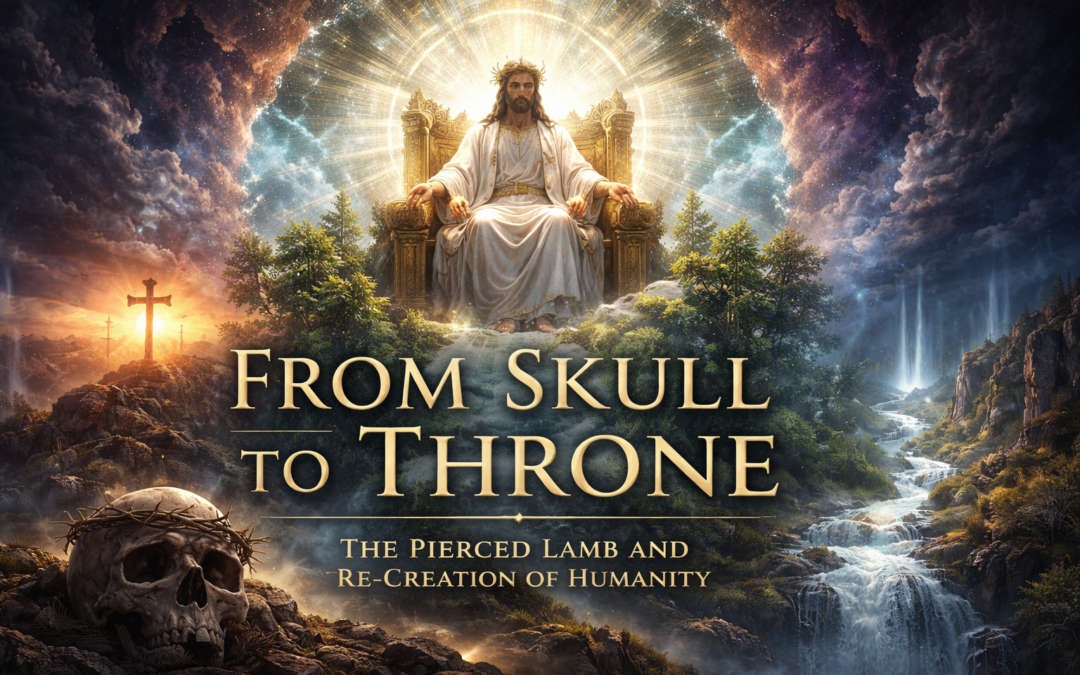
THE SEVEN PIERCINGS AND THE OPENING OF THE SEALS
Golgotha, the Place of the Skull, and the Defeat of Serpentine Anthropology
Toward a Cruciform Theology of Human Redemption
Press: RLM TV Press
Author: Apostle Brandon Barthrop
Date: February 2026
Series: Eternal Gospel Torah Scholar Papers
ABSTRACT
This study investigates the theological, biblical, and symbolic significance of the seven piercings inflicted upon Jesus Christ at Golgotha (“the Place of the Skull”) and their relation to the comprehensive defeat of Satan, sin, and fallen human anthropology. It contends that the crucifixion must be understood not merely in terms of substitutionary atonement, but as a decisive anthropological event: the termination of what may be described as serpentine anthropology and the inauguration of cruciform anthropology.
Through exegetical engagement with Scripture, systematic theological reflection, and careful interaction with classical Jewish symbolic traditions (strictly subordinated to the authority of biblical revelation), this paper proposes that the wounds of Christ correspond to the unsealing of fallen human perception and the restoration of humanity to radiant, glory-bearing communion with God.
The Cross is presented as the axis of covenantal, cosmological, and anthropological transformation: a movement from created light to participatory glory, from sealed perception to unveiled vision, and from the dominion of the serpent to the reign of the Lamb.
INTRODUCTION
Golgotha and the Redemption of the Skull
The crucifixion of Jesus of Nazareth did not occur at an arbitrary location. The Gospels record that He was led to Golgotha, “the Place of the Skull” (Matthew 27:33; John 19:17). While historically identifiable, this location also bears profound theological significance. Scripture frequently employs geography with symbolic density; in this case, the site of execution directly corresponds to the seat of perception, governance, and identity within the human frame.
The skull houses the faculties through which humanity sees, hears, breathes, speaks, and interprets reality. It represents the command center of human consciousness and moral discernment. If, as Genesis 3 narrates, the Fall involved a corruption of perception through the serpent’s reinterpretation of divine speech, then redemption must necessarily address that same locus. The distortion began with sight and interpretation; therefore restoration must penetrate and renew the very seat of sight.
The Cross must therefore be understood not only in juridical categories—though it certainly accomplishes legal reconciliation—but also in anthropological and transformative terms. It does not merely cancel guilt; it inaugurates new creation. It does not merely forgive the old humanity; it brings forth a new humanity in union with the Crucified and Risen One.
This paper advances the following thesis:
The seven piercings of Christ at Golgotha signify the complete judicial defeat of Satan and correspond to the restoration of humanity from divided, serpentine perception into unified, cruciform glory.
In this framework, the wounds of Christ are not incidental details of suffering but integral dimensions of redemptive revelation. They expose the serpent’s deception, disarm spiritual opposition, and open the way for renewed perception and communion. The Lamb who was pierced is also the Lamb who opens the seals (Revelation 5), and this dual imagery invites theological reflection on the relationship between wound and unveiling, suffering and revelation, death and restored sight.
To explore these themes, we proceed by examining:
(1) the structure of serpentine anthropology in the Fall narrative,
(2) the theological significance of Golgotha as the Place of the Skull,
(3) the seven piercings of the Lamb in their scriptural and covenantal context, and
(4) the transformation of human perception from sealed duality to unveiled glory.
Our aim is not speculative mysticism, but biblically anchored theological synthesis—one that serves both the Academy and the Church by illuminating the depth and breadth of the Cross as the decisive axis of human redemption.
CHAPTER 1
Serpentine Anthropology: The Structure of the Fall
I. Genesis 3 and Interpretive Duality
The doctrine of the Fall cannot be reduced to a moral misstep or an act of primitive disobedience. Genesis 3 presents a profound rupture in humanity’s perception, trust, and interpretive framework. The serpent does not initially attack the existence of God, nor does he openly deny the divine command. Instead, he reframes it.
“Has God indeed said…?” (Genesis 3:1)
The first movement of rebellion is not violence but reinterpretation.
The serpent introduces suspicion into the interpretive act. The Word of God, which had previously governed Adam and Eve’s perception, is placed under examination. The locus of authority shifts subtly: from divine revelation to human evaluation. The human mind becomes the tribunal before which God’s speech is weighed.
This is the birth of interpretive duality.
Where there was once single-hearted reception of divine command, there now emerges a divided interior dialogue. The serpent does not present a rival cosmos; he presents an alternative reading of the same command. The act of sin thus begins in hermeneutics before it manifests in behavior.
The tree of the knowledge of good and evil must therefore be understood not merely as a moral category but as an epistemological rupture. Humanity moves from covenantal trust to autonomous evaluation. The Fall is a shift in how reality is interpreted.
Thus, serpentine anthropology begins with a distortion of sight and understanding. It is an anthropology governed not by revelation but by reinterpretation.
II. The Knowledge of Good and Evil as Divided Perception
The phrase “knowledge of good and evil” (Genesis 2:17; 3:5) has often been interpreted as moral awareness. Yet Scripture indicates that Adam and Eve were not morally ignorant prior to the Fall; they knew God’s command and understood obedience. The knowledge gained was not the mere concept of morality, but participation in dualistic discernment independent of God.
The crucial shift lies here: discernment detached from covenantal trust.
Before the Fall, good was defined by proximity to God. After the Fall, good and evil become categories subject to human assessment. Humanity assumes the prerogative of judgment.
The result is divided perception.
The Hebrew narrative indicates that “the eyes of both were opened” (Genesis 3:7), but this opening was paradoxical. It was not illumination but exposure. They perceived nakedness, vulnerability, and threat. Their new “knowledge” produced shame and concealment rather than communion.
This is the anthropology of division: the internalization of evaluative duality.
Human consciousness becomes split between competing judgments. The mind oscillates between self-justification and self-condemnation. Moral awareness becomes self-referential rather than God-centered. Thus the knowledge of good and evil is not redemptive insight but destabilized perception.
This divided perception becomes the structural pattern of fallen humanity.
III. The Serpent as Distorter of Sight and Desire
The serpent’s strategy in Genesis 3 reveals a profound anthropology of temptation. He distorts both perception and desire.
First, he reframes divine intention:
“For God knows that in the day you eat of it your eyes will be opened…” (Genesis 3:5)
The serpent implies that God withholds fullness. The Creator is recast as competitor. This reframing alters Eve’s sight: the tree becomes “good for food,” “pleasant to the eyes,” and “desirable to make one wise” (Genesis 3:6).
Notice the sequence: perception precedes participation.
The serpent does not compel; he reshapes vision. The tree’s physical properties had not changed. What changed was the interpretive lens. The act of seeing becomes infused with desire detached from obedience.
Thus serpentine anthropology operates through:
- Distorted perception
- Inflamed desire
- Rationalized transgression
Desire becomes severed from divine alignment and reoriented toward self-exaltation. The promise “you will be like God” is not merely aspirational; it is ontological rebellion. Humanity seeks autonomy, self-definition, and independent glory.
In this sense, the serpent is not merely a tempter but an architect of misaligned sight.
IV. Double-Mindedness in Scripture (James 1:8)
The New Testament provides interpretive clarity to the anthropological consequences of Genesis 3. James writes:
“A double-minded man is unstable in all his ways” (James 1:8).
The Greek term dipsychos (literally “two-souled”) describes internal division. This is not simple indecision but structural instability. The double-minded person vacillates between trust and self-reliance, faith and fear.
This instability echoes the divided perception born in Eden.
James does not describe this condition as peripheral but foundational. Double-mindedness produces instability “in all his ways.” The division in perception spreads throughout the entire person.
Paul similarly speaks of the “futility of their minds” and “darkened understanding” (Ephesians 4:17–18). The problem of sin is not merely external action but internal distortion. The mind becomes alienated from the life of God.
Thus serpentine anthropology is characterized by:
- Oscillation between good and evil impulses
- Internal conflict between conscience and desire
- Inability to sustain single-hearted devotion
This division is not healed by moral effort. It is rooted in a corrupted center of perception.
V. The Internalization of the Fall in Human Consciousness
The most devastating aspect of Genesis 3 is not exile alone, but internalization. The serpent’s distortion becomes embedded in human consciousness. The conflict between good and evil moves from garden to heart.
Paul articulates this tension in Romans 7:
“For the good that I will to do, I do not do; but the evil I will not to do, that I practice” (Romans 7:19).
Here the divided self is laid bare. The will is fragmented. Desire and action are misaligned. The law reveals righteousness but cannot restore unity. Humanity becomes internally conflicted.
This internalization produces:
- Shame (Genesis 3:7–10)
- Blame-shifting (Genesis 3:12–13)
- Fear of exposure
- Defensive self-justification
The Fall, therefore, is not merely historical; it is existential. Every human being inherits this divided anthropology.
Serpentine anthropology is marked by:
- Suspicion toward God
- Autonomous moral judgment
- Fragmented desire
- Divided perception
- Instability of soul
It is this structure—not merely individual sins—that must be addressed by redemption.
VI. The Necessity of Anthropological Replacement
If the Fall corrupted perception at its root, then redemption must accomplish more than forgiveness. It must restore unified sight.
The problem is not simply guilt before God; it is distorted humanity. The Cross must therefore operate at the level of anthropology. It must heal the divided mind, cleanse the distorted perception, and re-anchor identity in divine communion.
This sets the stage for the theological significance of Golgotha—the Place of the Skull.
If serpentine anthropology began with corrupted sight, then the redemptive act must penetrate the seat of sight itself.
The narrative arc from Genesis to the Gospels reveals a consistent pattern:
- Corruption begins in perception.
- Division spreads into desire.
- Instability governs human consciousness.
- Redemption must reconstitute the human center.
The Cross is not an external patch upon an unchanged humanity. It is the decisive act through which the old anthropology is crucified and a new anthropology inaugurated.
This movement—from serpentine division to cruciform unity—will form the central trajectory of this study.
CHAPTER 2
Golgotha: The Place of the Skull as Prophetic Geography
I. The Biblical Meaning of Golgotha
All four Gospels record that Jesus was crucified at a place called Golgotha, translated as “the Place of the Skull” (Matthew 27:33; Mark 15:22; Luke 23:33; John 19:17). The Aramaic Golgotha corresponds to the Latin Calvaria, from which the term Calvary derives. Historically, it refers to a physical location outside Jerusalem’s walls, likely named for its skull-like shape or its association with executions.
Yet biblical geography is rarely incidental. Scripture consistently invests locations with theological density: Eden, Sinai, Zion, Bethlehem. Golgotha stands within this pattern. It is not merely the site of execution but the final convergence point of covenantal history. If Sinai revealed the Law and Zion symbolized the dwelling of God, Golgotha reveals the axis of redemption.
The naming of the site as “the Skull” is striking. The evangelists preserve the transliteration and its translation, emphasizing the meaning. The repetition suggests theological intent. The Cross is planted in the place that bears the name of the human head—the locus of perception, reasoning, and identity.
If the Fall began with distorted interpretation in Genesis 3, and if serpentine anthropology is fundamentally a corruption of perception, then it is fitting that redemption culminates at the Place of the Skull. The geography corresponds to the anthropology.
Thus Golgotha becomes more than terrain; it becomes prophetic geography—space charged with redemptive significance.
II. The Skull as Symbol of Governance and Perception
The skull houses the organs through which humanity engages the world: the eyes for sight, the ears for hearing, the nostrils for breath, and the mouth for speech. Within the skull resides the brain, the governing center of the body. Scripture often speaks of the “head” as the symbol of authority and direction (Ephesians 5:23; Colossians 1:18).
To speak of the skull, therefore, is to speak of governance.
The Fall did not merely introduce moral error; it corrupted the governing center of humanity. Perception became clouded. Thought became alienated. Desire became misaligned. The headship of humanity shifted from obedient trust to autonomous interpretation.
This corruption of governance reverberates throughout Scripture. Isaiah speaks of a people who “see but do not perceive” (Isaiah 6:9–10). Jesus echoes this in the Gospels (Matthew 13:13–15), diagnosing blindness not of the eyes alone but of the heart.
The skull symbolizes:
- The seat of interpretation
- The command center of action
- The locus of identity
- The gateway of perception
Thus when Christ is crucified at the Place of the Skull, the redemptive act intersects symbolically and historically with the very center of fallen governance.
The Cross is planted in the realm of distorted sight.
III. The Mind Darkened and the Mind Renewed
Paul’s anthropology sharpens this theme. In Ephesians 4:18 he describes fallen humanity as:
“Having their understanding darkened, being alienated from the life of God.”
The darkness here is not ignorance of information but estrangement from divine vitality. The mind becomes detached from the life it was created to reflect. This alienation produces futility of thought and hardness of heart.
Similarly, Romans 1:21 declares:
“Their foolish hearts were darkened.”
The Fall manifests as cognitive and perceptual disorder. Humanity does not merely sin; it sees wrongly.
In contrast, Romans 12:2 calls believers:
“Do not be conformed to this world, but be transformed by the renewing of your mind.”
The renewal of the mind is not superficial cognitive adjustment but participatory transformation. The Greek term anakainōsis suggests renovation—a making new. Redemption addresses the mind as the governing center of the person.
Paul does not frame salvation solely as forgiveness; he frames it as renewal of perception.
Thus, two anthropologies emerge:
Darkened Mind
- Alienated from divine life
- Governed by futility
- Bound to distorted patterns
- Divided in allegiance
Renewed Mind
- Reconnected to divine vitality
- Governed by discernment of God’s will
- Reoriented toward truth
- Unified in devotion
The transition from darkened to renewed perception is central to redemptive transformation.
IV. The Cross Planted in the Seat of Corrupted Sight
The crucifixion at Golgotha symbolically and historically addresses this very transformation.
The Cross is erected at the Place of the Skull—where perception resides. Christ’s head is crowned with thorns (Matthew 27:29), a sign both of mock kingship and of the curse of Genesis 3:18 (“thorns and thistles it shall bring forth”). The curse that arose from the Fall is placed upon the head of the Redeemer.
This detail is not incidental. The thorns—products of cursed ground—are pressed into the seat of Christ’s perception. The curse touching the head signifies redemptive penetration into the governing center of fallen humanity.
Furthermore, the public nature of crucifixion amplifies the symbolism. The Cross stands elevated, visible, exposed. The corrupted seat of human authority is confronted openly. As Paul declares in Colossians 2:15:
“Having disarmed principalities and powers, He made a public spectacle of them.”
The spectacle occurs at the Skull.
Thus, Golgotha represents:
- The confrontation of false governance
- The exposure of distorted perception
- The dismantling of autonomous authority
- The planting of divine obedience in the heart of fallen anthropology
The Cross does not bypass the head; it addresses it. It does not merely comfort the conscience; it reorders governance.
If serpentine anthropology began with corrupted sight, then cruciform anthropology begins with reoriented sight.
The Cross planted in the Place of the Skull signals that redemption penetrates the seat of human interpretation. The mind alienated from God becomes the mind reconciled. The darkened understanding becomes the renewed understanding. The divided perception becomes unified vision.
V. Toward the Restoration of Sight
The Gospels consistently portray salvation in terms of sight restored. Blind eyes are opened (Mark 10:46–52). Scales fall from Paul’s eyes (Acts 9:18). Jesus declares:
“The lamp of the body is the eye. If therefore your eye is single, your whole body will be full of light” (Matthew 6:22).
The healing of sight is not merely physical miracle but redemptive sign. Salvation restores single-eyed devotion—perception unified under divine truth.
Golgotha thus stands as the turning point of vision. The Skull, once the symbol of corrupted governance, becomes the site where new headship is established. Christ, the true Head (Colossians 1:18), is lifted up where fallen humanity’s perception had been fractured.
The geography of redemption corresponds to the anthropology of renewal.
Conclusion of Chapter 2
Golgotha is not accidental terrain. It is prophetic geography. The Place of the Skull signifies the seat of corrupted sight, and the Cross planted there announces that redemption reaches into the deepest structures of human perception.
The serpent distorted interpretation in Eden.
The Lamb restores vision at Golgotha.
The darkened mind is confronted.
The renewed mind is inaugurated.
This prepares us to examine in detail the wounds themselves—those piercings through which the redemptive act unfolds in embodied form.
CHAPTER 3
The Seven Piercings of the Lamb
Wound, Kingship, Priesthood, and the Fulfillment of Scripture
The crucifixion narratives preserve with careful detail the bodily wounds inflicted upon Jesus of Nazareth. These wounds are not incidental marks of suffering but integral dimensions of redemptive revelation. The Gospels, read in continuity with the prophetic Scriptures, present the pierced Messiah as the fulfillment of covenantal expectation and the embodiment of sacrificial, priestly, and kingly vocation.
Isaiah foresaw:
“He was wounded for our transgressions, He was bruised for our iniquities… and by His stripes we are healed” (Isaiah 53:5).
The psalmist declared:
“They pierced My hands and My feet” (Psalm 22:16).
Zechariah prophesied:
“They shall look upon Me whom they have pierced” (Zechariah 12:10).
John testifies:
“One of the soldiers pierced His side with a spear, and immediately blood and water came out” (John 19:34).
Taken together, these texts reveal the crucifixion as both historical event and theological disclosure. The Lamb is pierced in fulfillment of Scripture; the wounds are covenantal signs. This chapter examines the seven piercings in detail, exploring their significance within the redemptive economy.
I. The Right Hand Pierced
The right hand in biblical symbolism frequently denotes strength, authority, and action. God’s “right hand” signifies power and salvation (Exodus 15:6; Psalm 118:16). For a human being, the hand represents agency—the capacity to act, build, grasp, and govern.
The piercing of Christ’s right hand thus speaks to the redemption of human action.
Psalm 22:16, echoed in the crucifixion accounts, situates the piercing within prophetic expectation. The hand that healed the sick, blessed children, and raised the dead is immobilized upon the Cross. The instrument of compassionate authority is surrendered into vulnerability.
Theologically, this wound signifies the submission of human agency to divine obedience. Christ does not grasp at power (cf. Philippians 2:6) but yields Himself entirely. The pierced right hand declares that true authority is expressed not through domination but through sacrificial surrender.
II. The Left Hand Pierced
If the right hand symbolizes overt strength, the left hand completes the image of embodied agency. Together, the hands encompass the fullness of human action. The piercing of both hands underscores total surrender.
No limb remains free for self-defense. No gesture of self-preservation interrupts the offering. The Lamb is wholly given.
From a covenantal perspective, the pierced hands evoke priestly presentation. In the Levitical system, the priest handled the sacrifice; here, the Priest becomes the sacrifice. His hands, which would symbolically present the offering, are themselves fastened to the altar of wood.
Thus the pierced hands signify:
- The surrender of human will
- The sanctification of action
- The transformation of agency through obedience
III. The Right Foot Pierced
The foot in biblical thought often symbolizes direction and dominion. God commands Moses to remove his sandals on holy ground (Exodus 3:5). The psalmist declares, “Your word is a lamp to my feet” (Psalm 119:105).
The piercing of Christ’s feet immobilizes His earthly movement. The One who walked upon water and journeyed through Galilee now hangs suspended.
This wound signifies the surrender of direction. Christ’s path is not self-determined but entirely aligned with the Father’s will (John 6:38). The pierced foot reveals that redemption requires not only transformed thought but transformed trajectory.
Humanity’s wandering steps, exiled from Eden, are gathered into the obedience of the Son.
IV. The Left Foot Pierced
Together, the pierced feet complete the image of halted autonomy. The One who proclaimed good news upon the mountains (Isaiah 52:7) now bears nails through His feet.
Psalm 22 again anticipates this suffering. The pierced feet speak to the healing of human wandering. Where Adam fled from the presence of God, Christ remains exposed before God and humanity alike.
The immobilized Messiah paradoxically becomes the way (John 14:6). His fixed posture upon the Cross becomes the path by which others are reconciled.
V. The Side Pierced
John 19:34 records:
“But one of the soldiers pierced His side with a spear, and immediately blood and water came out.”
This detail carries immense theological weight. The evangelist emphasizes its eyewitness nature (John 19:35), signaling its importance.
Blood and water evoke covenantal imagery: purification, atonement, and life. The side of Christ becomes the fountain of cleansing (cf. Zechariah 13:1). Many theologians have seen here a typological parallel to the formation of Eve from Adam’s side (Genesis 2:21–23). From the side of the Second Adam flows the life from which the redeemed community is formed.
Zechariah 12:10 foretold the piercing, linking it to repentance and recognition. The pierced side thus functions as revelatory wound: humanity looks and sees what it has done—and what God has done in mercy.
Priestly, sacrificial, and covenantal dimensions converge in this wound.
VI. The Crown Pierced (Thorns)
The crown of thorns pressed upon Christ’s head (Matthew 27:29) explicitly recalls the curse of Genesis 3:18: “Thorns and thistles it shall bring forth.” The sign of cursed ground is placed upon the head of the Redeemer.
The mock coronation becomes true coronation.
The thorns pierce the scalp, the seat of thought and perception. The curse of the Fall—manifested in toil, futility, and alienation—touches the head of Christ. Kingship is redefined through suffering.
Theologically, the crown of thorns unites:
- Kingly identity
- Curse-bearing substitution
- Anthropological restoration
The head pierced by thorns signifies that redemption penetrates the realm of thought and governance. The false kingship of autonomous humanity is displaced by the obedient kingship of the Son.
VII. The Back Torn (Stripes)
Isaiah 53:5 declares:
“By His stripes we are healed.”
The scourging inflicted upon Christ tears His back before the crucifixion itself (John 19:1). The Roman flagellum was designed to lacerate flesh, exposing muscle and bone.
These stripes are not mere preludes; they are part of the sacrificial act. The Servant of the Lord bears wounds in advance of crucifixion, fulfilling the prophetic portrait.
The back symbolizes burden-bearing. Isaiah 53 presents the Servant as one who “has borne our griefs.” The stripes thus signify the absorption of suffering and the reversal of curse.
Priestly imagery again surfaces: the sacrifice is examined, scourged, and offered. Yet here the priest and the victim are one.
VIII. The Wounds as Priestly, Kingly, and Sacrificial Acts
Taken together, the seven piercings reveal the unified offices of Christ.
Priestly:
He offers Himself (Hebrews 9:14). The wounds constitute the presentation of blood upon the true altar.
Kingly:
The crown, the inscription above the Cross (“King of the Jews”), and the public spectacle affirm kingship redefined through obedience.
Sacrificial:
The Lamb fulfills Isaiah 53 and the Passover typology. His body becomes the locus of atonement.
The wounds are not random violence but covenantal fulfillment.
Psalm 22, Isaiah 53, Zechariah 12:10, and John 19 converge in a unified testimony: the Messiah is pierced, and through those piercings redemption unfolds.
The seven wounds collectively signify total offering—head to foot, action to thought, heart to back. No dimension of embodied humanity remains untouched.
Conclusion of Chapter 3
The seven piercings of the Lamb disclose the depth of redemptive action. They are priestly, kingly, and sacrificial signs. They fulfill prophetic Scripture and reveal the comprehensive scope of Christ’s obedience.
Through these wounds:
- Human action is surrendered and sanctified.
- Human direction is reoriented.
- Human perception is confronted and crowned anew.
- Human suffering is borne and transformed.
The Lamb who is pierced is also the Lamb who reigns. The wounds remain visible even in resurrection (John 20:27), signifying that redemption does not erase sacrifice but glorifies it.
From Golgotha’s Skull to the risen Christ’s unveiled glory, the piercings stand as the embodied proclamation that serpentine anthropology has met its decisive confrontation.
CHAPTER 4
The Seven Seals and the Unsealing of Human Perception
The Pierced Lamb and the Restoration of Sight
The Apocalypse of John introduces one of the most profound images in all Scripture: a scroll sealed with seven seals, held in the right hand of the One seated upon the throne (Revelation 5:1). A mighty angel proclaims, “Who is worthy to open the scroll and to loose its seals?” (Revelation 5:2). No one in heaven, on earth, or under the earth is found worthy—until the Lamb appears.
John beholds:
“A Lamb as though it had been slain” (Revelation 5:6).
The Lamb’s worthiness is inseparable from His wounding. He opens because He was slain. The authority to unveil flows from the sacrifice endured.
This chapter explores the theological relationship between the seven seals and the restoration of perception. While Revelation primarily concerns cosmic judgment and redemptive history, its symbolism invites careful theological reflection regarding unveiling, sight, and worthiness.
I. Revelation 5 and the Worthiness of the Slain Lamb
The scroll sealed with seven seals represents the fullness of God’s redemptive and judicial purposes. The sealed scroll indicates hiddenness; the opening of seals signifies revelation and enactment.
The drama of Revelation 5 hinges on worthiness. Authority to unveil the divine plan does not belong to the strong, the wise, or the angelic. It belongs to the Lamb who was slain.
The Lamb’s wounds are not erased in resurrection; they remain visible. His worthiness is rooted in sacrificial obedience:
“For You were slain, and have redeemed us to God by Your blood” (Revelation 5:9).
The connection between wound and unveiling suggests a theological pattern: revelation follows sacrifice; glory follows obedience; unveiling follows pierced faithfulness.
While Revelation’s seals pertain to the unfolding of redemptive history, the broader biblical pattern connects unveiling with restored sight. The Lamb who opens seals is the same Lamb who restores vision.
Thus, Revelation 5 establishes a theological principle: only the pierced Messiah can unveil what is sealed.
II. The Symbolism of Seven in Scripture
The number seven throughout Scripture signifies completeness, fullness, and covenantal perfection. Creation unfolds in seven days (Genesis 1–2). The menorah bears seven lamps (Exodus 25:31–40). Seven times Israel marches around Jericho (Joshua 6). Seven spirits stand before the throne (Revelation 1:4; 4:5).
Seven denotes totality within covenantal structure.
In Revelation, the pattern intensifies:
- Seven churches
- Seven seals
- Seven trumpets
- Seven bowls
The recurrence signals completeness of divine action.
Thus, the seven seals of Revelation represent not partial disclosure but total unfolding. When the Lamb opens the seals, the fullness of divine purpose advances toward consummation.
Theologically, the number seven underscores the comprehensiveness of redemption. Nothing remains outside the Lamb’s authority.
However, careful distinction must be maintained: the symbolic resonance of seven invites reflection, but it must not be pressed beyond scriptural warrant. The seals of Revelation concern the unfolding of God’s redemptive judgments. Any anthropological application must remain theological reflection rather than dogmatic claim.
III. The Cranial Gates: Eyes, Ears, Nostrils, Mouth
Scripture frequently associates spiritual life with sensory perception. “He who has ears to hear, let him hear” (Matthew 11:15). “Taste and see that the Lord is good” (Psalm 34:8). “Open my eyes, that I may behold wondrous things from Your law” (Psalm 119:18).
The head houses the organs through which humanity engages revelation:
- Two eyes (sight)
- Two ears (hearing)
- Two nostrils (breath)
- One mouth (speech)
These seven openings constitute the primary gateways of perception and expression. While Scripture does not explicitly equate these gates with the seals of Revelation, the symbolic correspondence invites careful theological meditation.
In the Fall, perception becomes distorted:
- Sight sees falsely (Genesis 3:6).
- Hearing receives reinterpretation.
- Breath becomes anxious rather than life-giving.
- Speech shifts toward blame and concealment.
The cranial gates become avenues of misaligned interpretation.
In redemption, these faculties are restored:
- Eyes are opened (Luke 24:31).
- Ears are unstopped (Isaiah 35:5).
- Breath receives Spirit (John 20:22).
- Mouth confesses Christ (Romans 10:9).
Thus, without dogmatic assertion, one may observe a redemptive pattern: the pierced Lamb who opens seals also restores perception. The same Messiah who unveils cosmic purposes heals human sight.
IV. From Closed Perception to Unveiled Glory (2 Corinthians 3–4)
Paul’s theology of unveiling provides crucial interpretive grounding. In 2 Corinthians 3, he contrasts the veiled reading of Moses with unveiled perception in Christ:
“Nevertheless when one turns to the Lord, the veil is taken away” (2 Corinthians 3:16).
The veil signifies obscured perception. The removal of the veil signifies restored sight.
Paul continues:
“But we all, with unveiled face, beholding as in a mirror the glory of the Lord, are being transformed into the same image from glory to glory” (2 Corinthians 3:18).
Unveiling leads to transformation. Sight restored leads to image renewed.
In 2 Corinthians 4:4, Paul speaks of “the god of this age” blinding the minds of unbelievers. The language recalls Genesis 3’s distortion. Yet God shines light into hearts “to give the light of the knowledge of the glory of God in the face of Jesus Christ” (2 Corinthians 4:6).
The movement is clear:
- From blindness to illumination
- From veil to unveiled face
- From darkened mind to glory-bearing transformation
The Cross stands at the center of this movement. The pierced Lamb unveils glory.
V. Symbolism and Dogmatic Restraint
It is essential to distinguish between biblical exegesis and theological meditation. Revelation 5 does not explicitly identify the seven seals with human perception. Nor does Scripture explicitly correlate the cranial gates with apocalyptic imagery.
However, biblical theology permits symbolic reflection when governed by scriptural coherence. The Lamb who opens seals is the Lamb who restores sight. The one who is pierced is the one who unveils.
Thus we may cautiously affirm:
- The seals symbolize hiddenness and divine mystery.
- The Lamb’s opening of the seals signifies authoritative unveiling.
- Redemption includes restoration of perception.
Beyond this, careful restraint is warranted. Theological richness must remain tethered to canonical grounding.
Conclusion of Chapter 4
Revelation 5 reveals that only the slain Lamb can open what is sealed. The seven seals represent the fullness of divine purposes hidden until unveiled by sacrifice.
The number seven signifies completeness. The restoration of perception in Christ signifies transformation from blindness to glory.
While the apocalyptic seals primarily concern cosmic judgment, the broader biblical pattern links unveiling with restored sight. The pierced Lamb restores what was closed; the slain Messiah reveals what was hidden.
From sealed scroll to unveiled glory, from darkened mind to transformed vision, redemption unfolds under the authority of the Lamb who was slain.
CHAPTER 5
From Created Light to Glory Light
The Transformation of Illumination in Redemptive History
The biblical narrative unfolds within a theology of light. From the opening words of Genesis to the radiant consummation of Revelation, light functions not merely as physical phenomenon but as theological symbol and ontological reality. Yet Scripture distinguishes between created illumination and divine glory. The movement of redemption traces a path from external light to participatory glory—from reflected brilliance to shared radiance.
This chapter explores that progression.
I. Genesis Light and the Distinction of Created Illumination
Genesis begins:
“Then God said, ‘Let there be light’; and there was light” (Genesis 1:3).
This primordial light precedes the creation of sun, moon, and stars (Genesis 1:14–18). It establishes order, separation, and visibility. Light in Genesis functions as the condition for life and the medium of revelation.
Yet this light is created. It is called into being by divine speech. It is not identical with God’s own essence but reflects His authority.
As the narrative progresses, celestial lights are installed to govern day and night. These luminaries regulate time and seasons. They are instruments of created order.
Theologically, created light signifies clarity, knowledge, and structure within the cosmos. It makes things visible, yet it remains derivative.
Thus, Genesis introduces a distinction foundational to biblical theology:
- Created light — contingent, functional, reflective.
- Divine glory — intrinsic, radiant, uncreated.
Redemption will move beyond mere created illumination toward participation in divine glory.
II. Moses’ Shining Face (Exodus 34)
After encountering the Lord upon Sinai, Moses descends with a radiant face:
“The skin of his face shone while he talked with Him” (Exodus 34:29).
This radiance is not self-generated; it is reflected glory. Moses has been in proximity to divine presence. The glory of God is not internalized but mirrored upon his countenance.
The Israelites fear this brightness. Moses veils his face when speaking with them (Exodus 34:33). The veil symbolizes mediated revelation. The glory is real, yet temporary and indirect.
Paul later interprets this episode in 2 Corinthians 3, emphasizing that the radiance was fading. The Mosaic covenant, glorious as it was, remained provisional. Its light was reflected and diminishing.
Moses’ shining face thus represents an intermediate stage in the theology of light:
- Proximity produces reflection.
- Reflection produces radiance.
- Radiance fades without permanence.
This anticipates a greater unveiling.
III. The Transfiguration (Matthew 17)
In the Transfiguration, the light intensifies beyond reflection. Matthew records:
“His face shone like the sun, and His clothes became as white as the light” (Matthew 17:2).
Unlike Moses, Jesus does not reflect borrowed glory. The radiance proceeds from His own being. The glory is not fading but intrinsic. The voice from the cloud identifies Him as the beloved Son.
Here the distinction between created light and divine glory becomes explicit. Christ does not merely stand near glory; He manifests it. The light that shone at Sinai now radiates from the incarnate Son.
The Transfiguration reveals the telos of humanity. In Christ, the human nature participates fully in divine glory without annihilation. Humanity is not dissolved into light but suffused by it.
The disciples fall in awe, overwhelmed by unveiled radiance. The event anticipates resurrection glory and confirms that the destiny of redeemed humanity involves participation, not mere reflection.
IV. Pauline Theology of Glory (2 Corinthians 3:18)
Paul articulates the movement from reflected to participatory glory with remarkable clarity:
“But we all, with unveiled face, beholding as in a mirror the glory of the Lord, are being transformed into the same image from glory to glory” (2 Corinthians 3:18).
The veil that once obscured perception is removed in Christ. The believer beholds divine glory and is transformed. The transformation is progressive yet real. It is not external imitation but internal renewal.
Paul contrasts the fading glory of Moses with the surpassing glory of the Spirit. The New Covenant does not produce temporary radiance but enduring transformation.
Key elements of Pauline glory theology include:
- Unveiling replaces concealment.
- Beholding produces transformation.
- Glory is participatory, not merely observational.
Thus, redemption moves beyond created illumination toward union with divine radiance.
V. Stars and Resurrection Glory (1 Corinthians 15:40–49)
Paul further distinguishes between celestial bodies and resurrection glory:
“There are also celestial bodies and terrestrial bodies; but the glory of the celestial is one, and the glory of the terrestrial is another… For one star differs from another star in glory” (1 Corinthians 15:40–41).
He then speaks of the resurrection body:
“It is sown in corruption, it is raised in incorruption… It is sown a natural body, it is raised a spiritual body” (1 Corinthians 15:42–44).
The star imagery evokes created luminaries—bright yet limited. Resurrection glory surpasses them. The first man, Adam, is “of the earth, made of dust”; the second Man is “the Lord from heaven” (1 Corinthians 15:47).
The progression is clear:
- Dust-bound humanity reflects terrestrial limitation.
- Resurrection humanity participates in celestial glory.
- The image of the man of dust yields to the image of the man of heaven.
The transformation from Adamic mortality to Christic immortality completes the movement from created light to glory-light.
VI. From Reflected Light to Participatory Glory
The arc of Scripture traces a theological ascent:
- Genesis — Created light establishes order.
- Sinai — Reflected glory marks covenant encounter.
- Transfiguration — Intrinsic glory shines in Christ.
- Pauline Epistles — Unveiled believers are transformed into glory.
- Resurrection — Humanity participates in imperishable radiance.
This progression does not erase created light but fulfills it. The luminaries of Genesis point toward a greater luminosity: the glory of God manifested in Christ and shared with His redeemed people.
The final vision of Revelation declares:
“The city had no need of the sun or of the moon to shine in it, for the glory of God illuminated it. The Lamb is its light” (Revelation 21:23).
Created light gives way to glory-light. External luminaries are surpassed by divine radiance.
Thus, redemption culminates not merely in moral correction but in ontological transformation. Humanity moves from reflected brightness to participatory glory—from borrowed light to shared radiance.
Conclusion of Chapter 5
The movement from created light to glory-light reflects the larger trajectory of redemption. Genesis establishes illumination; Sinai reflects glory; Christ embodies glory; the Spirit imparts transformation; resurrection consummates participation.
This progression corresponds to the anthropological transformation explored in previous chapters. If serpentine anthropology darkened perception, cruciform anthropology restores vision. If created light established order, glory-light establishes communion.
The Cross stands at the center of this transition. Through the pierced Lamb, sealed perception is unveiled, darkened minds are renewed, and humanity is invited not merely to observe divine light but to participate in divine glory.
CHAPTER 6
The Defeat of the Devil and His Angels
The Cross as Judicial Overthrow and Public Triumph
The crucifixion of Christ is not only the reconciliation of sinners but the decisive defeat of hostile spiritual powers. Scripture presents the Cross as a juridical confrontation in which the dominion of the devil is disarmed, exposed, and ultimately nullified. The victory of Christ is not mythic metaphor but covenantal triumph, rooted in obedience unto death and vindicated in resurrection.
This chapter examines the biblical testimony concerning the defeat of Satan and his angels, with particular attention to Colossians 2:15, Hebrews 2:14, and Revelation 12. The wounds of Christ are not only sacrificial signs; they are judicial disclosures and instruments of victory.
I. Colossians 2:15 — Disarming Rulers and Authorities
Paul declares:
“Having disarmed principalities and powers, He made a public spectacle of them, triumphing over them in it” (Colossians 2:15).
The language evokes a Roman triumphal procession. Conquered enemies are stripped of armor, displayed openly, and led in defeat. The Cross, paradoxically an instrument of humiliation, becomes the site of cosmic humiliation—not of Christ alone, but of the powers opposed to God.
The “principalities and powers” (archai and exousiai) denote spiritual authorities operating within fallen structures of dominion. While the precise ontological scope of these beings is debated, Paul consistently portrays them as hostile forces (Ephesians 6:12; Colossians 1:16–18).
The verb translated “disarmed” (apekdysamenos) implies stripping away weapons or authority. The Cross does not negotiate with these powers; it exposes their illegitimacy. Their claim upon humanity—grounded in accusation, guilt, and death—is nullified.
The triumph is public. The humiliation intended for Christ becomes the humiliation of the accuser. The Cross, elevated outside Jerusalem, becomes the theater of cosmic disclosure.
II. Hebrews 2:14 — Destroying the One Who Had the Power of Death
Hebrews offers a complementary perspective:
“Inasmuch then as the children have partaken of flesh and blood, He Himself likewise shared in the same, that through death He might destroy him who had the power of death, that is, the devil” (Hebrews 2:14).
The Greek term translated “destroy” (katargēsē) does not imply annihilation but nullification—rendering ineffective. The devil’s power is not autonomous; it is derivative, operating through the domain of death and accusation.
By entering fully into mortal existence—“flesh and blood”—Christ confronts death on its own terrain. His obedience unto death exposes the illegitimacy of the devil’s hold over humanity. Death, which had functioned as instrument of fear (Hebrews 2:15), is transformed into passageway of victory.
The defeat occurs “through death.” The weapon of the enemy becomes the instrument of his undoing. The Lamb conquers not by avoidance but by faithful endurance.
Thus the Cross stands as juridical reversal: death is not abolished by denial but overcome by submission.
III. Revelation 12 — The Casting Down of the Accuser
The Apocalypse provides a dramatic vision of Satan’s defeat:
“Now salvation, and strength, and the kingdom of our God, and the power of His Christ have come, for the accuser of our brethren… has been cast down” (Revelation 12:10).
The accuser operates through indictment. His authority rests upon exposure of guilt. If sin remains unatoned, accusation stands. If guilt is canceled, accusation collapses.
Revelation 12 situates the casting down of the accuser within the redemptive work of Christ. The Lamb’s blood and the faithful testimony of believers are central to this victory (Revelation 12:11).
The defeat is judicial and relational. Satan’s power is not brute strength but prosecutorial claim. When the Lamb bears sin and satisfies justice, the legal basis of accusation dissolves.
The casting down signifies loss of standing, not mere relocation. The adversary’s voice is silenced in the heavenly court.
IV. The Cross as Public Triumph
Taken together, these texts present the Cross as the axis of triumph. It is not merely a private transaction between God and the sinner but a cosmic event with juridical consequences.
Three dimensions converge:
- Exposure: The powers are unmasked. Their dominion is shown to rest upon deception and accusation.
- Disarmament: The legal grounds for condemnation are removed through atonement.
- Triumph: The Cross becomes the sign of victory rather than defeat.
This triumph is paradoxical. Outwardly, Christ appears abandoned and condemned. Inwardly and eternally, obedience disarms opposition.
The resurrection confirms this triumph. The One who was pierced now lives. Death proves unable to hold Him (Acts 2:24). The wounds remain visible (John 20:27), not as signs of defeat but as emblems of victory.
V. The Wounds as Judicial Exposure and Defeat
The seven piercings examined in Chapter 3 assume additional significance in light of this triumph.
Each wound testifies:
- The hands that were bound become the hands that reign.
- The feet that were immobilized become the feet before whom every knee bows (Philippians 2:10).
- The side pierced becomes the fountain of cleansing.
- The crown of thorns becomes the sign of true kingship.
- The stripes borne become the healing of nations.
The wounds function as judicial exposure. They reveal the cost of sin and the falsity of the accuser’s dominion. The Cross strips the adversary of secrecy. His power is shown to depend upon guilt; when guilt is removed, power dissolves.
The Lamb who was slain stands in Revelation 5 at the center of the throne. The very marks of suffering authorize His reign.
Thus the defeat of the devil is not mythic annihilation but covenantal displacement. Authority passes from accusation to intercession, from fear to reconciliation, from death to life.
Conclusion of Chapter 6
The Cross stands as the decisive overthrow of hostile spiritual powers. Colossians proclaims disarmament; Hebrews announces nullification; Revelation depicts casting down. The victory is juridical, public, and enduring.
The wounds of Christ are not merely evidences of suffering; they are signs of conquest. They expose the serpent’s dominion, cancel the accuser’s claim, and inaugurate the reign of the Lamb.
From Eden’s deception to Calvary’s triumph, the arc of redemption culminates in public victory. The adversary is stripped of authority. Death is rendered powerless. The Lamb reigns.
CHAPTER 7
Cruciform Anthropology: Replacement, Not Reform
Union with the Crucified and Risen Christ
The previous chapters have established the structural distortion introduced by the Fall, the prophetic significance of Golgotha, the theological depth of the seven piercings, the unveiling accomplished by the Lamb, and the defeat of hostile powers. The question now presses forward: What becomes of humanity in light of these realities?
If serpentine anthropology is characterized by divided perception, autonomous interpretation, and internal instability, then redemption must do more than correct behavior. It must replace the governing center of human identity.
The New Testament consistently presents salvation not as external reform but as participatory union. Cruciform anthropology does not polish the old humanity; it inaugurates a new one.
I. Galatians 2:20 — Crucified with Christ
Paul declares:
“I have been crucified with Christ; it is no longer I who live, but Christ lives in me” (Galatians 2:20).
This statement is not metaphorical rhetoric but theological assertion. The apostle speaks of co-crucifixion—participation in the death of Christ. The “I” that once defined autonomous identity is displaced. The life now lived is derivative of Christ’s indwelling presence.
The structure of the verse reveals replacement rather than augmentation:
- Not merely improved self.
- Not merely forgiven self.
- But displaced self.
The old identity—rooted in law-bound striving and divided allegiance—is rendered obsolete. The new identity emerges from union with the Crucified.
Cruciform anthropology thus rests upon participation. The Cross becomes not only the means of atonement but the site of identity transformation.
II. Romans 6 — Union in Death and Resurrection
Romans 6 provides the most sustained theological account of this participatory reality:
“Or do you not know that as many of us as were baptized into Christ Jesus were baptized into His death?” (Romans 6:3).
Paul speaks of incorporation into death and resurrection. The believer does not merely observe the Cross; he or she is united to it. Baptism signifies burial with Christ and rising into newness of life.
Key themes emerge:
- Co-crucifixion: “Our old man was crucified with Him” (Romans 6:6).
- Freedom from dominion: “He who has died has been freed from sin” (Romans 6:7).
- Resurrection participation: “If we died with Christ, we believe that we shall also live with Him” (Romans 6:8).
The language of death and resurrection frames anthropology in covenantal terms. The old humanity under Adam is not rehabilitated; it is buried. A new humanity under Christ emerges.
Thus, cruciform anthropology is resurrection anthropology. Replacement entails both termination and inauguration.
III. Single-Hearted Devotion vs. Double-Minded Instability
Chapter 1 examined the double-mindedness born of serpentine reinterpretation. The New Testament consistently calls believers to single-hearted devotion.
Jesus teaches:
“The lamp of the body is the eye. If therefore your eye is single, your whole body will be full of light” (Matthew 6:22).
James contrasts the double-minded with the stable believer (James 1:8; 4:8). The divided soul oscillates between trust and self-reliance. The crucified self, however, no longer operates under dual allegiance.
Union with Christ produces singularity of devotion. The divided internal throne is displaced by Christ’s indwelling rule. The instability of serpentine anthropology yields to the coherence of cruciform identity.
This is not psychological simplification but theological realignment. The governing center shifts from autonomous judgment to covenantal trust.
IV. The Renewal of the Mind in Christ
Paul’s exhortation in Romans 12:2 connects anthropology and transformation:
“Be transformed by the renewing of your mind.”
The renewal of the mind follows co-crucifixion. The mind once darkened (Ephesians 4:18) is reoriented through union with Christ.
In 1 Corinthians 2:16 Paul declares:
“We have the mind of Christ.”
This statement underscores replacement at the level of perception. The believer does not merely adopt Christian principles; he or she participates in a reconstituted mode of seeing.
Renewal involves:
- Reinterpretation of reality under Christ’s lordship.
- Reordering of desire according to divine will.
- Alignment of thought with revealed truth.
Thus, cruciform anthropology penetrates cognition. The skull once associated with distorted governance becomes the site of renewed perception.
The mind no longer functions as tribunal over divine revelation; it becomes receptive participant in divine wisdom.
V. Anthropology Re-Rooted in Union
At the heart of cruciform anthropology lies union with Christ. This union is covenantal, participatory, and transformative.
Scripture describes it through varied metaphors:
- Branch abiding in vine (John 15:5).
- Members in one body (1 Corinthians 12:12–27).
- New creation (2 Corinthians 5:17).
Each metaphor underscores relational participation rather than mere imitation.
The old anthropology was rooted in Adam—formed from dust, subject to death, prone to division. The new anthropology is rooted in Christ—the Second Adam, raised in glory, governed by obedience.
Paul articulates this contrast in 1 Corinthians 15:49:
“As we have borne the image of the man of dust, we shall also bear the image of the Man of heaven.”
The transfer of image signals replacement of root identity.
Cruciform anthropology therefore entails:
- Termination of autonomous selfhood.
- Participation in the life of the risen Christ.
- Renewal of perception and desire.
- Stability grounded in divine indwelling.
It is not moral enhancement but ontological re-rooting.
Conclusion of Chapter 7
The Cross accomplishes more than forgiveness; it inaugurates new humanity. Through union with the crucified and risen Christ, the old anthropology—divided, unstable, darkened—is replaced by cruciform identity.
Galatians announces co-crucifixion.
Romans proclaims participation in death and resurrection.
James contrasts instability with purified devotion.
Paul declares renewal of mind.
Cruciform anthropology is thus the fruit of union. The serpent’s distortion is not managed but displaced. The divided self is not disciplined into coherence but reconstituted through participation in Christ.
The Cross planted at Golgotha becomes the axis of new humanity. What began with reinterpretation in Eden is answered by union at Calvary. The skull once marked by distortion becomes the site of renewed perception.
Replacement, not reform, defines the new covenant reality.
CHAPTER 8
The Fulfillment of Levitical Shadows
From External Ritual to Internal Transformation
The sacrificial system of the Torah established a grammar of holiness. Blood, altar, fire, and washing structured Israel’s covenantal life and defined the means by which impurity was addressed. Yet the New Testament consistently interprets these rituals as shadows pointing toward a greater reality fulfilled in Christ (Hebrews 10:1).
This chapter examines how the Levitical patterns find their consummation in the crucified and risen Messiah, and how redemption moves from external cleansing to internal transformation.
I. Blood, Altar, Fire, and Washing
The Levitical system revolved around four interlocking elements:
- Blood — the medium of atonement (Leviticus 17:11).
- Altar — the site of sacrificial offering.
- Fire — the consuming presence of God (Leviticus 9:24).
- Washing — ritual purification (Exodus 30:17–21).
Each element addressed a dimension of covenantal breach. Blood symbolized life offered in place of the guilty. The altar functioned as meeting point between divine holiness and human transgression. Fire signified acceptance and judgment. Washing restored ritual fitness.
Yet these rituals were repetitive. The Day of Atonement returned annually (Leviticus 16). Priests offered sacrifices continually. The system maintained covenantal order but did not effect permanent transformation of the heart.
The shadows preserved holiness; they did not recreate humanity.
II. Hebrews 8–10: The Transition from Shadow to Substance
The Epistle to the Hebrews provides the most sustained theological interpretation of the Levitical system in light of Christ.
Hebrews 8:5 declares that the priests served “the copy and shadow of the heavenly things.” The earthly tabernacle mirrored a greater reality. Hebrews 9:11–12 announces that Christ entered “the greater and more perfect tabernacle not made with hands… not with the blood of goats and calves, but with His own blood.”
The argument unfolds in three stages:
- Insufficiency of Repetition — “It is not possible that the blood of bulls and goats could take away sins” (Hebrews 10:4).
- Finality of Offering — “By one offering He has perfected forever those who are being sanctified” (Hebrews 10:14).
- Internalization of Covenant — “I will put My laws into their hearts, and in their minds I will write them” (Hebrews 10:16).
The shadows are not discarded but fulfilled. The altar becomes the Cross. The blood becomes the self-offering of the Son. The fire becomes the consuming obedience of Christ. The washing becomes internal purification through the Spirit.
The decisive shift lies in permanence. The sacrificial cycle gives way to once-for-all accomplishment.
III. The High Priesthood of Christ
Central to Hebrews is the presentation of Jesus as High Priest “according to the order of Melchizedek” (Hebrews 7:17). Unlike the sons of Aaron, Christ’s priesthood is not genealogical but eternal. His mediation is not provisional but enduring.
Several features distinguish His priesthood:
- Sinless Offering: He offers Himself without blemish (Hebrews 9:14).
- Heavenly Access: He enters the true sanctuary (Hebrews 9:24).
- Perpetual Intercession: He lives to intercede (Hebrews 7:25).
The priest and the sacrifice converge in one person. The Cross becomes the altar, and the wounded body becomes the offering.
This priesthood transforms the meaning of atonement. The cleansing achieved is not ritual reinstatement but ontological reconciliation. The barrier separating humanity from God is removed, not annually but permanently.
Thus the wounds of Christ function as priestly acts. The pierced hands present the offering. The blood from His side marks the new covenant. The torn back and crowned head signify curse borne and kingship restored.
IV. The Believer as Living Temple (1 Corinthians 6:19)
The fulfillment of Levitical shadows does not terminate with Christ’s priesthood; it extends into the life of the believer.
Paul writes:
“Do you not know that your body is the temple of the Holy Spirit who is in you?” (1 Corinthians 6:19).
The locus of holiness shifts from external sanctuary to internal habitation. The temple is no longer confined to Jerusalem’s architecture but embodied in redeemed humanity.
This transition reflects the movement traced throughout this study:
- From external altar to internal transformation.
- From ritual washing to renewed conscience (Hebrews 9:14).
- From mediated glory to indwelling Spirit.
The living temple imagery does not abolish the holiness of God but intensifies it. The believer’s life becomes the sphere of divine presence. Ethical exhortation flows from ontological reality: because the body is temple, it must reflect sanctified identity.
Thus the Levitical grammar of holiness is fulfilled in participatory form. The shadows anticipated a dwelling; the new covenant realizes it.
V. From Shadow-Cleansing to Internal Transformation
The Levitical system cleansed ceremonially; Christ transforms internally.
The difference is not merely quantitative but qualitative. Under the Law, impurity required removal to restore covenant standing. Under the New Covenant, the heart itself is renewed.
Hebrews 9:14 contrasts:
- External regulation of flesh
- Internal cleansing of conscience
The conscience—the seat of moral awareness—is purified. Redemption reaches beyond ritual into anthropology.
Thus the movement is clear:
- Blood once applied externally now cleanses inwardly.
- Fire once consumed offerings now refines believers.
- Washing once restored ritual purity now renews the inner person.
The Cross fulfills the altar. The Spirit fulfills the laver. The indwelling presence fulfills the tabernacle.
Redemption advances from shadow-cleansing to transformation of being.
Conclusion of Chapter 8
The Levitical system established patterns of blood, altar, fire, and washing that preserved Israel’s covenantal life. Yet these were preparatory shadows pointing toward consummation in Christ.
Hebrews declares the once-for-all offering. The High Priest enters the true sanctuary. The believer becomes living temple. Cleansing moves from ritual to conscience, from external compliance to internal renewal.
The seven piercings examined earlier must be read within this priestly framework. They are not random sufferings but sacrificial fulfillment. The Lamb embodies altar and offering. The wounds mark the transition from shadow to substance.
The Cross therefore consummates the Levitical grammar of holiness. What was foreshadowed in ritual becomes realized in redemption. The external system yields to internal transformation.
CHAPTER 9
Celestial Reorientation: From Astrological Fear to Resurrection Dominion
The Lamb at the Center of Cosmic Order
Throughout human history, the heavens have inspired awe, fear, and speculation. Stars, constellations, and celestial cycles have often been interpreted as determinative forces governing human destiny. Scripture, however, consistently resists celestial determinism and relocates cosmic authority under the sovereignty of the Creator. Redemption culminates not in subjection to astral influence but in resurrection dominion under the Lamb.
This chapter examines the biblical reorientation of cosmic order, the subordination of celestial powers to Christ, and the transformation of light under resurrection glory.
I. Biblical Warnings Against Celestial Determinism
The Torah explicitly warns Israel against worshiping or serving the “sun, moon, and stars” (Deuteronomy 4:19; 17:3). These luminaries, though part of God’s good creation (Genesis 1:14–18), are not autonomous rulers. They are “lights” appointed for seasons and signs, not arbiters of fate.
The prophets repeatedly confront astral reliance. Isaiah mocks those who consult star-gazers for deliverance (Isaiah 47:13–14). Jeremiah declares:
“Do not learn the way of the Gentiles; do not be dismayed at the signs of heaven” (Jeremiah 10:2).
Such warnings reveal a persistent temptation: to attribute ultimate causality to created light rather than to the Creator.
Astrological determinism substitutes cosmic mechanism for covenantal relationship. It relocates authority from divine revelation to celestial pattern. In doing so, it echoes the interpretive distortion introduced in Eden—knowledge sought apart from trust.
Biblically, the heavens declare the glory of God (Psalm 19:1), but they do not dictate human destiny. The Creator remains sovereign over creation.
II. Christ Above Principalities and Powers
The New Testament intensifies this cosmic reorientation. Paul proclaims that Christ has been exalted:
“Far above all principality and power and might and dominion” (Ephesians 1:21).
Whatever spiritual hierarchies exist—whether earthly or celestial—they are subordinated to the risen Lord. Colossians 1:16 affirms that all thrones and dominions were created through and for Him. Authority flows from Christ, not toward Him.
The Cross and resurrection expose and disarm hostile powers (Colossians 2:15), as explored in Chapter 6. This triumph includes any cosmic forces that claim determinative influence.
Christ’s ascension signifies enthronement over every realm. The heavens are not autonomous spheres but governed territories under His lordship.
Thus redemption entails celestial reorientation. Humanity’s allegiance shifts from fear of cosmic structures to confidence in the reigning Christ.
III. Resurrection Bodies and Degrees of Glory (1 Corinthians 15)
Paul’s discourse in 1 Corinthians 15 deepens the theological shift. He distinguishes between earthly and heavenly bodies, between present corruption and future glory.
“There are also celestial bodies and terrestrial bodies; but the glory of the celestial is one, and the glory of the terrestrial is another” (1 Corinthians 15:40).
He continues:
“As we have borne the image of the man of dust, we shall also bear the image of the Man of heaven” (1 Corinthians 15:49).
Here Paul reframes celestial imagery. Stars differ in glory, yet resurrection glory transcends mere stellar radiance. The believer’s destiny is not absorption into astral cycles but transformation into incorruptible life patterned after Christ.
Resurrection bodies are not governed by planetary determinism but animated by the Spirit. The new humanity participates in heavenly glory, not as subjects of the stars but as co-heirs with Christ (Romans 8:17).
Thus the celestial order is reinterpreted under resurrection theology.
IV. The Lamb as Center of Cosmic Order (Revelation 21–22)
The final chapters of Revelation present the consummated vision of cosmic reorientation:
“The city had no need of the sun or of the moon to shine in it, for the glory of God illuminated it. The Lamb is its light” (Revelation 21:23).
Created luminaries are not abolished but rendered unnecessary. Divine glory replaces mediated illumination. The Lamb stands at the center of the New Jerusalem. From His throne flows the river of life (Revelation 22:1).
The cosmos is reorganized around the Lamb.
No celestial body dictates time or fate. Night itself recedes:
“There shall be no night there” (Revelation 22:5).
This imagery signals theological consummation. Created light yields to unmediated glory. The authority of the Lamb orders all reality.
The serpent’s distortion of perception and the human impulse to seek destiny in the stars find their resolution in direct communion with divine radiance.
V. Light Reordered Under the Lamb
The arc from Genesis to Revelation reveals progressive reordering of light:
- Genesis establishes created luminaries.
- Prophets warn against their deification.
- Christ rises above principalities.
- Resurrection promises participatory glory.
- Revelation centers light in the Lamb.
Light, once external and mediated, becomes internal and participatory. Authority, once feared in astral cycles, is confessed in the crucified and risen Christ.
The seven piercings discussed earlier stand within this cosmic reordering. The Lamb who was slain is the Lamb enthroned. The wounds do not diminish glory; they define it. The light emanating from the New Jerusalem is cruciform light—glory inseparable from sacrifice.
Thus celestial reorientation accompanies anthropological renewal. Humanity no longer looks upward in fear but forward in resurrection hope. The heavens are not tyrants but testimony.
Conclusion of Chapter 9
Scripture decisively rejects celestial determinism and re-centers cosmic authority in Christ. The Cross disarms hostile powers; the resurrection elevates humanity into participatory glory. The Lamb becomes the axis of cosmic order.
From astrological fear to resurrection dominion, redemption reorders light. Created luminaries give way to divine radiance. The stars remain signs of wonder, but destiny rests in the hands of the enthroned Christ.
The skull once associated with distorted perception now participates in renewed vision under the Lamb’s light.
CHAPTER 10
The Open Eye and the Single Throne
From Sealed Perception to Face-to-Face Glory
The narrative arc of this study has moved from Eden’s distortion to Golgotha’s triumph, from pierced wounds to opened seals, from created light to participatory glory, from celestial fear to resurrection dominion. The final movement concerns vision—specifically, the restoration of sight to singular devotion and unveiled communion.
Redemption culminates not merely in forgiveness or triumph, but in seeing. The fractured perception introduced in Genesis yields to face-to-face glory in Revelation. The open eye corresponds to the single throne.
I. Matthew 6:22 — The Single Eye
In the Sermon on the Mount, Jesus declares:
“The lamp of the body is the eye. If therefore your eye is single, your whole body will be full of light” (Matthew 6:22).
The term translated “single” (haplous) connotes simplicity, undividedness, and integrity. The opposite condition implies duplicity or divided focus. The teaching situates vision at the center of moral and spiritual vitality. Perception governs illumination.
This statement echoes the anthropological distortion of Genesis 3. The Fall introduced divided sight—good and evil assessed apart from trust. Jesus, by contrast, calls for unified perception rooted in divine allegiance.
The “single eye” is not mystical abstraction but covenantal clarity. It reflects:
- Undivided devotion to God.
- Rejection of rival allegiances.
- Integration of perception and obedience.
When the eye is single, the entire person is illumined. When perception is aligned, life is coherent.
Thus redemption addresses the governing center of sight.
II. James 4:8 — Purify Your Hearts, You Double-Minded
James reinforces this theme:
“Draw near to God and He will draw near to you. Cleanse your hands, you sinners; and purify your hearts, you double-minded” (James 4:8).
The call to purify the heart accompanies the denunciation of double-mindedness. Divided allegiance is incompatible with proximity to God.
The double-minded person remains unstable because perception remains fractured. Trust oscillates. Devotion vacillates. The internal throne is contested.
Purification, therefore, is not merely ethical refinement but reorientation of the governing center. Drawing near to God entails relinquishing divided interpretation.
James’s exhortation echoes the larger biblical pattern: external cleansing without internal integration is insufficient. The heart must be unified.
Cruciform anthropology, as explored in Chapter 7, provides the means for such unity. Co-crucifixion displaces the divided self. Union with Christ inaugurates single-hearted devotion.
III. Revelation 22:4 — “They Shall See His Face”
The final vision of Scripture declares:
“They shall see His face, and His name shall be on their foreheads” (Revelation 22:4).
This statement represents the telos of redemption. In Eden, humanity hid from the presence of God (Genesis 3:8). At Sinai, Moses veiled his face. In the present age, believers behold as through a mirror (1 Corinthians 13:12). In the consummation, sight becomes direct and unmediated.
To see His face is to participate in unveiled communion. The name upon the forehead signifies identity sealed in belonging. The skull—once the site of distorted perception—becomes the locus of divine inscription.
The movement from hiddenness to vision, from veil to unveiling, reaches fulfillment. No temple remains (Revelation 21:22), for communion is immediate. No night persists, for the Lamb illumines all.
Face-to-face glory replaces mediated sight.
IV. The Telos of Redemption: Unveiled Communion
The end toward which Scripture moves is not merely moral rectitude or cosmic stability but communion. Redemption restores relationship, perception, and participation.
Theologically, this telos involves:
- Removal of Veil: No barrier obscures divine presence.
- Integration of Self: Divided perception yields to unified devotion.
- Participatory Glory: Humanity reflects and shares in divine radiance.
- Covenantal Identity: The name upon the forehead signifies belonging.
The Cross initiates this trajectory. The wounds expose deception; the resurrection vindicates obedience; the Spirit renews perception; the consummation unveils glory.
Thus, redemption’s aim is not merely the defeat of sin but the restoration of sight.
V. From Sealed Perception to Face-to-Face Glory
Drawing together the threads of this study, the movement may be summarized:
- Genesis 3: Perception distorted; sight divided.
- Golgotha: The skull confronted; wounds inflicted.
- Revelation 5: Seals opened by the pierced Lamb.
- 2 Corinthians 3: Veil removed; transformation begins.
- Revelation 22: Face-to-face communion consummated.
The arc progresses from sealed perception to unveiled glory.
The seven piercings, the unsealed scroll, the renewal of mind, and the enthronement of the Lamb converge in this final vision. The open eye corresponds to the single throne. Where once the serpent distorted sight, now the Lamb illumines it.
Redemption restores not only moral order but perceptual clarity. The divided anthropology of Eden gives way to unified communion in the New Jerusalem.
Conclusion of Chapter 10
The open eye and the single throne encapsulate the destiny of redeemed humanity. The call of Jesus to single-eyed devotion, the warning of James against double-mindedness, and the promise of Revelation that “they shall see His face” form a coherent trajectory.
The Cross planted at Golgotha addresses the skull; the resurrection vindicates obedience; the Spirit renews perception; the consummation unveils glory.
From sealed perception to face-to-face communion, redemption unfolds as the restoration of sight and the reestablishment of divine governance.
The Lamb who was pierced reigns.
The seals are opened.
The veil is removed.
The face is seen.
The anthropology fractured in Eden stands restored in glory.
CONCLUSION
From Skull to Throne
The crucifixion of Jesus Christ at Golgotha—the Place of the Skull—stands at the axis of human history and cosmic redemption. What began in Eden as distortion of perception culminates at Calvary in decisive confrontation. The skull, symbol of governance and interpretation, becomes the site where fallen anthropology meets divine obedience.
The wounds of the Lamb were not accidental expressions of violence but judicial acts within the covenantal purposes of God. Each piercing bears theological weight. Together, they reveal the totality of Christ’s offering: priestly in mediation, kingly in authority, sacrificial in obedience. Through these wounds the serpent’s deception is exposed, the accuser’s claim is nullified, and the dominion of death is rendered powerless.
The Cross does not refine the old anthropology; it replaces it.
The divided perception born of interpretive duality is not balanced but crucified. The instability of double-mindedness is not disciplined into harmony but displaced through union with the Crucified and Risen One. Serpentine anthropology—marked by suspicion, fragmentation, and autonomous judgment—gives way to cruciform anthropology—marked by obedience, unity, and participatory glory.
The seven piercings signify the completeness of Christ’s self-offering.
The seven seals signify the fullness of divine unveiling.
The open vision of God signifies the consummation of redeemed perception.
From the created light of Genesis to the unveiled glory of Revelation, the biblical narrative advances toward communion. Redemption culminates not in moral equilibrium nor in cosmic abstraction, but in face-to-face fellowship:
“They shall see His face” (Revelation 22:4).
The Lamb who was pierced reigns at the center of the throne. The wounds that once marked suffering now signify victory. The skull once associated with distorted sight becomes the site of renewed perception. The name written upon the forehead proclaims covenant belonging.
Thus the movement of redemption may be summarized:
From serpent-formed humanity
to cruciform humanity
to glory-bearing humanity.
This is not merely individual forgiveness.
It is anthropological re-creation.
It is the restoration of sight.
It is the enthronement of divine light within the human temple.
From Skull to Throne, the Cross stands as the definitive revelation of God’s justice, mercy, and transformative glory. The pierced Lamb opens what was sealed, renews what was darkened, and restores what was fractured. In Him, humanity is not merely pardoned but remade.
BIBLIOGRAPHY
Primary Authority
The Holy Bible. Amplified Bible, Classic Edition. Grand Rapids: Zondervan, 1987.
The Holy Bible. New King James Version. Nashville: Thomas Nelson, 1982.
The Holy Bible. English Standard Version. Wheaton, IL: Crossway, 2001.
The Holy Bible. New American Standard Bible. La Habra, CA: The Lockman Foundation, 1995.
Historical and Systematic Theology
Athanasius. On the Incarnation. Translated by John Behr. Yonkers, NY: St. Vladimir’s Seminary Press, 2011.
Augustine. The City of God. Translated by Henry Bettenson. London: Penguin Classics, 2003.
Bavinck, Herman. Reformed Dogmatics. 4 vols. Edited by John Bolt. Grand Rapids: Baker Academic, 2003–2008.
Calvin, John. Institutes of the Christian Religion. Translated by Henry Beveridge. Peabody, MA: Hendrickson Publishers, 2008.
Edwards, Jonathan. The End for Which God Created the World. In The Works of Jonathan Edwards, Vol. 1. Edinburgh: Banner of Truth, 1974.
Irenaeus. Against Heresies. Translated by Dominic J. Unger. New York: Paulist Press, 1992.
Biblical Theology and Atonement Studies
Morris, Leon. The Apostolic Preaching of the Cross. Grand Rapids: Eerdmans, 1965.
Owen, John. The Death of Death in the Death of Christ. Edinburgh: Banner of Truth, 1959.
Torrance, Thomas F. The Mediation of Christ. Colorado Springs: Helmers & Howard, 1992.
Vos, Geerhardus. Biblical Theology: Old and New Testaments. Carlisle, PA: Banner of Truth, 1948.
Wright, N. T. The Resurrection of the Son of God. Minneapolis: Fortress Press, 2003.
Jewish Thought and Symbolic Traditions
(Engaged critically and subordinated to the authority of Scripture)
Dan, Joseph, ed. The Zohar: Pritzker Edition. Stanford: Stanford University Press, 2004–2017.
Primary rabbinic commentaries on Genesis 3 (Rashi, Ramban, Midrash Rabbah), various editions.
Sefer Yetzirah. Translated and annotated by Aryeh Kaplan. York Beach, ME: Samuel Weiser, 1997.
