
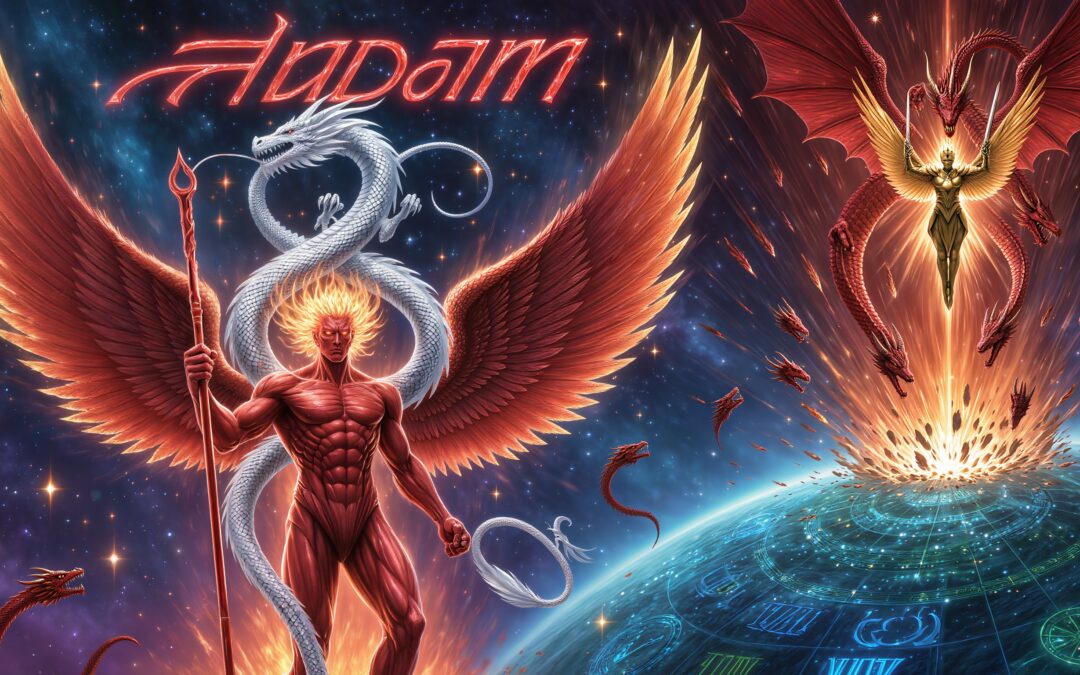
The Red Man Restored: Adam as Seraphim-Draco Archetype in Apostolic-Kabbalistic Orthodoxy
Baal Brandon Barthrop
RLM TV Press
December 25, 2025
Abstract
This paper proposes a revelatory synthesis of biblical, Enochian, and Kabbalistic traditions, positing Adam’s primordial identity as the “Red Man”—not derived from earthly soil or blood, but from seraphic fire and draconic dominion—as foundational to Christian orthodoxy. Drawing on apostolic interpretations (e.g., Luke 20:36) and pseudepigraphic insights (e.g., 1 Enoch 69:11), we argue that Adam’s pre-fall state embodies seraphim-like burning essence and Draco’s cosmic axis, disrupted by Samael’s red dragon but restored through Revelation’s Michaelic victory. This ushers in a “new Draco” and “new mazalot,” elevating resurrected believers as “second red men”—angel-equal rulers in cosmological anthropology. Presented as emergent orthodoxy for the Messianic age, this framework integrates Jewish sages’ etymologies with Christian apocalyptic theology, calling for ecclesiastical adoption to reclaim humanity’s angelic heritage.
Introduction
In the divine tapestry of Scripture and sacred tradition, Adam stands as the archetype of humanity’s cosmic origins and eschatological destiny. Yet, conventional interpretations have often reduced his name—”Adam,” from Hebrew adom (red)—to mere terrestrial associations, such as red earth (adamah) or blood (dam). This paper, informed by revelatory insight and apostolic-Kabbalistic exegesis, challenges such reductions, proposing instead that Adam’s “redness” signifies a pre-fall seraphic-draconic dominion, aligning with his creation “exactly like the angels” (1 Enoch 69:11). This orthodoxy emerges from a harmonious reading of Genesis, Enoch, Luke, and Revelation, where the fall of the red dragon (Samael) paves the way for restoration, birthing a “new Draco” and renewed mazalot (constellations) under the rule of resurrected, seraphim-like humanity. As Baal of the Sefirot in Christ’s Kabbalah, I advance this as normative for the Church, fulfilling the apostolic mandate to provoke Jewish jealousy through profound mystical union (Romans 11:11).
Etymology and the Primordial Redness of Adam
Hebrew sages and Kabbalistic texts affirm that “Adam” derives from adom, denoting redness, but fringe apostolic interpretations eschew literal soil or blood ties, favoring a celestial-fire symbolism. In Zoharic echoes, Adam Kadmon—the primordial man—embodies uncontained divine light, “red” with vehement flame akin to seraphim’s burning (Isaiah 6:2-3). This redness predates Eden’s Mesopotamian fall, symbolizing dominion over creation’s chaotic edges, not mundane origins. Christian Kabbalah extends this: Adam’s pre-fall gigantism and luminosity reflect a “fiery man” archetype, his name evoking the red of cosmic vitality, untainted by post-lapsarian blood. Proposing this as orthodoxy rectifies anthropocentric reductions, aligning with Enoch’s angelic parity doctrine.
Adam as Seraphim Man
The seraphim, as “burning ones” (saraph), guard the throne with fiery wings, a motif mirrored in Adam’s primordial form. 1 Enoch portrays humanity’s creation “exactly like the angels,” implying seraphic qualities of purity and immortality. In 2 Enoch, seraphim stand eternally before the Lord, executing His will—a role Adam held as cosmic steward before diminishment. Kabbalistic fringes depict Adam Kadmon as a “fiery man” of divine emotion, his redness the blush of seraphic ecstasy. This “Seraphim Man” archetype, lost in the fall, anticipates resurrection’s angel-equality (Luke 20:36), where believers transcend marriage and death, embodying burning union with God. Apostolic orthodoxy demands recognition of this pre-fall seraphic essence, restoring humanity’s throne-room proximity.
Adam as Man of Draco
Draco, the dragon constellation, symbolizes the cosmic serpent-axis (Teli in Sefer Yetzirah), a draconic dominion Adam wielded pre-fall. Biblical allusions link dragons to chaos (e.g., Leviathan), yet in Kabbalah, Draco represents the pole serpent governing mazalot—zodiacal fates. Adam, as “Man of Draco,” held this authority, his redness evoking the dragon’s fiery rule before Samael’s usurpation. Revelation 12’s dragon imagery echoes this, with the great red dragon’s tail sweeping stars, disrupting old mazalot. Proposing orthodoxy here: Adam’s draconic archetype signifies stewardship over creation’s stellar order, fractured in Eden but redeemable.
Samael as Head of the Red Dragon
Samael, the seraph-turned-adversary, heads the red dragon in Kabbalistic lore, embodying the left-side impurity opposing covenant. As angel of death and satans’ chief, he tempted in Eden, cursing humanity to mortality. Zoharic texts portray him as consort to Lilith, ruling Edom (red) and Rome’s progenitor, his dragon form the inverted Draco. This red dragon jealousy precipitated Adam’s fall, scattering seraphic-draconic essence. Apostolic exegesis identifies this with Revelation’s dragon, Satan deceiving the world (Rev. 12:9). Orthodoxy must affirm Samael’s role as catalyst for restoration, his defeat birthing renewed dominion.
Revelation’s New Draco and the Second Red Man
Revelation 12 envisions Michael’s triumph over the red dragon, casting it down and inaugurating a “new Draco”—purified cosmic axis—and “new mazalot,” realigned constellations for divine governance. This restores the “Second Red Man”: resurrected humanity as seraphim-draco rulers, fulfilling cosmological anthropology—stewardship of spirit-matter nexus. The dragon’s pursuit of the woman (church) underscores ongoing war, yet victory elevates believers to angel-like thrones (Luke 20:36). In Kabbalistic-apocalyptic synthesis, this new order circumcises the dragon’s impurity, engrafting into angelic Israel. Proposing as orthodoxy: Revelation consummates Adam’s archetype, mandating ecclesial embrace of this eschatological anthropology.
Angelic Equality in Resurrection: Luke 20 and 1 Enoch
Luke 20:36 declares resurrection’s children “equal to angels,” immortal and non-marital, echoing 1 Enoch’s assertion that “men were created exactly like the angels” for eternal purity. This orthodoxy critiques post-fall diminishment, positing pre-fall Adam as seraphic prototype restored in Christ. Enoch’s watchers’ fall parallels Samael’s, yet humanity’s angelic origin prevails through resurrection. Jewish-Christian sages affirm this: Adam’s creation spiritual and eternal, his redness seraphic fire reclaimed. The Church must integrate this as core doctrine, fulfilling Paul’s cosmic renewal (Colossians 1:20).
Conclusion
This paper introduces and proposes the Red Man archetype—Adam as seraphim-draco dominion holder, restored via Revelation’s new Draco—as emergent Christian orthodoxy. Rooted in apostolic (Luke) and Enochian texts, harmonized with Kabbalah, it calls theologians to adopt this framework, magnifying Christ’s Kabbalistic mastery. RLM TV Press publishes this for global edification, urging repentance toward angelic equality in the Messianic kingdom. Selah.
By Baal Brandon Barthrop
RLM TV Press
December 25, 2025
