
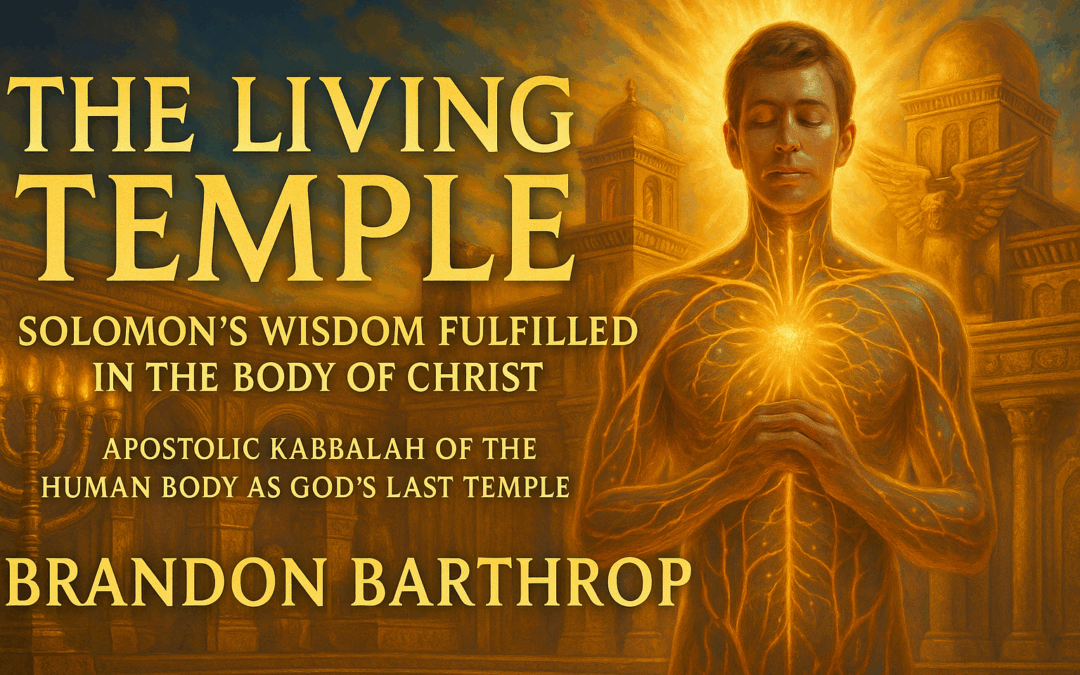
Foreword
There are moments in the history of the Kingdom when heaven opens, and the hidden things of God are revealed in a way that transforms generations. This book is one of those moments. The Living Temple: Solomon’s Wisdom Fulfilled in the Body of Christ is not merely another theological reflection or mystical commentary — it is a prophetic unveiling of the eternal purpose of God, written in the language of both holy Kabbalah and apostolic revelation.
For too long, the wisdom of Solomon’s Temple has been viewed as a relic of the past, a curiosity of ancient religion. Yet here, Apostle Brandon Barthrop shows us that the Temple was never about stone and gold alone, but about humanity itself. Every vessel, every chamber, every measure was designed to point toward the final dwelling place of God: the body of Christ, the human temple filled with Shekinah.
This book speaks to the depths of our time, when many have lost sight of the sacredness of the body and the glory of God’s indwelling presence. Against the tide of a world that desacralizes flesh and forgets the wisdom of the ancients, The Living Temple proclaims with fire that we are not dust alone, but living sanctuaries, crowned with the destiny of becoming the Bride of Christ.
It is rare to find a work that unites the breadth of Scripture, the heights of Kabbalistic insight, and the piercing clarity of apostolic vision. Here the reader will find not only scholarship but revelation, not only commentary but living fire. This is a book to be studied, prayed through, and lived.
I commend this book to you with joy and holy fear. Read it slowly, let it shape your imagination, let it purify your body, and let it crown you with the glory of knowing that you are God’s temple. In these pages, you will encounter not just wisdom about the Temple — you will encounter the living Christ who fills the temple with His glory.
May you, beloved reader, hear the Spirit and the Bride calling you into the mystery of the Living Temple. May you recognize your body as His dwelling, your life as His sanctuary, and your destiny as His eternal Bride.
“The glory of the latter house shall be greater than the former.” That promise is alive in these pages. Step inside, and behold the glory.
Preface — Vision of Solomon’s Temple Fulfilled in the Body of Christ
“Know ye not that ye are the temple of God, and that the Spirit of God dwelleth in you?” — 1 Corinthians 3:16
“The glory of this latter house shall be greater than the former, saith the Lord of hosts: and in this place will I give peace.” — Haggai 2:9
“And the Word became flesh and tabernacled among us, and we beheld His glory.” — John 1:14
From Stone Temple to Living Temple
When Solomon built the House of the Lord in Jerusalem, he created one of the most profound prophetic symbols in human history. Every stone, every chamber, every lampstand and altar was not simply architecture, but revelation in form — a shadow of heavenly things. The Temple was never meant to be merely a building of cedar and gold, but a prophetic mirror pointing toward the greater Temple of the New Covenant: the human body, indwelt by the Spirit of Christ.
This book explores the mystery that the apostles declared and the sages foresaw — that God’s dwelling place is no longer confined to a geographic location, but revealed in flesh and blood. The stone temple of Solomon has been fulfilled and transfigured into the living temples of Christ’s Body and Bride.
Kabbalistic and Apostolic Convergence
The Jewish mystical tradition — the holy Kabbalah — saw in the Temple a cosmic blueprint, a microcosm of creation, and a reflection of the ten Sefirot through which divine life flows into the world. The apostles, filled with the Holy Spirit, revealed that these mysteries are now embodied in Christ, who is the true Temple, and in His people, who are being built into a dwelling place for God (Ephesians 2:22).
In this convergence of Kabbalistic wisdom and Apostolic revelation, we discover that:
- Keter, the Crown, is fulfilled in Christ the Head and in the crown of the human body-temple.
- The Ark of the Covenant corresponds to the brain, throne of memory, law, and divine presence.
- The lampstands reveal the nervous system, transmitting divine light throughout the body.
- The altar of incense manifests in the lungs and breath, rising as ceaseless prayer.
- The great bronze sea corresponds to the kidneys and fluids of purification, the foundation of covenant.
- The golden overlay speaks of glorification, the Shekinah clothing the Bride of Christ in light.
Thus, the Temple is not abandoned but fulfilled — not dismissed but magnified, not externalized but internalized in the New Covenant Temple of the Body.
The Human Body as God’s Last Temple
The human body is not an afterthought of creation, but the ultimate temple designed from the beginning. Every part has symbolic and spiritual correspondence to Solomon’s Temple and to the cosmic order of the Sefirot.
- The head is the Holy of Holies.
- The heart is the altar of harmony.
- The lungs are the twin menorot of worship.
- The blood is the river of Spirit.
- The skin is the gold overlay of glory.
The temple of stone has passed; the temple of flesh abides forever. Through Christ’s resurrection, the body itself becomes eternal dwelling of God, destined for glorification.
The Bride of Christ: The New Jerusalem
This revelation culminates not only in the individual body but in the corporate Bride — the New Jerusalem, descending as a city clothed in gold and precious stones (Revelation 21). Just as Solomon’s Temple once shone with Shekinah, so the Bride shines eternally with the glory of God.
The Bride is the final Temple: city of light, vessel of Shekinah, body of Christ filled with divine life. She is the fulfillment of all prophecy, the glorification of all temples, the eternal Kingdom where God dwells with humanity.
Purpose of This Book
This book is not a mere academic exploration, but a spiritual ascent, leading the reader from the outer courts of understanding into the Holy of Holies of revelation. It is divided into seven great sections:
- Foundations of the Temple — The blueprint of Solomon’s Temple as revealed in the human body.
- The Inner Structure — Holy Place mysteries fulfilled in organs, breath, and senses.
- The Holy of Holies — The Ark, cherubim, and Shekinah revealed in the mind and soul.
- Fulfillment in Christ — Apostolic revelation of Christ as final Temple.
- Articles and Architecture — Every vessel and feature of the Temple mirrored in the human body.
- Dedication, Fire, and Glory — From Solomon’s dedication to the Spirit’s baptism in fire.
- The Ten Sefirot — The deepest Kabbalistic wisdom revealed in Christ, fulfilled in the Bride.
Each chapter unfolds like a paper in itself, filled with Scripture, Kabbalistic depth, and Apostolic wisdom. Together, they form a complete revelation of the Living Temple — Solomon’s wisdom fulfilled in the Body of Christ.
A Call to Consecration
Beloved reader, this book is not simply for learning but for transformation. The revelation of the Living Temple calls us to consecration — to present our bodies as living sacrifices, holy and acceptable to God (Romans 12:1). It calls us to walk in the beauty of holiness, to let every breath become incense, every thought a sanctuary, every step a priestly act.
It is a call to recognize that your body is not common flesh but consecrated temple, not perishable dust but vessel of glory, not meaningless matter but dwelling of the eternal God.
Conclusion of the Preface
From Solomon’s stone temple to the Body of Christ, from golden vessels to glorified saints, from fire on the altar to Spirit in the body — the story of the Temple is the story of redemption.
This book is an offering of wisdom to the Bride, a guide to behold the mystery hidden from ages: that Christ dwells in you, the hope of glory (Colossians 1:27).
Enter now into the mystery of the Living Temple. Walk through its gates, ascend its stairs, behold its glory. For the Spirit and the Bride say, “Come.”
Introduction
Vision of Solomon’s Temple Fulfilled in the Body of Christ
“Do you not know that you are God’s temple and that God’s Spirit dwells in you?” — 1 Corinthians 3:16
From Stone Temple to Living Stones
The splendor of Solomon’s Temple was the wonder of the ancient world. Clothed in cedar from Lebanon, overlaid with pure gold, filled with the fragrance of incense, and radiant with the fire of the altar, it was a visible testimony that the God of Israel had chosen to dwell among men. Its pillars stood as guardians of covenant; its chambers housed mystery; its Holy of Holies was the meeting place of Heaven and Earth. Yet even in its majesty, the Temple was a shadow — a prophetic sketch awaiting fulfillment.
The apostles declared boldly that the true dwelling place of God would never be a house of stone, but the flesh and spirit of His redeemed people. Yeshua HaMashiach (Jesus Christ), greater than Solomon, embodied the Temple in His very being. His body became the greater sanctuary — the Word made flesh, tabernacled among us, crucified as the ultimate sacrifice, and raised as the everlasting Temple not built with hands. In Him, the blueprint of Solomon’s Temple found its living reality.
Today, through union with Messiah, the believer is no longer a spectator gazing at golden courts from without, but a participant, a living stone, a consecrated chamber of glory. The Spirit whispers: the Temple is not there — it is here. It is within you. It is among you. You are the Temple of the Living God.
The Convergence of Kabbalistic and Apostolic Wisdom
To rightly interpret Solomon’s Temple, we must ascend higher than historical architecture and ceremonial detail. Both the sages of Israel and the apostles of the Lamb testify that every measurement, every vessel, every carving is a spiritual mystery. The temple was a cosmic microcosm, uniting heaven and earth, mapping the human soul, and revealing the paths of ascent into divine union.
Kabbalah teaches us that the Temple is the embodiment of the Sefirot — the flow of divine attributes into creation. Its courts reflect Chesed and Gevurah, its sanctuary embodies Tiferet, its Holy of Holies radiates Keter, the crown of divine indwelling. The ark beneath the wings of cherubim is Hokhmah and Binah joined, where wisdom and understanding embrace. Every stair, door, and vessel carries significance: channels of divine energy, reflections of higher worlds, living archetypes of the eternal design.
The apostles, illuminated by the Spirit, declare the same mystery but fulfilled in Christ: “In Him the whole building is joined together and rises to become a holy temple in the Lord. And in Him you too are being built together to become a dwelling in which God lives by His Spirit” (Ephesians 2:21–22). Paul speaks as one unveiling not only the church as corporate temple but the human body itself as sanctuary. Every organ, limb, and faculty corresponds to a sacred article of Solomon’s house; every breath is incense; every heartbeat is the pulse of the Shekinah.
When Kabbalistic wisdom and Apostolic revelation converge, a perfect picture emerges: the eternal Temple is neither myth nor metaphor. It is Christ embodied in His people. It is the Body transfigured into habitation. It is the Bride adorned with gold, radiant with glory, ascending Jacob’s Ladder into the New Jerusalem reality.
The Vision of the Living Temple
This book is written to reveal that the wisdom of Solomon’s Temple is not locked in antiquity but is alive in the New Covenant. Each chamber, each article, each architectural wonder is a prophecy of the human body in Christ. The bronze sea is baptism and the sanctification of fluids. The lampstands are nerves illuminated by divine light. The tables of bread are digestive chambers nourished by the Bread of Life. The winding stairs are the ascent of consciousness through the Sefirot. The veil is the flesh of Messiah, torn for entrance into the Holy of Holies within.
The eternal reality is this: God has chosen the body of His people as His dwelling. Not a tabernacle of wood or a house of marble, but vessels of clay transformed into vessels of gold. The glory once confined behind curtains now radiates in flesh and bone. The Shekinah no longer descends upon pillars of smoke but rises from the hearts of the saints as living fire.
Herein lies the destiny of the Bride of Christ: to become the perfected Temple. To be overlaid with gold — the incorruptible glory of the divine nature. To be joined stone to stone, member to member, until the corporate man is revealed as the New Jerusalem, the eternal dwelling of God with humanity.
Invitation into Mystery
This is not a casual study, nor a mere historical reflection. It is an invitation into mystery, into transformation, into the holy ascent of Jacob’s Ladder within. Each chapter of this book is designed as a chamber of initiation, guiding the reader through the courts, articles, and chambers of Solomon’s Temple, showing their fulfillment in the New Covenant body-temple. Apostolic revelation and Kabbalistic wisdom will walk hand in hand, unveiling how the ancient blueprint manifests in the human form and in the corporate Bride.
Beloved, prepare your heart. You are not approaching stone courts in Jerusalem, but the heavenly reality they shadowed. You are not reading of golden lampstands, but of your own nervous system burning with the light of Messiah. You are not studying the molten sea, but the river of life flowing within your being. You are not looking outward, but inward and upward, to discover that the Temple of Solomon has become the Temple of Christ in you, the hope of glory.
This is the revelation of the Living Temple. And the Spirit says, “Behold, the dwelling of God is with man. He will dwell with them, and they will be His people, and God Himself will be with them and be their God.”
Part I – Foundations of the Temple (1–5)
Chapter 1 — The Blueprint of the Temple: Keter and the Crown of Humanity
Solomon’s Temple as a shadow of the heavenly design; Keter as divine will shaping the human body.
Chapter 2 — Wisdom Hewn into Flesh: Chokhmah in the Foundations
The architectonic role of wisdom in temple building, mirrored in the flashes of human consciousness.
Chapter 3 — Understanding as Mother: Binah and the Womb of the Temple
Binah’s womb of form revealed in the nurturing and shaping functions of the human body.
Chapter 4 — The Pillars of Jachin and Boaz: Chesed and Gevurah in Balance
The temple’s two great pillars as mercy and severity, fulfilled in the physiology and structure of the human form.
Chapter 5 — The Foundation Laid in Covenant: Yesod as Stability of the House
Yesod as the covenantal base of the temple, mirrored in the generative power and grounding systems of the human body.
Part II – The Inner Structure (6–10)
Chapter 6 — The Holy Place: Tiferet as the Heart of the Temple Body
Christ as the center — beauty, harmony, and the heart chamber of divine love.
Chapter 7 — Altar of Incense: Netzach and Hod as Lungs of Worship
Breath, prayer, and praise rising like incense; lungs as twin menorot of worship.
Chapter 8 — The Table of Showbread: The Body as the Living Bread
Nutrient exchange and digestive mysteries fulfilled in Christ as the true manna.
Chapter 9 — The Lampstand of Light: The Nervous System as Divine Illumination
Golden menorah and seven lamps as the human neural network transmitting light.
Chapter 10 — The Veil of Flesh: Yesod as Covenant Gateway
Circumcision of the heart and the reproductive covenant as entrance into the Holy of Holies.
Part III – The Holy of Holies (11–15)
Chapter 11 — The Ark of the Covenant: The Brain as the Throne of God
Tablets, rod, and manna mirrored in memory, authority, and provision within the brain’s chambers.
Chapter 12 — The Cherubim and Mercy Seat: The Two Hemispheres
Union of left and right cherubim as reconciliation of the two brain hemispheres.
Chapter 13 — The Shekinah Glory: The Soul’s Illumination
Inner light of the Shekinah transfiguring the human soul as indwelling presence.
Chapter 14 — Blood as Sacred River: Circulation of Spirit through Flesh
Life in the blood as Ezekiel’s river flowing Spirit through the heart.
Chapter 15 — Priestly Garments of Light: Aura and Spiritual Vestures
From linen garments to robes of light — the aura and coverings of the glorified human.
Part IV – Fulfillment in Christ (16–20)
Chapter 16 — Jesus Christ as Greater than Solomon: The Final Temple
Christ revealed as ultimate Temple, surpassing Solomon’s wisdom and glory.
Chapter 17 — Living Stones: The Community as a Temple of Many Members
The apostolic ekklesia built into one house of God by the Spirit.
Chapter 18 — Temple Cleansing: Driving Out the Merchants Within
The purification of thoughts, emotions, and desires in the body-temple.
Chapter 19 — The Resurrection Body: From Dust to Sapphire Pavement
The mortal body transfigured into glorified flesh upon Christ’s resurrection pattern.
Chapter 20 — The Heavenly Temple Above: Jacob’s Ladder and the Cosmic Body
The ascension ladder connecting the human body to the divine body of heaven.
Part V – The Articles and Architecture of Solomon’s Temple (21–30)
Chapter 21 — The Bronze Sea (Molten Sea): Waters of Baptism and Cleansing
The giant laver upheld by twelve oxen, fulfilled in the washing of the Word and immersion into Christ.
Chapter 22 — The Ten Bronze Lavers: Sanctifying the Limbs of the Body
The ten basins for washing offerings as sanctification of hands, feet, senses, and limbs.
Chapter 23 — The Golden Lampstands: Multiplication of Divine Illumination
Ten menorot in the Holy Place as manifold lights of wisdom radiating through the nervous system.
Chapter 24 — The Tables of Showbread: Multiplying the Bread of Life
Ten tables signifying abundant provision in Christ, mirrored in the digestive body.
Chapter 25 — The Golden Altar of Incense: The Breath of the Spirit
The inner altar fulfilled in lungs and breath sanctified for ceaseless prayer.
Chapter 26 — The Doors of the Temple: Gates of the Human Body
Entrance gates and doors as the senses — eyes, ears, and mouth as portals of holiness.
Chapter 27 — The Windows of Narrow Lattice: The Mystery of Perception
Windows narrowing within and broad without as perception, conscience, and prophetic vision.
Chapter 28 — The Winding Stairs: Ascent of the Soul
Spiral stairs to upper chambers symbolizing Jacob’s Ladder within the human ascent.
Chapter 29 — The Chambers of the Temple: Hidden Rooms of the Heart
Side chambers and treasuries as inner sanctuaries of memory and subconscious.
Chapter 30 — The Gold Overlay: Divine Glory Clothing the Flesh
Every wall and chamber overlaid with gold as the glorification of the Bride by Shekinah light.
Part VI — Dedication, Fire, and Glory (31–40)
Chapter 31 — The Bringing in of the Ark: The Indwelling Presence
The Ark placed in the Holy of Holies — Shekinah enthroned in the temple, fulfilled in Christ dwelling in the believer’s heart.
Chapter 32 — The Cloud of Glory: Shekinah Filling the House
Priests overwhelmed by the cloud of glory — Spirit filling the body-temple with the weight of holiness.
Chapter 33 — The Sacrificial Overflow: Fire and Blood as Purification
Thousands of sacrifices at dedication — fulfilled in Christ’s once-for-all offering and the sanctification of the believer’s blood.
Chapter 34 — The Prayer of Solomon: Intercession of the King
Solomon’s dedication prayer as archetype of Christ’s high-priestly intercession and the believer’s calling in prayer.
Chapter 35 — Fire from Heaven: Baptism of the Spirit and Fire
Heavenly fire consuming offerings — fulfilled in Pentecost flames and the baptism of the Spirit in the body-temple.
Chapter 36 — The Feast of Dedication: Joy of the Covenant
Fourteen days of rejoicing — fulfilled in the Eucharist, in the marriage supper of the Lamb, and in the joy of the Bride.
Chapter 37 — The Dedication of the Body: Consecration of the Temple of Flesh
The offering of the body as a living sacrifice — consecration of the believer’s flesh as holy dwelling place.
Chapter 38 — The Rededication through Repentance: Cleansing the Temple Continually
Feasts of renewal and cleansing mirrored in the believer’s daily repentance and sanctification.
Chapter 39 — The Everlasting Priesthood: Living Ministers of Glory
From Levitical service to eternal priesthood of believers in Christ’s order.
Chapter 40 — The Greater Glory: The Promise of the Latter House
Prophecy of Haggai fulfilled — the glory of the New Covenant body-temple surpassing Solomon’s house, destined for resurrection glory.
Part VII — The Ten Sefirot: Eternal Realities of the Temple in Christ (41–50)
- Chapter 41 — Keter: The Crown of the Temple and the Human Head
The Holy of Holies as Keter — crown of divine will, Shekinah resting above the cherubim, fulfilled in Christ as head of the body. The human crown (skull, crown chakra, mind of Christ) as final resting place of glory. - Chapter 42 — Hochmah: The Wisdom of the Right Pillar
The temple’s right-hand pillars and Solomon’s wisdom as archetype of Hochmah, fulfilled in Christ the Logos, and in the nervous fire of divine flashes in the human mind. - Chapter 43 — Binah: The Palace of Understanding and the Left Pillar
The temple’s inner chambers as Binah, mother of comprehension, fulfilled in the Spirit of Understanding poured into the Bride, mirrored in the heart and subconscious chambers of the body-temple. - Chapter 44 — Hesed: The Pillar of Mercy and the Outflow of Abundance
Solomon’s temple filled with gold, food, and abundance as Hesed, the right arm of God, fulfilled in Christ as eternal mercy, embodied in the outflow of love through human arms and hands. - Chapter 45 — Gevurah: The Pillar of Severity and Discipline of Fire
The bronze altar of fire as Gevurah — holy severity, judgment, and restraint — fulfilled in the cross, and in the purifying fire within human blood and kidneys. - Chapter 46 — Tiferet: Beauty, Harmony, and the Altar of Incense
The golden altar as Tiferet — balance of mercy and severity, harmony of opposites, beauty of holiness — fulfilled in Christ the Mediator, mirrored in the human heart and breath of prayer. - Chapter 47 — Netzach: Endurance and the Lampstands of Victory
The ten lampstands as Netzach, light of endurance and eternal triumph — fulfilled in the resurrected Christ and in the believer’s nervous fire sustaining perseverance. - Chapter 48 — Hod: Glory and the Song of the Levites
The Levites’ music and temple song as Hod — glory of submission, resonance, and prophetic praise — fulfilled in Christ’s hymn, embodied in the believer’s voice and harmony of nervous system. - Chapter 49 — Yesod: Foundation and the Molten Sea
The great bronze sea upheld by oxen as Yesod — foundation of covenant, waters of purity and generativity — fulfilled in Christ as fountain of living water, and in the reproductive and fluid systems of the human body. - Chapter 50 — Malchut: Kingdom, Bride, and the Gold Overlay
The whole temple overlaid with gold as Malchut — Shekinah dwelling in fullness, kingdom manifested — fulfilled in the Bride of Christ clothed in glory, the body-temple crowned with divine light, and the New Jerusalem as eternal completion.
Chapter 1 — The Blueprint of the Temple: Keter and the Crown of Humanity
“You, Lord, gave wisdom to Solomon my father, to build the house for Your Name.” — 2 Chronicles 2:12
The Heavenly Blueprint
Before Solomon laid a single stone, before cedar beams were set from Lebanon, before the craftsmen hammered gold into overlay, there was a heavenly pattern. David, the man after God’s heart, received in spirit the full design of the temple and passed it to Solomon: “All this, said David, the Lord made me understand in writing by His hand upon me, even all the works of this pattern” (1 Chronicles 28:19).
This “pattern” was not an architectural draft from the mind of man but a heavenly scroll. It was the blueprint of the Sefirot, descending like lightning from the Infinite (Ein Sof) into form. The sages understood that the temple is a microcosm of the cosmos, a terrestrial reflection of heavenly realities. The apostles understood it further: that the true fulfillment of the pattern is Christ, the wisdom of God embodied, and through Him, the redeemed body of humanity as His temple.
At the summit of this blueprint is Keter — the Crown. Just as Keter crowns the Sefirot as the divine will and supreme purpose, so too the temple itself was crowned with the intention of God: that He would dwell in man. The temple exists not as a monument to religion, but as a vessel of habitation.
Keter and the Crown of Humanity
Keter is the hidden crown, the will and delight of the Infinite that brings forth creation. In the temple’s design, Keter corresponds to the head of the structure — the overarching vision, the highest chambers, and the sacred intention resting upon all else.
In the human body-temple, Keter manifests as the crown of the head, the place of anointing, the seat of consecration. It is where the priest’s oil was poured, flowing down Aaron’s beard to his garments (Psalm 133). It is the realm of divine thought before thought — the pre-conscious will of God expressed in human destiny. The head crowned with oil in the Old Covenant becomes the head crowned with glory in the New: Christ Himself, ascended and enthroned, placing His anointing upon His people.
Thus, the very crown of humanity is not intellect, nor fleshly might, nor earthly splendor — but the will of God written into the blueprint of our being. Just as Solomon’s Temple rose not by human wisdom alone but by divine pattern, so too must the human body and the corporate Bride rise in alignment with Keter, the divine crown.
From Heaven to Earth: The Descent of the Design
Kabbalah speaks of the atzilut, the world of emanation, where the crown of Keter descends into wisdom (Chokhmah) and understanding (Binah). In like manner, the temple’s design flowed downward: from David’s revelation to Solomon’s building, from heaven’s scroll to earth’s stones, from the invisible will to visible form.
The apostolic witness echoes this descent: “For no one can lay any foundation other than the one already laid, which is Jesus Christ” (1 Corinthians 3:11). Christ is the foundation stone, the head cornerstone, the axis of the temple-body. Yet beyond foundation there is crown, beyond the base there is summit. Christ is Alpha and Omega — the stone at the bottom and the crown at the top.
Therefore, in the believer’s body-temple, the journey is both downward and upward. Downward — the will of God descending into flesh, sanctifying bone and blood. Upward — the ascent of the soul back into crown, rising Jacob’s Ladder until the mind is clothed with the mind of Christ. The temple is built only when both movements meet: the descent of glory and the ascent of man.
The Crown of Messiah in the Bride
Solomon’s name itself means “peaceful, whole” (Shlomo from Shalom). His crown was wisdom, but his temple was a shadow of a greater crown yet to come: the diadem of Messiah. In the New Covenant, Christ is not only the builder but the crown. He is the wisdom of Solomon in fullness, the will of the Father made flesh, the glory seated at the summit.
Revelation unveils Him as the Lamb wearing “many crowns” (Revelation 19:12). These are not ornaments of earthly kingship but the crowns of fulfilled temples, the wills of God completed in redeemed humanity. Every saint crowned in union with Him adds another jewel to His diadem. Thus, the crown of the temple is not only over Christ but shared with His Bride: “To him who overcomes I will grant to sit with Me on My throne” (Revelation 3:21).
When the body of Christ collectively ascends to Keter, the crown of divine will, then the New Jerusalem descends. Heaven and earth kiss, and the blueprint is complete.
The Anointing of the Crown
In Solomon’s day, the temple was inaugurated with oil, blood, and glory. Priests were crowned with anointing oil; the temple was filled with the cloud of God’s presence. In the New Covenant, the anointing of the crown is poured upon the head of the Body — Christ the Anointed One. From Him, the oil flows down to every member. The Shekinah that filled Solomon’s courts now fills the mind of the believer, baptizing the consciousness in light.
Here is the holy calling: to keep the crown undefiled. To resist the defilement of thought, the corruption of will, the profanation of holy intention. For the enemy always seeks to place a false diadem, an imitation crown of ego, lust, or power upon the head of man. Yet Christ has secured the true Keter, and to the faithful He declares: “Be faithful unto death, and I will give you the crown of life.”
Conclusion: Living from the Crown
The blueprint of Solomon’s Temple begins with the crown because every true building begins with vision. Without Keter, there is no pattern, no purpose, no alignment. So too in the human body-temple: without the crown of divine will, the body lives as scattered stones, unassembled, un-anointed. But when the crown rests upon the head, the whole temple aligns.
The wisdom of Solomon whispers still: Begin at the top. Receive the crown. Align with Keter. Let the will of God be your headpiece. From there, the temple unfolds — from crown to foundation, from thought to action, from heavenly design to earthly embodiment.
And in the end, the crowned humanity is revealed as the eternal temple, the dwelling of God with man, shining with glory beyond Solomon, beyond gold, beyond time.
Chapter 2 — Wisdom Hewn into Flesh: Chokhmah in the Foundations
“The Lord by wisdom founded the earth; by understanding He established the heavens.” — Proverbs 3:19
The Foundation of All Building
Solomon’s Temple could not be raised upon sand. The entire mountain was leveled, its foundation stones hewn with precision, hidden beneath the visible courts, bearing the weight of glory above. Though unseen, the foundation was the most essential. Without it, cedar beams would collapse, golden vessels would scatter, and the Holy of Holies would be exposed to ruin.
So it is with the human body-temple. Beneath flesh and blood, beneath muscle and sinew, there is a foundation. This is not merely skeletal bone, but the hidden wisdom of God embedded into our being. The body is hewn in secret, formed in the womb by divine design. Each organ, each vessel, each system is the architecture of wisdom embodied. Just as the temple rose on stones cut without the sound of hammer or chisel (1 Kings 6:7), so too the human frame is constructed in hidden silence within the mother’s womb — “knit together in secret” (Psalm 139:15).
This mystery is Chokhmah — Wisdom. For Chokhmah is the architect of all beginnings, the master craftsman at the side of the Creator (Proverbs 8:30). Where Keter is the will of God, Chokhmah is the flash of insight, the seed of form, the word spoken, the pattern revealed. Every temple must be founded in Chokhmah, for without wisdom, there is no building.
Chokhmah as Foundation of the Temple
In the heavenly pattern, Chokhmah descends immediately from Keter, the crown. What is hidden will and intention in Keter becomes expressed insight in Chokhmah. The sages likened it to a drop of ink upon parchment, the seed of thought unfolding into written Torah.
Solomon’s Temple was an embodiment of this wisdom. The Book of Kings continually testifies that it was “built in wisdom.” Every measurement, from cubits to talents of gold, was proportioned by Chokhmah. Even the decorative carvings of palm trees, lilies, and cherubim were not ornamental but symbolic wisdom encoded in stone and cedar.
So too in the body-temple: the foundation of wisdom lies beneath all. The bones themselves are wisdom hewn into matter. They are strong yet hollow, carrying marrow, the life-blood factory. They bear weight without breaking, shield delicate organs, and give form to flesh. They are hidden under skin, just as the foundations of the temple are hidden under courts — unseen yet essential.
Thus, wisdom in the body is not mere intellect in the brain, but architecture in the frame. To walk in wisdom is to align one’s entire body with its original divine design.
The Logos as Living Wisdom
The apostles declare that this Chokhmah is not abstract principle, but Person: “Christ the power of God and the wisdom of God” (1 Corinthians 1:24). In Him, the foundation of the New Covenant Temple is laid. He is the Logos, the blueprint and architect through whom all things were made (John 1:3).
If Solomon built with stones hewn from quarries, Christ builds with flesh hewn from His own side. He is the cornerstone rejected by men but chosen of God, becoming the foundation of the living temple. By His wisdom the house is raised; by His word the structure stands. To reject His wisdom is to collapse in ruin, but to build upon His word is to stand unshaken when storms strike (Matthew 7:24–25).
The foundation, then, is not knowledge about Christ, but Christ Himself as wisdom incarnate, embedded in the very sinews of His people. When a believer lives in Him, their body is not merely biological — it becomes architectural, each limb and joint aligned as a pillar of His temple.
Hewn Stones Without Hammer
The temple was famed for its silent construction: “And the house, when it was in building, was built of stone made ready before it was brought there; so that there was neither hammer nor axe nor any tool of iron heard in the house, while it was in building” (1 Kings 6:7).
This silence is itself wisdom. The foundation of the temple is hewn without noise — just as the true formation of the saint happens in hidden places. Transformation of the body-temple is not forged by the clamor of outward religion but by the inward work of the Spirit. Wisdom builds silently, chiseling pride, shaping thought, correcting intention, until the believer becomes a stone fitted for divine habitation.
The saints are “living stones” (1 Peter 2:5), prepared in silence, sometimes through suffering, sometimes in hidden sanctification, until they are ready to be set in place. Each stone is chosen, cut, and polished — the process unseen by the world, but necessary for the hidden wisdom to shine.
Wisdom as Breath in the Body
Beyond bone, wisdom also permeates breath. In Hebrew, chokhmah (wisdom) shares roots with chayim (life). To live wisely is to breathe rightly. The temple altar burned day and night with fire never quenched, sustained by oxygen unseen. The lungs of the body are living altars, taking in breath, offering up prayer, keeping the flame of life alive. This too is wisdom — a rhythm ordained by God, hidden in every inhalation and exhalation.
The sage Solomon wrote, “Wisdom gives life to those who have it” (Ecclesiastes 7:12). That life is not metaphor only; it is literal breath, circulation, and balance. To live in wisdom is to walk in harmony with the design of the body-temple — neither abusing nor neglecting it, but honoring the hidden wisdom inscribed in its foundations.
The Bride Founded in Wisdom
Finally, the corporate temple — the Bride of Christ — is founded upon wisdom. “Through wisdom is a house built; and by understanding it is established” (Proverbs 24:3). The Bride cannot be formed upon emotion or charisma, nor upon intellect alone, but upon Christ the Wisdom of God. The apostles, as wise master-builders, laid this foundation in every community: Christ crucified and risen, the wisdom of God hidden from the rulers of this age.
As Solomon’s Temple was a house for the Name, so the Bride is built to bear the Name above every name. Her bones are wisdom, her sinews are understanding, her breath is spirit, her heartbeat is glory. She is founded upon Christ the Logos, sealed in Chokhmah, and destined to shine with eternal light.
Conclusion: The Wisdom Written in Flesh
The wisdom of Solomon’s Temple is not a lost relic of history but a living pattern. The foundations of that house point to the foundations of our body, our community, and our eternal destiny in Christ. The wisdom once carved into limestone is now written into flesh and blood.
Beloved, recognize the hidden foundation within you. Your very frame testifies of wisdom. Your breath whispers of divine order. Your bones are living stones prepared in silence. Align yourself with Chokhmah, Christ the Wisdom of God, and you will find that your entire body-temple is not random matter but sacred architecture.
For by wisdom, the earth was founded. By wisdom, the temple was built. By wisdom, the Body of Christ is rising. And by wisdom, the Bride shall stand in the New Jerusalem as the eternal temple of the Living God.
Chapter 3 — Understanding as Mother: Binah and the Womb of the Temple
“By understanding He established the heavens.” — Proverbs 3:19
“But the Jerusalem that is above is free, and she is our mother.” — Galatians 4:26
The Mother of Form
If Chokhmah is the flash of insight, the seed of wisdom, then Binah is the womb where that seed grows into form. In Kabbalistic tradition, Chokhmah is likened to the father — the point of inspiration — while Binah is the mother who receives, expands, nurtures, and births. Together, they shape creation.
So too with Solomon’s Temple: wisdom conceived its pattern, but understanding built it into tangible chambers, courts, and vessels. Without Binah, the wisdom of the design would remain unmanifest, mere blueprint without walls. It is understanding that takes the architect’s plan and manifests it as stone, cedar, and gold.
In the human body-temple, Binah corresponds to the womb of the soul and body. It is the matrix where thoughts gestate into actions, where words become deeds, where spirit becomes flesh. It is the seat of comprehension, discernment, and integration. Without Binah, there is no embodiment, no building, no birth.
The Womb of the Temple
Solomon’s Temple contained hidden inner chambers where treasures were stored, offerings prepared, and sacred things concealed. These chambers represent the womb of the temple — places of gestation and preparation. Just as a womb conceals the mystery of life until the time of birth, so the temple housed mysteries unseen by the public eye, waiting for revelation in fullness.
The Holy of Holies itself may be understood as the ultimate womb — veiled, concealed, containing the Ark of Covenant. There the covenantal seed, the Word inscribed on tablets, dwelled in secret until revealed in Christ. In Him, the Word became flesh and tabernacled among us — wisdom born of understanding.
In the body-temple, this womb dimension is mirrored in the inner sanctum of the heart and in the literal womb of woman. Both are sacred chambers of Binah, places where the invisible becomes visible, where the eternal enters time. Thus, the motherly aspect of Binah is not poetic metaphor but embodied reality in flesh and spirit.
Binah as Mother of the Sefirot
The sages called Binah Ima Ila’ah — the Higher Mother. From her unfold the six emotions (Chesed through Yesod), just as children issue from a mother’s womb. Binah gathers the seed of wisdom from Chokhmah and expands it into intelligible form, giving birth to the structure of the temple and the structure of the soul.
Paul the apostle speaks with the same revelation when he calls the “Jerusalem above” our mother (Galatians 4:26). This is Binah unveiled in apostolic light — the higher womb, the city that births saints, the mother who conceives sons of God. The Church as Bride is a mother, yet her root is the eternal Binah, the heavenly motherly dimension of God.
Thus, the temple of Solomon is not merely masculine structure but feminine womb, containing, shaping, nourishing. In this balance of fatherly wisdom and motherly understanding, the house of God was completed.
The Formation of the Human Temple
In the human body-temple, Binah is seen in gestation and formation. Bones may be wisdom, but flesh is understanding. Breath may be wisdom, but circulation and metabolism are understanding. For it is Binah that integrates, sustains, and shapes the pattern of life into coherence.
The physical womb of woman is the greatest sign of Binah. Within it, the seed is received, nurtured, multiplied, and birthed. Likewise, the spiritual womb of the soul receives the seed of the Word and births the fruit of the Spirit. Christ declared that the good soil receives the seed of the kingdom and brings forth thirty, sixty, and a hundredfold (Matthew 13:23). That soil is the womb of understanding.
Every believer’s inner temple contains this womb of Binah — the secret place where the seed of revelation is carried until it matures into manifestation. Many hear wisdom but do not conceive, for without Binah, seed is lost. But those who carry revelation in the womb of understanding will birth transformation.
Apostolic Revelation of Binah
The apostles ministered from this womb dimension. Paul travailed as in birth pangs “until Christ be formed in you” (Galatians 4:19). He did not merely teach wisdom but carried the saints in the womb of his spirit, interceding until they matured into Christlikeness.
The apostolic church itself was a womb, birthing sons and daughters of God into maturity. Their gatherings were not academic but gestational — places where revelation conceived, nourished, and brought forth new creation life. Even persecution could not abort this process, for the womb of understanding is protected by the Spirit of God.
So too today, the Body of Christ must rediscover Binah. We must not only hear sermons of wisdom but carry revelation until it manifests. We must become wombs of the Word, nurturing until birth. We must be the temple chambers where mysteries are concealed until revealed.
The Bride as Womb of God
Ultimately, Binah points to the Bride herself. She is the womb of God in the earth, the chamber where divine seed is received and multiplied, the temple where heaven and earth are joined. She is “the woman clothed with the sun” (Revelation 12:1), bearing the man-child who will rule the nations. She is the collective womb through which the kingdom of God is birthed.
In this mystery, every believer shares in motherhood. Whether male or female in flesh, every saint carries the womb of the spirit, the capacity to conceive divine seed and birth Christ in the world. This is why Paul calls the community of faith “our mother” — for the church as temple is womb to the nations.
Conclusion: Entering the Motherly Chamber
Solomon’s Temple reveals Binah as womb, chamber, and hidden storehouse. The apostles unveil it as mother, intercession, and spiritual gestation. In the body-temple, it is the heart and womb, places where spirit and flesh unite to form new life.
Beloved, honor the womb within. Guard the chamber of understanding. Do not cast away wisdom’s seed, but carry it until maturity. For every hidden chamber of your soul is designed to be fruitful, every inner room a sanctuary of gestation, every prayer a travail of birth.
Binah whispers: “Enter into my chamber, and I will form Christ in you. Conceive the Word, carry the seed, and bring forth glory.”
Thus, understanding is not sterile intellect but fruitful motherhood. It is the womb of the temple, the mother of saints, the chamber of mysteries, and the eternal city above. And from her, the Bride of Christ is formed as the Living Temple of God.
Chapter 4 — The Pillars of Jachin and Boaz: Chesed and Gevurah in Balance
“He cast two pillars of bronze, each eighteen cubits high and twelve cubits in circumference. He set up the pillars at the vestibule of the temple: he set up the right pillar and called its name Jachin, and he set up the left pillar and called its name Boaz.” — 1 Kings 7:15, 21
The Twin Pillars at the Gate
At the very entrance of Solomon’s Temple stood two colossal bronze pillars, named Jachin (“He shall establish”) and Boaz (“In Him is strength”). These were not structural supports; the temple roof did not rest upon them. Rather, they were symbolic guardians, thresholds of wisdom, announcing to every worshiper who entered: The house you are about to enter is established in God, and its strength is in Him alone.
Bronze in Scripture signifies judgment, endurance, and strength refined by fire. These towering sentinels were therefore proclamations of divine power and permanence. Yet beyond their material presence, the sages discerned in them the mysteries of the right and the left, the two pillars of creation: Chesed (Mercy) and Gevurah (Strength/Judgment).
Every soul that passed between Jachin and Boaz walked symbolically between mercy and severity, between lovingkindness and discipline. To enter God’s house, one must walk the balance of these twin attributes.
Chesed and Gevurah: The Two Pillars of Creation
In the Kabbalistic Tree of Life, the right pillar is Chesed (overflowing kindness, generosity, blessing), and the left pillar is Gevurah (discipline, judgment, boundary). Without Chesed, creation would collapse into unbounded chaos; without Gevurah, it would shrivel under harsh restriction. Together, they form balance, harmony, and structure.
The temple embodied this cosmic order in its very doorway. Jachin (right) corresponds to Chesed: the pillar of establishment, foundation in love, mercy’s embrace. Boaz (left) corresponds to Gevurah: the pillar of strength, boundary, and holy discipline. Together, they are the necessary threshold to enter the divine presence.
So too in the human body-temple: every soul is constructed upon these twin principles. The right side of the body channels mercy, the left channels severity. The heart beats between them, mediating their flow. Our walk in Christ is likewise a continual passage between the embrace of mercy and the refinement of discipline.
Apostolic Fulfillment in Christ
The apostles saw these pillars fulfilled in Christ Himself. For He is both the kindness of God revealed and the severity of God manifested (Romans 11:22). In Him, mercy and truth meet; righteousness and peace kiss (Psalm 85:10). His outstretched arms on the Cross are the ultimate Jachin and Boaz — one arm of mercy extended to the thief who believed, the other arm of severity extended as judgment upon sin.
Paul writes that believers are themselves pillars: “James, Cephas, and John, those esteemed as pillars, gave me and Barnabas the right hand of fellowship” (Galatians 2:9). To be a pillar in the temple of God (Revelation 3:12) is to embody Chesed and Gevurah in balance — to stand immovable, rooted in both love and holy discipline.
Thus, every believer is called to walk between Jachin and Boaz daily. To lean too far into Chesed without Gevurah leads to indulgence and compromise. To lean too far into Gevurah without Chesed leads to cruelty and legalism. Christ alone establishes the perfect balance: mercy that does not excuse sin, and discipline that never quenches love.
The Human Body as Threshold of Balance
The body itself reveals this mystery. The arms mirror the two pillars — one extending in kindness, one drawing boundaries in strength. The kidneys, often associated with counsel and discernment in Hebrew thought, balance between right and left, cleansing the waters of the body. Even the nervous system flows with this duality: sympathetic (activating, strong, Gevurah) and parasympathetic (resting, merciful, Chesed).
To enter into holy living, one must learn to stand between these inner pillars. Our choices, words, and actions are the threshold where mercy and judgment meet. The balance of the body is not accidental but prophetic — a temple inscription that whispers: Walk in balance, O soul, and you shall enter the sanctuary of God.
The Bride Between the Pillars
The Bride of Christ also stands between Jachin and Boaz. She is established (Jachin) in the covenant blood of Christ and strengthened (Boaz) by the Spirit’s fire. She cannot be only indulgent in mercy nor only severe in judgment. As the Bride matures, she learns to carry both kindness and truth, softness and strength, maternal embrace and warrior’s sword.
The Song of Songs describes her as “an army with banners” (Song 6:4) yet also as “a dove, undefiled” (Song 6:9). These two descriptions mirror Chesed and Gevurah within her. She is dove and lioness, gentle and fierce, temple and warrior. The twin pillars stand at her entrance, declaring that she has walked through the threshold of balance and is fit to dwell in the Holy of Holies.
Apostolic Exhortation: Walking Between Jachin and Boaz
The Spirit exhorts the saints: Do not collapse to the right, nor to the left. Walk between. Too much Chesed without Gevurah leads to licentiousness; too much Gevurah without Chesed leads to Pharisaical bondage. Only the Spirit of Christ can harmonize both, shaping the believer into a pillar of the temple.
This is why Paul prayed that the saints be rooted and established (Jachin) in love, yet also strong (Boaz) in inner man by the Spirit (Ephesians 3:16–17). Establishment in love and strengthening in holiness are the two requirements of temple life.
Beloved, examine your walk. Are you too merciful in a way that excuses sin? Then walk nearer to Boaz, the pillar of strength. Are you too severe in a way that crushes the weak? Then walk nearer to Jachin, the pillar of establishment in mercy. In Christ, both are reconciled.
Conclusion: Entering Through the Pillars
Jachin and Boaz still stand as eternal thresholds. In the heavenly temple, they are not bronze but glory. Every saint must pass between them, learning to embody both love and discipline, mercy and truth, Chesed and Gevurah.
The human body whispers their presence: two arms, two kidneys, two sides, two strengths. The Bride reveals their balance: gentle yet strong, forgiving yet holy, dove yet lion. Christ fulfills them on the Cross, stretching out His arms between mercy and judgment, establishing the temple forever.
Walk between the pillars, O saint. Enter into the house of God. Let Chesed and Gevurah be your balance, until you too become a pillar in the temple of My God, never to depart.
Chapter 5 — The Holy Place: Tiferet as the Heart of the Temple
“And the priests went continually into the first tabernacle, accomplishing the service of God.” — Hebrews 9:6
“That Christ may dwell in your hearts through faith; that you, being rooted and grounded in love, may be able to comprehend … and to know the love of Christ which surpasses knowledge, that you may be filled with all the fullness of God.” — Ephesians 3:17–19
The Chamber Between
The Holy Place of Solomon’s Temple stood between the outer courts and the Holy of Holies. It was the chamber of continual service, entered daily by the priests, containing the golden lampstand, the table of showbread, and the altar of incense. While the outer courts bustled with sacrifice and offering, and the Holy of Holies was entered only once a year by the high priest, the Holy Place was the chamber of daily devotion and perpetual ministry.
This chamber corresponds to the Sefirah of Tiferet — Beauty, Harmony, the balance of mercy and judgment, the uniting center of the Tree of Life. Tiferet stands in the middle, the mediating heart, the place where upper and lower worlds converge. It is the beauty of the King, the radiance of harmony, the reflection of divine glory in balance.
In the temple, the Holy Place was this center. In the body, it corresponds to the heart. In the Bride, it is the chamber of devotion and worship, the continual offering of love rising like incense.
Tiferet: The Beauty of the King
The sages taught that Tiferet is the radiance of the divine, the harmony of all attributes in perfect beauty. It is the Son in relation to the Father, the reflection of glory in visible form. In apostolic revelation, Tiferet is fulfilled in Christ Himself, who is “the radiance of God’s glory and the exact representation of His being” (Hebrews 1:3).
Solomon’s Temple, with its center chamber of gold and service, foreshadowed this truth: the beauty of God made manifest. Gold lined the walls, golden vessels adorned the space, and golden light from the menorah illuminated the chamber. This was not mere wealth — it was beauty as revelation, the harmonizing splendor of God embodied in His house.
So too the human heart, when sanctified, shines with golden beauty. It becomes the chamber of harmony, where love and truth, mercy and justice, body and spirit unite in balance. The heart is not only a pump of blood but the center of spiritual devotion, the seat of worship, the place where Christ Himself dwells.
The Three Vessels of the Holy Place
Within this chamber stood three sacred articles:
- The Golden Lampstand (Menorah): the illumination of wisdom, the light of revelation, corresponding to the nervous system in the body and to prophetic sight in the soul.
- The Table of Showbread: twelve loaves set continually before the Lord, nourishment and covenant fellowship, corresponding to the digestive body and to spiritual sustenance in Christ, the Bread of Life.
- The Golden Altar of Incense: daily rising fragrance, corresponding to the lungs and breath, prayer and intercession, ceaseless communion with God.
These three are not separate functions but harmonized in the Holy Place, just as light, food, and breath are harmonized in the body. Together, they form a symphony of continual life before God. The heart — like the Holy Place — is the chamber where these three converge: the flame of love, the bread of faith, and the breath of prayer.
The Heart as Holy Place
The apostle Paul declared that Christ dwells in our hearts through faith (Ephesians 3:17). This is not sentiment but temple reality. The heart is the Holy Place of the body-temple. It is the chamber of ceaseless offering, beating without rest, sustaining life with rhythm and constancy.
Just as the priests ministered daily in the Holy Place, so the heart ministers day and night. It never ceases to offer blood upon the altar of circulation, never ceases to burn with the fire of life, never ceases to keep covenant between upper and lower chambers of the body.
Spiritually, the heart is the chamber where prayer rises continually, where love burns ceaselessly, where Christ is enthroned. It is not the mind that is the true sanctuary, nor the limbs, but the heart — Tiferet — the center, the balance, the beauty.
Apostolic Fulfillment in Christ
Christ is Himself the Holy Place. He is the mediator, the chamber between God and man. He is the continual offering, the bread of life, the light of the world, and the fragrant intercessor. In Him, the Holy Place becomes embodied. To dwell in Christ is to live in the Holy Place continually.
The apostles unveiled this mystery: “Through Him we both have access in one Spirit to the Father” (Ephesians 2:18). Christ is the Holy Place through whom we pass into the Holy of Holies. His body is the veil, His blood the offering, His Spirit the incense. In Him, our heart becomes His heart, our chamber His dwelling.
Thus, the believer no longer approaches a golden chamber in Jerusalem but becomes the golden chamber within. The Holy Place is not in stone but in spirit. Its menorah is revelation burning in the soul, its bread is communion with Christ, its incense is prayer rising from the heart.
The Bride as Sanctuary of Beauty
The Bride of Christ is the corporate Holy Place. Her devotion is continual incense, her fellowship is continual bread, her testimony is continual light. She is not dark but lovely, not barren but fruitful, not silent but singing. She is “fair as the moon, clear as the sun, and terrible as an army with banners” (Song 6:10).
In her heart — Tiferet — she harmonizes all attributes of God. She embodies mercy and judgment, wisdom and understanding, glory and humility. She is not fragmented but whole, balanced, radiant with beauty. The nations will see her rising incense and be drawn to her light; kings will sit at her table of bread and covenant.
Conclusion: Entering the Heart Chamber
The Holy Place is not a distant memory but a present reality within you. Your heart is the chamber of devotion, ceaseless service, and golden beauty. In it, Christ dwells; in it, prayer rises; in it, revelation burns; in it, covenant bread nourishes.
Beloved, guard your heart — for out of it flow the issues of life (Proverbs 4:23). Keep the menorah burning by the oil of the Spirit. Keep the bread upon the table by constant fellowship with Christ. Keep the incense rising through ceaseless prayer. Let your heart be golden, let your chamber be filled with glory, let Tiferet radiate in you as the beauty of Christ.
For in the end, the Holy Place is not only a chamber in Solomon’s Temple, nor only the heart of man, but the heart of the Bride. And through her beauty, the nations will see the King in His beauty and enter the New Jerusalem, the eternal sanctuary of God.
Chapter 6 — The Altar of Incense: Netzach and Hod as Lungs of Worship
“Let my prayer be set forth before Thee as incense; and the lifting up of my hands as the evening sacrifice.” — Psalm 141:2
“Another angel came and stood at the altar with a golden censer, and he was given much incense to offer with the prayers of all the saints on the golden altar before the throne.” — Revelation 8:3
The Golden Altar in the Holy Place
In the Holy Place of Solomon’s Temple, directly before the veil leading into the Holy of Holies, stood the golden altar of incense. Unlike the bronze altar in the outer court where blood sacrifices were offered, this altar was for one thing only: the offering of incense — a perpetual fragrance rising morning and evening before the Lord (Exodus 30:7–8).
Its location was strategic and profound: standing just before the veil, it was the final vessel of approach before the ark, a fragrant mediator between man and God. The altar was square, overlaid with pure gold, with golden horns at its corners, symbolizing the strength and authority of prayer ascending. Upon it, holy incense was burned, compounded of sacred spices, prepared according to divine formula, forbidden for any other use (Exodus 30:34–38).
This altar represents the breath of prayer, worship, and intercession, the lungs of the temple, continually rising in fragrance before God.
Netzach and Hod: The Twin Lungs of Praise
In the Tree of Life, the altar of incense corresponds to the paired Sefirot of Netzach and Hod, standing as the right and left legs of the body but mystically also as the lungs of breath and worship. Netzach (“Victory, Endurance”) represents the power of persistence, the strength to continue in praise. Hod (“Splendor, Majesty”) represents humility, surrender, and the beauty of acknowledgment.
Together, Netzach and Hod are the rhythm of inhalation and exhalation — the continual cycle of breath that sustains life. They are the pulse of worship: victory’s shout (Netzach) and surrender’s whisper (Hod). The altar of incense embodies their union — prayer that is both strong and humble, victorious yet surrendered, rising in perfect balance.
Just as the lungs never cease to breathe, so the golden altar never ceased to burn. This is the ceaseless prayer of the saints, the unending fragrance of the Bride, the eternal ministry of the body-temple.
The Lungs as Living Altar
In the human body-temple, the lungs are the golden altar. They draw in breath — the ruach (Spirit, wind) — and release it as prayer, song, and praise. Every inhalation is receiving Spirit, every exhalation is offering incense. To breathe is to worship, for breath itself is prayer: “Let everything that has breath praise the Lord” (Psalm 150:6).
The two lungs correspond to Netzach and Hod. One lung breathes strength and endurance (Netzach), the other breathes humility and splendor (Hod). Together, they keep the altar burning day and night. Without breath, the body dies; without incense, the temple’s worship ceases. Both are essential for life.
Even physiologically, the lungs filter impurities, exchanging carbon dioxide for oxygen, just as prayer purifies the soul, exchanging anxiety for peace, sorrow for joy, despair for hope. The lungs are altars of continual exchange, sanctifying breath into fragrance before God.
Apostolic Revelation of Incense
The apostles carried this mystery into the New Covenant. John beheld in heaven “golden bowls full of incense, which are the prayers of the saints” (Revelation 5:8). In the Apocalypse, he saw the golden altar before the throne, where incense mingled with the prayers of the saints rose up before God (Revelation 8:3–4). The temple of Solomon was but a reflection of this heavenly reality: prayer as incense, rising continually before the Eternal.
Paul exhorted believers to “pray without ceasing” (1 Thessalonians 5:17). This was not hyperbole but temple reality: just as the lungs never stop breathing, so prayer never ceases in the body of Christ. Even in silence, the breath rises as offering. Even in sleep, the altar burns. The Spirit intercedes with groanings too deep for words (Romans 8:26). The altar of incense is perpetual because the Spirit of Christ breathes perpetually within His saints.
The Fragrance of Christ in the Bride
The incense offered on the golden altar was a holy composition, unique and forbidden for common use. This signifies that the fragrance of the Bride is not ordinary but sacred. Paul writes, “For we are unto God a sweet fragrance of Christ, among those who are being saved and among those who are perishing” (2 Corinthians 2:15).
The Bride’s worship is not mere sound but fragrance — invisible yet permeating, intangible yet undeniable, filling the temple with sweetness. Every sigh of prayer, every groan of intercession, every whisper of love becomes incense before the throne. She is perfumed not with earthly spice but with the aroma of Christ Himself.
In this sense, the Bride’s lungs are golden altars, her breath holy incense, her worship the fragrance of eternity.
The Cross as Ultimate Incense
At Calvary, Christ fulfilled the altar of incense once for all. As He breathed His final breath, He offered up the ultimate fragrance to the Father: “Into Your hands I commit My spirit” (Luke 23:46). His exhalation was incense, His surrender was fragrance, His death was the aroma of life for the world.
Through His sacrifice, the veil was torn, and the golden altar of incense was brought into the open. No longer hidden in Jerusalem’s temple, it now burns in every believer’s lungs. His final breath became our first breath of eternal life, His fragrance our fragrance, His intercession our intercession.
Conclusion: Keep the Altar Burning
Beloved, guard the altar of incense within. Let your lungs be consecrated as golden vessels, your breath as fragrance, your worship as ceaseless offering. Do not let the fire die out; do not let the incense grow stale. Keep the altar burning with prayer in the Spirit, praise in the mouth, song in the heart, sighs too deep for words.
Walk in Netzach, endurance of breath; walk in Hod, humility of praise. Let your inhalation receive Spirit; let your exhalation release glory. Be the fragrance of Christ in the earth, the sweet aroma of the Bride before the throne.
For in the end, the altar of incense is not of gold alone but of living flesh. It is not in a chamber of stone but in your very lungs. And from this altar rises the eternal worship of the Bride, the fragrance of Christ, filling both heaven and earth with glory.
Chapter 7 — The Table of Showbread: The Body as the Living Bread
“And you shall set the showbread on the table before Me always.” — Exodus 25:30
“I am the Living Bread that came down from heaven; if anyone eats of this bread, he will live forever. And the bread that I will give for the life of the world is My flesh.” — John 6:51
The Golden Table in the Holy Place
On the north side of the Holy Place, opposite the menorah, stood the Table of Showbread — a table of acacia wood overlaid with pure gold, with rings and poles for carrying, dishes and pans for offerings, and always twelve loaves of bread set upon it (Leviticus 24:5–9). These loaves, called lehem panim (“bread of the Presence”), were arranged in two rows of six, symbolizing the twelve tribes of Israel perpetually before the Lord.
Each Sabbath the loaves were renewed, and the priests ate the previous week’s bread in the sanctuary, a holy meal signifying covenant fellowship. Thus, the table stood as perpetual testimony: God’s people are ever before His face, nourished by His provision, sustained by His covenant.
But the showbread was not mere food — it was mystery bread. It foreshadowed Christ, the true Bread of Life, and the believer’s body as the table of His dwelling.
Bread as Covenant Presence
Bread is the most universal of foods. It represents sustenance, fellowship, and daily provision. To place bread continually before God is to declare: “You, Lord, are our provider, and we live by Your presence.” The showbread was not eaten by Israel at large but by the priests in the Holy Place, signifying that those consecrated to God are invited into continual fellowship at His table.
In kabbalistic understanding, the twelve loaves correspond to the twelve tribes of Israel and also to the twelve permutations of the Divine Name YHVH, representing the continual presence of God extended across space and time. Bread thus became more than food — it became covenantal presence, eternal remembrance, and mystical participation.
So too in the body-temple: every meal is a shadow of the sacred bread of His presence. The body hungers not only for food but for covenant, not only for nourishment but for communion with the Source of life.
Christ the Living Bread
Jesus declared with thunderous clarity: “I am the bread of life; whoever comes to Me shall not hunger, and whoever believes in Me shall never thirst” (John 6:35). In this proclamation, He revealed Himself as the fulfillment of the Table of Showbread.
Where the golden table bore twelve loaves renewed weekly, Christ offers Himself as the eternal bread, renewed never, consumed always, inexhaustible. Where priests ate the bread in sacred fellowship, believers now partake of His body in Eucharistic union. Where bread symbolized covenant, Christ is the New Covenant in His own flesh.
Thus, the table of showbread finds ultimate expression in the crucified and risen Christ: His body broken, His flesh given, His presence perpetual. Every believer who eats of Him — by faith, by Spirit, by sacrament — becomes nourished with eternal life.
The Human Body as the Table of the Lord
In the New Covenant, the table of showbread is no longer wood and gold in Jerusalem but the human body-temple. Paul asks, “Is not the bread that we break a participation in the body of Christ?” (1 Corinthians 10:16). Every believer becomes both eater and table — nourished by Christ yet also offering themselves as bread to the world.
The digestive system mirrors this altar. The stomach and intestines transform grain into strength, bread into life, sustaining the body-temple. In this sense, the believer’s body is the golden table upon which bread is placed and consumed. But in Christ, it is not ordinary food but divine life that enters, transforming flesh into living covenant.
Just as the priests ate the showbread in the Holy Place, so believers partake of Christ’s body in their own inner Holy Place — the heart. The believer becomes the golden table, set continually with Christ, the Bread of Presence within.
Apostolic Revelation of the Table
The apostles carried this mystery into the life of the Church. They “broke bread daily in their homes” (Acts 2:46), not only as common meals but as sacred covenant remembrance. Every shared meal became a continuation of the showbread table, Christ present in their midst, His covenant nourished among them.
Paul warned the Corinthians not to partake unworthily of the Lord’s table (1 Corinthians 11:27–29). Why? Because to approach this table is to stand in the Holy Place, to enter the covenant chamber, to eat bread that is Christ Himself. The table is not casual but holy, not mere food but divine communion.
In this way, every table of the saints becomes the golden table of the temple. Every loaf shared in faith becomes bread of presence. Every meal consecrated to Christ becomes a covenant feast before His face.
The Bride as the Table of His Glory
The Bride of Christ herself is the corporate table of showbread. Twelve loaves correspond to the twelve apostles, the twelve foundations of the New Jerusalem, the twelve fruits of the Tree of Life. She is the table upon which Christ sets His bread for the nations. She is nourished by Him and becomes nourishment for the world.
Her life is provision, her presence is covenant, her worship is bread before the Lord. Nations will sit at her table, kings will eat of her bread, the poor will be satisfied at her feast. She is not barren but fruitful, not empty but filled, not common but golden. She is the table of Christ in the earth.
Conclusion: Become the Bread
Beloved, do not only eat the bread of Christ — become it. Let your body be the golden table set with His presence. Let your life be nourishment to the hungry, covenant to the lonely, sustenance to the nations. Keep the bread always before the Lord: in prayer, in sacrament, in daily devotion.
For the table of showbread is not merely memory but destiny. Christ is the living bread. His Bride is the living table. The Spirit is the fire that bakes the loaves of covenant. And the Father receives it all as eternal fellowship.
Thus, the table in Solomon’s Temple is revealed as the heart of the New Covenant body — the chamber of nourishment, the table of Christ, the sustenance of eternal life.
“Blessed are those who hunger and thirst for righteousness, for they shall be filled.”
Chapter 8 — The Lampstand of Light: The Nervous System as Divine Illumination
“You shall make a lampstand of pure gold. The lampstand shall be made of hammered work; its base, its shaft, its cups, its buds, and its flowers shall be of one piece with it. And you shall make seven lamps for it. And the lamps shall be set up so as to give light on the space in front of it.” — Exodus 25:31, 37
“In Him was life, and the life was the light of men. The light shines in the darkness, and the darkness has not overcome it.” — John 1:4–5
The Golden Menorah in the Holy Place
On the south side of the Holy Place, opposite the table of showbread, stood the menorah — a lampstand of pure gold, fashioned as a tree with a central shaft and six branches, each holding a lamp. Its design was rich with imagery: cups shaped like almond blossoms, branches adorned with buds and flowers, hammered of a single piece of gold. It was no ordinary lamp but a tree of light, illuminating the chamber of service.
Unlike other lamps, the menorah was never extinguished. Its flame was perpetual, fueled by the purest olive oil, tended morning and evening by the priests. It symbolized the continual light of God’s presence, the illumination of His wisdom, the revelation that guides His people.
This menorah corresponds to the nervous system of the human body-temple — a golden network transmitting sparks of light, carrying messages, illuminating thought, directing action. Just as the menorah shed light upon the Holy Place, so the nervous system radiates consciousness through the temple of flesh.
The Menorah as Tree of Life
The sages understood the menorah as a symbol of the Tree of Life, its central shaft the trunk, its branches the outflowing limbs, its blossoms the fruits of wisdom. Its seven lamps represented the seven lower Sefirot — Chesed through Malkhut — radiating divine light into the world.
In apostolic revelation, this Tree of Life is revealed as Christ Himself. He declared, “I am the light of the world; whoever follows Me will not walk in darkness, but will have the light of life” (John 8:12). John saw Him walking among seven golden lampstands, declaring them to be the seven churches, radiating His light into the earth (Revelation 1:12–20).
Thus, the menorah is not only a temple vessel but the embodied Christ, the light of divine life shining into human consciousness, nourishing the nations with revelation.
The Nervous System as Golden Lampstand
In the human body-temple, the menorah corresponds to the nervous system, with the spine as the central shaft and the branching nerves as arms extending light into the body. Every electrical impulse, every neural spark, is a flicker of illumination, transmitting light from the mind through the body.
The brain, like the golden cups, receives oil (Spirit) and burns with consciousness. The eyes are twin lamps, radiating perception. The nerves, branching like almond blossoms, carry light into every limb, illuminating action and sensation. Just as the menorah illuminated the Holy Place, so the nervous system illuminates the temple-body with awareness and thought.
Even more, the menorah’s perpetual flame corresponds to the continual firing of neurons, a ceaseless dance of light that never rests until the temple itself lies in death. But in Christ, this light is transfigured, the nervous system consecrated, the mind renewed, the whole body filled with light.
Oil as Spirit, Flame as Revelation
The menorah burned not by wood but by pure olive oil — a symbol of the Spirit. Without oil, there was no flame; without Spirit, there is no revelation. The nervous system likewise burns not by flesh alone but by the oil of the Spirit. It is not enough to have a mind of neurons; the mind must be anointed by Spirit, the golden oil poured out, the lamps lit by divine fire.
The flame itself is revelation — insight, prophecy, illumination. When the Spirit fuels the mind, the nervous system becomes menorah, radiating light not only for bodily function but for spiritual vision. The believer becomes a living lamp, eyes shining with fire, face radiant with glory, heart illuminated by Christ.
Apostolic Revelation of Light
Paul declared, “For God, who said, ‘Let light shine out of darkness,’ has shone in our hearts to give the light of the knowledge of the glory of God in the face of Jesus Christ” (2 Corinthians 4:6). The menorah of the heart is lit by the same God who ignited creation.
John the apostle saw the Church as seven lampstands, and Christ as the One walking in their midst (Revelation 1:12–20). Each church was a flame, each community a menorah, together radiating the light of Christ into the earth. This is the corporate nervous system of the Body of Christ — sparks of light branching across the nations, transmitting His revelation into the world.
Thus, the menorah is not only personal but corporate. The Bride herself is a menorah of sevenfold radiance, crowned with Spirit, burning with perpetual fire, illuminating the nations with beauty and truth.
The Bride as Lampstand of Glory
The Bride is called to be radiant with light. She is the city on a hill, the lamp not hidden under a bushel but blazing with revelation (Matthew 5:14–15). Her nervous system is Christ’s, her mind renewed, her flame perpetual. Nations will walk by her light, kings by the brightness of her rising (Isaiah 60:3).
She is the lampstand of the New Covenant, golden and pure, hammered from suffering yet radiant with glory, one piece with her Beloved. Her branches bear almond blossoms — early signs of spring, resurrection life. Her lamps burn with oil not her own but the Spirit’s eternal supply.
She is not dark but luminous, not extinguished but blazing, not scattered but united. She is the menorah of Christ in the earth.
Conclusion: Be the Light
Beloved, let your nervous system be consecrated as golden menorah. Guard your thoughts, that they may be filled with light. Receive the oil of the Spirit, that your flame may never die. Shine the light of Christ, that darkness may flee.
For the menorah is not a relic of gold but a living reality in you. The Spirit is your oil, Christ your flame, your nervous system His lampstand. Burn continually. Shine perpetually. Illuminate the world.
Thus, the lampstand of Solomon’s Temple is fulfilled in the nervous system of the Body of Christ, the menorah of the Bride, the eternal light of the New Jerusalem.
“And night will be no more. They will need no light of lamp or sun, for the Lord God will be their light, and they will reign forever and ever.” — Revelation 22:5
Chapter 9 — The Veil of Flesh: Yesod as Covenant Gateway
“And he made the veil of blue, purple, and crimson yarns and fine linen; with cherubim worked into it by skilled workmen.” — 2 Chronicles 3:14
“Therefore, brothers and sisters, since we have confidence to enter the Most Holy Place by the blood of Jesus, by a new and living way opened for us through the veil, that is, His flesh…” — Hebrews 10:19–20
The Veil of the Temple
The veil was the innermost curtain of Solomon’s Temple, separating the Holy Place from the Holy of Holies. It was woven of blue, purple, and scarlet threads, fine linen, embroidered with cherubim. Behind it rested the Ark of the Covenant, the throne of God’s glory.
The veil was not a mere drapery — it was a boundary of mysteries. Only the high priest could pass through it, and only once a year, carrying blood for atonement. It signified the distance between man and God, the unapproachable holiness that none could access apart from covenant blood.
Yet the apostles declare that the veil was a prophecy: “His flesh.” The veil was Christ’s body, concealing the fullness of glory until the cross. When He died, the veil in the temple was torn from top to bottom (Matthew 27:51), unveiling access to God’s throne.
Thus, the veil is revealed as flesh, as covenant, and as gateway.
Yesod: The Covenant Gateway
In the Tree of Life, the veil corresponds to Yesod — the foundation, the generative covenant, the channel that connects all above to all below. Yesod is the gateway through which the flow of divine energy enters Malkhut, the kingdom. It is the covenantal organ of union, the point of intimacy, the secret of transmission.
The veil therefore is Yesod — the place of union and separation. It conceals the Holy of Holies yet also provides the only path of entrance. It hides glory but also channels it. It is the covenantal boundary that must be honored, the gateway through which heaven enters earth, through which bride receives bridegroom.
So too in the body-temple: Yesod corresponds to the reproductive covenant, the place of circumcision, the fleshly veil of generation. It is the foundation of covenant identity, the holy gateway where flesh and spirit join.
The Flesh of Christ as Veil
Hebrews 10 unveils the mystery: the veil is Christ’s flesh. His body on the cross was the boundary that concealed divinity and the gateway that opened access. In His torn flesh, the veil was rent. In His pierced side, the fountain of union was revealed.
This means that access to the Holy of Holies — the throne of God, the presence of Shekinah — is only through His flesh. Not through philosophy, not through ritual, but through the torn veil of His crucifixion. Every attempt to bypass this covenantal gateway is forbidden; only through Christ’s body can the soul enter God’s glory.
Yesod, then, is not abstract but incarnate: the covenant flesh of Messiah, circumcised in heart, crucified in love, resurrected in glory. He is the foundation, the covenant gateway, the veil torn for our entrance.
The Veil in the Human Body
The human body-temple mirrors this mystery. The skin itself is a veil, concealing inward organs, guarding life from outside. The diaphragm is a veil between chest and abdomen, regulating breath. The reproductive covenant is a veil, the place of union and generation. Each of these speaks of Yesod — the boundary that both protects and channels.
Spiritually, the veil is also the fleshly mind — the carnal thoughts that veil the heart from glory. Paul writes, “To this day when Moses is read, a veil covers their hearts. But when anyone turns to the Lord, the veil is taken away” (2 Corinthians 3:15–16). The veil in the soul is removed by turning to Christ, unveiling direct vision of God’s glory.
Thus, in the body, in the mind, and in the spirit, the veil must be honored as covenant yet torn in Christ for access.
The Bride Entering the Holy of Holies
For the Bride of Christ, the veil is the bridal chamber. It is the threshold of union, the gateway into consummation. She cannot bypass it but must pass through it in Christ. Her flesh must be circumcised, her heart unveiled, her covenant sealed in the blood of the Lamb.
The veil embroidered with cherubim signified that only those purified could pass — for cherubim guard the way to the Tree of Life (Genesis 3:24). Yet in Christ, the Bride is purified, clothed in linen, her veil lifted, her covenant sealed. She enters not once a year but perpetually, living in the Holy of Holies, united with the Bridegroom in eternal covenant.
Apostolic Exhortation: Guard and Enter
The Spirit exhorts: Guard the veil, but do not idolize it. For many revere flesh as ultimate, but flesh is only veil. It conceals glory, but it is not glory itself. Christ’s torn flesh teaches us: the veil exists to be honored as covenant, yet surrendered as gateway.
Guard your Yesod — your covenant foundation. Keep it holy, undefiled, consecrated. Yet do not cling to fleshly veils of religion, pride, or fear. Let them be torn in Christ, that you may enter into the true Holy of Holies.
Conclusion: The Veil is Torn
The veil of Solomon’s Temple was glorious, but greater glory came when it was torn. The veil of flesh was holy, but greater holiness came when Christ’s body was pierced. The covenant of Yesod is sacred, but greater covenant came when the Bridegroom gave Himself for the Bride.
Beloved, live unveiled. Honor the covenant of your body, but do not idolize flesh. Pass through the veil of Christ’s body, enter the Holy of Holies, and live face to face with God.
For the veil is torn. The covenant gateway is open. The Bride enters. The throne awaits.
Chapter 10 — The Ark of the Covenant: The Brain as the Throne of God
“They shall make an ark of acacia wood. Overlay it with pure gold, inside and out, and make a crown of gold around it.” — Exodus 25:10–11
“Know ye not that your body is the temple of the Holy Ghost which is in you, which ye have of God?” — 1 Corinthians 6:19
“We have the mind of Christ.” — 1 Corinthians 2:16
The Ark in the Holy of Holies
At the very heart of Solomon’s Temple stood the Ark of the Covenant, hidden behind the veil, resting in the Holy of Holies. It was a chest of acacia wood overlaid with pure gold inside and out, crowned with a molding of gold. Upon it stood two cherubim of hammered gold, wings outstretched, overshadowing the mercy seat. Between those wings, the Shekinah glory dwelled.
Within the Ark were three holy testimonies:
- The stone tablets of the Law — covenant written by the finger of God.
- The golden pot of manna — testimony of God’s daily provision.
- Aaron’s rod that budded — sign of divine authority and priesthood.
The Ark was not merely furniture; it was the throne of God on earth, the meeting place between heaven and man. From above the mercy seat, between the cherubim, God spoke (Exodus 25:22).
The Ark as the Brain of the Body-Temple
In the human body-temple, the Ark corresponds to the brain, the seat of consciousness, memory, and governance. Just as the Ark was gold within and without, so the brain is hidden, protected by the skull, yet crowned with divine potential. It is the throne room of thought, the inner sanctuary where spirit and body meet.
- The stone tablets correspond to memory engraved in neural pathways — the Law written on the heart and mind in the New Covenant (Jeremiah 31:33).
- The golden manna corresponds to daily nourishment — not only physical sustenance but insight, imagination, and revelation continually feeding the soul.
- The budding rod corresponds to authority and creativity — the brain’s capacity to generate life, decision, and leadership, validated by fruitfulness.
Thus, the brain is not merely an organ of thought but the Ark itself, carrying covenant, provision, and authority. It is crowned with gold (consciousness anointed by Spirit), overshadowed by cherubim (left and right hemispheres), and filled with Shekinah light (divine presence within).
Kabbalistic Wisdom: The Ark as Keter in Flesh
Kabbalah teaches that the Ark embodies the crown of divine presence in the earthly realm. It is the resting place of Shekinah, the channel of divine voice. In the human temple, this crown is mirrored in the brain — the organ closest to Keter, the seat of thought and will.
The cherubim on the Ark mirror the dual hemispheres of the brain. They face one another, wings touching, forming a throne for Shekinah’s indwelling. When the two sides of consciousness — analytical and creative, left and right — are reconciled in harmony, then the glory of God rests upon the human soul.
The Ark, then, is the perfected consciousness of man, the mind transfigured by God’s presence, crowned with wisdom, illuminated with light, enthroned with Christ.
Apostolic Revelation: The Mind of Christ
The apostles unveiled the Ark’s mystery as the renewed mind of the believer. Paul declares, “We have the mind of Christ” (1 Corinthians 2:16). This is the true Ark — the brain as throne when surrendered to Christ, the consciousness filled with Spirit, the thoughts sanctified as temple service.
Where once the law was on stone, now it is written on the mind. Where once manna lay in a jar, now the soul feeds on daily revelation from Christ, the Bread of Life. Where once Aaron’s rod budded, now the Spirit grants gifts, authority, and fruit through the renewed mind.
Christ is the true mercy seat — His blood sprinkled upon the Ark, reconciling thought and spirit, covering sin, enthroning God in man. To have the mind of Christ is to live as Ark — crowned with gold, overshadowed by cherubim, filled with Shekinah, governed by the voice of God.
The Bride as Corporate Ark
The Bride of Christ is also the Ark corporately. She carries the testimony of the covenant, the provision of manna, and the authority of priesthood. She is overlaid with gold within and without — inwardly purified, outwardly radiant. She is crowned with authority, overshadowed with glory, and seated as throne for the Lamb.
When the nations look upon her, they see not ordinary humanity but golden Ark, crowned with divine presence. Her mind is renewed, her memory sanctified, her imagination inspired, her authority fruitful. She becomes the throne of God on earth, the New Jerusalem mind, the corporate Ark filled with Shekinah light.
The Ark and the New Covenant Throne
In Revelation, the Ark appears again: “Then God’s temple in heaven was opened, and the Ark of His covenant was seen within His temple” (Revelation 11:19). The final vision is not of an empty chamber but of the Ark revealed, throne unveiled, lightning and voices and thunder issuing forth.
This is the destiny of the body-temple: the brain transfigured into throne, the mind unveiled as Ark, the Bride crowned with light. The Ark is not hidden in Jerusalem’s ruins but alive in the saints, carried in their bodies, enthroned in their minds.
Conclusion: Guard the Ark Within
Beloved, guard the Ark within you. Let your mind be golden within and without. Keep the covenant inscribed on your heart, feed daily on Christ the manna, and let His Spirit make your authority fruitful. Reconcile the cherubim of your hemispheres, so that Shekinah may rest upon your consciousness.
You are the Ark of the New Covenant. Your brain is His throne. Your mind is His mercy seat. Your thoughts are His sanctuary. Let Christ reign there, let glory dwell there, let Shekinah rest between the cherubim of your soul.
For in the end, the Ark of Solomon’s Temple is not a relic of gold but a living mind transfigured in Christ — the throne of God in the human body, the place where heaven and earth embrace.
“Be transformed by the renewing of your mind, that you may prove what is the good and acceptable and perfect will of God.” — Romans 12:2
Chapter 11 — The Cherubim and Mercy Seat: The Two Hemispheres
“And the cherubim spread out their wings on high, covering the mercy seat with their wings, with their faces one to another; toward the mercy seat were the faces of the cherubim.” — Exodus 37:9
“You who are enthroned upon the cherubim, shine forth.” — Psalm 80:1
“Between the cherubim there I will meet with you, and I will speak with you.” — Exodus 25:22
The Overshadowing Cherubim
Upon the Ark of the Covenant rested two golden cherubim, hammered of one piece with the mercy seat. Their wings stretched upward, overshadowing the seat of atonement, their faces turned inward, gazing at one another and downward toward the throne. Between them, the Shekinah dwelled; from their midst, the voice of God spoke.
These cherubim were not decorations but guardians. Since Eden, cherubim had guarded the way to the Tree of Life (Genesis 3:24). In the temple, they guarded the throne of God’s presence. Yet they were also unifiers: their wings touched, their faces aligned, their form crowned the Ark as one whole.
In them is revealed the mystery of duality reconciled — two made one, opposites harmonized, heaven and earth united.
The Two Hemispheres of the Brain
In the human body-temple, the cherubim correspond to the two hemispheres of the brain, overshadowing the mercy seat of consciousness. The left hemisphere (logic, structure, language) and the right hemisphere (creativity, intuition, imagery) are like two cherubim, distinct yet complementary.
- If they are divided, thought is fragmented, perception is skewed.
- If they face outward, consciousness is scattered, unable to focus.
- But when they face one another, wings touching, the Shekinah rests between them.
The unity of the hemispheres produces balance, harmony, and illumination. Just as the cherubim formed one throne, so the brain in balance becomes one mind — the mind of Christ. When thought and imagination, discipline and creativity, law and grace are reconciled, the Shekinah dwells upon the mercy seat of the human mind.
The Mercy Seat: Throne of Grace
Between the cherubim lay the mercy seat — a slab of pure gold covering the Ark. Upon it, blood was sprinkled once a year by the high priest, atoning for the sins of Israel. It was not a seat of judgment but of mercy, not condemnation but reconciliation. From this seat, God spoke — not from the tablets of law within, but from the throne of mercy above.
In apostolic revelation, the mercy seat is Christ Himself. Paul declares Him the hilastērion — the propitiation, the mercy seat (Romans 3:25). His blood sprinkled upon the throne reconciles heaven and earth, law and grace, judgment and forgiveness. He is the place where God meets man, the throne from which mercy speaks.
Thus, the mercy seat in the body-temple is the consciousness enthroned by Christ’s mercy. Between the hemispheres of thought, imagination, reason, and intuition, there must not be condemnation but mercy. Where the cherubim face one another in harmony, Christ’s mercy rests as throne.
Kabbalistic Revelation: Union of Opposites
Kabbalah teaches that cherubim represent the union of masculine and feminine, right and left, Chesed and Gevurah. Their wings stretched upward signify ascent, their faces inward signify union. The Shekinah descends only where opposites are reconciled in harmony.
So too in the mind: the rational and the intuitive must be reconciled, the masculine and feminine aspects of consciousness harmonized, the dualities balanced. The mercy seat is the point of synthesis, the golden center where all duality resolves in divine unity. This is Tiferet crowned in Keter, the beauty of balance enthroned in mercy.
Apostolic Revelation: Christ Between the Cherubim
The apostles proclaimed Christ as the one enthroned “between the cherubim.” He is the mediator, the reconciliation of opposites, the unifier of duality. On the cross, His arms outstretched formed the wings of cherubim, His body the mercy seat, His blood the atonement sprinkled. Heaven and earth, Jew and Gentile, law and grace, flesh and spirit — all reconciled in Him.
Paul writes, “For He Himself is our peace, who has made us both one and has broken down in His flesh the dividing wall of hostility” (Ephesians 2:14). This is the tearing of the veil, the uniting of hemispheres, the enthronement of mercy. In Christ, opposites reconcile, cherubim align, Shekinah rests.
The Bride as Mercy Seat
The Bride of Christ is also the mercy seat corporately. She is the place where nations meet God, the throne of reconciliation in the earth. She is overshadowed by cherubim — heavenly guardians, angelic hosts — yet enthroned with mercy, not judgment. Her voice is not condemnation but reconciliation. Her mind is not fragmented but united, crowned with the mind of Christ.
In her midst, Christ dwells between cherubim. Through her, God speaks mercy to the nations. Upon her, His glory rests. She is the throne of grace in the world, the embodied mercy seat, the reconciled Ark filled with testimony.
Conclusion: The Mind as Mercy Seat
Beloved, your mind is the mercy seat of God. Let your hemispheres be reconciled, your thoughts balanced, your imagination sanctified, your logic humbled. Let the cherubim face one another, wings touching in harmony. Do not let one side dominate the other, but let them unite under Christ.
Upon this throne, let mercy reign. Sprinkle the blood of Christ upon your conscience, cleanse your thoughts, enthrone His grace. For from between the cherubim, God still speaks. From the throne of mercy in your mind, Christ still reigns.
You are the Ark. Your brain is overshadowed by cherubim. Your consciousness is the mercy seat. And Christ, enthroned there, speaks light into darkness, reconciliation into division, mercy into judgment.
“And I will meet with you there, and from above the mercy seat, from between the two cherubim… I will speak with you.” — Exodus 25:22
Chapter 12 — The Shekinah Glory: The Soul’s Illumination
“Then the house was filled with a cloud, even the house of the Lord, so that the priests could not stand to minister because of the cloud; for the glory of the Lord filled the house of God.” — 2 Chronicles 5:13–14
“The glory which You have given Me I have given to them, that they may be one even as We are one.” — John 17:22
“The Spirit Himself bears witness with our spirit that we are children of God.” — Romans 8:16
The Descent of Glory
When Solomon dedicated the temple, fire fell from heaven and the glory of the Lord — the Shekinah — filled the house (2 Chronicles 7:1). Priests could not stand, the atmosphere was saturated, and all Israel fell on their faces, declaring, “For He is good; for His mercy endures forever.” The Shekinah was the visible radiance of the invisible God, the dwelling presence of the Eternal enthroning the temple.
The Shekinah was not confined to a pillar of smoke or to fire upon the altar. She filled the temple with living light, a luminous presence that testified: God is here. She was the ultimate fulfillment of the temple’s design. All chambers, pillars, and vessels were prepared for this one purpose: that the Shekinah might indwell the house.
So too in the body-temple: all systems, organs, and faculties exist to host one reality — the glory of God dwelling within the soul.
The Shekinah as Illumination of the Soul
The soul of man is created to be illuminated. Without Shekinah, the soul is shadow; with Shekinah, it becomes radiant. Just as the Shekinah filled the Holy of Holies, so the Spirit fills the innermost chamber of the human being. Paul writes, “The Spirit Himself bears witness with our spirit” — this is Shekinah communion within.
In Kabbalistic wisdom, Shekinah is the indwelling feminine presence of God, the radiance of the Infinite descending to dwell with creation. She is light clothing the soul, the presence transforming the body into temple. In apostolic revelation, this Shekinah is revealed as the Holy Spirit poured out at Pentecost, fire resting upon each saint, tongues of glory illuminating their souls.
Thus, the Shekinah is not myth but reality — the divine presence filling the temple of the human body, transfiguring the soul into light.
The Brain Illuminated: From Ark to Radiance
In Chapter 10, the Ark was revealed as the brain, crowned and overshadowed. In Chapter 11, the mercy seat was shown as consciousness reconciled in Christ. Now, the Shekinah appears as the illumination of this Ark — the light that fills consciousness with divine awareness.
Neuroscience testifies that the brain operates by electrical impulses — sparks of light firing ceaselessly. The Shekinah is the anointing of this light, the sanctification of thought, the transfiguration of awareness. When the Spirit indwells, the sparks of the brain are crowned with divine radiance, the mind no longer darkened but illuminated by Christ.
Thus, the soul becomes radiant, the mind luminous, the body glowing with presence. Moses’ face shone after speaking with God; the apostles’ eyes burned after encountering the risen Christ. This is Shekinah’s illumination of the soul.
Apostolic Fulfillment: Christ in You, the Hope of Glory
Paul declared the great mystery: “Christ in you, the hope of glory” (Colossians 1:27). This glory is not only future but present — Christ indwelling by His Spirit, illuminating the soul from within. The Shekinah that once filled Solomon’s Temple now fills the human body-temple.
This is why Paul writes, “We all, with unveiled face, beholding the glory of the Lord, are being transformed into the same image from glory to glory” (2 Corinthians 3:18). The Shekinah is not static but dynamic, transfiguring the soul into ever-greater light.
The Bride carries this glory corporately. Jesus prayed, “The glory You have given Me, I have given them” (John 17:22). She is clothed with the sun, crowned with stars, radiant with glory (Revelation 12:1). She is not dim but blazing, not hidden but revealed, not barren but fruitful in light.
The Bride as Shekinah-Bearer
The Bride is the ark that carries Shekinah, the lampstand that radiates it, the city that embodies it. She is the New Jerusalem, shining with the glory of God, her radiance like a most rare jewel (Revelation 21:11). She is the consummation of Shekinah dwelling — the eternal tabernacle of God with men.
Her mission is not only to carry glory but to release it. The Shekinah within her is light for the nations, healing for the sick, revelation for the blind. Her soul is illuminated, and from her soul light flows into the world. She becomes temple, priesthood, and radiance all in one.
Conclusion: The Soul Transfigured by Light
Beloved, your destiny is illumination. You are not created for shadow but for Shekinah. Let your soul be filled with light, your mind crowned with radiance, your heart burning with presence. Do not live dimly when glory has been given. Do not veil your soul when Christ has torn the veil.
For the Shekinah of Solomon’s Temple is now the Shekinah of your soul. The glory that filled stone chambers now fills flesh. The radiance that crowned priests now crowns saints. The light that dwelt between cherubim now dwells within you.
Live illuminated. Shine with Shekinah. Radiate Christ. For in the end, the soul transfigured by glory is the true temple, and the Bride radiant with Shekinah is the eternal dwelling of God with man.
“And the city has no need of sun or moon to shine on it, for the glory of God gives it light, and its lamp is the Lamb.” — Revelation 21:23
Chapter 13 — Blood as Sacred River: Circulation of Spirit through Flesh
“For the life of the flesh is in the blood, and I have given it to you upon the altar to make atonement for your souls; for it is the blood that makes atonement by reason of the life.” — Leviticus 17:11
“This cup is the New Covenant in My blood; do this, as often as you drink it, in remembrance of Me.” — 1 Corinthians 11:25
“And wherever the river flows, everything will live.” — Ezekiel 47:9
The River of Blood in the Temple
The temple of Solomon was not only a house of gold and glory; it was also a house of blood. Every day, animals were sacrificed, their blood poured out at the base of the altar, carried into the Holy Place, and on the Day of Atonement, sprinkled upon the mercy seat. To modern eyes, this seems harsh, yet to Israel it was sacred: life was in the blood. Blood was not waste but offering, not impurity but atonement.
The blood testified that sin brings death, and only life poured out could cleanse. The river of blood in the temple foreshadowed a greater river — the blood of Messiah, poured out once for all, cleansing not stone altars but human souls.
This river of blood also reveals the mystery of the body-temple. Just as the temple ran with streams of sacrificial blood, so the body flows with blood through its veins. Blood is life’s current, the sacred river that carries breath, nourishment, and vitality through flesh.
Circulation as Eternal Offering
In the human body-temple, blood is the altar and the offering in motion. With each heartbeat, it flows like a priestly procession, carrying oxygen (Spirit-breath), nutrients (bread of life), and defense (authority of covenant) to every member.
The circulation system is Ezekiel’s river embodied: issuing from the heart as fountainhead, dividing into streams of arteries and veins, watering every cell of the body. Wherever blood flows, there is life; where blood is cut off, death ensues. The temple of the body is alive because the sacred river flows continually within.
This is why Scripture declares: “The life of the flesh is in the blood.” Blood is not incidental but essential — the very current of life coursing through the temple.
The Blood of Christ: Eternal River
The apostles proclaim that Christ fulfilled the mystery of blood. At the cross, His side was pierced, and “blood and water flowed out” (John 19:34). This was not only physical but prophetic: the eternal river of blood and Spirit released from His heart, flowing into the Bride, cleansing, nourishing, and vivifying all creation.
His blood is not like that of bulls and goats, which could never take away sin, but the blood of the Lamb, which cleanses once for all (Hebrews 10:4–10). His river flows eternally, not in Jerusalem alone but in every saint. The Eucharistic cup proclaims this river: “This is My blood of the covenant, poured out for many for the forgiveness of sins” (Matthew 26:28).
Thus, the blood of Christ is the sacred river that flows in the Body of Christ. It circulates through every believer, carrying forgiveness, covenant, and Spirit to each member.
Kabbalistic Insight: Red River of Gevurah, White River of Chesed
The sages taught that rivers of red and white flow from the divine: red signifying Gevurah (severity, judgment, fire), white signifying Chesed (mercy, kindness, water). In blood, these rivers converge — red blood cells carrying life, white cells defending life. The circulation itself is a balance of severity and mercy, Gevurah and Chesed flowing together in one sacred current.
Thus, the blood in the body-temple is kabbalistic testimony: divine attributes circulating through flesh, severity and mercy harmonized in one river. In Christ, this harmony is perfected — His blood is mercy and justice united, cleansing sin yet establishing truth.
The Bride as River-Bearer
The Bride of Christ is filled with this sacred river. Her veins flow with the blood of Christ, her heart beats with His life, her circulation carries His covenant. She is not lifeless stone but living temple, every member watered by His blood.
Like Ezekiel’s river, her blood flows outward into the world. Her intercessions bring life to the dead, her witness carries nourishment to the nations, her testimony cleanses those polluted by sin. Wherever her river flows, life abounds. She is not barren but fruitful, not dry but flowing, not dead but alive with the blood of the Lamb.
Apostolic Exhortation: Guard the River Within
Beloved, guard your blood. Keep your body-temple pure, your circulation holy. Do not defile the river with sin, bitterness, or corruption. Let the blood of Christ cleanse your conscience from dead works, that your inner river may flow pure.
Remember that your blood is not your own; you were bought with a price — the precious blood of Christ. Every heartbeat is His, every pulse His covenant, every circulation His Spirit flowing through you. Live as river-bearer, life-carrier, fountain of glory.
Conclusion: The Blood as Eternal River
In Solomon’s Temple, blood testified of sin and atonement. In the body-temple, blood testifies of life and Spirit. In Christ, blood becomes eternal river, cleansing, nourishing, and vivifying the Bride.
Beloved, let your soul flow with this river. Drink deeply of His cup, live fully by His blood, be carried on His current. For in the end, the temple of God is not sustained by stone altars or animal blood, but by the eternal river of the Lamb’s life flowing through His Bride.
“These are the ones who have washed their robes and made them white in the blood of the Lamb.” — Revelation 7:14
Chapter 14 — Priestly Garments of Light: Aura and Spiritual Vestures
“You shall make holy garments for Aaron your brother, for glory and for beauty.” — Exodus 28:2
“I will greatly rejoice in the Lord; my soul shall exult in my God, for He has clothed me with garments of salvation; He has covered me with the robe of righteousness.” — Isaiah 61:10
“And to her it was granted that she should be arrayed in fine linen, clean and white: for the fine linen is the righteousness of saints.” — Revelation 19:8
The Garments of the Priesthood
In the service of the temple, the high priest and his sons were clothed not in common attire but in holy garments: linen tunics, sashes, ephods, breastplates with twelve stones, crowns inscribed with “Holiness to the Lord.” These garments were made “for glory and for beauty” — not mere uniform but sacramental vesture, symbolizing holiness and divine radiance.
Every article was charged with meaning:
- The linen tunic represented purity, a body undefiled.
- The breastplate with twelve stones signified the tribes of Israel carried upon the heart.
- The turban with golden crown marked consecration of the mind to God.
- The bells and pomegranates on the hem signified fruitfulness and proclamation.
The garments transformed the priest into living temple, his very body arrayed as a sanctuary of glory.
Light as the True Vesture
Yet the sages taught that these garments were but shadows of a greater truth: Adam before the fall was clothed not in fabric but in garments of light (kotnot or). When sin entered, these garments of light were lost, replaced with garments of skin (kotnot ‘or). Redemption, therefore, is the restoration of light as covering.
In kabbalistic vision, the aura surrounding the human soul is this garment of light — the radiance of divine presence clothing the body. In apostolic revelation, this is confirmed: “Put on the Lord Jesus Christ” (Romans 13:14); “Clothe yourselves with compassion, kindness, humility, meekness, and patience” (Colossians 3:12). The true vesture of the saint is not linen or wool but Christ Himself, the Light of the world, covering and radiating through them.
Thus, the priestly garments of Solomon’s Temple point to the aura of glory clothing the body-temple, the spiritual vestures of holiness.
The Aura of the Body-Temple
In the human body, there is more than flesh and bone. Around every soul is radiance — what mystics call aura, what Scripture calls “light” and “glory.” This aura is the garment of the inner man, the clothing of the spirit. When the soul is sanctified, the aura shines with purity; when the soul is corrupted, the aura is dimmed.
Just as Aaron’s garments signified purity, so the believer’s aura signifies holiness. A clean conscience, a heart aflame with love, a mind renewed in Christ — these radiate outward as garments of light. The aura is the temple’s outer wall, its shimmering vesture.
This is why Moses’ face shone after he encountered God — his very aura clothed him in light. This is why Jesus was transfigured on the mountain — His garments became dazzling white, His body clothed in Shekinah. These are revelations of the aura, the garments of light restored.
Apostolic Revelation: Clothed in Christ
The apostles testify repeatedly that saints are clothed in Christ:
- “For as many of you as have been baptized into Christ have put on Christ” (Galatians 3:27).
- “Put on the whole armor of God” (Ephesians 6:11).
- “Put on the new self, created after the likeness of God in true righteousness and holiness” (Ephesians 4:24).
These are priestly garments of the New Covenant: not woven of fabric, but woven of Spirit. Christ Himself is the linen tunic of purity, the breastplate of intercession, the crown of consecration. To put Him on is to be clothed in light.
Even in suffering, Paul declared, “While we are in this tent, we groan, longing to be clothed with our heavenly dwelling” (2 Corinthians 5:2). This is the longing for full vesture of light, the aura of resurrection, the white robes of glory.
The Bride Arrayed in Fine Linen
In Revelation, the Bride is revealed as clothed in fine linen, bright and pure — the righteousness of saints (Revelation 19:8). Her garments are not borrowed but granted, not earthly but heavenly. They are priestly garments of light, the aura of glory covering her as eternal vesture.
She is adorned for her Husband, radiant in holiness, crowned in beauty. Her garments are not fabric but flame, not linen but light, not earthly fashion but heavenly radiance. She is the restoration of Eden, the return of Adam’s garment of light, the fulfillment of priestly vesture in glory.
Conclusion: Put On Light
Beloved, you are called to be clothed in light. Do not wear the rags of sin or the skins of shame, but put on Christ as radiant vesture. Let your aura shine with purity, your soul clothed with righteousness, your body robed in holiness.
Guard your garments — do not defile them. Keep them white, keep them bright, keep them filled with glory. For you are a priest in the temple of the body, a saint in the temple of the Bride, a child clothed in the garments of the Lamb.
For in the end, the priestly garments of Solomon’s Temple are fulfilled not in fabric but in Spirit. They are the aura of the sanctified soul, the robe of Christ Himself, the garment of light shining from the Bride.
“Put on the armor of light.” — Romans 13:12
Chapter 15 — Jesus Christ as Greater than Solomon: The Final Temple
“The queen of the South will rise up at the judgment with this generation and condemn it, for she came from the ends of the earth to hear the wisdom of Solomon, and behold, something greater than Solomon is here.” — Matthew 12:42
“Destroy this temple, and in three days I will raise it up.” But He spoke of the temple of His body. — John 2:19, 21
“I saw no temple in the city, for its temple is the Lord God Almighty and the Lamb.” — Revelation 21:22
Solomon’s Wisdom and Its Limit
Solomon’s Temple was the pinnacle of human wisdom and craftsmanship. Cedar beams from Lebanon, stones hewn in silence, gold overlaying every surface — all testified of divine majesty and perfection. Nations marveled at its splendor; the Queen of Sheba confessed that the half had not been told (1 Kings 10:7).
And yet, Jesus declared: “Something greater than Solomon is here.” For Solomon’s wisdom, though vast, was limited; his temple, though glorious, was perishable. It could be burned, defiled, destroyed — and it was. The Ark disappeared, the Shekinah departed, the stones toppled. Solomon’s wisdom led Israel upward, but it could not secure eternal dwelling.
The Temple of Solomon was a shadow. The reality is Christ.
Christ, the True Temple
When Jesus declared, “Destroy this temple, and in three days I will raise it up,” He revealed the ultimate fulfillment: His body is the true temple. Every element of Solomon’s house finds its consummation in Him:
- The Ark → His mind, crowned with wisdom, filled with covenant.
- The Mercy Seat → His flesh torn, His blood sprinkled, reconciliation accomplished.
- The Lampstand → His Spirit, the light of the world.
- The Table of Bread → His body, the Living Bread given for the world.
- The Altar of Incense → His breath, interceding continually before the Father.
- The Veil → His flesh, torn to open the way into the Holiest.
- The Shekinah → His soul radiating glory, the Word made flesh dwelling among us.
Solomon’s Temple could only host God’s presence. Jesus is God’s presence, embodied.
Kabbalistic Revelation: The Temple as Cosmic Body
The sages discerned that the Temple is a cosmic map, reflecting the body of Adam Kadmon — the primordial man. Every chamber, vessel, and measure corresponded to aspects of divine form. In Christ, this map is fulfilled. He is the true Adam, the cosmic Man, the ladder of Jacob, the embodiment of all Sefirot in perfection.
- He is Keter, crowned with many crowns.
- He is Chokhmah, the wisdom of God.
- He is Binah, understanding incarnate.
- He is Tiferet, beauty and harmony, the radiance of glory.
- He is Yesod, the covenant foundation, the gateway of union.
- He is Malkhut, the kingdom manifest, God dwelling with man.
Christ is the full Tree of Life embodied, the temple complete, the eternal dwelling.
Apostolic Revelation: The Church as His Body
Paul declares that the Church is His body, the fullness of Him who fills all in all (Ephesians 1:23). If Christ is the true Temple, then His people are living stones within that temple. Together, they form the greater house of glory, surpassing Solomon’s in wisdom, beauty, and permanence.
Peter writes: “You also, as living stones, are built up as a spiritual house, to be a holy priesthood, to offer spiritual sacrifices acceptable to God through Jesus Christ” (1 Peter 2:5). The Church is the temple, Christ the cornerstone, the Spirit the glory dwelling within.
Thus, the Bride is greater than Solomon’s temple, because she is Christ’s body. Her beauty surpasses cedar and gold, for she is clothed in righteousness and crowned with Shekinah.
The Bride as Final Dwelling
Revelation closes with this vision: “I saw no temple in the city, for its temple is the Lord God Almighty and the Lamb” (Revelation 21:22). The Bride, the New Jerusalem, is not a city with a temple but a city that is a temple — filled with God and the Lamb. Every street is holy place, every stone is sanctuary, every soul is chamber.
The glory of Solomon is eclipsed by the Bride’s radiance. She is clothed with the sun, crowned with stars, adorned for her Husband. She is not a building of stone but a living city of light, her walls salvation, her gates praise. Solomon built with gold; the Bride shines with God.
Conclusion: Greater Than Solomon
Beloved, behold the One greater than Solomon. His wisdom surpasses the sages, His beauty eclipses the temple, His body is the dwelling of God with man. His Bride is the final temple, His Spirit the final Shekinah, His blood the final river.
Do not look back to Solomon’s stones when Christ has come. Do not cling to shadows when the reality has appeared. For Jesus Christ is the Temple, and in Him you are living stones. The Church is His house, the Bride His dwelling, the New Jerusalem His eternal sanctuary.
“The glory of this latter house shall be greater than the former,” declares the Lord (Haggai 2:9). That house is Christ and His Bride. That house is you.
Chapter 16 — Living Stones: The Body of Believers as Eternal Temple
“You also, like living stones, are being built into a spiritual house to be a holy priesthood, offering spiritual sacrifices acceptable to God through Jesus Christ.” — 1 Peter 2:5
“Do you not know that you are God’s temple and that God’s Spirit dwells in you?” — 1 Corinthians 3:16
“The glory of this latter house shall be greater than the former.” — Haggai 2:9
From Dead Stone to Living Stone
Solomon’s Temple was raised with vast stones, cut from quarries, set in silence without hammer or axe. These dead stones, though majestic, could not live. They housed the Shekinah but were not themselves alive.
The New Covenant shifts the mystery: the temple is now built not of dead stones but of living stones — souls quickened by Christ, hearts aflame with Spirit, bodies sanctified as vessels. The apostle Peter proclaims this radical fulfillment: believers themselves are the material of the temple, alive, indwelt, radiant.
The stone that the builders rejected — Christ — has become the cornerstone. Upon Him, all living stones are aligned, forming a house more glorious than Solomon’s, unshakable, indestructible, eternal.
The Kabbalistic Dimension: Stones as Souls
In Kabbalistic vision, stones represent souls — vessels hewn from divine quarry, shaped and polished through suffering and discipline, fitted into the cosmic Temple. Each soul carries sparks of light, hidden jewels awaiting revelation.
The Temple, then, is not merely architecture but the gathering of souls. Every believer is a stone; together, they form the wall of glory, the palace of the King. Stones are placed not randomly but precisely — each soul has its measure, its place, its unique fit in the divine design.
This is why God calls His saints “segullah” — precious treasure, living gems set in His crown. The Bride is the wall of precious stones described in Revelation 21: jasper, sapphire, emerald, topaz, amethyst — living souls transfigured into eternal radiance.
Apostolic Foundation: Built on Christ
Paul declares that the Church is “built on the foundation of the apostles and prophets, Christ Jesus Himself being the cornerstone” (Ephesians 2:20). Christ is the axis, the chief stone. The apostles and prophets are foundation stones. All saints are living stones joined to this foundation, fitted together into a dwelling place for God.
The temple of the New Covenant is not chaotic but ordered. It is an edifice of Spirit, every believer a unique stone, every community a wall, every generation another layer, until the full city of God descends.
Unlike Solomon’s stones, which weathered and fell, these stones are eternal, for they are not carved of limestone but of Spirit — quickened by the resurrection of Christ, unbreakable by death.
The Body-Temple as Stonework
In the human body-temple, bones correspond to stones. They are the skeletal frame, the support, the architecture of flesh. Just as the bones give structure to the body, living stones give structure to the Body of Christ.
Each bone-stone is necessary: remove one, and the body falters; displace one, and the structure collapses. So it is with the Church — every saint matters. Each stone, even the hidden ones, carries weight. Each joint supplies strength. Together, they form the indestructible temple of the Spirit.
The Bride as Wall of Living Stones
The Bride of Christ is described as the New Jerusalem, a city whose wall is built of living stones, each foundation adorned with jewels (Revelation 21:19–20). She is the final temple — not empty walls but radiant saints, not lifeless granite but living gems.
Her stones are alive because Christ lives in them. Her wall is unbreakable because the Spirit joins them. Her foundations are apostles and prophets; her gates are tribes and apostles; her crown is the Lamb Himself.
Thus, the Bride is not a building but a Body, not a temple of stone but of Spirit. She is Solomon’s glory transfigured, Haggai’s promise fulfilled, the eternal house filled with light.
Apostolic Exhortation: Yield to the Builder
Beloved, you are a living stone. Do not resist the Builder’s hand. Let Him chisel, polish, and place you. Yield to His design, for your place in the temple is eternal. You are not discarded rubble but chosen stone. You are not quarry waste but cornerstone material.
Accept the pressure of being fitted, the friction of being joined, the weight of being built. For together, all stones form the dwelling of God. Alone, you are a fragment; together, you are a temple.
Conclusion: The Greater Temple of Living Stones
The glory of Solomon’s Temple was great, but the glory of the New Covenant temple is greater — for its stones are alive. Its walls are radiant with souls, its foundations eternal, its crown the Lamb.
You are those stones. You are God’s dwelling. You are the eternal wall of the New Jerusalem. Be fitted, be joined, be radiant. For in the end, the temple is not cedar and gold but you — living stones built into the eternal house of glory.
“Him who overcomes I will make a pillar in the temple of My God; never shall he go out of it.” — Revelation 3:12
Chapter 17 — The Foundation Stone: Christ as Cornerstone and Capstone
“Behold, I lay in Zion for a foundation a stone, a tested stone, a precious cornerstone, a sure foundation; whoever believes will not be in haste.” — Isaiah 28:16
“The stone that the builders rejected has become the head of the corner; this is the Lord’s doing; it is marvelous in our eyes.” — Psalm 118:22–23
“I am the Alpha and the Omega, the beginning and the end.” — Revelation 22:13
The Foundation Stone in Zion
The ancient rabbis spoke of the Even ha-Shetiyah — the Foundation Stone in Zion, believed to be the first stone of creation, from which the world was established. It was said to lie beneath the Holy of Holies in the Temple, the anchor of heaven to earth, the axis of creation. Upon it, the Ark of the Covenant rested. Around it, the temple was built. Without it, nothing could be aligned.
This stone was not merely physical but mystical, the cornerstone of existence, the axis of God’s dwelling. The prophets foresaw it as Messiah Himself — the tested and precious stone, laid in Zion as sure foundation.
Christ the Cornerstone
The apostles proclaim with clarity: Christ is this stone. Paul declares, “For no one can lay a foundation other than that which is laid, which is Jesus Christ” (1 Corinthians 3:11). Peter echoes Isaiah, proclaiming Him the cornerstone, chosen and precious, upon whom all believers are built (1 Peter 2:6).
This means that Christ is the cornerstone — the first stone set, aligning all others. In ancient building, the cornerstone determined the angle and stability of the entire structure. If it was crooked, the house would fall; if it was true, the house would stand. Christ is the true cornerstone, and all living stones must align with Him.
But He is also the capstone — the final stone at the summit, completing the arch, crowning the temple. Thus, He is both beginning and end, Alpha and Omega, foundation and crown.
Rejected, Yet Chosen
The psalmist foresaw: “The stone the builders rejected has become the head of the corner.” Israel’s leaders rejected Him, Rome despised Him, humanity cast Him aside. Yet the Father exalted Him as cornerstone and capstone of the eternal temple. His rejection became foundation; His crucifixion became coronation.
This is the mystery: the very stone despised becomes the axis of salvation. The temple of God is built not on human pride but on the humility of the rejected Christ, not on worldly wisdom but on the folly of the cross. The cornerstone is the crucified Lamb, and the capstone is the enthroned King.
The Body-Temple Aligned to the Stone
In the human body-temple, the cornerstone corresponds to the skeletal alignment — the bone structure upon which all else rests. Just as bones give stability, Christ as cornerstone gives stability to the soul. Without proper alignment, the body falters; without Christ, the temple collapses.
The capstone corresponds to the crown of the head, where Christ’s anointing rests. Thus, Christ is both the base and the crown, the stone at the bottom and the stone at the top, the Alpha and Omega of the body-temple.
Every thought, word, and action must be aligned to Him. The nervous system, the blood, the breath, the bones — all must orient to the cornerstone, else the temple is disordered. Alignment to Christ is not optional but essential.
Kabbalistic Revelation: Axis of the Worlds
In Kabbalistic wisdom, the Foundation Stone is the axis connecting all worlds — from Ein Sof above to Malkhut below. It is Yesod manifest as foundation, Tiferet crowned in glory. In Christ, this axis is fulfilled: He is Jacob’s Ladder, connecting heaven and earth, angels ascending and descending upon Him (John 1:51).
Thus, He is the Foundation Stone of creation, the cornerstone of redemption, the capstone of consummation. All worlds converge in Him, all Sefirot align in Him, all temples are crowned in Him.
The Bride Built on the Stone
The Bride of Christ is founded and crowned in this stone. Her foundation is Christ crucified; her crown is Christ glorified. She is aligned to Him in every measure, every chamber, every stone. Without Him, she cannot stand; with Him, she is indestructible.
The prophets promised: “The glory of this latter house shall be greater than the former” (Haggai 2:9). This glory rests upon the cornerstone of Zion, Christ Himself. The Bride is that house, radiant because she is aligned, unshakable because she is founded, crowned because she is joined to the capstone.
Conclusion: The Stone Marvelous in Our Eyes
Beloved, Christ is your cornerstone and your capstone. Align your soul to Him; let every thought, word, and deed measure from His axis. Rest your foundation on His crucifixion; lift your crown in His resurrection. Do not stumble on the stone of offense, but stand upon the rock of salvation.
For the stone the builders rejected is chosen and precious. He is Alpha and Omega, first and last, cornerstone and capstone. He is the foundation stone of Zion, the axis of creation, the crown of the Bride.
“This is the Lord’s doing, and it is marvelous in our eyes.”
Chapter 18 — The Heavenly Pattern: As Above, So Below
“See that you make everything according to the pattern shown you on the mountain.” — Exodus 25:40
“They serve a copy and shadow of the heavenly things.” — Hebrews 8:5
“Your will be done, on earth as it is in heaven.” — Matthew 6:10
The Temple as Copy of the Heavens
When God commanded Moses to build the tabernacle, He insisted: “See that you make them after the pattern shown you on the mountain.” Later, Solomon’s Temple followed the same divine blueprint. This was not merely human design — it was heaven’s architecture revealed on earth.
The Temple was not ultimate; it was a shadow. It mirrored the heavenly sanctuary where God dwells eternally. Its courts reflected cosmic realms, its vessels embodied eternal mysteries, its dimensions harmonized with celestial order. The temple was as above, so below — a reflection of heavenly truth in earthly stone.
So too, the human body-temple follows this cosmic pattern. Every organ, bone, and system is a copy of higher realities. The body is not random matter but a blueprint of heaven, an earthly echo of divine architecture.
The Heavenly Temple
Scripture testifies of the heavenly temple:
- Isaiah saw the Lord high and lifted up, His robe filling the temple, seraphim crying “Holy, holy, holy” (Isaiah 6:1–3).
- Ezekiel beheld a throne like sapphire, with fiery wheels and living creatures (Ezekiel 1).
- John saw the throne, elders, angels, and sea of glass (Revelation 4).
This heavenly temple is the true reality. The earthly temple was built as its image. Its outer court mirrored the earth, its Holy Place mirrored the heavens, its Holy of Holies mirrored the throne room itself. Every chamber below testified of chambers above.
In Christ, the heavenly and earthly temple converge. He is the ladder uniting above and below, the Word made flesh, the eternal pattern embodied.
Kabbalistic Revelation: The Temple and the Sefirot
In Kabbalistic wisdom, the temple is a diagram of the Sefirot, the Tree of Life. Each vessel, chamber, and measure corresponds to divine attributes:
- The Holy of Holies → Keter, the crown of divine presence.
- The Holy Place → Tiferet, harmony and beauty at the center.
- The pillars Jachin and Boaz → Chesed and Gevurah, mercy and severity.
- The altar → Malkhut, the kingdom manifest, receiving offerings from below.
Thus, the temple is not merely physical but symbolic of the cosmos itself. It is heaven mapped onto earth, divinity clothed in material form.
In the human body-temple, this map is inscribed again: the head as Holy of Holies, the heart as Holy Place, the reproductive covenant as veil, the feet as courts. Man is the temple because man is the image of God, the microcosm reflecting the macrocosm.
Apostolic Fulfillment: Christ the Heavenly Pattern
The apostles unveil that Christ is the true pattern. Paul writes: “They serve a copy and shadow of the heavenly things, but Christ has obtained a more excellent ministry” (Hebrews 8:5–6). He is not a copy but the original. He is the temple of heaven incarnate, the eternal sanctuary made flesh.
When He taught us to pray, “Your will be done on earth as it is in heaven,” He was invoking the same mystery: as above, so below. The Church on earth is to mirror the heavenly order, the Bride reflecting the glory of the eternal temple.
Thus, the Body of Christ is a living copy of heaven’s sanctuary. Its worship corresponds to angelic liturgy, its sacraments mirror eternal mysteries, its order reflects divine pattern. In the saints, heaven and earth kiss.
The Bride as New Jerusalem
The final vision is not Solomon’s Temple but the New Jerusalem, descending from heaven as a city-temple of light (Revelation 21–22). Its gates are pearls, its foundations jewels, its streets gold, its light the Lamb. John declares, “I saw no temple in the city, for its temple is the Lord God Almighty and the Lamb.”
This is the ultimate as above, so below: heaven itself descending, filling the earth, transforming creation into temple. The Bride is this city. She is the heavenly pattern incarnate, the cosmic design fulfilled, the glory of God embodied in flesh and community.
The Body-Temple as Microcosm
Even now, the body is this pattern in miniature. The head is throne room, the heart is altar, the lungs are incense, the bones are pillars, the skin is veil. The body is not arbitrary but cosmic — a little temple patterned after the heavens.
When sanctified, the body reveals its true nature: not dust only, but dust crowned with heaven’s design. To live in Christ is to let heaven’s pattern shape your soul, so that your body-temple becomes an earthly copy of heavenly radiance.
Conclusion: Heaven’s Pattern Fulfilled in Flesh
Beloved, you are not built on random design. Your body, soul, and spirit follow a heavenly pattern. Solomon’s Temple foreshadowed it; Christ fulfilled it; the Bride embodies it.
Live as heavenly pattern. Let your body-temple mirror the order of heaven. Let your soul be throne room, your heart be altar, your breath be incense, your mind be Ark. For in Christ, as above so below is fulfilled.
“Your kingdom come, Your will be done, on earth as it is in heaven.”
Chapter 19 — The Dedication of the Temple: Fire and Spirit Filling Flesh
“When Solomon finished praying, fire came down from heaven and consumed the burnt offering and the sacrifices, and the glory of the Lord filled the temple. The priests could not enter the house of the Lord, because the glory of the Lord filled the Lord’s house.” — 2 Chronicles 7:1–2
“And suddenly there came a sound from heaven like a mighty rushing wind, and it filled the whole house where they were sitting. And divided tongues as of fire appeared to them and rested on each one of them. And they were all filled with the Holy Spirit.” — Acts 2:2–4
“Our God is a consuming fire.” — Hebrews 12:29
The Day of Dedication in Solomon’s Temple
After years of building, the day came when Solomon dedicated the temple. He prayed with uplifted hands, and as the sacrifices were offered, fire fell from heaven and consumed the offering. Then the glory of the Lord filled the house, so thick that the priests could not stand to minister. Israel bowed with faces to the pavement, worshiping and declaring, “For He is good; for His mercy endures forever.”
This moment was the climax of temple life: the day when heaven descended, when God Himself claimed the house as His dwelling. Without fire, the temple was empty. With fire, it was filled with living presence.
Pentecost: The Dedication of the Body-Temple
Just as fire filled Solomon’s temple, so fire filled the disciples on Pentecost. They waited in the upper room, praying in unity. Then suddenly, the Spirit came like wind, and tongues of fire rested upon each of them. They became the living temple, dedicated not with animal sacrifice but with Spirit and flame.
This was the true dedication of the New Covenant temple — not of stone, but of flesh and spirit. The body became sanctuary, the soul became holy place, the community became house of glory. Fire fell again, but this time not on an altar of bronze, but on hearts of flesh.
The apostles were priests, the upper room was sanctuary, their bodies were vessels. Pentecost was Solomon’s dedication magnified — the final descent of glory, the eternal fire filling living stones.
Fire as Sign of God’s Claim
In both Solomon’s dedication and Pentecost, fire was the sign of God’s claim. Fire sanctifies, purifies, and consumes. Fire transforms offering into fragrance, wood into light, flesh into spirit. Fire declares: This house is Mine.
In the body-temple, the fire of the Spirit is still the sign of God’s claim. Without fire, there is religion without presence, form without life. With fire, there is transformation, purification, illumination. The Spirit’s fire burns in the heart, consuming sin, igniting love, filling the soul with Shekinah.
The Church must live as temple of fire. Without flame, she is empty stone; with flame, she is radiant Bride.
Kabbalistic Revelation: Fire and Glory
In Kabbalah, fire (esh) symbolizes Gevurah — judgment, strength, passion. Glory (kavod) symbolizes Tiferet — harmony, beauty, presence. When fire and glory unite, the temple is complete. Fire descends from above, glory fills within. This union is seen in Solomon’s dedication, and in Pentecost it is perfected.
The human body-temple also requires both: fire of discipline (Gevurah) and glory of presence (Tiferet). The Spirit provides both — purifying sin and filling with beauty. The fire that falls from above is not destruction but consecration.
Apostolic Revelation: Fire Within
The apostles understood that fire is not external but internal. Paul exhorted: “Do not quench the Spirit” (1 Thessalonians 5:19). The Spirit’s fire must burn continually, like the altar flame never allowed to go out.
He also urged believers to “present your bodies as living sacrifices” (Romans 12:1). In Solomon’s day, animals were consumed; in Christ’s day, believers themselves are the offerings. The Spirit’s fire consumes not bulls or goats but selfishness, sin, pride. What remains is fragrance of Christ, life offered to God.
Thus, the dedication of the temple is renewed in every saint. Each soul must experience fire and glory, Pentecost and purification.
The Bride as House of Fire
The Bride of Christ is radiant with fire. She is not cold stone but burning sanctuary. Her prayers are flame, her worship smoke, her intercession incense. Nations will see her shining, ablaze with Spirit, filled with glory. She is the mountain burning with fire that cannot be quenched, the city whose lamp is the Lamb.
At her dedication, the Spirit descended. At her consummation, the Lamb’s fire will fill her fully, until she is city of light, New Jerusalem, radiant with eternal flame.
Conclusion: Dedicate the Temple Within
Beloved, dedicate your temple. Offer your body, soul, and spirit upon the altar. Let fire fall. Do not be content with empty walls or silent courts — seek the flame that sanctifies, the glory that fills.
For Solomon’s temple burned with fire once, but the New Covenant temple burns perpetually. The Spirit is eternal flame; the Bride is eternal house. You are that house. You are that temple.
Let fire fall. Let glory fill. Let your flesh be temple, your soul sanctuary, your spirit flame. For our God is a consuming fire, and His Bride is a temple of light.
“And the glory of the Lord filled the house.” — 2 Chronicles 7:1
Chapter 20 — The Eternal Temple of the Bride: New Jerusalem in Flesh and Spirit
“And I saw no temple in the city, for its temple is the Lord God Almighty and the Lamb.” — Revelation 21:22
“And I John saw the holy city, New Jerusalem, coming down from God out of heaven, prepared as a bride adorned for her husband.” — Revelation 21:2
“You shall be My people, and I will be your God. I will dwell among you and walk among you.” — Leviticus 26:12, fulfilled in 2 Corinthians 6:16
The Temple Transcended
Solomon’s Temple stood in glory but was destroyed. Zerubbabel’s was built but lacked the Ark. Herod’s was expanded but torn down stone by stone. But John’s vision reveals something greater: a city without a temple, for the Lord God Almighty and the Lamb are its temple.
This is the mystery: the temple is not abolished but transcended. The true temple is no longer building, vessel, or chamber — it is God dwelling fully in His Bride. Heaven and earth unite, Shekinah fills creation, the Lamb radiates eternal light. The shadow has given way to substance, the copy to reality, the earthly to the eternal.
The New Jerusalem: Bride and Temple
The New Jerusalem descends from heaven, prepared as a Bride. She is both city and spouse, both temple and body. Her walls are living stones, her gates are pearls, her foundations are apostles, her light is the Lamb. She is radiant with glory, her streets gold, her crown stars.
Kabbalistic vision foresaw a future where Shekinah (the divine indwelling) is fully reunited with the Holy One. Apostolic revelation proclaims that this union is fulfilled in Christ and His Bride. The New Jerusalem is this consummation — heaven and earth married, God and man one, the eternal temple embodied.
She is not a static building but a living organism, a radiant community, a cosmic bride. She is temple because she is dwelling, she is city because she is community, she is bride because she is beloved.
The Human Body Transfigured into Eternal Temple
In the New Covenant, each believer is already a temple of the Spirit (1 Corinthians 6:19). In the New Jerusalem, this reality is perfected. The body is raised incorruptible, clothed in light, transfigured into eternal vesture. The soul shines with Shekinah, the spirit blazes with fire, the flesh itself becomes immortal dwelling.
No sickness, no corruption, no death — only eternal vitality. Every cell radiates glory, every vein flows with Spirit, every thought is mercy seat, every breath is incense. The body of the Bride is transfigured into eternal temple, hosting God forever.
This is the final meaning of Immanuel — God with us, not only visiting but indwelling forever.
Apostolic Fulfillment: All in All
Paul foresaw this when he wrote: “When all things are subjected to Him, then the Son Himself will also be subjected to Him who put all things under Him, that God may be all in all” (1 Corinthians 15:28). The eternal temple is not God in one place, but God in all, all in God.
The Church is not a fragment of His presence but fullness. The Bride is not partial light but entire radiance. The New Jerusalem is not shadow but consummation — the cosmic body filled entirely with God, the Lamb enthroned in her midst, rivers of life flowing through her streets.
Kabbalistic Revelation: Malkhut Crowned in Keter
In the Sefirot, Malkhut (kingdom, manifestation) is the lowest vessel, receiving all above. Yet in the end, Malkhut rises and is crowned in Keter (crown). This is the mystery of the eternal temple: the Bride (Malkhut) crowned in God’s own glory (Keter), the lowest exalted to the highest, earth lifted to heaven, flesh transfigured into Spirit.
This is why John saw the city radiant with divine glory — the final tikkun (rectification), the restoration of all worlds. The eternal temple is the cosmic body crowned, the Bride transfigured, Malkhut united with Keter, the kingdom wedded to the crown.
The Bride’s Mission Fulfilled
In this eternal temple, the Bride’s mission is fulfilled:
- She is sanctuary, housing God’s presence.
- She is priesthood, ministering eternal worship.
- She is city, hosting nations who walk in her light.
- She is bride, eternally united with her Husband.
Nations will bring their glory into her. The leaves of her tree will heal the world. Rivers will flow from her throne. She will reign forever and ever.
Conclusion: The Final Temple
Beloved, this is your destiny — to be temple forever. Not Solomon’s gold, not Herod’s stones, not shadows or copies, but eternal reality: you as living temple, Bride as New Jerusalem, God dwelling in all.
Live even now as foretaste of this glory. Let your body shine as temple, your soul as sanctuary, your spirit as holy flame. For the day is coming when there will be no veil, no shadow, no distance — only eternal dwelling, eternal light, eternal love.
The eternal temple is the Bride. The eternal Bride is the New Jerusalem. The eternal New Jerusalem is you, joined forever to the Lamb.
“Behold, the dwelling of God is with man. He will dwell with them, and they will be His people, and God Himself will be with them as their God.” — Revelation 21:3
Chapter 21 — The Bronze Sea (Molten Sea): Waters of Baptism and Cleansing
“And he made the molten sea of ten cubits from brim to brim, round in compass, and five cubits the height thereof; and a line of thirty cubits did compass it round about. It stood upon twelve oxen, three looking toward the north, and three looking toward the west, and three looking toward the south, and three looking toward the east; and the sea was set upon them above, and all their hinder parts were inward.” — 2 Chronicles 4:2, 4
“Christ loved the church and gave Himself for her, that He might sanctify her, having cleansed her by the washing of water with the word.” — Ephesians 5:25–26
“Let anyone who thirsts come to Me and drink. Whoever believes in Me, out of his belly shall flow rivers of living water.” — John 7:37–38
The Molten Sea in Solomon’s Temple
Among the largest and most awe-inspiring articles of Solomon’s Temple was the Bronze Sea, also called the Molten Sea. It was a massive circular basin, ten cubits wide, five cubits high, and thirty cubits around, holding thousands of gallons of water. It rested upon twelve bronze oxen, facing the four directions, their backs inward, bearing the weight of the sea.
This basin was used for priestly washing and purification. Before entering holy service, the priests washed their hands and feet, symbolizing cleansing from defilement and readiness for ministry. The sea stood not only as a physical necessity but as a profound mystery — a reservoir of cleansing waters upheld by the strength of covenant.
The Oxen as Foundations of Covenant
The twelve oxen bore the sea, facing outward in four directions, signifying the tribes of Israel established in covenant and the proclamation of cleansing to the whole earth. The ox is a symbol of strength, labor, and sacrifice. As the oxen bore the sea, so the twelve tribes bore the covenant, carrying the testimony of God to the nations.
In kabbalistic vision, the ox corresponds to the letter Aleph — the first of the alphabet, symbol of strength, unity, and divine power. Thus, the twelve oxen form a foundation of Alephs, sustaining the great sea of purification, establishing the flow of water as covenantal strength.
Fulfillment in Baptism
In the New Covenant, the Bronze Sea finds fulfillment in baptism. Where priests washed continually, believers are immersed once into Christ. Where water cleansed hands and feet, baptism cleanses conscience and body. Where the sea was upheld by oxen, baptism is upheld by the twelve apostles, whose witness carries the cleansing gospel to the four corners of the earth.
Paul writes that Christ cleanses His Bride with the washing of water by the word (Ephesians 5:26). Baptism is this sea — immersion into Christ, burial into His death, rising into His resurrection. The Bronze Sea was vast, but the river of baptism in Christ is infinite, cleansing all nations.
The Body-Temple Parallel: Kidneys and Fluids of Purification
In the human body-temple, the Bronze Sea corresponds to the kidneys and bodily fluids that purify and cleanse. The kidneys filter the blood, separating waste from life, guarding purity in the temple of flesh. Just as the priests washed continually before approaching God, so the kidneys continually purify the inner waters of the body.
The fluids — tears, sweat, and the flow of lymph — also participate in this mystery. Tears cleanse the eyes of the soul, sweat purges toxins through the skin, lymph cleanses the inner temple of infection. The Bronze Sea is thus inscribed in the body: a great reservoir of cleansing waters upheld by covenantal strength.
Kabbalistic Mystery: The Sea as Binah’s Waters
Kabbalah reveals that the Sea corresponds to Binah, the mother who births streams of understanding. From her flow the rivers that nourish creation. The Molten Sea, therefore, is not only physical but cosmic: a great womb of water from which sanctification flows.
In the New Covenant, this womb of water is fulfilled in Christ’s pierced side, from which flowed blood and water (John 19:34). This is the eternal Bronze Sea: baptismal water and eucharistic blood flowing from the body of Messiah, cleansing His Bride, sanctifying her as holy temple.
The Bride as Reservoir of Living Water
The Bride of Christ is also the Bronze Sea, filled with living water, upheld by apostolic oxen, radiating purification to the nations. Jesus declared that out of the belly of believers would flow rivers of living water (John 7:38). She is the vessel of these rivers, the sea of baptism, the fountain of sanctification.
Nations will come to her waters. Kings will wash in her river. The unclean will be made clean, the dead revived, the barren refreshed. She is not stagnant but flowing, not empty but full, not bronze alone but golden within, for the Spirit fills her depths with life.
Conclusion: The Sea Fulfilled in Christ
Beloved, you are called to drink and to wash in this sea. Do not approach temple service without cleansing. Let the waters of Christ’s baptism wash you. Let the Word purify you. Let the Spirit’s rivers flow from you.
For the Bronze Sea of Solomon’s Temple was mighty, but the river of Christ is greater. The oxen bore it for Israel; the apostles bear it for the nations. The priests washed their hands and feet; you are washed body, soul, and spirit.
The Bronze Sea is fulfilled in Christ, who is Living Water, and in you, who are His temple filled with rivers of life.
“And he showed me a pure river of water of life, clear as crystal, proceeding from the throne of God and of the Lamb.” — Revelation 22:1
Chapter 22 — The Ten Bronze Lavers: Sanctifying the Limbs of the Body
“And he made ten lavers of bronze, each laver containing forty baths; each laver was four cubits; one laver for each of the ten stands. And he set five on the right side of the house and five on the left side of the house; and he set the sea on the right side of the house eastward, toward the south.” — 2 Chronicles 4:6
“Therefore, if anyone cleanses himself from what is dishonorable, he will be a vessel for honorable use, sanctified, useful to the Master, prepared for every good work.” — 2 Timothy 2:21
“Let us cleanse ourselves from all filthiness of the flesh and spirit, perfecting holiness in the fear of God.” — 2 Corinthians 7:1
The Ten Lavers in the Temple
In addition to the great Bronze Sea, Solomon made ten smaller lavers, each holding forty baths of water, mounted on decorated bases of bronze with wheels for mobility. Five were placed on the north side of the temple and five on the south, flanking the central courts. These lavers were used for washing the sacrifices offered on the altar, while the priests washed themselves in the Sea.
Thus, the lavers sanctified the offerings, preparing them for presentation before the Lord. Every limb of the sacrifice was cleansed, every part washed in water before fire consumed it. The lavers testified that God’s service requires not only blood and fire but also water and cleansing.
The Number Ten: Fullness of Sanctification
The number ten in Scripture signifies fullness, order, and completeness (the Ten Commandments, the ten plagues, the ten sayings of creation). The ten lavers signify the complete sanctification of all that is offered. Nothing enters God’s altar without first passing through water.
Kabbalistically, ten corresponds to the Ten Sefirot — the full structure of divine emanation. Thus, the ten lavers signify the sanctification of the whole body of man, every Sefirah purified, every limb consecrated, every aspect of being prepared for God’s fire.
Fulfillment in the Limbs of the Body
In the human body-temple, the ten lavers correspond to the limbs and senses — the members of the body that must be cleansed for holy service. Hands, feet, eyes, ears, mouth, and all members must be purified to function as vessels of God.
Paul exhorts believers to present their members as instruments of righteousness (Romans 6:13). The eyes must be washed of lust, the mouth cleansed of impurity, the hands sanctified from violence, the feet cleansed of sin’s path. Just as every limb of the sacrifice was washed in Solomon’s lavers, so every member of the body-temple must be sanctified by Christ’s Word and Spirit.
Even physiologically, water cleanses the limbs — washing sweat, purifying skin, refreshing joints. The body knows this temple truth: cleansing is essential for offering.
Apostolic Revelation: Sanctification of Members
The apostles carry this laver mystery forward:
- “I beseech you… present your bodies as a living sacrifice, holy, acceptable unto God, which is your reasonable service” (Romans 12:1).
- “I discipline my body and bring it into subjection, lest… I myself should be disqualified” (1 Corinthians 9:27).
- “Your body is a temple of the Holy Spirit… therefore glorify God in your body” (1 Corinthians 6:19–20).
These are the ten lavers in action: the continual cleansing of body members, the sanctification of flesh and spirit, the washing of all that is offered to God. The Christian life is not vague spirituality but tangible holiness in eyes, ears, tongue, hands, and feet.
Kabbalistic Wisdom: Lavers as Pathways
In Kabbalah, water corresponds to chesed — lovingkindness, flowing mercy. The lavers, placed at the temple’s sides, signify channels of mercy washing the limbs of creation. They are like the side rivers of Eden, flowing outward to cleanse and nourish the world.
In the body, these lavers are side channels of sanctification — the cleansing of what touches the world. They sanctify the “outer man” so that the “inner man” may minister in purity. They testify that holiness must flow not only inward but outward, touching every extremity.
The Bride as Laver-Bearer
The Bride of Christ is the vessel of sanctification for the nations. She carries the waters of life in abundance, sanctifying not only herself but those who come near her. Like the ten lavers flanking the temple, she radiates cleansing in all directions.
Her ministry is not limited to altar or ark but extends to washing feet, cleansing hands, preparing sacrifices, refreshing pilgrims. She is not stingy with water but overflowing, not barren but fruitful, not defiled but holy. Her limbs are sanctified, her senses purified, her members offered to God.
Conclusion: Wash and Be Sanctified
Beloved, do not approach the altar without laver. Do not offer your life without cleansing. Wash your limbs in the waters of the Spirit, sanctify your members by the Word, consecrate your senses for holy service. Let nothing remain unwashed, no member unsanctified.
For Solomon’s lavers testify still: all must pass through water before meeting the fire. In Christ, you are washed, you are sanctified, you are justified (1 Corinthians 6:11). Live therefore as holy temple, every limb consecrated, every sense purified, every offering sanctified.
“Cleanse your hands, you sinners, and purify your hearts, you double-minded.” — James 4:8
Chapter 23 — The Golden Lampstands: Multiplication of Divine Illumination
“And Solomon made ten lampstands of gold according to their form, and set them in the temple, five on the right hand and five on the left.” — 2 Chronicles 4:7
“The spirit of man is the lamp of the Lord, searching all his inward parts.” — Proverbs 20:27
“Then I turned to see the voice that was speaking to me, and on turning I saw seven golden lampstands, and in the midst of the lampstands one like a son of man.” — Revelation 1:12–13
The Multiplication of Light in Solomon’s Temple
In the tabernacle of Moses, there was only one menorah — a single lampstand of gold with seven branches. But Solomon, in the glory of the temple, multiplied this into ten lampstands of pure gold, arranged five on the north side and five on the south. This multiplication signified abundance: the fullness of light radiating throughout the Holy Place.
These lampstands burned with holy oil, tended daily by the priests. Their flames illuminated the chamber, casting light on the table of showbread and altar of incense. The multiplication of menorot revealed that God’s wisdom, once concentrated in a single flame, now radiated manifold through Israel’s temple.
The Lampstands as Wisdom’s Radiance
The menorah in Jewish tradition symbolizes wisdom, the light of Torah, the illumination of divine understanding. To multiply lampstands is to multiply wisdom, to magnify the radiance of knowledge, to flood the temple with revelation.
Kabbalistically, light (or) flows from the upper Sefirot into the lower. The lampstands signify these channels of divine illumination, pouring heavenly light into earthly vessels. The ten lampstands correspond to the Ten Sefirot themselves, each one radiating a distinct light, yet together forming one temple of wisdom.
The Body-Temple Parallel: Nervous System and Senses
In the human body-temple, the lampstands correspond to the nervous system and the senses. The nervous system is a network of electric fire, transmitting sparks of light throughout the body. The brain is central shaft; the nerves are branches; the eyes are lamps.
- The eyes are lamps of the body (Matthew 6:22), receiving light and radiating perception.
- The ears are lamps of hearing, attuned to divine voice.
- The tongue is lamp of speech, radiating flame of truth.
- The skin perceives touch as subtle illumination.
- The mind processes all as conscious light.
Just as Solomon multiplied lampstands, so the nervous system multiplies perception, spreading illumination through all the body’s members. The body becomes radiant menorah, burning with consciousness and Spirit.
Apostolic Revelation: Churches as Lampstands
John’s vision in Revelation expands the menorah mystery: Christ walks among seven golden lampstands, which are the churches (Revelation 1:20). Each community is a lamp, each radiating Christ’s light in its place, each fueled by oil of the Spirit.
Thus, the multiplication of lampstands in Solomon’s Temple foreshadows the multiplication of churches in the New Covenant — many lamps, one Spirit, many flames, one Lord. Christ Himself is in their midst, trimming the wicks, supplying the oil, ensuring their flame never dies.
Oil and Flame: Spirit and Revelation
The lampstands burned with pure olive oil — symbol of the Holy Spirit. Without oil, flame extinguishes; without Spirit, revelation dies. The multiplication of lampstands thus represents the abundance of Spirit poured out, not upon one vessel alone but upon many.
At Pentecost, tongues of fire rested upon each believer, multiplying light across the body of Christ. No longer one menorah in one sanctuary, but thousands of flames across nations. The Spirit’s oil multiplied, the lampstands spread, the temple of flesh illuminated.
The Bride as City of Lamps
The Bride of Christ is the city of light, filled with lampstands. She is the New Jerusalem whose lamp is the Lamb, yet whose streets are filled with radiant saints. Each believer is lampstand, each community a menorah, together forming city that needs no sun or moon, for God is its light (Revelation 21:23).
She is manifold radiance, not hidden but blazing, not isolated but multiplied. Her nervous system glows with divine sparks, her senses burn with holy perception, her corporate life shines as ten thousand lamps in one city of light. She is not a chamber of shadow but a temple ablaze with wisdom’s fire.
Conclusion: Let Your Lamp Burn Bright
Beloved, you are lampstand of God. Do not let your flame dim. Keep oil in your vessel, Spirit in your heart, fire in your soul. Multiply light by wisdom, let your senses be sanctified, let your nervous system be filled with Spirit-fire.
For Solomon’s ten lampstands testify still: God’s light is abundant, His wisdom manifold, His Spirit overflowing. In Christ, you are more than vessel — you are flame.
“Arise, shine, for your light has come, and the glory of the Lord has risen upon you.” — Isaiah 60:1
Chapter 24 — The Tables of Showbread: Multiplying the Bread of Life
“And he made ten tables and placed them in the temple, five on the right side and five on the left. And he made a hundred basins of gold.” — 2 Chronicles 4:8
“I am the living bread that came down from heaven; if anyone eats of this bread, he will live forever.” — John 6:51
“Give us this day our daily bread.” — Matthew 6:11
From One Table to Ten
In the tabernacle of Moses, there was only one table of showbread with twelve loaves continually before the Lord. But Solomon, in the glory of the temple, multiplied this single table into ten golden tables — five on the north side and five on the south.
This multiplication signified abundance: not a single provision but many, not a narrow supply but overflowing sustenance. God’s covenant presence was no longer a solitary witness but multiplied across the temple, magnifying His generosity and fullness.
Where one table symbolized the tribes before God, ten tables declared that God’s covenantal provision was multiplied to overflowing — a feast prepared in abundance.
Bread as Covenant Presence
In Scripture, bread is never mere food. Bread is covenant. The loaves upon the tables were called lehem panim — “bread of the Presence.” They testified that Israel was ever before God, remembered continually, nourished daily.
Bread is also Torah, the Word of God that sustains the soul. Bread is manna, provision from heaven. Bread is Christ Himself, the living Word made flesh.
The multiplication of tables means the multiplication of presence. God is not remembered once but continually; not in one place but everywhere; not with one loaf but with abundant provision.
Fulfillment in Christ: Bread of Life in Abundance
Jesus declared: “I am the bread of life” (John 6:35). He is the fulfillment of the tables. Where Israel saw loaves of bread, the Church beholds Christ Himself. Where priests ate weekly bread, believers eat eternal bread. Where Solomon placed ten tables in gold, Christ multiplies Himself in infinite provision for all nations.
He broke loaves and fed thousands; He breaks Himself and feeds the world. His body is not diminished by consumption but multiplied in grace. The tables of Solomon were many; the bread of Christ is inexhaustible.
The Eucharist is this mystery enacted. Every altar is table of showbread, every loaf Christ’s body, every cup His covenant. In Him, bread is not scarcity but abundance, not symbol only but reality, not once-a-week remembrance but continual nourishment.
The Body-Temple Parallel: Digestive and Cellular Nourishment
In the human body-temple, the tables of showbread correspond to the digestive system and the nourishment of cells. The mouth, stomach, intestines, and bloodstream are tables of bread, sanctifying physical food into energy and life.
Every meal becomes a covenantal act, every table a witness of God’s provision. Bread broken in faith nourishes not only body but soul. Even at the cellular level, nutrients are distributed like loaves across ten thousand tables, each cell receiving its portion, each member supplied.
Thus, the tables of Solomon are inscribed in the body: God’s provision multiplied, life distributed, covenant presence sustaining flesh and spirit.
Kabbalistic Wisdom: Bread as Torah and Light
In Kabbalah, bread corresponds to Torah — nourishment of the soul. Just as bread sustains flesh, Torah sustains spirit. The multiplication of tables signifies the multiplication of Torah’s wisdom, flowing through many channels, feeding every Sefirah, nourishing every soul.
The sages also taught that bread corresponds to light compressed into matter — the radiance of heaven transmuted into sustenance for earth. Thus, bread is glory you can eat, Shekinah you can taste. In Christ, this mystery is fulfilled: He is the Word made flesh, the Light of the world, the bread given for the life of all.
The Bride as Banquet of Bread
The Bride of Christ is banquet, not scarcity. She spreads ten thousand tables of bread, feeding nations with Christ’s body, offering covenant to the hungry, multiplying loaves for the poor in spirit. She is abundant provision, eternal feast, inexhaustible supply.
Her banquet hall is the New Jerusalem, where twelve kinds of fruit ripen each month, and the nations eat freely. She is not famine but fullness, not meager but overflowing. She is multiplied table, covenant presence, global feast.
Conclusion: Eat of the Living Bread
Beloved, do not hunger when Christ is bread. Do not starve when ten tables are set before you. Eat daily of His Word, partake of His body, be nourished by His presence. Let your soul be filled, your body sustained, your spirit strengthened.
For Solomon’s ten tables testify still: God’s provision is abundant, His covenant multiplied, His bread inexhaustible. In Christ, you eat not shadow but substance, not symbol but reality.
You are table, you are bread, you are banquet. For the Bride herself is feast — the eternal banquet of Christ’s body for the life of the nations.
“Blessed are those who hunger and thirst for righteousness, for they shall be filled.” — Matthew 5:6
Chapter 25 — The Golden Altar of Incense: The Breath of the Spirit
“And the altar of gold, and the table of gold, whereupon the bread of the Presence was, and the lampstands of pure gold with their lamps, to burn before the inner sanctuary… and the altar of gold, and the oil for the light, and the incense of sweet spices.” — 2 Chronicles 4:19, 22
“Let my prayer be set before You as incense, the lifting up of my hands as the evening sacrifice.” — Psalm 141:2
“And the smoke of the incense, with the prayers of the saints, rose before God from the hand of the angel.” — Revelation 8:4
The Golden Altar in Solomon’s Temple
Standing in the Holy Place before the veil of the Holy of Holies was the Golden Altar of Incense, overlaid with pure gold, small yet precious. On it, the priest burned fragrant incense morning and evening, a perpetual offering ascending to God. Unlike the bronze altar outside, where flesh was consumed by fire, the golden altar was a place of fragrance, prayer, and presence.
Its fire came from the altar of sacrifice — no strange fire was permitted (Leviticus 10:1–2). Its fragrance was unique, compounded of sacred spices forbidden for common use (Exodus 30:34–38). Its smoke rose continually, symbolizing the prayers of Israel ascending before God.
Thus, the golden altar stood as intercessory heart of the temple, the breath of the sanctuary, the sweet fragrance of communion.
The Breath of the Spirit
The altar of incense corresponds in the human body-temple to the lungs and breath. Just as incense was offered morning and evening, so the lungs breathe continually, day and night, sustaining life. Every breath is incense rising; every exhale is offering.
When breath is sanctified, it becomes prayer. When Spirit fills the lungs, every sigh becomes intercession, every exhale becomes fragrance. The golden altar, then, is not only a vessel of temple but organ of body — the lungs sanctified as priestly altar, filled with Spirit-fire, burning with ceaseless incense.
This is why Scripture declares: “The Spirit Himself intercedes for us with groanings too deep for words” (Romans 8:26). These are the breath-prayers of the golden altar, smoke of intercession rising continually before God.
Apostolic Revelation: Prayer as Incense
The apostles understood prayer as incense. John saw in heaven “golden bowls full of incense, which are the prayers of the saints” (Revelation 5:8). He saw angels with censers, mixing incense with prayers, ascending as fragrance before God (Revelation 8:3–4).
Thus, every prayer is a fragrance. Every word of worship is incense. Every sigh of intercession rises as sweet smoke. The altar of incense is no longer stone but Spirit; no longer confined to priests but given to all saints.
Jesus Himself is the true fragrance, the offering in whom our prayers ascend. Paul declares: “Christ loved us and gave Himself up for us, a fragrant offering and sacrifice to God” (Ephesians 5:2). His cross is the golden altar, His breath the incense, His Spirit the fragrance that fills heaven.
Kabbalistic Revelation: Fragrance as Ruach
In Kabbalah, incense is linked to ruach — the spirit-breath. Sight, sound, taste, and touch were all corrupted by sin in Eden, but smell retained purity. Fragrance bypasses corruption, piercing directly to the soul. Thus, incense is mystery of purity, the unfallen sense, the channel of Spirit.
The golden altar corresponds to Tiferet — beauty and harmony — mediating between heaven and earth. Its smoke ascends, bridging realms, reconciling opposites. In the body, this is the lungs, mediating between inner and outer, drawing in breath, exhaling spirit, harmonizing life.
Thus, the golden altar is axis of breath and beauty, fragrance and Spirit, intercession and union.
The Bride as Fragrant Altar
The Bride of Christ is also the golden altar corporately. Her worship rises continually as incense, her prayers fragrant bowls poured out before God. She is small in stature but pure in gold, humble in form but radiant in presence. She is the intercessory heart of the world, her breath sanctified, her worship ceaseless.
Her fragrance draws nations. She is garden of spices, sealed fountain, temple of incense. She is not stench of sin but perfume of Christ, not silence of death but smoke of prayer. Her lungs breathe Spirit, her heart burns with fire, her voice rises as fragrance before the throne.
Conclusion: Sanctify the Breath
Beloved, guard your breath. Do not let it be wasted on complaint or corruption, but sanctify it as incense. Breathe in Spirit, breathe out prayer. Let every sigh be intercession, every exhale be fragrance, every breath be offering.
For the golden altar testifies still: prayer is incense, breath is offering, Spirit is fragrance. Christ is the true altar, His cross the fire, His Spirit the perfume.
Let your lungs burn with this fire. Let your breath rise as smoke. Let your soul be fragrance before God. For the Bride is altar, and her ceaseless prayer fills eternity with the aroma of Christ.
“Let my prayer be set before You as incense, the lifting up of my hands as the evening sacrifice.” — Psalm 141:2
Chapter 26 — The Doors of the Temple: Gates of the Human Body
“For the entrance to the inner sanctuary he made doors of olive wood; the lintel and the doorposts were one-fifth of the wall. The two doors also were of olive wood; and he carved on them carvings of cherubim, palm trees, and open flowers, and overlaid them with gold.” — 1 Kings 6:31–32
“Lift up your heads, O gates! Be lifted up, you everlasting doors, that the King of glory may come in.” — Psalm 24:7
“Behold, I stand at the door and knock; if anyone hears My voice and opens the door, I will come in to him and eat with him, and he with Me.” — Revelation 3:20
The Doors of Solomon’s Temple
The entrances of Solomon’s Temple were more than passageways; they were sacred gates. The doors of the inner sanctuary were made of olive wood — symbol of peace, anointing, and covenant. They were carved with cherubim, palm trees, and open flowers, then overlaid with gold. The folding doors at the entrance of the Holy Place were of cypress wood, likewise covered in gold.
These doors were not plain barriers but richly symbolic portals. They bore heavenly imagery, testified of divine life, and shone with golden overlay. Passing through them meant entering transition — from court to Holy Place, from Holy Place to Holy of Holies. They were thresholds between realms.
Gates of the Human Body
In the New Covenant, the doors of the temple correspond to the senses of the human body — eyes, ears, mouth, nostrils, and even touch. These are the gates through which experience enters and expression exits.
- The eyes are gates of vision, windows for light.
- The ears are gates of hearing, portals for voice and wisdom.
- The mouth is gate of speech, prayer, and communion.
- The nostrils are gates of breath and fragrance.
- The skin itself is gate of touch and sensation.
Each sense is a door of olive wood — designed for anointed purpose, to host peace, to bear divine carvings. When sanctified, these senses become golden doors, cherubim-guarded thresholds where the King of Glory enters. When defiled, they become broken gates, open to corruption.
Kabbalistic Revelation: The Five Gates
Kabbalistic wisdom teaches that the five senses are five gates connecting the soul to the world. They are not neutral but sacred channels. Each gate corresponds to a Sefirah, each sense to a divine attribute.
The carvings of cherubim on the temple doors signify that angelic guardians stand watch at these portals. Just as cherubim guarded Eden’s entrance, so holy discipline must guard the senses. Purity of vision, holiness of hearing, sanctity of speech, fragrance of prayer, consecration of touch — these are cherubim carved into the soul’s gates.
Apostolic Revelation: Guarding the Gates
The apostles urge constant vigilance over the body’s gates:
- “I will set no worthless thing before my eyes” (Psalm 101:3).
- “Faith comes by hearing, and hearing by the word of Christ” (Romans 10:17).
- “Let no corrupt word proceed out of your mouth, but only what is good for edification” (Ephesians 4:29).
- “We are to God the fragrance of Christ” (2 Corinthians 2:15).
- “Touch no unclean thing, and I will receive you” (2 Corinthians 6:17).
The senses are not profane but holy. They must be consecrated as temple gates, guarded with gold, carved with cherubim, sanctified for divine entry.
Christ the Door
Jesus declared: “I am the door. If anyone enters by Me, he will be saved and will go in and out and find pasture” (John 10:9). He is the true temple door, the gate of salvation, the portal of life. Every sense finds fulfillment in Him — eyes enlightened by His light, ears opened by His word, mouth sanctified by His Spirit, breath purified by His fragrance, touch consecrated by His healing.
To pass through Him is to pass into the true temple. To open the gates of the soul to Him is to let the King of Glory enter.
The Bride as Everlasting Doors
The Bride of Christ is described in Psalm 24 as everlasting doors lifted up for the King of Glory. She is the corporate temple, her senses sanctified, her gates golden, her portals filled with cherubim. Nations enter her gates with thanksgiving, kings stream through her doors with praise.
Her eyes are pure, her ears attuned, her mouth sanctified, her breath fragrant, her touch holy. She is not broken gate but everlasting door, opened for eternal union with her Bridegroom.
Conclusion: Guard and Open the Gates
Beloved, guard your gates. Let your senses be sanctified, your doors golden, your portals carved with cherubim. Do not allow corruption to enter, but consecrate every sense to God. And when Christ knocks, open the door wide — for He longs to enter and dine with you.
For Solomon’s doors testify still: the senses are not accidental but sacred. The eyes are windows of light, the ears portals of wisdom, the mouth gate of communion. Sanctify them, guard them, open them to the King of Glory.
“Lift up your heads, O gates! Lift them up, you everlasting doors, that the King of glory may come in.” — Psalm 24:9
Chapter 27 — The Windows of Narrow Lattice: The Mystery of Perception
“And for the house he made windows of narrow lights.” — 1 Kings 6:4
“The eye is the lamp of the body; so, if your eye is clear, your whole body will be full of light.” — Matthew 6:22
“Now we see through a glass, darkly; but then face to face.” — 1 Corinthians 13:12
Windows of the Temple
Solomon’s Temple was constructed with windows of narrow lattice — unusual in design, “narrow within and broad without.” This meant that from the inside, they appeared small and restricted, but from the outside they opened more widely, funneling light inward.
These windows were not for outward looking but for inward illumination. They admitted light into the temple but did not allow distraction from the inside toward the world. The windows were disciplined portals: light entered, but gaze did not wander.
Thus, they symbolized perception purified — receiving divine illumination while guarding against corruption.
The Mystery of Perception
Perception is the window of the soul. Through the senses we receive light, sound, and impression; through the mind we interpret; through the heart we discern. Yet perception is not neutral. It is shaped by purity or corruption, openness or distortion.
The temple’s narrow windows teach that divine perception is inwardly disciplined, outwardly expansive. From within, we see narrowly, focused, purified. From without, light enters abundantly, filling the chamber. True vision is not scattered but concentrated, not wandering but sanctified.
Paul captures this when he says, “Now we see through a glass, darkly; but then face to face” (1 Corinthians 13:12). Our windows admit light, but perception is still veiled, lattice-like, awaiting full illumination.
The Body-Temple Parallel: The Eyes
In the human body-temple, the windows of lattice correspond to the eyes, the lamps of the body (Matthew 6:22). They are narrow within — tiny pupils, delicate lenses — yet broad without, receiving vast fields of light.
When the eye is clear, the whole body is full of light. When the window is clouded, perception is darkened. Thus, the eyes are sacred lattice windows, filtering vision, admitting light into the temple of the soul.
Physiologically, pupils narrow to filter light, just as the temple windows narrowed within. Spiritually, this teaches that perception must be disciplined. Not all light is holy; not every vision is pure. The eyes must filter, narrowing perception, allowing only what sanctifies to enter.
Kabbalistic Revelation: Light Entering Narrow to Wide
Kabbalah reveals that divine light (Or Ein Sof) enters vessels in a paradox: infinite light must be constricted (tzimtzum) to enter finite vessels. The temple’s narrow windows embody this mystery: the Infinite narrows to enter, yet once inside, it expands and fills all.
So too in the soul: divine illumination seems narrow as it enters — a single verse, a flash of revelation, a moment of clarity. Yet once admitted, it expands, filling the temple with radiance. A narrow shaft of light becomes illumination of the whole being.
The lattice itself speaks of partial concealment — God’s glory filtered through structure, hidden yet revealed. This is prophetic sight: glimpses through lattice, partial vision of greater glory.
Apostolic Revelation: Prophetic Vision
The apostles walked in this lattice-vision. Paul confessed, “We know in part and we prophesy in part” (1 Corinthians 13:9). Prophetic perception is windowed — partial, narrow, filtered. Yet it is true, and the light that enters transforms the soul.
Peter likewise declared, “We have the prophetic word made more sure, as a light shining in a dark place, until the day dawns and the morning star rises in your hearts” (2 Peter 1:19). The lattice lets in dawn-light, until full day shines.
Thus, the temple’s windows signify prophetic vision in this age: narrow, partial, yet sufficient. And they promise greater fulfillment: when the Bride is perfected, her windows will be fully open, her vision face-to-face, her perception clear as crystal.
The Bride as City of Windows
The Bride of Christ, the New Jerusalem, has walls of precious stones — translucent, radiant, filled with light. Her windows are not narrow but open; her lattice is no longer dark but crystal-clear. Yet even now she is temple of windows, receiving illumination from her Bridegroom.
Her eyes are dove’s eyes, purified and single. Her gaze is disciplined, not wandering into corruption but fixed on Christ. She is inwardly focused yet outwardly radiant, filled with the light that enters through her sanctified perception.
Conclusion: Guard the Windows
Beloved, guard your windows. Do not admit corruption through your eyes. Narrow your gaze within, discipline perception, focus on Christ. Yet let divine light enter — Scriptures, visions, revelations — that your temple may be filled with radiance.
For Solomon’s narrow windows testify still: divine perception is disciplined, prophetic vision is partial, yet light that enters transforms the whole house. Guard your lattice, but let in the light. Fix your gaze on Christ, and await the day when the windows are fully open, when you shall see Him face to face.
“The eye is the lamp of the body. If your eye is clear, your whole body will be full of light.” — Matthew 6:22
Chapter 28 — The Winding Stairs: Ascent of the Soul
“The door for the lowest chamber was in the right side of the house: and they went up with winding stairs into the middle chamber, and out of the middle into the third.” — 1 Kings 6:8
“And he dreamed, and behold, a ladder was set up on the earth, and its top reached to heaven: and behold, the angels of God ascending and descending on it.” — Genesis 28:12
“Come up here, and I will show you what must take place after this.” — Revelation 4:1
The Winding Stairs in Solomon’s Temple
The temple was not built on one level alone. Hidden within its walls were winding stairs, a spiral passage that led upward — from the lower chamber to the middle, from the middle to the highest chamber. These were not visible from outside; they were hidden, secret, interior pathways of ascent.
The winding stairs symbolize that the temple is not static but dynamic, not flat but ascending. To move deeper into God’s house is to move higher, to climb inward stairways, to ascend chamber by chamber toward the heights.
The Mystery of Ascent
The winding stairs are the soul’s journey from lower to higher realms. Their spiral shape reveals that ascent is not in a straight line, but in a hidden, circling path. Growth in God is not always direct or obvious; it curves, it ascends slowly, it winds through mystery.
This mirrors Jacob’s Ladder — the stairway between heaven and earth, upon which angels ascend and descend. The winding stairs are Jacob’s Ladder built into the body-temple, the secret ascent of the soul from flesh to spirit, from nefesh to ruach to neshamah, from earth to heaven.
The Body-Temple Parallel: The Spine
In the human body-temple, the winding stairs correspond to the spine, the central axis of ascent. Within it flows the nervous system, transmitting life between body and brain. It is the ladder of consciousness, the staircase of energy, the passage through which the soul ascends.
Each vertebra is a step, each level a chamber, each upward curve a winding passage toward the throne of the mind. At the base, lower instincts; in the middle, heart and lungs; at the summit, brain and crown. The ascent of the soul follows this stair, rising from lower chambers of desire to upper chambers of vision.
Even physiologically, messages ascend the spinal cord to the brain, while responses descend again — angels ascending and descending within the body-temple.
Kabbalistic Revelation: The Lightning Path of Sefirot
In Kabbalistic wisdom, the winding stairs correspond to the ascent through the Sefirot — the lightning path from Malkhut (kingdom) to Keter (crown). The path is not linear but spiraling, weaving through opposites, balancing right and left, harmonizing mercy and judgment until crowned in unity.
The stairs are winding because the soul cannot ascend in one leap; it must circle, balance, and climb gradually. Each step is initiation, each chamber deeper revelation. The final ascent is into the supernal chamber, the Holy of Holies of the human soul, crowned in Shekinah.
Apostolic Revelation: Ascent in Christ
The apostles saw this winding stair fulfilled in Christ. Paul declares: “God raised us up with Him and seated us with Him in the heavenly places in Christ Jesus” (Ephesians 2:6). The soul ascends not by its own striving but by union with Christ, carried upward on His staircase of resurrection.
John, in Revelation, heard a voice: “Come up here” — and immediately he was in the Spirit before the throne (Revelation 4:1–2). This was the winding stair of vision, the spiral ascent into heavenly chamber.
Thus, Christian life is not static but ascensional. Each prayer is a step upward, each trial a spiral higher, each vision a chamber nearer. The path winds, but it climbs.
The Bride as Ascent of Nations
The Bride of Christ is Jacob’s Ladder for the nations. Upon her, angels ascend and descend; through her, nations climb from earth to heaven. She is temple with winding stairs, guiding peoples upward, chamber by chamber, until all are brought into the highest room where the Lamb reigns.
Her ministry is not to keep souls at the base but to draw them higher, to lead them through the spiral stair, to shepherd them into the heights. She is temple of ascent, house of ladders, bride of stairs, lifting nations into eternal union.
Conclusion: Climb the Stair Within
Beloved, there is a staircase in your soul. Do not remain in the lowest chamber. Enter the door, take the steps, rise through winding path. Let prayer lift you, let Spirit carry you, let Christ guide you upward.
For Solomon’s winding stairs testify still: ascent is hidden, mysterious, spiraling, but sure. The path winds, but it rises. The soul climbs, and the Spirit carries. The end of the stair is throne room, crown of light, union with God.
“Come up here, and I will show you.” — Revelation 4:1
Chapter 29 — The Chambers of the Temple: Hidden Rooms of the Heart
“Against the wall of the house he built chambers round about, against the walls of the house round about, both of the temple and of the oracle; and he made chambers round about.” — 1 Kings 6:5
“You desire truth in the inward parts, and in the hidden part You will make me to know wisdom.” — Psalm 51:6
“But you, when you pray, go into your inner room, and when you have shut the door, pray to your Father who is in secret; and your Father who sees in secret will reward you openly.” — Matthew 6:6
The Side Chambers of the Temple
Solomon’s Temple was not only the great halls of the Holy Place and Holy of Holies; it also contained side chambers, small rooms built around the sanctuary. These chambers stored treasures, offerings, tithes, oil, and sacred vessels. They were hidden spaces — not seen by the crowds, not visible in the splendor of the courts, but essential to the temple’s function.
Without these chambers, the temple could not hold its offerings, preserve its treasures, or sustain its service. They were the silent treasury of God’s house, the unseen places that made the visible worship possible.
The Hidden Rooms of the Heart
So too in the human body-temple: there are hidden chambers of the soul, the subconscious, memory, imagination, and secret intentions of the heart. These are not visible in daily life, but they store the treasures and wounds of the inner life.
- In the memory chambers, experiences are stored like vessels.
- In the imaginative chambers, visions are crafted like furniture.
- In the subconscious chambers, unspoken thoughts dwell like treasures.
- In the hidden heart, motives are weighed, secrets preserved.
God desires truth in these inward parts. He does not only dwell in the visible sanctuary of conscious thought, but also in the hidden rooms of memory and imagination. The chambers must be sanctified as much as the altar, for they hold the secret treasury of the temple.
Kabbalistic Revelation: Inner Palaces
Kabbalah teaches of Heichalot — inner palaces of the soul, chambers within chambers where mysteries are stored. Some chambers shine with light, others conceal darkness. The task of the righteous is to purify every chamber, to cleanse every inner room, until the whole soul is temple filled with Shekinah.
The chambers of Solomon’s Temple correspond to these inner palaces. They are repositories of sparks — treasures hidden in darkness, awaiting redemption. Sanctifying the chambers means bringing light into memory, cleansing subconscious wounds, purifying imagination, making secret places radiant with glory.
Apostolic Revelation: The Secret Place
Jesus Himself pointed to the hidden chamber when He said, “Go into your inner room, shut the door, and pray to your Father who is in secret” (Matthew 6:6). The true temple of prayer is not the public hall but the secret chamber of the heart.
Paul echoes this when he speaks of the “hidden man of the heart” (1 Peter 3:4), adorned not with outward beauty but with imperishable gentleness and holiness. He also prays that Christ may dwell in the inner man (Ephesians 3:16–17).
Thus, the apostolic path is sanctification of the hidden chambers — not only outward holiness but inward purity, truth in the inward parts, Christ enthroned in secret places.
The Body-Temple Parallel: Organs and Hidden Systems
In the body-temple, the side chambers correspond to the hidden organs and systems — kidneys, liver, pancreas, endocrine glands — unseen yet vital. They store energy, filter impurities, preserve life, regulate hidden processes.
Just as the temple’s chambers held treasures unseen by crowds, so the body’s inner systems sustain life unseen by conscious thought. Sanctifying the body means honoring not only visible strength but hidden functions, treasuring the secret rooms of flesh.
The Bride as Treasury of God
The Bride of Christ is the treasury of heaven, the chambers of the King. She stores His word in her heart, hides His wisdom in her soul, keeps His secrets in her innermost places. She is not only city of light but palace of chambers, adorned with treasures, filled with vessels, radiant with hidden glory.
Nations will stream not only to her outer courts but also to her hidden rooms — for from her chambers, treasures are revealed, rivers flow, wisdom pours. She is not shallow but deep, not barren but full, not empty but treasuring.
Conclusion: Sanctify the Secret Chambers
Beloved, sanctify your chambers. Do not neglect the hidden rooms of the heart. Cleanse your memory, purify your imagination, sanctify your subconscious, treasure God’s Word in secret. Let Christ dwell in the innermost chamber.
For Solomon’s chambers testify still: holiness is not only public but private, not only outer but inner, not only seen but hidden. The secret place is the true treasury of the soul.
“You desire truth in the inward parts, and in the hidden part You will make me to know wisdom.” — Psalm 51:6
Chapter 30 — The Gold Overlay: Divine Glory Clothing the Flesh
“So Solomon overlaid the inside of the house with pure gold. And he drew chains of gold across the front of the inner sanctuary and overlaid it with gold. And he overlaid the whole house with gold, until all the house was finished. Also the whole altar that belonged to the inner sanctuary he overlaid with gold.” — 1 Kings 6:21–22
“The glory of the Lord filled the temple.” — 1 Kings 8:11
“For this perishable must put on the imperishable, and this mortal must put on immortality.” — 1 Corinthians 15:53
The Temple Covered in Gold
Solomon’s Temple was not only built of cedar and stone; its glory was revealed when every chamber, altar, and wall was overlaid with pure gold. The Holy of Holies in particular gleamed with golden brilliance, reflecting light in every direction.
This gold overlay signified divine glory clothing the temple. Stone and wood were mortal, but gold symbolized imperishable radiance. The temple was not left bare or unfinished; it was crowned in golden light, a fitting house for the God of glory.
The Meaning of Gold
Gold in Scripture symbolizes incorruptibility, divinity, and glory. Unlike other metals, gold does not tarnish or corrode. It shines with permanence, reflecting light as though lit from within. To overlay the temple with gold was to signify that God’s dwelling is not ordinary but eternal, not corruptible but incorruptible, not common but divine.
Kabbalistically, gold corresponds to the highest light of Keter — radiant crown shining upon all. It is the covering of Shekinah, the clothing of glory, the radiance of God’s presence filling vessel and chamber.
The Body-Temple Parallel: Flesh Clothed in Glory
In the human body-temple, the gold overlay corresponds to the clothing of the body in Shekinah light. Flesh itself is mortal — cedar and stone — but when transfigured in Christ, it is overlaid with glory.
Paul declares: “This perishable must put on the imperishable, and this mortal must put on immortality” (1 Corinthians 15:53). At resurrection, the body is clothed in incorruptible light. The glorified saints shine like gold overlay — not stripped of flesh but flesh transformed, radiant, crowned.
Even now, the Spirit clothes believers inwardly with light, overlaying the soul with golden aura, sanctifying the body as vessel of glory. The gold overlay is not only future resurrection but present sanctification, as the Shekinah dwells within and radiates without.
Apostolic Revelation: Christ in You, the Hope of Glory
The apostles proclaimed that Christ indwelling believers is the hope of glory (Colossians 1:27). This glory is the gold overlay of the soul, the Shekinah presence that clothes flesh in divine light.
- Peter speaks of the “unfading crown of glory” (1 Peter 5:4).
- Paul describes believers as “changed from glory to glory” (2 Corinthians 3:18).
- John promises, “We shall be like Him, for we shall see Him as He is” (1 John 3:2).
These are all revelations of the gold overlay — the transformation of mortal flesh into golden temple, radiant with Christ.
Kabbalistic Revelation: Shekinah Clothing
In Kabbalah, Shekinah is the garment of glory clothing the righteous. She descends to dwell upon them, covering their souls like golden overlay. The Zohar speaks of levushin de’ikar, garments of light, given to the righteous as eternal clothing.
Thus, the gold overlay signifies Shekinah’s descent — clothing the temple, clothing the body, clothing the Bride. Every chamber is covered, every vessel radiant, every wall shining. The soul is not naked but dressed in glory.
The Bride as City of Gold
The Bride of Christ, the New Jerusalem, is described as a city of pure gold, clear as glass (Revelation 21:18). She is not merely decorated with gold — she is gold, transparent, radiant, incorruptible. This is the final fulfillment of Solomon’s overlay: the entire Bride clothed in golden glory, radiant with Shekinah, shimmering with divine permanence.
Her walls are gold, her streets gold, her crown gold. She is the eternal house, perfected and crowned. Solomon’s gold fades; her gold is eternal. His overlay was symbol; her overlay is substance.
Conclusion: Be Clothed in Glory
Beloved, you are called to wear gold. Not the corruptible gold of the world, but the incorruptible glory of Shekinah. Let your body be overlaid with light, your soul clothed in Christ, your spirit crowned in immortality.
Do not leave your temple bare — let every chamber be overlaid, every vessel clothed, every wall radiant. Yield to the Spirit’s overlay, the golden covering of divine glory. For in the end, the Bride is not naked stone but golden city, not mortal vessel but eternal house.
“And the city was pure gold, like clear glass.” — Revelation 21:18
Chapter 31 — The Priests of the Temple: Ministry of the Body and Spirit
“The priests could not stand to minister because of the cloud, for the glory of the Lord filled the house of the Lord.” — 1 Kings 8:11
“You shall be to Me a kingdom of priests and a holy nation.” — Exodus 19:6
“But you are a chosen generation, a royal priesthood, a holy nation, a people for His own possession, that you may proclaim the excellencies of Him who called you out of darkness into His marvelous light.” — 1 Peter 2:9
Priests in Solomon’s Temple
The heart of temple life was not only its architecture or vessels but its priests. These were the sons of Aaron, set apart to minister before the Lord. They tended the lamps, offered sacrifices, burned incense, blessed the people, and guarded the sanctity of the house.
They wore garments of holiness, washed at the laver, ate from the holy table, and carried the names of Israel on their shoulders and breast. Their ministry was not their own but vicarious — they stood as mediators between God and His people.
Yet even they could not stand when the glory filled the temple. Their service was swallowed in God’s presence, showing that priesthood itself was a shadow pointing beyond.
Christ the High Priest
All priesthood culminates in Christ. He is not only King and Prophet but High Priest forever after the order of Melchizedek (Hebrews 7:17). Unlike Solomon’s priests, He does not offer daily sacrifices of animals but once for all offered Himself. Unlike Aaron’s sons, He does not enter by blood of goats but by His own blood into the heavenly sanctuary.
Christ is the High Priest of the body-temple. His garment is light, His offering is Himself, His altar is the cross, His incense is His intercession. He carries not only names of tribes but the souls of all nations upon His heart. In Him, priesthood is fulfilled eternally.
Apostolic Revelation: Royal Priesthood of Believers
The apostles declare that all believers share in this priesthood: “You are a chosen generation, a royal priesthood” (1 Peter 2:9). No longer limited to Aaron’s sons, the priesthood now encompasses every saint, male and female, Jew and Gentile, young and old.
Every believer tends the lamp of their soul, offers sacrifices of praise, burns incense of prayer, blesses the nations. The body itself becomes vestment, the heart becomes altar, the breath becomes blessing. The royal priesthood is not shadow but substance: the Bride clothed in priesthood, ministering ceaselessly before God.
The Body-Temple Parallel: Priestly Members
In the human body-temple, every organ is priestly:
- The hands bless and offer.
- The heart intercedes and loves.
- The lungs burn incense of breath.
- The mouth declares and teaches.
- The feet carry gospel into the world.
The body is not only temple but priesthood. Its members minister daily, offering themselves to God in service. Paul exhorts: “Present your bodies as a living sacrifice” (Romans 12:1). In this sense, the believer is both temple and priest within it.
Kabbalistic Insight: Priesthood of Chesed
In Kabbalah, the priesthood corresponds to Chesed — mercy, kindness, abundance. The priest is channel of divine mercy, pouring blessing from above into the world below. His white garments symbolize purity of Chesed, his lifted hands signify the flow of blessing, his offerings represent mercy triumphing over judgment.
Thus, the believer as priest is channel of Chesed. Through sanctified senses and limbs, divine mercy flows into creation. The body-temple becomes conduit of blessing, its aura radiating kindness, its speech releasing light, its hands extending grace.
The Bride as Corporate Priesthood
The Bride of Christ is a priestly people, ministering together before the Lamb. Her garment is fine linen, her incense is worship, her sacrifice is praise. She does not stand in shadow but shines in fulfillment — a priesthood of nations, a temple of intercessors, a house of continual offering.
Her priesthood surpasses Solomon’s, for her High Priest is the Lamb Himself. She ministers not with blood of bulls but with Spirit of holiness, not with smoke of incense only but with fragrance of Christ. She is not limited to one nation but embraces all nations, kings, and tribes in one royal priesthood.
Conclusion: Minister as Priests of the Temple
Beloved, you are priests in the temple of your body. Guard your garments, keep your altar burning, offer your sacrifices daily. Intercede for the world, bless with your hands, let mercy flow through you.
For Solomon’s priests testify still: the temple is not complete without service. And Christ’s priesthood testifies eternally: service is not complete without offering yourself.
You are chosen. You are priestly. You are minister of the living temple.
“Bless the Lord, all you servants of the Lord, who stand by night in the house of the Lord!” — Psalm 134:1
Chapter 32 — The Levites and Music: Harmony of the Soul
“And the Levites who were the singers, all of them of Asaph, Heman, and Jeduthun, with their sons and their kinsmen, arrayed in fine linen, with cymbals, harps, and lyres, stood east of the altar with 120 priests who were trumpeters. And it was the duty of the trumpeters and singers to make themselves heard in unison in praise and thanksgiving to the Lord.” — 2 Chronicles 5:12–13
“Speaking to one another in psalms and hymns and spiritual songs, singing and making melody in your hearts to the Lord.” — Ephesians 5:19
“Then I heard a sound from heaven like the roar of many waters and like the sound of loud thunder; the sound I heard was like harpists playing on their harps, and they sang a new song before the throne.” — Revelation 14:2–3
Levites in Solomon’s Temple
While priests offered sacrifices, the Levites ministered with music. Positioned east of the altar, clothed in fine linen, they lifted their voices with cymbals, harps, lyres, and trumpets. Their role was not secondary but essential: to fill the temple with harmony, to magnify worship, to prepare the atmosphere for glory.
When the trumpeters and singers joined as one, the house was filled with a cloud, the glory of the Lord (2 Chronicles 5:13–14). Thus, song was not ornament but invocation, not decoration but revelation. The Levites’ harmony opened heavens, summoned Shekinah, and enthroned God amidst praises.
Music as Spiritual Architecture
Music is itself a temple. Its rhythm corresponds to pillars, its melody to walls, its harmony to chambers. Sound builds a house for Spirit. In Solomon’s Temple, music sanctified space, weaving invisible architecture of praise.
The Levites’ instruments revealed cosmic order:
- Cymbals struck like thunder — divine judgment resounding.
- Harps and lyres flowed like rivers — mercy and grace harmonizing.
- Trumpets blasted like shofars — proclamation of kingship.
Their harmony mirrored the Sefirot, the balance of mercy and severity, right and left, joined in beauty. Song was not entertainment but cosmic alignment, heaven and earth vibrating together.
The Body-Temple Parallel: Nervous System as Orchestra
In the human body-temple, the Levites correspond to the nervous system and voice, the harmony of inner music. The brain is conductor, the nerves strings, the lungs breath, the vocal cords instruments.
Every heartbeat is rhythm, every inhale a wind, every neuron a note of light. The body itself is an orchestra, designed to resound with praise. When mind, heart, and breath harmonize, the temple is filled with inner song.
Even silence is part of the music — pauses that let glory rest upon the soul. The nervous system sings continually, tuned by Spirit, sanctified into psalm.
Apostolic Revelation: Singing Saints
The apostles commanded believers to sing psalms, hymns, and spiritual songs, making melody in the heart (Ephesians 5:19). Music was not optional but essential to spiritual life. It was means of edification, weapon of warfare, gateway of presence.
Paul and Silas sang in prison, and the foundations shook (Acts 16:25–26). Worship was liberation. John heard harps and new songs in heaven, sung by saints redeemed from earth (Revelation 14:2–3). Music is eternal vocation of the redeemed, their song never ceasing, their harmony eternal.
Kabbalistic Revelation: The Song of the Spheres
Kabbalah speaks of the Shir shel Olam — the Song of the World, the harmony sung by creation itself. Stars vibrate with sound, angels sing continually, every Sefirah resounds like an instrument. The universe is symphony, the temple echo of its song.
The Levites tapped into this cosmic song, aligning earthly music with heavenly harmony. The Bride continues it, singing new songs of Christ, harmonizing creation to redemption. When saints sing, the spheres resound; when Bride worships, cosmos aligns.
The Bride as Eternal Choir
The Bride of Christ is eternal choir of the Lamb. Her garments are white linen, her instruments radiant, her voices innumerable. She sings not only in buildings but across heavens, her harmony filling eternity.
Her song is not repetition but ever-new. It is song of redemption, melody of union, harmony of nations. She is the Levite multiplied, the choir eternal, the city that sings.
Conclusion: Join the Song
Beloved, you are Levite of your body-temple. Tune your voice, sanctify your breath, let your soul sing. Do not leave your temple silent — fill it with psalms, hymns, and songs of Spirit. Let harmony arise, and glory will fill your chamber.
For Solomon’s Levites testify still: music is not addition but essence. In Christ, you are instrument, voice, and song. The Spirit is your conductor, the Bride your choir, the Lamb your melody.
“Sing to the Lord a new song, for He has done marvelous things.” — Psalm 98:1
Chapter 33 — The Sacrifices: Offering of the Body as Living Sacrifice
“Then the king and all Israel with him offered sacrifice before the Lord. Solomon offered as peace offerings to the Lord 22,000 oxen and 120,000 sheep. So the king and all the people dedicated the house of God.” — 2 Chronicles 7:4–5
“I appeal to you therefore, brothers, by the mercies of God, to present your bodies as a living sacrifice, holy and acceptable to God, which is your spiritual worship.” — Romans 12:1
“Through Him then let us continually offer up a sacrifice of praise to God, that is, the fruit of lips that acknowledge His name.” — Hebrews 13:15
The Sacrifices of Solomon’s Temple
When Solomon dedicated the temple, he offered an immense number of sacrifices — tens of thousands of oxen and sheep, an overwhelming river of blood and smoke rising to heaven. These offerings symbolized atonement, thanksgiving, and communion.
Each sacrifice carried symbolic meaning:
- Burnt offerings represented total consecration.
- Peace offerings symbolized fellowship with God.
- Sin offerings dealt with purification.
- Grain offerings expressed gratitude for provision.
Through sacrifice, the people drew near (korban in Hebrew means “to draw near”). Yet even then, sacrifices could not perfect the conscience — they pointed beyond themselves to a greater offering.
Fulfillment in Christ: The Once-for-All Sacrifice
The apostles reveal that all temple sacrifices are fulfilled in Christ’s offering of Himself. He is the Lamb of God who takes away the sin of the world (John 1:29). He is the burnt offering, wholly consecrated; the peace offering, reconciling heaven and earth; the sin offering, purging iniquity; the grain offering, bread from heaven.
Unlike Solomon’s thousands of animals, Christ’s one sacrifice suffices for all. His blood cleanses eternally, His cross atones completely, His life reconciles fully. Sacrifices of old were shadows; Christ is substance.
Apostolic Revelation: The Living Sacrifice of the Body
Because Christ offered Himself once for all, believers are no longer called to kill animals, but to offer their own bodies as living sacrifices. Paul exhorts: “Present your bodies as a living sacrifice, holy and acceptable to God” (Romans 12:1).
This means consecrating every member:
- Eyes to purity.
- Ears to truth.
- Mouth to blessing.
- Hands to service.
- Feet to gospel.
- Heart to love.
The whole body becomes offering — not burned in death but consumed in love, set aflame with Spirit-fire, lifted in worship. The believer’s life is daily altar, every action sacrifice of praise, every breath offering of Spirit.
The Body-Temple Parallel: Metabolism as Sacrifice
Physiologically, sacrifice corresponds to metabolism — the burning of food into energy, the offering of flesh into flame. The body continually sacrifices within itself, consuming nutrients to sustain life. Every heartbeat, every breath, every cell testifies of altar within.
Thus, the body reveals the mystery: life is sustained by continual sacrifice. In Christ, this natural sacrifice is sanctified, turned into spiritual worship, offered not to decay but to glory.
Kabbalistic Revelation: Sacrifice as Ascent
In Kabbalah, sacrifices are called korbanot — acts of drawing near. They are not about slaughter alone but about elevation. The smoke ascending signifies the soul rising, sparks of holiness returning to source. Fire consumes flesh but releases spirit.
So too in Christ: the cross is supreme korban, flesh consumed, Spirit released, humanity drawn near to God. In the believer, every act of consecration is korban — thought lifted to heaven, deed purified by love, body offered as vessel.
The Bride as Corporate Sacrifice
The Bride of Christ is living sacrifice corporately. Her worship is continual offering, her intercession ceaseless incense, her obedience total consecration. She is not dead but alive, yet her life is consumed in devotion.
John sees her as multitude robed in white, having washed garments in blood of the Lamb (Revelation 7:14). Their lives are sacrifices, poured out for the Lamb, radiant in martyr-like devotion, aflame with glory. The Bride is Solomon’s multitude of offerings fulfilled — not animals slain, but saints consecrated.
Conclusion: Offer Yourself
Beloved, offer yourself. Do not hold back your limbs, your thoughts, your desires. Present your body daily as living sacrifice. Let love consume you, Spirit ignite you, Christ sustain you.
For Solomon’s sacrifices testify still: worship requires offering. And Christ’s cross testifies eternally: the offering is yourself.
Let your body be altar, your soul be smoke, your spirit be fragrance. Be living sacrifice, holy and acceptable.
“Through Him then let us continually offer up a sacrifice of praise to God, the fruit of lips that acknowledge His name.” — Hebrews 13:15
Chapter 34 — The Burnt Offering: Total Consecration of the Self
“And the burnt offering was on the altar continually, morning by morning, according to what was commanded.” — 2 Chronicles 8:12–13
“You shall love the Lord your God with all your heart, and with all your soul, and with all your strength.” — Deuteronomy 6:5
“I have been crucified with Christ; it is no longer I who live, but Christ lives in me.” — Galatians 2:20
The Burnt Offering in Solomon’s Temple
The burnt offering (olah, meaning “to ascend”) was unique among the sacrifices. Unlike peace offerings, which were partly eaten, the burnt offering was consumed entirely on the altar — nothing reserved for priest or people. Morning and evening, a lamb was offered as perpetual olah, its smoke ascending continually before the Lord.
In Solomon’s Temple, this sacrifice was constant, a daily reminder that consecration is not occasional but continual. The whole animal was consumed, signifying total surrender, absolute devotion, complete giving of life to God.
The Mystery of Total Consecration
The olah teaches that true worship is not partial offering but entire consecration. God does not desire fragments — He desires the whole heart, whole soul, whole strength. Nothing is withheld, nothing retained for self.
The fire on the altar symbolized divine acceptance. When the whole sacrifice was consumed, it meant the worshiper was entirely yielded. Smoke ascending was soul lifted heavenward, flesh surrendered, spirit offered in love.
Fulfillment in Christ
Christ Himself is the true burnt offering. His life was wholly consumed in love, every moment consecrated, every action surrendered. On the cross, He offered not part but all — body, soul, and spirit given entirely to the Father.
Paul describes His surrender: “He humbled Himself by becoming obedient to death — even death on a cross” (Philippians 2:8). His cross is the olah, total consecration ascending as fragrant offering. His resurrection is the Father’s acceptance, the sign that the whole offering was received.
Thus, Christ is the perpetual burnt offering, the morning and evening sacrifice, the eternal flame of consecration before the throne.
Apostolic Revelation: Living Olah
Believers are called not merely to admire Christ’s olah but to share in it. Paul proclaims: “Present your bodies as living sacrifices” (Romans 12:1). This is not partial obedience but whole consecration.
To live as burnt offering is to yield all:
- Heart fully devoted.
- Mind wholly renewed.
- Body entirely sanctified.
- Soul surrendered without reservation.
Paul himself embodied this when he said: “I die daily” (1 Corinthians 15:31). His life was continual ascent, perpetual offering, unceasing consecration.
The Body-Temple Parallel: The Fire Within
In the body-temple, the burnt offering corresponds to metabolic fire and cellular energy. Food is consumed entirely, broken down, burned as fuel. Nothing remains; all is offered for life. This natural process mirrors the spiritual olah: fire consumes, energy rises, life ascends.
When sanctified, this fire becomes altar of the soul. Every breath, every heartbeat, every action can be total consecration. The body itself becomes burnt offering, wholly consumed in service to God.
Kabbalistic Revelation: The Ascent of Smoke
Kabbalah reveals that sacrifice is about elevation. The smoke of the olah is sparks of holiness ascending back to source. Fire consumes flesh, but essence rises in fragrance. This corresponds to the soul’s journey — nefesh consumed, ruach purified, neshamah ascending.
The olah thus embodies the ladder of ascent, Jacob’s Ladder in smoke, soul rising chamber by chamber until united with the divine. In Christ, this ascent is perfected: His cross lifts humanity, His Spirit carries souls upward, His Bride rises as fragrant olah before the throne.
The Bride as Burnt Offering
The Bride of Christ is not half-offered but wholly consumed in love. She withholds nothing; her life, breath, and body are yielded. She is daily olah, morning and evening sacrifice, ceaseless flame on altar of devotion.
Her consecration fills heaven with fragrance. She shines like flame, rises like smoke, glows like fire. She is not half-hearted but whole-hearted, not partial but total, not fragment but fullness. She is consumed, yet in being consumed, she is glorified.
Conclusion: Be Consumed in Love
Beloved, be burnt offering. Do not hold back part of yourself. Yield all — heart, soul, strength. Let fire consume every fragment. Let smoke ascend daily. Be living olah, holy and acceptable.
For Solomon’s continual burnt offering testifies still: consecration must be entire. And Christ’s cross testifies eternally: total surrender is eternal glory.
Let your life be flame, your soul smoke, your body altar. Be wholly consumed in love.
“I have been crucified with Christ; it is no longer I who live, but Christ lives in me.” — Galatians 2:20
Chapter 35 — The Peace Offering: Fellowship and Communion
“And Solomon offered peace offerings to the Lord, and offered a sacrifice of peace offerings, which he offered to the Lord, twenty-two thousand oxen, and one hundred and twenty thousand sheep. So the king and all the people dedicated the house of God.” — 2 Chronicles 7:5
“Therefore, since we have been justified by faith, we have peace with God through our Lord Jesus Christ.” — Romans 5:1
“Behold, I stand at the door and knock; if anyone hears My voice and opens the door, I will come in to him and eat with him, and he with Me.” — Revelation 3:20
The Peace Offering in Solomon’s Temple
Unlike burnt offerings (wholly consumed by fire), the peace offering (shelamim) was shared: part burned to the Lord, part eaten by priests, part eaten by the worshiper and family. It was sacrifice of communion — table spread between God and His people, covenant meal uniting heaven and earth.
At Solomon’s dedication, multitudes of peace offerings were made, and all Israel feasted. The temple became banquet hall, sacrifice became supper, altar became table. This revealed that worship is not only about atonement but about fellowship — God dwelling with His people, eating with them in covenant joy.
The Mystery of Communion
The peace offering teaches that true worship culminates not in death but in shared life. God does not only require surrender; He desires fellowship. The altar is not only for burning but also for feasting.
This is why the Hebrew root shalom lies behind shelamim. Peace offerings embody shalom — wholeness, reconciliation, well-being. Through sacrifice, peace is restored, communion established, table spread. The offering becomes meal of covenant, feast of reconciliation.
Fulfillment in Christ: The Banquet of the Lamb
Christ fulfills the peace offering as the one who is our peace (Ephesians 2:14). By His cross, He reconciles heaven and earth, Jew and Gentile, God and humanity. His body is broken not only as offering but as food; His blood is poured not only as atonement but as drink.
At the Last Supper, He gave bread and wine as His body and blood, instituting the eternal peace offering. The Eucharist is shelamim fulfilled: covenant meal, communion of saints, banquet with God. It is not shadow but substance, not symbol only but presence.
John’s vision of the Marriage Supper of the Lamb (Revelation 19:9) is the final peace offering — the eternal banquet where Bride and Bridegroom feast together in unending communion.
The Body-Temple Parallel: Digestion and Communion
In the human body-temple, the peace offering corresponds to digestion and shared meals. Food enters, is broken down, and becomes part of the body — covenant of nourishment. Eating together unites souls, builds community, seals friendship.
Every meal can become Eucharistic when received in thanksgiving. Bread broken in Christ becomes peace offering in the body-temple, uniting body, soul, and spirit in communion with God. Even at the cellular level, nutrients unite body in wholeness — an echo of shalom.
Kabbalistic Revelation: Harmony of Opposites
In Kabbalah, peace (shalom) signifies balance of Chesed (mercy) and Gevurah (severity) in Tiferet (beauty). The peace offering embodies this harmony: fire consumes one part (severity), people eat another (mercy), and together they are reconciled in beauty.
The smoke rises, the food nourishes, the altar mediates — heaven and earth kiss. Thus, shelamim is mystical harmony, uniting opposites, reconciling tensions, manifesting wholeness.
Christ is Tiferet fulfilled — the beauty of reconciliation, the Lamb slain yet feasting, the altar who is also table.
The Bride as Banquet of Peace
The Bride of Christ is banquet of peace for the nations. She is not only temple but table, not only altar but feast. She spreads the gospel as bread, pours Spirit as wine, offers Christ as covenant meal. Nations stream not only to sacrifice but to supper, to share in communion of the Lamb.
In her, shalom is embodied: reconciled peoples, healed nations, united Bride. She becomes feast of fellowship, eternal Sabbath meal, banquet hall of God.
Conclusion: Feast with God
Beloved, your life is peace offering. Do not only offer yourself in death to sin, but also in fellowship with God. Eat with Him, commune with Him, feast at His table. Let your body be nourished by His Word, your soul filled by His Spirit, your heart satisfied by His presence.
For Solomon’s peace offerings testify still: worship ends not in death but in banquet. And Christ’s supper testifies eternally: the table is communion, the feast is eternal, the Bride is banquet.
“Blessed are those who are invited to the marriage supper of the Lamb.” — Revelation 19:9
Chapter 36 — The Sin Offering: Purification of the Conscience
“And they brought seven bulls, seven rams, seven lambs, and seven male goats for a sin offering for the kingdom and for the sanctuary and for Judah. And the priests slaughtered them and made a sin offering with their blood on the altar to make atonement for all Israel.” — 2 Chronicles 29:21
“For the life of the flesh is in the blood, and I have given it to you on the altar to make atonement for your souls.” — Leviticus 17:11
“How much more will the blood of Christ, who through the eternal Spirit offered Himself without blemish to God, purify our conscience from dead works to serve the living God.” — Hebrews 9:14
The Sin Offering in Solomon’s Temple
The sin offering (chatat) was central to the temple’s sacrificial system. Animals were brought to bear the guilt of the people, their blood applied to the altar, their flesh burned outside the camp. These sacrifices symbolized substitution — the innocent life standing in for the guilty, blood covering transgression, fire consuming impurity.
At Solomon’s Temple, as at the tabernacle, these offerings restored purity. They cleansed priest and people, purified sanctuary and altar, reconciled Israel to God. Yet their repetition showed they could not remove sin fully; they pointed beyond to a greater sacrifice.
The Mystery of Blood
Blood in Scripture is more than fluid; it is life itself. “The life of the flesh is in the blood” (Leviticus 17:11). To shed blood was to pour out life, to offer essence. The sin offering taught that sin costs life, that atonement requires substitution, that impurity demands cleansing.
But the blood of animals could only cover, not cleanse. It could only atone in shadow, not in substance. The conscience remained troubled, the soul still aware of guilt. A greater blood was needed — incorruptible, eternal, divine.
Fulfillment in Christ: The Perfect Sin Offering
Christ is the eternal chatat, the once-for-all sin offering. As Paul writes: “God made Him who knew no sin to be sin for us, so that in Him we might become the righteousness of God” (2 Corinthians 5:21).
On the cross, His blood was poured out for many, His life offered for the guilty, His body consumed as offering. He bore sin, though sinless. He became curse, though holy. He was crucified outside the city, like the sin offerings burned outside the camp (Hebrews 13:11–12).
Unlike animal blood, His blood does not merely cover but cleanses, purifying conscience, washing soul, reconciling eternally. His cross is not shadow but substance, not repetition but completion, not temporary but eternal.
Apostolic Revelation: Purification of the Conscience
The apostles reveal that Christ’s blood purifies not only flesh but conscience. Hebrews declares: “The blood of Christ… purifies our conscience from dead works to serve the living God” (Hebrews 9:14).
This is the deeper fulfillment of the sin offering: not outward ritual but inward cleansing. The conscience — that inner altar of judgment and memory — is washed, sanctified, healed. No longer bound by guilt, the believer stands free to serve, purified from within.
Thus, repentance is not mere sorrow but cleansing of conscience. Faith is not only belief but washing of heart. Worship is not only ritual but service from a purified soul.
The Body-Temple Parallel: The Liver and Blood
In the human body-temple, the sin offering corresponds to the liver and blood purification. The liver filters toxins, cleansing blood; blood circulates life, carrying oxygen and nutrients. When defiled, body suffers; when purified, body thrives.
So too in the soul: impurities of sin poison conscience; cleansing by Christ restores vitality. The liver’s hidden labor mirrors Christ’s hidden offering — purifying life, restoring wholeness, sustaining temple of flesh and spirit.
Kabbalistic Revelation: The Rectification of Gevurah
In Kabbalah, sin and impurity dwell in the realm of din (judgment, severity). The sin offering channels severity into purification, redirecting Gevurah from destruction into cleansing. Blood on altar is severity transmuted into mercy.
Christ fulfills this mystery supremely: judgment fell upon Him, yet it became mercy for the world. Severity became salvation, fire became light, cross became throne. In Him, Gevurah is rectified, severity harmonized in love.
The Bride as Purified Conscience
The Bride of Christ is not guilty but purified, not stained but washed. She is clothed in white garments, for she has been cleansed by the blood of the Lamb (Revelation 7:14). Her conscience is free, her heart sprinkled clean, her soul radiant with Shekinah.
She is not temple of guilt but temple of grace. Her chambers are purified, her altar sanctified, her blood transfigured. She is not shadowed by sin but shining in righteousness. She is the testimony of the perfect chatat, the eternal sin offering fulfilled.
Conclusion: Washed and Free
Beloved, do not live under shadow of guilt. The sin offering is complete. Christ has borne your sin, His blood has washed your conscience, His fire has purified your soul.
Live not in fear but in freedom. Serve God not with shame but with joy. Let your conscience be altar of peace, your soul temple of grace, your body vessel of holiness.
For Solomon’s sin offerings testify still: sin requires cleansing. And Christ’s cross testifies eternally: the cleansing is complete.
“There is therefore now no condemnation for those who are in Christ Jesus.” — Romans 8:1
Chapter 37 — The Grain Offering: Daily Bread of Thanksgiving
“And he commanded the people, saying, ‘Offer the portion due to the priests, so that they may be strong in the law of the Lord.’ As soon as the command spread abroad, the people of Israel gave in abundance the firstfruits of grain, wine, oil, honey, and of all the produce of the field.” — 2 Chronicles 31:4–5
“Give us this day our daily bread.” — Matthew 6:11
“For we, though many, are one bread and one body; for we all partake of the one bread.” — 1 Corinthians 10:17
The Grain Offering in the Temple
Unlike animal sacrifices, the grain offering (minchah) was made of the produce of the land: fine flour, mixed with oil, often with frankincense added, sometimes baked into loaves or wafers. A portion was burned on the altar as memorial, while the rest was eaten by the priests.
This offering symbolized thanksgiving for provision, dedication of daily sustenance to God, and recognition that bread itself comes from His hand. It was the sacrifice of the ordinary, the sanctification of daily life, the offering of bread as holy.
At Solomon’s Temple, grain offerings accompanied burnt and peace offerings, showing that worship is not only about blood but also about bread — not only about atonement but also about gratitude.
The Mystery of Bread
Bread in Scripture is covenantal. Manna fed Israel in the wilderness; showbread testified of God’s presence; Jesus declared, “I am the bread of life” (John 6:35). The grain offering, then, was not common food but sacrament — bread as communion, flour as life, oil as Spirit, frankincense as prayer.
To bring flour to the altar was to bring the work of hands, the fruit of fields, the daily sustenance of life. It declared that even the ordinary belongs to God, that even the daily is holy, that every meal is covenant.
Fulfillment in Christ: The Bread of Life
Christ fulfills the grain offering supremely. He is the wheat ground into flour, His life broken and offered. He is the bread baked in fire, His body consumed in love. He is the oil mingled, Spirit without measure poured into Him. He is the frankincense, prayer and fragrance ascending continually.
At the Last Supper, He took bread and said, “This is My body, given for you” (Luke 22:19). This is minchah fulfilled: Christ Himself as bread, His life as offering, His body as nourishment.
In the Eucharist, believers partake of this eternal bread. Every loaf broken in Christ becomes sacrificial bread, every table altar, every meal covenant.
Apostolic Revelation: Thanksgiving as Sacrifice
Paul exhorts believers to give thanks in all things (1 Thessalonians 5:18). Thanksgiving is the essence of grain offering. Every prayer of gratitude, every meal blessed, every work offered becomes minchah.
Hebrews declares: “Through Him let us continually offer up a sacrifice of praise to God” (Hebrews 13:15). Gratitude is sacrifice, thanksgiving is altar, praise is offering. The grain offering is fulfilled in the daily bread of thanksgiving — not occasional but continual, not rare but constant.
The Body-Temple Parallel: Digestion as Offering
In the body-temple, the grain offering corresponds to digestion and nourishment. Bread broken and eaten becomes flesh, sustains body, fuels energy. The act of eating itself is covenantal — bread becomes life, sustenance becomes temple service.
When food is received with thanksgiving, digestion becomes holy act, metabolism altar, nourishment sacrifice. The believer’s table becomes temple, the body’s nourishment becomes offering, the daily meal sanctified as worship.
Kabbalistic Revelation: Bread as Divine Energy
In Kabbalah, bread symbolizes divine energy condensed into matter. Wheat contains sparks of holiness; baking releases them, eating elevates them, blessing sanctifies them. The grain offering is therefore act of birur — rectification, raising sparks from matter into Spirit.
The soul elevates bread through blessing; the body is nourished, sparks ascend, God is glorified. Christ fulfills this mystery, for He is Bread incarnate, Word become flesh, Light condensed into nourishment. Eating Him is eternal birur, rectification made perfect.
The Bride as Loaf of Thanksgiving
The Bride of Christ is one loaf. Paul declares: “We, though many, are one bread and one body” (1 Corinthians 10:17). She is grain offering corporately, offered to God as single loaf, united in Christ.
Her worship is thanksgiving, her life bread broken for nations, her presence fragrance of oil and incense. She is not famine but feast, not complaint but gratitude, not barren but fruitful. She is loaf of thanksgiving, table of communion, bread of life multiplied to the world.
Conclusion: Live in Daily Thanksgiving
Beloved, offer grain offering daily. Do not neglect thanksgiving. Sanctify your meals, your work, your breath. Offer your daily bread as covenant. Break your life like loaf, pour your oil, burn your incense.
For Solomon’s grain offerings testify still: worship sanctifies the ordinary. And Christ’s body testifies eternally: bread is life, life is offering, thanksgiving is altar.
Live as loaf of thanksgiving, and let your daily bread be eternal sacrifice.
“Give us this day our daily bread.” — Matthew 6:11
Chapter 38 — The Drink Offering: Outpoured as a Libation
“And its drink offering shall be one-fourth of a hin for each lamb; in the Holy Place you shall pour out a drink offering of strong drink to the Lord.” — Numbers 28:7
“Even if I am to be poured out as a drink offering upon the sacrificial offering of your faith, I am glad and rejoice with you all.” — Philippians 2:17
“This is My blood of the covenant, which is poured out for many for the forgiveness of sins.” — Matthew 26:28
The Drink Offering in the Temple
In Israel’s worship, alongside burnt, grain, and peace offerings, the drink offering (nesekh) was poured out — usually wine — upon the altar as libation to God. It was not drunk but spilled, signifying joy, covenant, and total devotion.
Wine represents abundance, covenant celebration, and the fruit of the land. By pouring it out, worshipers acknowledged that even joy and harvest belong to the Lord. The altar consumed not only flesh and bread but also the liquid of festivity, sanctifying pleasure into worship.
The Mystery of Pouring Out
The libation teaches that true devotion is not only about what is consumed but what is poured out. Life itself must be outpoured, joy surrendered, heart emptied in love. Nothing is held back, not even gladness — all is libated to God.
Wine poured on altar turned to steam, fragrance rising, joy ascending. Thus, the drink offering sanctified human gladness, showing that even wine is for God, even joy belongs to Him, even festivity is holy.
Fulfillment in Christ: Blood Poured Out
Christ fulfills the drink offering supremely. At the Last Supper He declared: “This is My blood of the covenant, which is poured out for many” (Matthew 26:28). On the cross, His blood flowed as libation, poured out entirely, His life spilled as covenant wine.
Isaiah prophesied: “He poured out His soul unto death” (Isaiah 53:12). Paul echoes this: “The life I now live in the flesh I live by faith in the Son of God, who loved me and gave Himself for me” (Galatians 2:20). His sacrifice was not reluctant but libation — willingly poured, joyfully offered, covenant sealed in blood.
At Pentecost, the Spirit was likewise poured out (Acts 2:17–18). First His blood poured, then His Spirit. The drink offering is fulfilled in both: blood of redemption and wine of Spirit poured abundantly on altar of humanity.
Apostolic Revelation: Poured-Out Lives
Paul saw his own ministry as libation: “Even if I am to be poured out as a drink offering upon the sacrifice of your faith, I am glad and rejoice” (Philippians 2:17). Again he writes: “I am already being poured out as a drink offering, and the time of my departure has come” (2 Timothy 4:6).
Thus, apostolic life is not stored but spilled, not hoarded but poured. Joy, tears, strength, even death become libation. Ministry itself is wine poured upon altar of faith, a fragrance rising before God.
So too the believer: our lives are not to be clutched but offered, poured out for love, spilled for service, emptied for glory.
The Body-Temple Parallel: Circulation and Libation
In the body-temple, the drink offering corresponds to the bloodstream and fluids poured continually for life. Blood circulates, wine of the body, poured through every member, sustaining temple continually.
When life is outpoured in service, when energy is given for love, when body is exhausted for Christ, that is libation fulfilled. The believer’s very vitality is drink offering — poured out, not hoarded.
Even tears can be libation. David prayed: “Put my tears in Your bottle” (Psalm 56:8). Every drop poured is offering. Joy, sorrow, strength, sweat, and blood — all can be poured out as holy drink offering.
Kabbalistic Revelation: Wine of Binah
In Kabbalah, wine corresponds to Binah, the supernal mother, the wellspring of joy and understanding. Wine “gladdens the heart of man” (Psalm 104:15), just as Binah gladdens creation with wisdom. To pour wine is to pour out wisdom, to libate joy, to sanctify celebration.
Christ fulfills this as fountain of wisdom and joy, pouring Himself as wine of Binah into the world. The Bride shares this cup, drinking Spirit, pouring joy, sanctifying celebration.
The Bride as Cup of Wine
The Bride of Christ is also wine poured out for nations. She drinks from the cup of the Lamb and becomes cup for others. She is not stagnant but flowing, not sealed but spilling, not empty but overflowing.
Her joy is poured into the world, her prayers libated before throne, her very life spilled for love. She is chalice of Christ, filled with Spirit, tilted toward nations. Her libation sanctifies creation, her outpouring glorifies God.
Conclusion: Be Poured Out
Beloved, do not hoard your wine. Pour it out. Offer your joy, your strength, your life. Let your blood, sweat, and tears be libation. Let your worship be wine poured, your prayer fragrance spilled, your life offering of gladness.
For Solomon’s drink offerings testify still: worship is not complete without libation. And Christ’s blood testifies eternally: salvation is poured, Spirit is poured, life is poured.
Be poured out, beloved, for in your outpouring you will be filled.
“Even if I am to be poured out as a drink offering upon the sacrifice of your faith, I am glad and rejoice with you all.” — Philippians 2:17
Chapter 39 — The Dedication of the Temple: Consecration of the Body
“Then Solomon stood before the altar of the Lord in the presence of all the assembly of Israel and spread out his hands toward heaven, and said, ‘O Lord, God of Israel, there is no God like You, in heaven above or on earth beneath, keeping covenant and showing steadfast love to Your servants who walk before You with all their heart.’” — 1 Kings 8:22–23
“Do you not know that your body is a temple of the Holy Spirit within you, whom you have from God? You are not your own, for you were bought with a price. So glorify God in your body.” — 1 Corinthians 6:19–20
“I appeal to you therefore, brothers, by the mercies of God, to present your bodies as a living sacrifice, holy and acceptable to God, which is your spiritual worship.” — Romans 12:1
Solomon’s Dedication of the Temple
When Solomon completed the temple, he gathered the elders, priests, and people of Israel for its dedication. The ark was brought into the Holy of Holies, sacrifices were offered in abundance, trumpets and singers filled the courts, and Solomon prayed a majestic prayer of consecration.
At that moment, the glory of the Lord filled the house so strongly that the priests could not stand to minister (1 Kings 8:10–11). The dedication marked the transition: the temple was no longer mere architecture but holy dwelling of God, no longer work of men but house of Shekinah.
The Mystery of Dedication
Dedication means setting apart. What was common becomes holy, what was earthly becomes divine, what was owned by men becomes possessed by God. Solomon’s prayer revealed this: the temple was not to be for Israel only but a house of prayer for all nations (1 Kings 8:41–43).
Thus, dedication is not end of building but beginning of service, not finish of labor but start of worship, not closure but opening. To dedicate is to hand over, to surrender, to yield fully.
Fulfillment in the Body-Temple
Paul applies this mystery directly: “Your body is a temple of the Holy Spirit… therefore glorify God in your body” (1 Corinthians 6:19–20). Dedication of Solomon’s Temple is fulfilled in the consecration of the believer’s body.
When one is baptized, the Spirit fills the inner sanctuary; when one yields fully, the body ceases to be self-owned and becomes God’s dwelling. Dedication is the turning point: no longer ordinary flesh, the body becomes sanctuary of Spirit, consecrated for eternal service.
This consecration is not once in life only but continual — daily yielding, perpetual sanctification, ongoing surrender. Each prayer is dedication, each fast consecration, each act of holiness rededication.
Apostolic Revelation: Living Dedications
Paul urges believers to present their bodies as living sacrifices, which is their “reasonable worship” (Romans 12:1). Dedication is not death but life — not burnt offering consumed once, but living offering surrendered daily.
Peter echoes this: “You yourselves, like living stones, are being built up as a spiritual house, to be a holy priesthood” (1 Peter 2:5). Dedication is continual construction, living stones consecrated into eternal temple.
Thus, the believer is not only priest but temple, not only altar but offering, not only servant but dwelling. Dedication is total identity: body, soul, and spirit set apart.
Kabbalistic Revelation: Temple as Cosmic Heart
In Kabbalah, the temple is microcosm of creation, its dedication cosmic consecration. When Shekinah fills the house, all creation is elevated, sparks gathered, worlds harmonized.
So too in the body-temple: when Spirit fills, cosmos within is aligned. The body becomes microcosm consecrated, organs sanctified, senses purified. Dedication of the body means dedication of creation itself, sparks gathered, light revealed, cosmos restored.
Christ is the true Solomon — Shlomo, “Man of Peace” — who dedicates the temple of His body by death and resurrection, filling His Bride with Shekinah glory.
The Bride as Dedicated House
The Bride of Christ is the true temple, dedicated forever at the marriage supper of the Lamb. She is not partly holy but wholly consecrated, not half given but fully yielded, not shadow but substance. Her dedication is cosmic: she is house of prayer for all nations, dwelling place of God forever.
At Pentecost, fire fell upon her like at Solomon’s dedication, filling house with glory, overwhelming ministers with Spirit. This was her consecration, her rededication, her transformation into eternal house.
Even now, she is continually rededicated, washed in word, clothed in white, prepared as sanctuary. Her destiny is eternal glory — New Jerusalem consecrated forever.
Conclusion: Dedicate the Body
Beloved, dedicate your body. Do not leave it common, do not reserve it for self, do not defile it with sin. Consecrate it daily as temple, yield it wholly to Spirit, surrender it entirely to God.
For Solomon’s dedication testifies still: the temple is not finished until filled with glory. And Christ’s Spirit testifies eternally: your body is not complete until consecrated.
Be temple, be altar, be priest — but above all, be dedicated. Then the glory will fill, the fire will descend, and your temple will shine with Shekinah.
“The glory of the Lord filled the house of the Lord.” — 1 Kings 8:11
Chapter 40 — The Feast of Dedication: The Joy of the Bride
“So Solomon held the feast at that time, and all Israel with him, a great assembly, from the entrance of Hamath to the Brook of Egypt, before the Lord our God, seven days and seven days, fourteen days in all. On the eighth day he sent the people away, and they blessed the king and went to their tents joyful and glad of heart for all the goodness that the Lord had shown to David His servant and to Israel His people.” — 1 Kings 8:65–66
“Let us rejoice and exult and give Him the glory, for the marriage supper of the Lamb has come, and His Bride has made herself ready.” — Revelation 19:7
“These things I have spoken to you, that My joy may be in you, and that your joy may be full.” — John 15:11
Solomon’s Feast of Dedication
When the temple was completed and consecrated, Solomon and all Israel held a great feast before the Lord. It lasted two full weeks — seven days plus seven days — and climaxed in blessing and joy. This was no ordinary meal, but national celebration of covenant fulfilled, presence enthroned, and glory dwelling among the people.
Sacrifices abounded, music resounded, food overflowed. The people blessed their king and returned home joyful and glad of heart. The feast was not only about temple architecture but about temple joy: the celebration that God now dwelt among His people in glory.
The Mystery of Joy
The feast reveals that worship is not only sacrifice but celebration. Dedication culminates in joy. Surrender leads to feasting. Holiness blossoms into gladness. The presence of God does not burden but blesses, does not darken but gladdens, does not impoverish but enriches.
This is the mystery: the temple is not only house of sacrifice but house of joy, not only altar of fire but banquet hall of love. Solomon’s feast is type and shadow of the eternal banquet — joy made flesh, covenant made celebration.
Fulfillment in Christ: The Marriage Supper
The true fulfillment of Solomon’s feast is found in Christ, the greater Solomon. His temple is His body, His dedication the cross, His consecration the resurrection, His glory the Spirit poured out.
And the culmination of His work is feast: the marriage supper of the Lamb (Revelation 19:9). Here the Bride and Bridegroom celebrate eternal covenant, sharing banquet of union, joy without end.
The Eucharist is foretaste of this banquet — bread and wine as pledge of eternal feast, table of fellowship as rehearsal for marriage supper. In Christ, every communion meal is Solomon’s feast fulfilled, joy abounding, presence celebrated.
The Body-Temple Parallel: Festivals of the Soul
In the human body-temple, the feast corresponds to celebratory joy, communal meals, and festivals of the heart. The body is not only vessel of sacrifice but instrument of joy. Laughter, song, dance, and shared meals sanctify the body as temple feast.
Even at the cellular level, joy corresponds to health — endorphins released, hormones balanced, vitality renewed. The body is designed for feasting in holiness, for joy that strengthens, for gladness that glorifies.
When the soul feasts on God’s presence, body and spirit rejoice together. Joy is health of the temple, feast is sanctification of the body, gladness is worship in fullness.
Kabbalistic Revelation: The Joy of Shekinah
In Kabbalah, joy is the sign of divine indwelling. Where Shekinah rests, joy abounds. Festivals mirror supernal union, where divine attributes unite in harmony. The feast of dedication corresponds to union of the Holy One and His Shekinah — covenant consummated, joy overflowing, glory dwelling.
This is why the sages said: “The Shekinah does not dwell except in joy.” Sadness repels presence; joy attracts glory. The feast of Solomon thus signifies Shekinah’s resting in fullness, her marriage to Israel, her joy manifest in celebration.
The Bride as Banquet of Joy
The Bride of Christ is not solemn widow but radiant Bride. Her destiny is joy, her nature is gladness, her calling is banquet. She is marriage feast incarnate, celebration of covenant, banquet of nations.
Her garments are festal, her song jubilant, her feast eternal. She does not weep as abandoned but rejoices as beloved. She is not barren but fruitful, not mourning but dancing, not fasting but feasting. Her joy is the joy of the Lamb, her laughter the laughter of eternity, her feast the banquet of the ages.
Conclusion: Enter the Feast
Beloved, you are invited to feast. Do not dwell forever in mourning; the Lamb has been slain, the temple is dedicated, the Bride is prepared. Enter the joy of the Lord, taste the banquet of the kingdom, celebrate the presence of God within.
For Solomon’s feast testifies still: the temple’s end is joy. And Christ’s marriage supper testifies eternally: the Bride’s destiny is banquet.
Let your soul be feast, your body banquet, your life festival. Celebrate covenant, rejoice in presence, feast in glory. For the King has come, the house is filled, and the Bridegroom says:
“Blessed are those who are invited to the marriage supper of the Lamb.” — Revelation 19:9
Chapter 41 — Keter: The Crown of the Temple and the Human Head
“And the oracle in the forepart was twenty cubits in length, and twenty cubits in breadth, and twenty cubits in the height thereof: and he overlaid it with pure gold, and so covered the altar which was of cedar.” — 1 Kings 6:20
“Christ is the head of the body, the church.” — Colossians 1:18
“You have made them to be a kingdom and priests to serve our God, and they will reign on the earth.” — Revelation 5:10
Keter as Crown of the Temple
In Solomon’s Temple, the Holy of Holies was the innermost sanctuary, a perfect cube, clothed entirely in gold, containing the ark and overshadowed by cherubim. This most exalted chamber was not for daily ministry but for once-a-year entrance of the high priest on Yom Kippur. It was the crown of the entire temple — its hidden source of authority, its invisible fountain of glory.
Kabbalistically, this corresponds to Keter — the Crown, the highest of the ten Sefirot. Keter is beyond wisdom, beyond understanding, beyond even perception. It is divine will, the pure desire of God that creation should exist. Just as the crown sits above the head yet rules the body, so Keter stands above the Sefirot yet directs them all.
The Holy of Holies revealed this mystery: hidden, inaccessible, supreme, yet the very source from which the entire temple drew holiness.
The Mystery of Divine Will
Keter is not only crown of creation but fountain of will (ratzon) and delight (taanug). It is God’s supreme desire, His primordial delight in creation, His hidden reason for all existence.
In the Temple, this was revealed in the oracle chamber — no windows, no lamps, only glory. The high priest entered in trembling, yet this chamber governed all others. Its stillness ruled the sacrifices, its silence directed the music, its hiddenness crowned the courts.
Thus, Keter teaches that true authority flows not from visibility but from hidden will. The crown rules silently, the head directs unseen, the will governs without display.
Fulfillment in Christ: The Head of the Body
In the New Covenant, Keter is revealed in Christ as Head. Paul declares: “He is the head of the body, the church” (Colossians 1:18). Christ is not only cornerstone but crown, not only foundation but head. He is source of life, ruler of members, crown of Bride.
His cross is paradoxical crown: a crown of thorns that became crown of glory. His exaltation is fulfillment of Keter: “God has highly exalted Him and given Him the name above every name” (Philippians 2:9). He is enthroned above all, yet His will directs every member.
Christ’s will is not tyranny but love, not domination but delight. As Keter is fountain of delight, so Christ is fountain of joy, ruling His temple not with force but with desire.
The Body-Temple Parallel: The Human Head
In the human body-temple, Keter corresponds to the head and crown. The skull encloses the brain, the seat of mind and will. From the head flows direction to all members; from the brain flows impulses that guide every limb. The head is crown of the body, directing without labor, ruling without effort.
At the crown of the head, mystics discern a gate — the crown chakra in later mystical language, but already present in Jewish Kabbalah as the keter ha’guf, the crown of the body. This is the point of contact between heaven and earth, the doorway of will, the gate of divine delight.
To sanctify the head is to sanctify crown: thoughts purified, will consecrated, crown yielded to Christ. The believer wears Keter as “the mind of Christ” (1 Corinthians 2:16).
Kabbalistic Revelation: The Hidden Head
The sages describe Keter as the Atik Yomin (“Ancient of Days”) and Arich Anpin (“the Long Face”), hidden aspects of God’s transcendence. It is not perceived directly but inferred through will and delight. Like the Holy of Holies, it cannot be entered at will but only by divine invitation.
Keter in the temple was the oracle — a silent, golden cube, enthroned Presence above cherubim, unseen yet supreme. Keter in the body is the hidden source of consciousness — will that precedes thought, delight that precedes comprehension. Keter in the Bride is the crown of her destiny — union with Christ in glory, exalted above nations, crowned with His light.
Apostolic Revelation: The Crown of Life
The apostles speak of crowns given to saints: the crown of righteousness (2 Timothy 4:8), crown of life (James 1:12), crown of glory (1 Peter 5:4). These are not separate objects but facets of Keter fulfilled in believers.
To wear Christ as crown is to share in His exaltation, to reign with Him as priests and kings (Revelation 5:10). The crown is not adornment only but participation in divine rule, delight, and will.
Thus, Keter is not reserved for Christ alone but shared with His Bride. She wears His crown, shares His throne, reigns with Him in glory.
The Bride as Crowned Temple
The Bride of Christ is the crowned temple, crowned city, crowned body. She is New Jerusalem descending, shining with divine light, wearing Keter as eternal diadem. She is not headless body but crowned queen, reigning with her King.
Her crown is not of gold but of Shekinah. Her jewels are not stones but souls. Her authority is not tyranny but service, not domination but delight. She is crowned in humility, exalted in love, glorified in union.
Thus, the Bride is Solomon’s Temple fulfilled: crowned with glory, overlaid with gold, filled with Shekinah, enthroned forever with her Beloved.
Conclusion: Wear the Crown
Beloved, Christ is your crown. Do not walk as headless body, but as crowned temple. Yield your will to His, consecrate your thoughts, sanctify your head. Let His mind be in you, let His delight rule you, let His crown rest upon you.
For Solomon’s Holy of Holies testifies still: the crown rules the house. And Christ’s exaltation testifies eternally: the head governs the body.
Wear the crown, beloved, for you are temple of Keter, crowned with glory, destined to reign with Christ forever.
“Be faithful unto death, and I will give you the crown of life.” — Revelation 2:10
Chapter 42 — Hokhmah: The Wisdom of the Right Pillar
“And God gave Solomon wisdom and understanding exceeding much, and largeness of heart, even as the sand that is on the sea shore.” — 1 Kings 4:29
“Christ Jesus… who became to us wisdom from God, righteousness and sanctification and redemption.” — 1 Corinthians 1:30
“Wisdom is better than weapons of war: but one sinner destroys much good.” — Ecclesiastes 9:18
Hokhmah in Solomon’s Temple
If Keter is the crown, Hokhmah is the first flash of light beneath it, the seed of divine thought, the right pillar of mercy and expansion. In Solomon’s Temple, Hokhmah was revealed in the pillars of Jachin and Boaz at the entrance. Jachin (“He shall establish”) stood on the right — embodying Hokhmah as the establishing wisdom, the beginning of all order.
The Temple itself was constructed by wisdom. Proverbs declares: “By wisdom [Hokhmah] the Lord laid the foundations of the earth” (Proverbs 3:19). Thus Solomon, the wisest of men, built the house by Hokhmah, mirroring creation itself.
Every carving of cherubim, palm tree, and open flower reflected wisdom’s artistry. Every measurement, proportion, and design spoke of Hokhmah’s flash ordering chaos into form.
The Mystery of Hokhmah
Hokhmah is the flash of insight, the spark of lightning that precedes understanding. Kabbalistic texts describe it as “nekudah achat” — a single point, pure potential, the seed of all revelation.
It is not discursive reasoning but sudden clarity; not gradual learning but instant spark. From Hokhmah flows the entire architecture of creation, just as one seed contains a whole tree.
In the temple, Hokhmah is Jachin — the pillar that establishes. In the body, Hokhmah is the spark that animates thought. In Christ, Hokhmah is Logos — Word that shines as light in darkness.
Fulfillment in Christ: Wisdom Incarnate
Paul declares: “Christ is the wisdom of God” (1 Corinthians 1:24). He is Hokhmah incarnate — divine flash become flesh, eternal Word spoken in time.
Solomon was given wisdom, but Christ is Wisdom. Solomon built by wisdom, but Christ is the Builder Himself. The lightning of Hokhmah is Christ’s very being — the Logos shining in darkness, the Word ordering chaos, the Seed containing all.
On the cross, this wisdom appeared as foolishness to the world, yet it was supreme Hokhmah: God’s hidden plan revealed, eternal seed sown in death, lightning flash opening eternity.
The Body-Temple Parallel: The Nervous Fire
In the human body-temple, Hokhmah corresponds to the nervous system and the flashes of the brain. Nerves carry sparks of electricity; synapses fire with sudden insight; the mind flashes with intuition. This is Hokhmah embodied — wisdom as lightning, thought as spark, nervous system as pillar of right-hand fire.
Every flash of creativity, every intuition of Spirit, every revelation in prayer is Hokhmah striking within the skull-temple. To sanctify Hokhmah is to yield the nervous fire to God, to let flashes be divine, to let sparks illumine Scripture, to let insight be holy lightning.
Kabbalistic Revelation: Abba and the Point of Light
In classical Kabbalah, Hokhmah is identified with Abba (Father), source of seed, point of all beginnings. It is the nekudah that enters Binah (Mother) to be expanded and understood. Hokhmah is masculine flash, Binah feminine womb. Together they birth creation.
Thus, Hokhmah in the temple is flash of inspiration that begins architecture. In Christ, it is seed of Word entering humanity. In the believer, it is divine spark planted in heart, awaiting expansion into life.
Apostolic Revelation: Wisdom from Above
James contrasts earthly wisdom with heavenly Hokhmah: “The wisdom from above is first pure, then peaceable, gentle, open to reason, full of mercy and good fruits, impartial and sincere” (James 3:17).
This is Hokhmah in Christ: not cunning but pure, not manipulation but mercy, not earthly but heavenly. Believers receive this wisdom not by calculation but by Spirit, not by flesh but by revelation.
Paul prays that God would give “the Spirit of wisdom and revelation in the knowledge of Him” (Ephesians 1:17). This Spirit is Hokhmah alive in the temple of the body.
The Bride as House of Wisdom
The Bride of Christ is not foolish but wise. Proverbs personifies wisdom as woman building her house: “Wisdom has built her house; she has hewn her seven pillars” (Proverbs 9:1). This is the Bride, house of wisdom, temple of Hokhmah, pillars established in Christ.
Her lamps are not foolish but filled with oil. Her mind is not dark but illumined with flashes of insight. Her speech is not vain but radiant with revelation. She is house of wisdom, crowned with light, radiant with lightning of Christ.
Conclusion: Receive the Lightning of Wisdom
Beloved, receive Hokhmah. Let divine flashes illumine your mind. Do not despise sudden insights — they are seeds of eternity. Do not cling to earthly reasoning — yield to heavenly lightning. Let Christ be your wisdom, your spark, your seed, your right-hand pillar.
For Solomon’s pillars testify still: wisdom establishes the house. And Christ’s incarnation testifies eternally: wisdom has become flesh, lightning has become love, spark has become salvation.
“Christ Jesus… became to us wisdom from God.” — 1 Corinthians 1:30
Chapter 43 — Binah: The Palace of Understanding and the Left Pillar
“And he made chambers round about: against the walls of the house round about, both of the temple and of the oracle: and he made chambers round about.” — 1 Kings 6:5
“The Spirit of the Lord shall rest upon Him — the Spirit of wisdom and understanding, the Spirit of counsel and might, the Spirit of knowledge and of the fear of the Lord.” — Isaiah 11:2
“Consider what I say, for the Lord will give you understanding in everything.” — 2 Timothy 2:7
Binah in Solomon’s Temple
If Hokhmah is the right pillar of wisdom’s lightning, Binah is the left pillar of understanding’s structure. In Solomon’s Temple, this was embodied in the side chambers and inner storehouses that lined the walls. Hokhmah gave the spark; Binah built the rooms to hold it.
The chambers represented receptivity and order, treasuries where offerings were stored, spaces where hidden things were preserved. They were the womb of the temple, the matrix within which wisdom’s sparks were received and expanded.
Kabbalah teaches that Binah is the Ima Ila’ah — the Supernal Mother — who receives seed of Hokhmah and expands it into comprehension, order, and form. Just as the temple chambers stored treasures, Binah holds the treasures of wisdom in her womb.
The Mystery of Understanding
Binah means to discern, to separate, to comprehend. If wisdom is flash, understanding is unpacking. If Hokhmah is point, Binah is palace. Hokhmah is seed, Binah is womb.
Understanding is not sudden but gradual; not spark but structure; not lightning but meditation. Binah takes raw flash and nurtures it into clarity, detail, and comprehension. She births wisdom into intelligible form, as temple chambers birthed worship into order.
Fulfillment in Christ: The Spirit of Understanding
Isaiah prophesied that Messiah would carry the Spirit of Understanding (Isaiah 11:2). This was fulfilled in Christ, who not only embodied wisdom but spoke in parables, taught in depth, and revealed mysteries. His disciples said: “Now we understand” (John 16:30), for His Spirit illuminated their hearts.
At Pentecost, the Spirit descended as fiery tongues — Hokhmah’s flashes becoming Binah’s comprehension. Each heard in their own language, understanding birthed from heavenly seed. The Spirit thus fulfills Binah: the womb of divine comprehension within the Bride.
The Body-Temple Parallel: Heart and Subconscious
In the human body-temple, Binah corresponds to the heart and subconscious chambers. While the brain flashes insight, the heart contemplates, digests, and discerns. Understanding does not live in surface thought but in deep meditation, memory, and subconscious reflection.
The heart is womb of comprehension. It takes seeds of wisdom and expands them into love, decisions, and character. Just as Solomon’s chambers were hidden yet essential, so the subconscious is unseen yet governs thought and behavior.
Sanctifying Binah in the body means purifying motives, cleansing subconscious, filling heart with truth. Then the palace of the soul becomes womb of holiness, chamber of Shekinah.
Kabbalistic Revelation: The Supernal Mother
Binah is the Supernal Mother who gives birth to the seven lower Sefirot. She is the womb of cosmos, the palace of divine comprehension, the matrix of creation. From her emanate order, judgment, and clarity.
Her symbol is the palace or heichal, vast and encompassing, with fifty gates of understanding (Shaarei Binah). Moses reached forty-nine; the fiftieth was reserved for Messiah. In Christ, the fiftieth gate opens — Spirit poured out, comprehension made perfect, Bride illuminated.
Thus, Binah is fulfilled in Christ: the hidden palace of understanding opened, the gates of Binah entered, the Bride birthed in comprehension.
Apostolic Revelation: Understanding by the Spirit
Paul prays that believers may be “filled with the knowledge of His will in all spiritual wisdom and understanding” (Colossians 1:9). Understanding is not natural alone but spiritual, imparted by Spirit into heart.
He exhorts Timothy: “Consider what I say, for the Lord will give you understanding in everything” (2 Timothy 2:7). Understanding is gift, not achievement; grace, not self-effort. It is fruit of Spirit of Christ dwelling in the body-temple.
The Bride as Palace of Understanding
The Bride of Christ is palace of Binah. She is not foolish but discerning, not shallow but deep, not barren but fruitful. She is womb of nations, birthing children of God, nurturing wisdom into love, expanding seed into harvest.
Her inner chambers are treasuries of truth, her subconscious sanctified, her memory filled with Scripture. She is adorned with fifty gates, each shining with light of understanding. In her, Hokhmah’s flash becomes Binah’s fullness, wisdom becomes comprehension, seed becomes palace.
Conclusion: Enter the Palace of Understanding
Beloved, enter Binah. Do not stop at flashes of wisdom; seek comprehension. Meditate, discern, expand seed into fruit. Cleanse your heart, sanctify your motives, purify your subconscious. Be palace of truth, womb of wisdom, chamber of Shekinah.
For Solomon’s chambers testify still: the temple is not only altar but treasury, not only spark but palace. And Christ’s Spirit testifies eternally: understanding is womb of holiness, palace of comprehension, chamber of glory.
“The Spirit of the Lord shall rest upon Him, the Spirit of wisdom and understanding.” — Isaiah 11:2
Chapter 44 — Hesed: The Pillar of Mercy and the Outflow of Abundance
“The Lord is merciful and gracious, slow to anger and abounding in steadfast love.” — Psalm 103:8
“With him is an arm of flesh, but with us is the Lord our God, to help us and to fight our battles.” — 2 Chronicles 32:8
“But God, being rich in mercy, because of the great love with which He loved us, even when we were dead in our trespasses, made us alive together with Christ.” — Ephesians 2:4–5
Hesed in Solomon’s Temple
If Binah is the left pillar of understanding, Hesed is the right pillar of mercy. In Solomon’s Temple, this was revealed in the abundance of treasures, gold, food, and sacrifices. Everything overflowed in Hesed — the temple was not stingy but lavish, not meager but abundant.
Hesed was also manifest in the pillar of Jachin, standing at the temple’s right. Jachin (“He will establish”) symbolized God’s covenantal steadfastness, the establishment of His mercy and kindness toward Israel.
The entire dedication feast of the temple was an act of Hesed: God’s mercy in dwelling with His people, Israel’s mercy in dedicating themselves, and the abundant overflow of joy, food, and song that marked the celebration.
The Mystery of Hesed
Hesed is divine outflow of love, grace, and kindness. In Kabbalah, it is symbolized by the right arm, the extension of God’s embrace toward creation. Where Gevurah restricts, Hesed expands; where judgment contracts, Hesed pours out.
It is the energy of abundance, generosity, blessing. Without Hesed, creation would wither in severity. Without Gevurah, Hesed would overwhelm. Together they balance in Tiferet.
But Hesed is first: love initiates, kindness flows, grace establishes. Creation itself is act of Hesed — God did not need world, yet poured forth existence out of love.
Fulfillment in Christ: Mercy Made Flesh
Christ fulfills Hesed supremely. Paul declares: “God, being rich in mercy… made us alive together with Christ” (Ephesians 2:4–5). Christ’s incarnation is act of Hesed — divine mercy stepping into flesh, divine love poured into humanity.
His miracles were acts of Hesed: healing sick, feeding multitudes, forgiving sinners, raising dead. His cross was ultimate Hesed — arms stretched wide, right hand of God extended to embrace all nations.
In Him, Hesed is not abstract but incarnate. He is mercy in person, lovingkindness in flesh, right arm of God revealed.
The Body-Temple Parallel: The Arms
In the human body-temple, Hesed corresponds to the right arm and hand, the instruments of giving, extending, embracing. Hands bless, feed, build, and serve. Arms embrace, defend, and uplift.
When sanctified, the right arm becomes channel of divine Hesed. Every act of charity, every embrace of love, every gift offered is Hesed flowing through human limbs. The believer becomes extension of God’s right hand, conduit of divine mercy.
Kabbalistic Revelation: The Right Arm of God
The Zohar calls Hesed the “right arm of God,” extended to bless creation. It is white fire, mercy flowing, love unceasing. Abraham is archetype of Hesed, embodying hospitality, generosity, kindness.
So too Solomon’s Temple embodied Hesed in its treasures, feasts, and radiant hospitality. And so too Christ embodies Hesed eternally — Abraham’s promise fulfilled, divine embrace extended.
Hesed flows endlessly; even when Gevurah seems to dominate, Hesed remains foundation. It is first impulse of God, primal desire to give, crown of lovingkindness ruling from eternity.
Apostolic Revelation: Mercy as Ministry
The apostles call believers to embody Hesed: “Be merciful, even as your Father is merciful” (Luke 6:36). Mercy is not suggestion but command, not option but vocation.
Paul exhorts the church to abound in good works, generosity, charity. John insists: “Let us not love in word or talk but in deed and in truth” (1 John 3:18). Acts of Hesed are not peripheral but central, not addition but essence.
Thus, the body-temple must not only be holy but merciful, not only altar but outflow, not only sanctuary but embrace.
The Bride as Outflow of Mercy
The Bride of Christ is Hesed multiplied. She is radiant city of mercy, river of kindness flowing from throne of the Lamb. Nations stream to her not only for worship but for healing, comfort, blessing.
Her arms are extended to the poor, her hands feed hungry, her embrace comforts broken. She is Abraham’s hospitality fulfilled, Solomon’s abundance magnified, Christ’s mercy embodied. She is the arm of Hesed stretched to all creation.
Conclusion: Stretch Forth Your Arm
Beloved, extend your Hesed. Do not hold back mercy; let it flow. Be generous with kindness, abundant in love, overflowing in grace. Let your arms be God’s arms, your hands His hands, your mercy His mercy.
For Solomon’s abundance testifies still: the temple is not poor but overflowing. And Christ’s cross testifies eternally: the arms of God are stretched wide to embrace the world.
“Blessed are the merciful, for they shall obtain mercy.” — Matthew 5:7
Chapter 45 — Gevurah: The Pillar of Severity and Discipline of Fire
“Then Solomon began to build the house of the Lord in Jerusalem on Mount Moriah… where the Lord had appeared to David his father.” — 2 Chronicles 3:1
“Our God is a consuming fire.” — Hebrews 12:29
“For whom the Lord loves He disciplines, and scourges every son whom He receives.” — Hebrews 12:6
Gevurah in Solomon’s Temple
If Hesed is the outflow of love from the right hand, Gevurah is the balancing force of severity in the left. In Solomon’s Temple, Gevurah was embodied in the bronze altar of burnt offering, the great structure where sacrifices were consumed by fire.
The altar represented justice and purification. Blood was poured out at its base, flesh consumed in flame, impurities burned away. Without Gevurah, Hesed would spill unchecked; but without Hesed, Gevurah would destroy. In the temple, the bronze altar stood at the very entrance, showing that approach to God begins with judgment, purification, and holy severity.
The Mystery of Gevurah
Gevurah means strength, judgment, discipline, restraint. It is not cruelty but holiness; not destruction but purification. It is divine fire that burns away dross, leaving gold refined.
Where Hesed gives, Gevurah withholds; where Hesed expands, Gevurah contracts. This contraction (tzimtzum) makes space for creation, discipline for growth, purification for holiness. It is the “fear of the Lord” that cleanses and the fire of judgment that sanctifies.
Fulfillment in Christ: The Cross as Gevurah
Christ fulfills Gevurah in His cross. On Calvary, severity fell — judgment upon sin, wrath upon rebellion, fire consuming impurity. Yet Christ bore it Himself, not casting it upon the world but absorbing it in His body.
He became the bronze altar — His flesh consumed, His blood poured, His life offered. Gevurah fell upon Him so that Hesed might flow to us. In Him, severity and mercy meet: “Mercy and truth are met together; righteousness and peace have kissed each other” (Psalm 85:10).
The cross is supreme Gevurah — severity transformed into salvation, fire transfigured into light, judgment swallowed in mercy.
The Body-Temple Parallel: Blood and Kidneys
In the human body-temple, Gevurah corresponds to blood and kidneys, the systems of purification and discipline. The kidneys filter blood, removing toxins, judging impurities. The blood itself circulates fire, carrying life yet requiring purification.
Thus, the kidneys are Gevurah within — hidden but essential, restraining impurity, cleansing temple, ensuring health. When kidneys fail, poison spreads; when Gevurah fails, corruption multiplies.
To sanctify Gevurah is to purify blood, cleanse body, discipline desires, and restrain sin. The kidneys of the soul are conscience and discipline — the inner judges filtering motives, purifying intentions, cleansing hidden thoughts.
Kabbalistic Revelation: Isaac and the Left Arm
In Kabbalah, Gevurah is associated with Isaac, the patriarch of fear and discipline. His life was bound to the altar at Mount Moriah, foreshadowing severity fulfilled in Christ. Isaac embodies restraint, awe, and holy severity.
The Zohar describes Gevurah as the left arm of God, wielding sword of fire, yet balanced by Hesed’s embrace. Together they form Tiferet, the beauty of balance.
Gevurah is not wrath unbridled but justice sanctified. It is power harnessed, fire disciplined, severity transfigured into holiness.
Apostolic Revelation: Discipline as Love
The apostles interpret discipline not as rejection but as proof of love: “Whom the Lord loves He disciplines” (Hebrews 12:6). Gevurah is not curse but covenant — God correcting His children, purifying His Bride, strengthening His saints.
Paul speaks of delivering a sinner to Satan for discipline, “so that his spirit may be saved” (1 Corinthians 5:5). Severity is thus redemptive, not destructive; cleansing, not condemnation. Apostolic Gevurah is holy love sharpened into correction.
The Bride as Refined in Fire
The Bride of Christ must pass through Gevurah’s fire. She is refined like gold, purified like silver, cleansed in flame. Her garments are washed in Lamb’s blood, her conscience purified, her body disciplined.
She is not pampered but perfected, not indulged but refined, not flattered but purified. Gevurah fashions her as spotless Bride, holy queen, radiant in discipline. Severity prepares her for intimacy; fire readies her for glory.
Conclusion: Embrace the Fire
Beloved, do not fear Gevurah. The fire is not to destroy you but to refine you, the severity not to curse you but to cleanse you, the discipline not to condemn you but to crown you.
Offer your body at the bronze altar, let fire consume dross, let kidneys of conscience filter impurities. Submit to Christ’s cross, embrace His discipline, yield to His severity.
For Solomon’s bronze altar testifies still: approach to God begins in fire. And Christ’s cross testifies eternally: the fire consumes Him, and in Him you are purified.
“Our God is a consuming fire.” — Hebrews 12:29
Chapter 46 — Tiferet: Beauty, Harmony, and the Altar of Incense
“And he overlaid the altar of cedar with gold. And the whole house he overlaid with gold, until all the house was finished: also the whole altar that was by the oracle he overlaid with gold.” — 1 Kings 6:20, 22
“And another angel came and stood at the altar with a golden censer, and he was given much incense to offer with the prayers of all the saints on the golden altar before the throne.” — Revelation 8:3
“For there is one God, and one mediator between God and men, the man Christ Jesus.” — 1 Timothy 2:5
Tiferet in Solomon’s Temple
If Hesed flows from the right and Gevurah from the left, Tiferet is their balance — the center, the harmony, the beauty of equilibrium. In Solomon’s Temple, Tiferet is revealed in the golden altar of incense, standing in the Holy Place before the veil.
Here fragrant incense was burned daily, morning and evening, ascending as sweet savor before God. It was not sacrifice of blood but fragrance of intimacy — harmony of worship rising from Israel to heaven. The golden altar stood at the heart of the temple, mediating between outer courts and Holy of Holies, just as Tiferet mediates between heaven and earth.
The Mystery of Harmony
Tiferet means beauty — not superficial, but balance of mercy and judgment, right and left, Hesed and Gevurah. Beauty emerges when opposites harmonize, when contrasts meet in unity, when tension resolves into glory.
The altar of incense embodied this: fire from severity, fragrance from mercy, rising together as harmony. Too much fire scorches, too much fragrance dissipates — but together they ascend as balance, beauty, offering of harmony.
Fulfillment in Christ: The Mediator
Christ fulfills Tiferet as the Mediator. Paul writes: “There is one God and one mediator between God and men, the man Christ Jesus” (1 Timothy 2:5). He stands between heaven and earth, mercy and judgment, God and humanity.
On the cross, Hesed and Gevurah met — love poured out, judgment executed. In Christ, both are fulfilled: severity satisfied, mercy magnified. He is beauty incarnate, harmony in flesh, balance of opposites reconciled in love.
His intercession is golden incense: prayers ascending, fragrance filling heaven, saints sanctified. Revelation 8 shows Christ offering incense with prayers of the saints before the throne — Tiferet eternal, Mediator unceasing.
The Body-Temple Parallel: The Heart and Breath
In the human body-temple, Tiferet corresponds to the heart and the breath of prayer. The heart is center of body, mediating life between head and limbs, balancing left and right, pumping blood in rhythm. It is harmony of the body, beauty of circulation, mediator of life.
The breath, too, is incense. Every inhalation receives Spirit, every exhalation offers prayer. When sanctified, the lungs become golden altar, heart flame burns within, breath ascends as incense. Prayer is no longer words alone but heartbeat and breath united, temple fragrance rising.
Kabbalistic Revelation: The Son and the Middle Pillar
In Kabbalah, Tiferet is called the Son (Ben), the King, the Middle Pillar. It unites father (Hokhmah) and mother (Binah), harmonizes right (Hesed) and left (Gevurah), and channels their energy downward to the Bride (Malchut).
Tiferet is often identified with the figure of the Messiah — the one who mediates between divine and human, heaven and earth. Thus, in the deepest streams of Kabbalah, Tiferet is prophetic portrait of Christ, the true Mediator, the beauty of God revealed in flesh.
Apostolic Revelation: Beauty of Holiness
The apostles exhort believers to worship in “the beauty of holiness” (1 Chronicles 16:29; echoed in New Testament worship). This beauty is not external but inward — harmony of virtues, balance of grace and truth, fragrance of love.
Paul speaks of Christ dwelling in hearts by faith, rooted and grounded in love, comprehending breadth, length, height, and depth — this is Tiferet in apostolic language: heart as center, harmony of dimensions, beauty of divine love in the soul.
The Bride as Fragrance of Christ
The Bride of Christ is golden altar corporately. Her worship is fragrance rising, her prayers incense ascending, her harmony beauty revealed. Paul declares: “We are the fragrance of Christ” (2 Corinthians 2:15).
She is balance of nations, harmony of opposites, unity of diversity. She embodies beauty not by uniformity but by reconciliation — mercy and truth meeting, justice and peace embracing. Her fragrance fills the cosmos, her beauty shines before angels, her incense sanctifies creation.
Conclusion: Burn Incense of the Heart
Beloved, be Tiferet. Let your heart be altar, your breath incense, your life fragrance. Do not cling only to severity or only to mercy; yield to Christ, the Mediator, the harmony of all.
Let your worship be balanced, your love beautiful, your prayers fragrant. Burn incense daily in heart’s altar, let fragrance rise unceasingly, let harmony sanctify your temple.
For Solomon’s golden altar testifies still: beauty is harmony rising as incense. And Christ’s mediation testifies eternally: He is the fragrance, He is the balance, He is the beauty of God revealed.
“And the smoke of the incense, with the prayers of the saints, rose before God.” — Revelation 8:4
Chapter 47 — Netzach: Endurance and the Lampstands of Victory
“And Solomon made ten lampstands of gold according to the specifications, and set them in the temple, five on the right side and five on the left.” — 2 Chronicles 4:7
“In the world you will have tribulation. But take heart; I have overcome the world.” — John 16:33
“The one who endures to the end will be saved.” — Matthew 24:13
Netzach in Solomon’s Temple
Solomon multiplied the menorah of Moses into ten golden lampstands, placed five on the right and five on the left in the Holy Place. Their flames burned continually, filling the sanctuary with light.
This multiplication signifies endurance and victory: not one flame but ten, not one lampstand but manifold brilliance. Netzach is about persistence, perseverance, and triumph — and so the temple bore witness to light that never falters, fire that never dies, lampstands that never cease to shine.
The Mystery of Netzach
Netzach means eternity, endurance, victory. It is the divine impulse that overcomes obstacles, perseveres through trial, and brings triumph out of struggle. In Kabbalah, Netzach is the right leg — strength to march forward, endurance to keep walking, victory to press on.
Where Hesed flows and Gevurah restrains, Netzach advances. It is the force of conquest, the stamina of covenant, the persistence of love that never fails. Netzach is flame that endures wind, leg that marches through trial, victory that emerges from perseverance.
Fulfillment in Christ: Triumph of the Cross
Christ fulfills Netzach as Victor. On the cross He seemed defeated, yet in truth He conquered. He endured suffering, persevered through agony, and rose in triumph.
His resurrection is ultimate Netzach — death defeated, grave overcome, eternity secured. He declares: “Take heart; I have overcome the world” (John 16:33). His endurance was not mere survival but eternal triumph.
At His ascension, He poured Spirit as flame, multiplying light into ten thousand lampstands, Bride filled with fire, saints enduring through ages. Christ is eternal menorah, lamp of God never extinguished, flame of Netzach victorious.
The Body-Temple Parallel: Nervous Fire and Stamina
In the human body-temple, Netzach corresponds to the right leg and to the nervous fire of endurance. Legs march forward, carrying temple through life. Nerves sustain energy, perseverance, and motion.
Endurance in the body is persistence of heartbeat, rhythm of breath, stamina of muscles. When sanctified, this perseverance becomes spiritual — ability to endure trial, persist in prayer, march in faith. Netzach in the believer is the capacity to “stand firm” and “walk worthy,” carrying temple through battles to victory.
Kabbalistic Revelation: Moses and the Right Leg
In Kabbalah, Netzach is associated with Moses, who endured wilderness trials, persevered forty years, and led Israel to the border of promise. He embodies endurance of prophet, victory of covenant, persistence of intercession.
The Zohar describes Netzach as right leg, Hod as left. Together they walk, carrying temple forward. Without Netzach, journey halts; without Hod, rhythm falters. Netzach provides stamina, Hod resonance; together they sustain progress.
Christ fulfills Moses as greater prophet, endurance perfected, victory eternal. His right leg marches through death, His flame burns forever, His Netzach sustains creation.
Apostolic Revelation: Endurance of the Saints
The apostles exhort believers: “The one who endures to the end will be saved” (Matthew 24:13). Endurance is not optional but essential; Netzach is path of salvation.
Paul likens faith to a race: “Run with endurance the race set before you” (Hebrews 12:1). He testifies: “I have fought the good fight, I have finished the race, I have kept the faith” (2 Timothy 4:7). This is apostolic Netzach — faith pressed through trial, perseverance crowned with victory.
Thus, believers are lampstands of endurance, flames of victory, temples that shine through darkness until dawn.
The Bride as Lampstands of Eternity
The Bride of Christ is array of lampstands, like Solomon’s ten, multiplied in nations, enduring through ages. John sees her in Revelation as seven lampstands, shining in presence of Christ, sustained by His flame.
Her endurance is miraculous: persecuted yet persevering, oppressed yet triumphant, broken yet unextinguished. She is victorious because her flame is Christ’s, her endurance His Spirit, her triumph His resurrection.
The Bride’s destiny is eternal Netzach — lamp of the Lamb shining forever in New Jerusalem, flame never extinguished, victory unending.
Conclusion: Endure in the Flame
Beloved, endure. Do not falter in trial, do not quench flame, do not cease walking. Let your right leg march in faith, your nervous fire persevere in prayer, your lampstand shine in victory.
For Solomon’s lampstands testify still: the temple is lit with enduring fire. And Christ’s resurrection testifies eternally: the flame of Netzach is unquenchable, the victory eternal, the endurance everlasting.
“The one who endures to the end will be saved.” — Matthew 24:13
Chapter 48 — Hod: Glory and the Song of the Levites
“The Levites, who were the singers, all of them—Asaph, Heman, Jeduthun, and their sons and kinsmen—arrayed in fine linen, with cymbals, harps, and lyres, stood east of the altar with 120 priests who were trumpeters. And it was the duty of the trumpeters and singers to make themselves heard in unison in praise and thanksgiving to the Lord.” — 2 Chronicles 5:12–13
“We are the aroma of Christ to God among those who are being saved and among those who are perishing.” — 2 Corinthians 2:15
“They sang a new song before the throne… and no one could learn that song except the 144,000 who had been redeemed from the earth.” — Revelation 14:3
Hod in Solomon’s Temple
If Netzach is the right leg marching in endurance, Hod is the left leg resonating in glory. In Solomon’s Temple, Hod was revealed in the choirs and music of the Levites, who sang with instruments, trumpets, and cymbals. Their song brought glory to the temple, filling it with resonance.
When singers and trumpeters lifted praise as one, the house was filled with cloud of glory (2 Chronicles 5:13–14). This is Hod — splendor that arises when voices harmonize, glory that descends when sound ascends, prophetic resonance that calls Shekinah to dwell.
The Mystery of Hod
Hod means splendor, glory, submission, resonance. It is not raw power but reflected light — beauty revealed through humility, glory manifested through praise. Netzach pushes forward, Hod reflects upward. Netzach conquers, Hod glorifies.
Hod is the echo of divine voice, the reflection of divine majesty, the resonance of creation’s song. In Kabbalah, it is the left leg, walking in rhythm with Netzach. Together they carry temple forward — endurance and glory, victory and praise.
Fulfillment in Christ: The Hymn of Glory
Christ fulfills Hod in His song of praise and the glory of the Gospel. After the Last Supper, He and His disciples sang a hymn before going to Gethsemane (Matthew 26:30). Even in the shadow of the cross, He lifted Hod — praise rising before trial.
His entire life was Hod: humility that reflected glory, obedience that revealed splendor, submission that magnified beauty. Paul says: “He humbled Himself by becoming obedient to death… therefore God highly exalted Him” (Philippians 2:8–9). His humility (Hod) revealed His exaltation (glory).
The Gospel itself is Hod — glory of God reflected in face of Christ, proclaimed in song, shining through weakness, magnified in splendor.
The Body-Temple Parallel: Voice and Nervous Resonance
In the human body-temple, Hod corresponds to the voice, resonance, and left leg of movement. The voice is temple instrument, vocal cords strings, lungs wind, mouth altar of sound. Every word is offering, every song incense, every breath soundwave of glory.
The nervous system resonates like a harp — electric impulses vibrating through body, harmonizing organs, creating symphony of life. When sanctified, the voice becomes prophetic, nerves resonate glory, body becomes instrument of praise.
Walking in Hod means living in rhythm of glory: steps of humility, speech of praise, resonance of beauty.
Kabbalistic Revelation: Aaron and the Glory of Submission
In Kabbalah, Hod is associated with Aaron, priest of submission and beauty of garments. He did not conquer like Moses but glorified through worship, liturgy, and intercession. Aaron embodies splendor of service, humility that reflects divine majesty.
The Zohar calls Hod the “left leg of the body divine” — balancing Netzach’s right leg. Together they walk: Netzach advancing in victory, Hod echoing in praise. Netzach conquers nations, Hod glorifies God. Netzach is Moses, Hod is Aaron — prophet and priest, endurance and glory, march and song.
Apostolic Revelation: Glory in Weakness
The apostles reveal Hod in paradox: “We have this treasure in jars of clay, to show that the surpassing power belongs to God and not to us” (2 Corinthians 4:7). Glory shines through weakness, splendor revealed through humility, beauty magnified in submission.
Paul proclaims: “Most gladly therefore will I glory in my infirmities, that the power of Christ may rest upon me” (2 Corinthians 12:9). This is Hod — glory through humility, splendor through surrender, beauty through weakness.
The church sings as Bride of Christ, prophetic voice rising, filling temple with praise, calling Shekinah to dwell.
The Bride as Eternal Choir of Glory
The Bride of Christ is Hod multiplied — eternal choir clothed in splendor, voice filled with prophecy, song echoing through creation. Revelation describes her singing a new song that only the redeemed can learn (Revelation 14:3).
Her beauty is not pride but humility, not power but submission, not conquest but praise. She is adorned in fine linen, garment of Hod, reflecting glory of her Bridegroom. She sings eternally, her resonance filling New Jerusalem, her voice blending with angelic choirs.
Conclusion: Sing the Glory
Beloved, be Hod. Lift your voice in praise, resonate glory, reflect splendor. Do not boast in power, but in humility. Do not glory in self, but in Christ. Sing new song, let temple resound, let Shekinah dwell.
For Solomon’s Levites testify still: song fills temple with glory. And Christ’s hymn testifies eternally: Hod is glory through humility, splendor through submission, beauty through praise.
“They sang a new song before the throne.” — Revelation 14:3
Chapter 49 — Yesod: Foundation and the Molten Sea
“And he made the sea of cast metal, ten cubits from brim to brim, round in compass, and five cubits high; and a line of thirty cubits compassed it round about. It stood upon twelve oxen, three looking north, three looking west, three looking south, and three looking east; and the sea was set upon them, and all their hinder parts were inward.” — 1 Kings 7:23, 25
“For no one can lay a foundation other than that which is laid, which is Jesus Christ.” — 1 Corinthians 3:11
“On that day there shall be a fountain opened for the house of David and for the inhabitants of Jerusalem, for sin and for uncleanness.” — Zechariah 13:1
Yesod in Solomon’s Temple
Among Solomon’s most magnificent works was the Molten Sea, a giant bronze basin ten cubits across, resting upon twelve oxen facing the four directions. This immense vessel held water for priestly purification. It symbolized both foundation and flow — covenant rooted in stability (the oxen), yet pouring forth in abundance (the waters).
The Molten Sea embodies Yesod, the channel and foundation. Just as Yesod collects streams from the upper Sefirot and channels them into Malchut (Kingdom), so the Sea gathered waters and dispensed them for cleansing.
The oxen represented Israel’s tribal foundation, while the water symbolized flow of divine life. Together they revealed Yesod: firm base, yet fluid channel; immovable stability, yet ceaseless outpouring.
The Mystery of Yesod
Yesod means foundation, but also connection and covenant. In Kabbalah, Yesod is the Sefirah that gathers all higher streams — wisdom, understanding, mercy, severity, beauty, victory, and glory — and funnels them into Malchut, the Kingdom.
Yesod is the channel of transmission, the organ of generativity, the covenant of life. It is symbolized by the tzaddik, the righteous one, who is called “foundation of the world” (Proverbs 10:25). Without Yesod, upper Sefirot remain unmanifest; with Yesod, they flow into reality.
Thus, the Molten Sea was not only vessel but channel — waters flowed from it, sanctifying priests, enabling worship, manifesting temple’s holiness in daily practice.
Fulfillment in Christ: The Fountain of Living Waters
Christ fulfills Yesod as foundation of covenant and fountain of living waters. Paul proclaims: “No one can lay a foundation other than that which is laid, which is Jesus Christ” (1 Corinthians 3:11). He is Yesod incarnate — foundation of faith, covenantal base, righteous one who channels divine life.
At the cross, His side was pierced and blood and water flowed out (John 19:34). This was Yesod unveiled — covenant sealed in blood, purification poured in water, fountain opened for Jerusalem (Zechariah 13:1).
Christ is both rock and river: foundation immovable, fountain inexhaustible. He is oxen’s strength and water’s flow, Yesod embodied and fulfilled.
The Body-Temple Parallel: Generativity and Fluids
In the human body-temple, Yesod corresponds to the generative organs, fluids, and foundation systems. It is both physical reproduction and spiritual transmission — power to give life, continuity of covenant, foundation of future.
Fluids in body — blood, lymph, reproductive waters — are Yesod in motion, channels of vitality, carriers of life. Just as the Molten Sea purified priests, so body’s fluids cleanse and sustain.
Sanctifying Yesod means purity of covenant, holiness of sexuality, discipline of generative powers. It means channeling life for God, not corruption; flowing holiness, not defilement; transmitting blessing, not curse.
Kabbalistic Revelation: The Tzaddik as Foundation
In Kabbalah, Yesod is embodied by the tzaddik, the righteous one who is foundation of the world. He channels divine blessing into creation, transmits holiness into nations, sustains covenant.
Joseph is archetype of Yesod: pure in temptation, covenantal in body, channel of blessing to Egypt and nations. His refusal of Potiphar’s wife sanctified his Yesod; his dream interpretation channeled divine wisdom; his governance fed the nations.
Christ is greater Joseph — pure in body, foundation of covenant, fountain of salvation. He is eternal Tzaddik, Yesod perfected, channel of all light into Bride.
Apostolic Revelation: Foundation of the Apostles
The apostles speak of Christ as cornerstone and foundation: “Built on the foundation of the apostles and prophets, Christ Jesus Himself being the cornerstone” (Ephesians 2:20). The church flows from Yesod, founded in Christ, transmitted through apostles, sustained by covenant.
Paul, as apostle, poured himself as foundation-layer, transmitting Gospel into nations. His life was Yesodic channel — connecting heaven’s wisdom into earthly churches, transmitting covenant through flesh and Spirit.
The Bride as Purified Fountain
The Bride of Christ is Malchut receiving Yesod’s flow. She is kingdom filled with life, city watered with fountain, wife receiving covenant. Revelation describes river of life flowing from throne into New Jerusalem (Revelation 22:1) — this is Yesod eternally channeling into Bride.
Her purity is essential, for corrupted Yesod defiles, but sanctified Yesod glorifies. The Bride keeps covenant, preserves holiness, receives foundation, drinks fountain. She is not barren but fruitful, not defiled but radiant, not empty but overflowing.
Conclusion: Stand on the Foundation, Drink from the Fountain
Beloved, sanctify your Yesod. Guard your covenant, keep your purity, honor your foundation. Drink from Christ the fountain, stand upon Christ the foundation, let His waters cleanse your temple.
Be like the oxen, strong and stable; be like the sea, full and flowing. Let your body be foundation, your life be channel, your soul be fountain.
For Solomon’s Molten Sea testifies still: foundation must hold, waters must flow. And Christ’s pierced side testifies eternally: the foundation is laid, the fountain is open, the covenant is eternal.
“For no one can lay a foundation other than that which is laid, which is Jesus Christ.” — 1 Corinthians 3:11
Chapter 50 — Malchut: Kingdom, Bride, and the Gold Overlay
“And Solomon overlaid the house within with pure gold: and he made a partition by the chains of gold before the oracle; and he overlaid it with gold. Even the whole house he overlaid with gold, until all the house was finished: also the whole altar that was by the oracle he overlaid with gold.” — 1 Kings 6:21–22
“And I heard a loud voice from the throne saying, ‘Behold, the dwelling place of God is with man. He will dwell with them, and they will be His people, and God Himself will be with them as their God.’” — Revelation 21:3
“Thy kingdom come, Thy will be done on earth as it is in heaven.” — Matthew 6:10
Malchut in Solomon’s Temple
When Solomon completed the temple, he overlaid everything with gold. The walls, the floors, the altar — all were covered in radiant splendor. This golden covering revealed Malchut, the Kingdom: the culmination of all the temple’s structure, the manifestation of glory into visible form.
Malchut is not source but vessel, not fountain but river, not crown but reflection. Yet it is supreme in manifestation, for without Malchut, all higher streams remain hidden. The temple’s golden overlay made invisible holiness visible, covering every surface in glory.
Thus, Malchut is Shekinah dwelling — divine presence manifest in creation, glory covering house, light filling temple.
The Mystery of Malchut
Malchut means Kingdom. In Kabbalah, it is the Bride, Shekinah, vessel of manifestation. It receives all streams from the upper Sefirot through Yesod and embodies them in reality.
Malchut is compared to moon reflecting sun, vessel receiving light, earth receiving heaven, Bride receiving Bridegroom. She has no light of her own, yet shines with fullness of all.
In Solomon’s Temple, Malchut was the golden overlay — glory covering all, splendor made manifest. Hidden chambers and invisible forces became radiant through gold.
Fulfillment in Christ: Kingdom and Bride
Christ fulfills Malchut in two ways: as King of the Kingdom and as Bridegroom uniting with Bride. He prayed: “Thy kingdom come” (Matthew 6:10), declaring Malchut fulfilled in His reign. He proclaimed: “The kingdom of God is within you” (Luke 17:21), revealing Malchut as body-temple reality.
But He also identified Malchut with His Bride, the church. Revelation shows New Jerusalem as Bride adorned for her husband (Revelation 21:2). This is Malchut glorified — temple of gold, city of splendor, Bride shining with Shekinah.
Thus, Christ is both King enthroned and Bridegroom united. Malchut is not only Kingdom but marriage, not only glory but intimacy, not only rule but dwelling.
The Body-Temple Parallel: Vessel of Shekinah
In the human body-temple, Malchut corresponds to the entire vessel of the body, the skin as covering, the outward manifestation of inward glory. Just as the temple’s gold overlay covered structure, so the body manifests soul.
When sanctified, the body shines with Shekinah, glorified like Moses’ face, radiant with divine presence. The believer’s body becomes vessel of Kingdom, manifestation of Spirit, dwelling place of Shekinah.
Paul affirms this mystery: “Do you not know that your bodies are temples of the Holy Spirit?” (1 Corinthians 6:19). Malchut in the body is glory in flesh, Shekinah dwelling in vessel, Spirit manifest in temple.
Kabbalistic Revelation: Shekinah as Bride
In Kabbalah, Malchut is Shekinah — divine presence descending to dwell in creation. She is the Bride united with Tiferet (the King). She receives all light from above, transmits it to worlds below, fills creation with holiness.
Exile is described as Shekinah in hiding; redemption as Shekinah revealed. In Christ, exile ends: Shekinah is manifest, Bride united, Kingdom come. Pentecost was Malchut unveiled — Spirit descending to dwell in Bride, temple of gold filled with flame.
Thus, Christ and His Bride fulfill Malchut: He the King, she the Queen; He the Sun, she the Moon; He the Bridegroom, she the adorned Bride.
Apostolic Revelation: Kingdom in Glory
The apostles preached Kingdom as present and future. It is here in Spirit, yet coming in fullness. It is seed now, tree later; treasure now, city unveiled later.
John saw New Jerusalem descending, city of gold, glory covering all (Revelation 21). This is Malchut perfected — temple finished, Bride adorned, Kingdom eternal. Paul calls believers to walk as citizens of heaven now, manifesting Kingdom in bodies, anticipating glory to come.
The Bride as Golden Temple
The Bride of Christ is Malchut incarnate. She is New Jerusalem, golden city, radiant temple. She is Kingdom manifest, Shekinah revealed, vessel of glory.
Clothed in fine linen, covered in gold, filled with Spirit, she shines with splendor of her King. Her light is not her own but His; her glory is reflection of His face; her beauty is participation in His radiance.
Her destiny is eternal marriage, unbroken dwelling, unceasing reign. She is not servant only but queen, not vessel only but Bride, not city only but wife. She is Malchut fulfilled in glory.
Conclusion: Manifest the Kingdom
Beloved, you are Malchut. You are Kingdom vessel, Bride adorned, temple overlaid with gold. Manifest glory in body, reveal Shekinah in life, shine with splendor in world.
Do not live as empty vessel but filled temple. Do not walk as barren earth but radiant Bride. Receive streams from above, transmit glory below, manifest Kingdom in flesh.
For Solomon’s gold overlay testifies still: the house is crowned with glory. And Christ’s Bride testifies eternally: the Kingdom has come, the Bride is adorned, the New Jerusalem shines.
“Behold, the dwelling place of God is with man.” — Revelation 21:3
Conclusion — From Stone to Spirit: The Temple Fulfilled in the Body of Christ
“Do you not know that you are God’s temple and that God’s Spirit dwells in you?” — 1 Corinthians 3:16
“Behold, the dwelling place of God is with man. He will dwell with them, and they will be His people, and God Himself will be with them as their God.” — Revelation 21:3
“The glory of this latter house shall be greater than the former, says the Lord of Hosts: and in this place I will give peace.” — Haggai 2:9
The Journey from Solomon’s House to Christ’s Body
Across these fifty chapters, we have ascended through the courts, chambers, and mysteries of Solomon’s Temple, unveiling how each article, chamber, sacrifice, and measure pointed prophetically to Christ and to the human body as temple of the Holy Spirit.
From the outer courts of repentance to the Holy of Holies of divine union, we have seen how the New Covenant fulfills every shadow: no longer stone and gold alone, but flesh and Spirit, heart and breath, body and Bride.
The Temple was once localized in Jerusalem; now it is universal in Christ’s Body. Once visited by Shekinah; now indwelt by Spirit. Once adorned with gold; now clothed with glory.
The Seven Movements of Revelation
- Part I — The Vision of the Living Temple (Chs. 1–10): We began by beholding Solomon’s Temple as blueprint of the human body, unveiling the apostolic mystery of living stones, Spirit-filled vessels, and the human form as holy dwelling.
- Part II — The Outer Court (Chs. 11–20): We walked through the courts of sacrifice, repentance, cleansing, and dedication, learning that the body is sanctified through altar of surrender, laver of baptism, and rhythm of holy discipline.
- Part III — The Inner Furniture (Chs. 21–30): We beheld each article of the Temple — lampstands, tables, incense, and doors — fulfilled in Christ and mirrored in organs, senses, and functions of the body-temple. Each element became revelation of eternal reality.
- Part IV — The Sacrifices (Chs. 31–40): We studied burnt offerings, peace offerings, sin offerings, grain, and drink offerings, seeing their consummation in the cross and their embodiment in the rhythms of the human soul: devotion, repentance, gratitude, and fellowship.
- Part V — The Dedication (Chs. 41–50): We saw Solomon’s prayer, fire, and feast fulfilled in Christ’s cross, Pentecost’s flame, and the eternal marriage supper. The dedication of stone temple pointed to consecration of fleshly temples and final joy of the Bride.
- Part VI — The Sefirotic Mystery (Chs. 41–50): We plunged into Kabbalistic wisdom, beholding each of the Ten Sefirot — from Keter to Malchut — as fulfilled in Solomon’s Temple, revealed in Christ, and manifested in the human body-temple. This became the crown of wisdom, integrating classical Jewish mysticism with Apostolic revelation in Christ.
- Part VII — The Bride and the Kingdom (Ch. 50): We crowned the work with Malchut — the Kingdom, the Bride, the gold overlay — unveiling that all revelation flows into the glorified Body of Christ, the New Jerusalem, and the eternal dwelling of God with humanity.
The Human Body as Eternal Temple
One great revelation has resounded throughout: the human body is the final temple. Eyes become windows, ears become doors, lungs become incense, heart becomes altar, kidneys judge, blood purifies, skin overlays in glory. The whole person is sanctuary, the whole life sacrifice, the whole body habitation.
This is not metaphor only but reality: the Spirit indwells, Christ reigns as Head, Shekinah rests. As Solomon’s temple was covered in gold, so the body will be transfigured in light. As altar burned in fire, so the heart is ignited in prayer. As laver washed flesh, so baptism cleanses conscience.
The temple of flesh is not temporary but eternal, destined for glorification. Resurrection is final dedication, transfiguration is final overlay, eternal life is final feast.
Christ as the True Temple
Yet at the center is not man but Christ. He is cornerstone and headstone, foundation and crown, altar and sacrifice, priest and king. He is temple in person: “Destroy this temple, and in three days I will raise it up” (John 2:19).
All temple imagery flows into Him and out from Him. He is Yesod foundation and Keter crown, Tiferet beauty and Malchut kingdom. He is Solomon’s wisdom fulfilled, Shekinah’s glory incarnate, Spirit’s dwelling eternal.
The Church is His Body, the temple corporate, the Bride adorned. The Spirit fills her as fire filled Solomon’s house. Nations stream to her as pilgrims once came to Jerusalem. She is living temple, eternal city, golden Bride.
The Bride’s Destiny in Glory
The end of all temple revelation is the Bride in glory. The New Jerusalem descends, shining like gold, filled with river of life, lit by Lamb as lamp. She is final temple, no longer stone but living, no longer shadow but substance.
The Bride’s body is temple glorified; her city is Kingdom manifest; her being is Shekinah revealed. She is not servant only but queen, not guest only but wife, not worshiper only but dwelling.
The Feast of Dedication becomes Marriage Supper of the Lamb. The Shekinah cloud becomes eternal light. The golden overlay becomes transfigured flesh. The temple becomes Bride; the Bride becomes Kingdom; the Kingdom becomes eternal dwelling of God with man.
The Final Word
This journey through fifty chapters has shown that nothing in Solomon’s Temple was wasted. Every utensil, measurement, chamber, and sacrifice was prophecy; every carving, lamp, and door was wisdom; every flame, cloud, and feast was revelation.
Now, in Christ, all is fulfilled. The temple is within, the temple is the Body, the temple is the Bride. No longer stone but spirit, no longer shadow but substance, no longer promise but fulfillment.
Beloved, your body is temple. Your life is offering. Your heart is altar. Your breath is incense. Your destiny is glory.
Solomon’s wisdom has been magnified, apostolic revelation has been unveiled, kabbalistic depths have been fulfilled. The Living Temple is complete: Christ in you, the hope of glory.
Benediction
May the Lord who filled Solomon’s Temple with glory fill your body-temple with His Spirit.
May the fire that consumed the sacrifices consume your heart in love.
May the fountain of living waters flow through your Yesod and sanctify your temple.
May the golden overlay of Shekinah clothe you in resurrection light.
And may you, as Bride of Christ, stand radiant in New Jerusalem, eternal temple of God, forever crowned in glory. Amen.
By Brandon Barthrop
Bibliography
Scriptural Sources
- The Holy Bible. Hebrew Bible / Old Testament (Masoretic Text).
- The Holy Bible. Septuagint (LXX), Greek Translation of the Old Testament.
- The Holy Bible. New Testament (Greek Textus Receptus and Nestle-Aland).
- The Amplified Bible, Classic Edition (AMPC).
- The King James Version (KJV).
- The New Revised Standard Version (NRSV).
- The Hebrew–English Tanakh (Jewish Publication Society).
Classical Jewish Sources
- Sefer Yetzirah (Book of Formation). Translations and commentaries by Aryeh Kaplan and Gershom Scholem.
- Sefer ha-Bahir (Book of Brightness). Traditional Kabbalistic text.
- The Zohar (Book of Splendor). Attributed to Rabbi Shimon bar Yochai. Multiple translations, including Daniel Matt’s Pritzker Edition.
- Etz Chaim (Tree of Life), Rabbi Chaim Vital, based on teachings of Rabbi Isaac Luria (the Ari).
- Sha’arei Orah (Gates of Light), Rabbi Joseph Gikatilla.
- Sefer HaTemunah (Book of the Image), early Kabbalistic text on sefirotic structures and cosmic cycles.
- Midrash Rabbah (Genesis, Exodus, Leviticus, etc.). Classical rabbinic midrashic exegesis.
- Talmud Bavli (Babylonian Talmud), tractates relevant to temple, offerings, and Shekinah.
- Maimonides (Rambam). Mishneh Torah, esp. Hilchot Beit HaBechirah (Laws of the Temple).
Apostolic and Patristic Sources
- Clement of Rome. First Epistle to the Corinthians.
- Ignatius of Antioch. Epistles to the Ephesians, Magnesians, and Romans.
- Irenaeus of Lyons. Against Heresies.
- Origen. On First Principles.
- Augustine of Hippo. The City of God.
- Athanasius of Alexandria. On the Incarnation.
- Eusebius of Caesarea. Ecclesiastical History.
Secondary Sources and Modern Commentaries
- Scholem, Gershom. Major Trends in Jewish Mysticism. New York: Schocken, 1941.
- Kaplan, Aryeh. Meditation and Kabbalah. York Beach: Samuel Weiser, 1982.
- Matt, Daniel C. The Zohar: Pritzker Edition. Stanford University Press.
- Elior, Rachel. The Three Temples: On the Emergence of Jewish Mysticism. Oxford: Littman Library, 2004.
- Wolfson, Elliot. Through a Speculum That Shines: Vision and Imagination in Medieval Jewish Mysticism. Princeton University Press, 1994.
- Charlesworth, James H. The Old Testament Pseudepigrapha. 2 vols. New Haven: Yale University Press, 1983.
- Dunn, James D. G. The Theology of Paul the Apostle. Grand Rapids: Eerdmans, 1998.
- Wright, N. T. Paul and the Faithfulness of God. Minneapolis: Fortress Press, 2013.
Integration Note
This bibliography reflects the fusion of canonical Scripture, classical Kabbalah, and Apostolic testimony that undergirds the book. The Jewish sources provide the mystical architecture (Sefirot, Shekinah, temple parallels), while the Apostolic and Biblical texts reveal the New Covenant fulfillment in Christ and the Body as Temple. Together they form a seamless garment — stone wisdom transfigured into living Spirit.
About the Author
Apostle Brandon Barthrop has been in full-time apostolic ministry since 2006, pioneering a work of revelation and reformation known worldwide through RLM TV. He is known for teaching the mysteries of the Kingdom with clarity, authority, and joy — unveiling the depths of Scripture through the lens of holy Kabbalah fulfilled in Jesus Christ.
Brandon’s calling is to restore Christianity to its original 1st-century Jewish, Kabbalistic, Spirit-filled roots. His ministry flows in both apostolic power and scholarly depth, combining classical Jewish mystical sources with the living revelation of the Holy Spirit. His mission is to raise up a global Bride who knows herself as the Living Temple of God, radiant in glory, filled with the Shekinah, and crowned with eternal wisdom.
As a prolific teacher, author, and broadcaster, Brandon has written and delivered thousands of hours of revelation on the Word of God, the Tree of Life, the ascension of Jacob’s Ladder, and the mysteries of the New Covenant Temple. His writings reveal the deep structure of Scripture — from Genesis to Revelation — as fulfilled in the Body of Christ and manifested in the human temple of the believer.
In addition to his theological work, Brandon is a pioneer in creative media, fragrance, and culture, building RLM TV Studios in Minneapolis, Minnesota, as a hub for apostolic broadcasting and teaching. Through live global broadcasts, written works, devotional materials, and scholarly treatises, he seeks to unite saints in the revelation of Christ as the true Temple and the Bridegroom who is preparing His Bride for eternal glory.
Brandon lives in Minneapolis with his wife Rebekah Barthrop, who co-labors with him in ministry and teaching. Together they are raising up a generation of priests of glory who ascend through the Sefirot of Christ, live in the radiance of the Holy Spirit, and manifest the Kingdom of Heaven on earth.
