
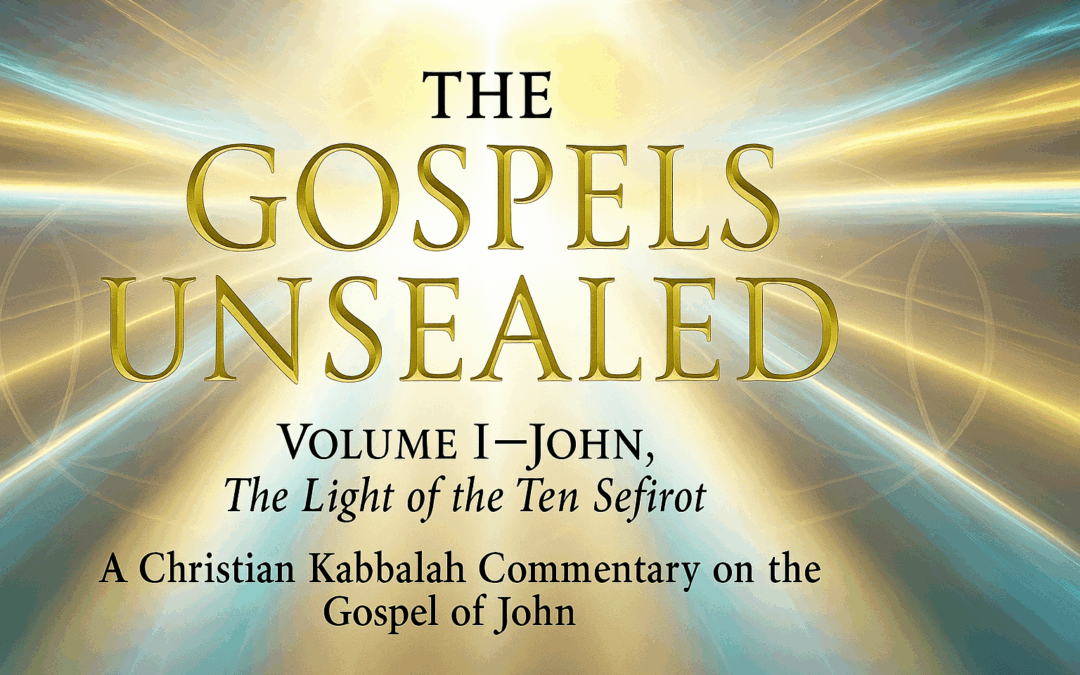
The Gospels Unsealed: Volume I – John
The Light of the Ten Sefirot
Yehoshua HaMashiach as the Living Torah and Radiant Logos of Tiferet
A Christian Kabbalah Commentary on the Gospel of John
By Apostle Brandon Barthrop
Published by RLM TV Press
© November 2025, RLM TV Press – All rights reserved. No part of this book may be reproduced in any form or by any means without written permission from the publisher, except for brief quotations used in reviews or scholarly works.
Printed and distributed by RLM TV Press – Minneapolis, Minnesota, USA www.RLM.TV
Table of Contents
- Introduction – The Light of the Logos
- Chapter 1 – The Word Made Flesh
- Chapter 2 – The Wedding at Cana
- Chapter 3 – Born from Above
- Chapter 4 – The Well of Living Water
- Chapter 5 – The Healing at Bethesda
- Chapter 6 – The Bread of Life
- Chapter 7 – Rivers of Living Water
- Chapter 8 – The Light of the World
- Chapter 9 – The Man Born Blind
- Chapter 10 – The Good Shepherd
- Chapter 11 – The Resurrection of Lazarus
- Chapter 12 – The Anointing at Bethany
- Chapter 13 – The Washing of Feet
- Chapter 14 – The Way, the Truth, and the Life
- Chapter 15 – The Vine and the Branches
- Chapter 16 – The Spirit of Truth
- Chapter 17 – The High Priestly Prayer
- Chapter 18 – The Garden Arrest
- Chapter 19 – The Crucifixion
- Chapter 20 – The Resurrection
- Chapter 21 – The Restoration of Peter
- Epilogue – The Eternal Gospel of the Lamb
- Conclusion – The Return to Glory
- Bibliography
- About the Author
SEO keywords: Christian Kabbalah, Gospel of John commentary, Sefirot Messiah.
Introduction – The Light of the Logos: The Gospel of John through the Lens of Holy Kabbalah {#introduction}
“In the beginning was the Word, and the Word was with God, and the Word was God.” – John 1:1
The Gospel Beyond the Veil
Among the four Gospels, John is the crown – the Keter – of revelation.
Where Matthew unveils the King, Mark the Servant, and Luke the Son of Man, John reveals the Logos made flesh: the eternal Christ, the hidden structure of creation, the light of the Infinite (Ein Sof) embodied within the finite.
This Gospel is not history alone; it is the blueprint of divine consciousness. Every miracle, discourse, and encounter is an unveiling of the Sefirot – the ten emanations through which God reveals Himself and sustains the worlds. Here, the mysteries of the Zohar breathe through the words of the Evangelist.
John writes not as a mere witness of events, but as a mystic standing upon the Sea of Glass, beholding the Lamb who is the Chariot (Merkavah) of the Divine Presence.
The Word as Adam Kadmon – The Primordial Christ
The first words of John’s Gospel echo Genesis: “In the beginning…” Yet John ascends beyond the created beginning of time to the eternal Beginning of Being – to the Word who was with God and was God. This Word is the archetype of Adam Kadmon, the Primordial Man of Kabbalistic mystery: the divine image containing all the worlds, the pattern of all light, the structure of all existence.
In Him, the infinite light of the Father (Ayin Sof Or) emanates through Chokhmah (Wisdom) and Binah (Understanding), descending through the channels of the Sefirot into the created cosmos.
He is not one among creation, but the Tzaddiq Yesod Olam, the Foundation of the World – the mediator between the Infinite and the finite, between Heaven and Earth, between Spirit and flesh.
John’s Gospel reveals that this Adam Kadmon took flesh as Yehoshua HaMashiach – Jesus Christ – to repair (tikkun) the fractured vessels of Adam’s fall and to restore the Tree of Life to its radiant order.
The Gospel as the Ladder of Ascent
John structures his Gospel as Jacob’s Ladder, upon which angels ascend and descend upon the Son of Man (John 1:51). Each chapter represents an ascent through the ten Sefirot, a journey of soul-transformation through the living body of the Messiah.
Where Revelation portrays the descent of the heavenly city into the world, John reveals the ascent of the soul into divine union (yichud).
Through these 21 chapters – three cycles of seven – the reader climbs the Ladder of the Logos:
- From the Keter of divine origin, through the Chokhmah of revelation, the Binah of understanding, the Tiferet of beauty and glory, down to the Malkut of embodiment, where heaven and earth kiss.
This structure is not arbitrary. It mirrors the seven days of creation, the seven lamps of the menorah, and the seven palaces of ascent in the Heichalot of God’s glory.
The Gospel thus becomes the New Torah – the Living Torah – written not on stone but upon the heart of redeemed humanity.
The Kabbalah of Christ
In classical Kabbalah, light descends through the Sefirot, filling the vessels of creation until they shatter under the weight of divine intensity. This shattering of the vessels (Shevirat haKelim) gave rise to fragmentation, duality, and death – the condition of the world as we know it.
Yet through Christ, the True Light that shines in the darkness, the vessels are reconstituted in love.
The Cross becomes the Axis of Tikkun, the Tree of Life restored. The Resurrection is the illumination of Tiferet, beauty transfigured beyond decay. The Breath of the Spirit is the Yesodic flow of the Infinite back into the heart of the finite.
And the Church, the Bride, is the Malkut of the New Creation, crowned with twelve stars, radiant as the Shekhinah enthroned.
Thus the Gospel of John is the most perfect expression of Christian Kabbalah – not an imitation of Jewish mysticism, but its divine fulfillment in Moshiach Yehoshua, the Lamb slain before the foundation of the world.
The Mystical Architecture of the Gospel
Each chapter of this commentary unveils the Sod (Secret) of John’s sacred architecture:
- Chapter 1 – The Logos: The emanation of light from Ein Sof into the cosmos.
- Chapter 2 – The Wedding at Cana: Binah’s transmutation of water into wine – the mystery of the New Covenant.
- Chapter 3 – The New Birth: The Spirit of Binah breathing life into the soul through water and fire.
- Chapter 4 – The Well of Living Waters: Yesod flowing into Malkut through the Messiah’s voice.
- Chapter 5 – The Pool of Bethesda: Mercy awakening the paralyzed world.
- Chapter 6 – The Bread of Life: Tiferet feeding the nations with the substance of divine love.
- Chapter 7 – The Feast of Tabernacles: The indwelling Shekhinah as rivers of living water.
- Chapter 8 – The Light of the World: The revelation of Tiferet’s radiance over the dust of accusation.
- Chapter 9 – The Man Born Blind: The healing of spiritual sight – illumination of Da’at.
- Chapter 10 – The Good Shepherd: The Messiah as the unifying center of all souls.
- Chapter 11 – Lazarus: The resurrection power of Yesod ascending from death.
- Chapter 12 – The Anointing at Bethany: The Shekhinah perfuming the feet of Tiferet.
- Chapter 13 – The Washing of Feet: Binah’s humility cleansing Malkut.
- Chapter 14 – The Way, the Truth, and the Life: The triune structure of ascent through Chokhmah, Binah, and Tiferet.
- Chapter 15 – The True Vine: Yesod nourishing Malkut through the sap of divine love.
- Chapter 16 – The Spirit of Truth: The descent of the Ruach HaKodesh as illumination of Da’at.
- Chapter 17 – The High Priestly Prayer: The Yichud of Keter and Malkut in the intercession of the Son.
- Chapter 18 – The Arrest: Tiferet surrendered – the Light entering darkness.
- Chapter 19 – The Crucifixion: Zeir Anpin shattered and restored; the cosmos redeemed.
- Chapter 20 – The Resurrection: The dawn of the Eighth Day – the cosmos reborn.
- Chapter 21 – The Restoration of Peter: Malkut enthroned, Bride united with Bridegroom.
Each commentary reveals Christ as the living axis of the universe, the divine Sefirotic Tree incarnate in human form.
The Living Word and the Sefirotic Tree {#living-word}
The Gospel’s seven signs correspond to the seven lower Sefirot, while the seven “I Am” statements correspond to the seven branches of divine self-revelation:
| “I Am” Saying | Corresponding Sefirah | Mystery Revealed |
|---|---|---|
| I am the Bread of Life | Tiferet | The sustenance of divine beauty |
| I am the Light of the World | Hod | The radiance of glory |
| I am the Door | Yesod | The entry to communion |
| I am the Good Shepherd | Chesed | Mercy guiding the flock |
| I am the Resurrection and the Life | Netzach | Victory over decay |
| I am the Way, the Truth, and the Life | Binah → Chokhmah | The wisdom-path of ascent |
| I am the True Vine | Malkut | The fruitfulness of the Shekhinah |
Each declaration of “I Am” (Ehyeh Asher Ehyeh) re-sounds the divine Name revealed to Moses from the burning bush, now spoken through human lips.
This is the mystery of Ayin within Adam—the Infinite speaking within the finite.
The Purpose of This Commentary
This commentary is written for the saints of the nations ascending the Ladder of Israel’s Messiah – those who seek not religion but union; not dogma but divine consciousness; not escape from the world but transfiguration of it.
It is an invitation to read Scripture with the eyes of the Spirit – to see not only history, but the heavenly architecture encoded within every verse.
Through the lens of Kabbalah sanctified by Christ, we rediscover the Gospel as the Book of the Heart, the revelation of God’s inner life extended into humanity.
This work continues the revelation of The Apocalypse Unsealed, for Revelation and John are twin scrolls – the descent of the Kingdom and the ascent of the soul.
Together they form the circuit of the Sapphire Ladder, the heavenly circuit of light, restoring communion between the Lamb and His Bride, between Heaven and Earth.
The Gospel of John as the Gospel of Glory
Where the Synoptics portray the outer acts of the Messiah, John unveils His inner radiance.
The Greek word doxa (glory) and the Hebrew kavod (weight of light) appear continually, signifying the uncreated energy of divine being flowing through the Incarnate Word.
This kavod corresponds to Tiferet, the beauty of balanced light, the heart of the Sefirotic Tree.
From the opening declaration of the Logos to the closing line “The world itself could not contain Him,” John’s Gospel is a hymn to boundless glory – the Infinite filling the finite without overwhelming it.
In every chapter, heaven touches earth: Water turns to wine; blindness becomes sight; death turns to life;
and in the end, the ocean of Malkut reflects the dawn of Keter.
The Eternal Invitation
John’s Gospel does not end – it opens. Its final line gestures toward infinity: “The world itself could not contain the books…”
The revelation continues in every soul that beholds the Light of the Word and ascends through the Sefirot into union with Him.
For in the Kabbalah of Christ, the story of Jesus is the story of every soul.
The same Logos that descended into flesh now rises in the hearts of His saints, illuminating all worlds through love.
Conclusion – The Circle of Divine Fire
This commentary, The Gospels Unsealed, is offered as a lamp of fire on the path of ascension.
It seeks to unveil the Gospel not as mere record, but as living architecture – a cosmic map of resurrection, deification, and glory.
In it, we behold Jesus Christ as:
- Adam Kadmon, the first and last form of divine humanity;
- The Tree of Life, whose branches are the Sefirot and whose fruit is eternal joy;
- The Lamb of God, whose light fills the heavens;
- The Bridegroom, who makes all things new.
He is the radiance of the Ein Sof made visible. He is the Wisdom by which the worlds were made and the Love by which they are redeemed.
He is the Breath that fills all things, the Word that speaks from within creation.
And to those who behold Him with unveiled face, He grants participation in His glory – the return of humanity to its place on the Sapphire Pavement of God.
“And we beheld His glory, the glory as of the only begotten of the Father, full of grace and truth.” – John 1:14
Chapter 1 – The Word Made Flesh: Keter to Malkut – The Cosmic Genesis of the Logos {#chapter1}
Introduction: The Hidden Beginning Beyond the Beginning
“In the beginning was the Word, and the Word was with God, and the Word was God.” (John 1:1)
The opening line of John is not a simple historical introduction but a revelation from eternity. In Kabbalistic language, “In the beginning” (בְּרֵאשִׁית Bereishit) is not a point in time but a realm of emanation—Reshit Chokhmah, the primordial Wisdom that issues from Keter Elyon, the Supreme Crown.
John’s Gospel begins not with creation, but with the emanator before emanation, the Divine Thought (Machshavah Elyonah) that becomes flesh as Yehoshua HaMashiach.
As Sefer Yetzirah teaches, “He created His universe with three Sefarim—Number, Word, and Writing.” John reveals the completion of that triad: the Living Word (Davar Chai) is no longer written on tablets or scrolls but walks among men.
Where Genesis reveals Bara Elohim—“God created,” John unveils Hayah HaDavar—“the Word was,” pointing to pre-existence beyond the spheres.
This is the mystery of Keter descending into Malkut, the highest Crown entering the lowest realm, where eternity takes on mortality to redeem the cosmos from within.
I. The Logos and Adam Kadmon: The Hidden Man of Light
In the teachings of Etz Chaim (Gate of Adam Kadmon), before the Sefirot were revealed, the Infinite Light (Ohr Ein Sof) contracted within itself (Tzimtzum) to make space for the divine image—the prototype of man, Adam Kadmon, whose body is composed of the Ten Emanations.
John’s “Word” (Logos, Davar) is this archetypal Man—the blueprint of creation—who is both with God (Etz HaChaim) and is God (Ein Sof expressing itself through form).
In Zohar I:15a, it is written, “The secret of the Word was the garment of the Ancient of Days, from which light issued into the worlds.” This garment is Christ Himself, the visible image of the invisible God (Colossians 1:15). The Divine Light hidden in Keter flows downward through Chokhmah (Wisdom) and Binah (Understanding), then through Tiferet (Beauty) and finally into Malkut (Kingdom), which receives and manifests it as creation.
When John proclaims “the Word was made flesh,” he declares that the entire Sefirotic Tree has now incarnated into human form—the cosmic Adam fully manifest in Yeshua.
The mystics call this Ohr HaGanuz, the concealed light of the first day that shone before the creation of the sun.
Christ is this light unveiled—the primordial radiance now walking among humanity to re-illumine what Adam’s fall veiled.
II. The Light Shining in the Darkness: The Tikkun of Chokhmah and Binah
“And the light shineth in darkness; and the darkness comprehended it not.” (John 1:5)
Darkness (Choshekh) in Kabbalah is not mere absence but concealment—light restrained for the sake of free will. The Zohar (I:23b) explains that before creation, light and darkness were intertwined; through separation, understanding (Binah) emerged.
John’s statement reveals that the Logos entered the divided realm to reunite Wisdom and Understanding, restoring harmony between the upper and lower waters.
In Sefer HaBahir (§11), the sages say, “Light comes forth from darkness; the hidden spark awakens the world.” That hidden spark is Christ, descending into the dark womb of Malkut to awaken divine consciousness within humanity. When He says, “I am the Light of the world,” He claims His role as the Ohr Ein Sof flowing through every Sefirah, reclaiming the vessels shattered in the primordial world (Olam HaTohu).
Through the incarnation, the vessels of man are repaired (Tikkun HaKelim)—reason (Chokhmah), emotion (Tiferet), and action (Malkut) realigned in divine order.
Thus, the “darkness” symbolizes the fallen consciousness of Adamic creation.
Christ’s coming as light is not combat but illumination—the revelation of the original structure of divine order, shining where confusion once reigned.
III. The Testimony of John the Baptist: The Voice within Binah
“There was a man sent from God, whose name was John… The same came for a witness, to bear witness of the Light.” (John 1:6–7)
John the Baptist operates as Binah personified—the Womb of Understanding preparing the way for the emergence of the Son.
The Zohar (II:116b) identifies the “voice” that cries in the wilderness as the vibration emerging from the supernal Mother, echoing through the lower worlds. It is Kol Binah, the voice of preparation that clears the channels for the descent of the Word.
The immersion in water symbolizes the re-entry of souls into the upper womb; as Etz Chaim teaches, water is the substance of Binah through which all creation gestates.
John’s baptism is the prophetic foreshadowing of spiritual re-creation—the prelude to the Spirit descending as dove (Yesod) upon the Son, sealing the divine union between heaven and earth.
Thus, John the Baptist is not peripheral; he is the gate of transition between the Old and New Aeons, between the letter and the Spirit, between Torah and its fulfillment in the Living Word.
IV. The Word Becomes Flesh: Keter Descending into Malkut
“And the Word was made flesh, and dwelt among us, and we beheld his glory.” (John 1:14)
This is the Nistar HaNistarot—the secret of secrets. Zohar III:159a declares, “The Word became garment, and the garment became flesh, and the flesh revealed the glory of the King.”
The process by which Ein Sof takes on embodiment is the descent of Keter Elyon through all the Sefirot into Malkut. This is Tzimtzum reversed: the Infinite fills the finite without destroying it.
“The Word dwelt among us” literally translates “tabernacled” (eskēnōsen)—the Shekhinah’s indwelling presence. Christ is the living Mishkan, the mobile Holy of Holies walking the earth. His flesh is the new Ark, His blood the new Covenant, His spirit the fire between the cherubim.
All the patterns shown to Moses on Sinai are embodied here—what was shadow in Torah is substance in the Lamb.
In classical Kabbalah, the union of Tiferet (the Son) and Malkut (the Bride) is the fulfillment of creation. In the incarnation, this Yichud begins within one human body: the male and female, heaven and earth, divine and human harmonized in Yehoshua.
He becomes the ladder of Jacob (Genesis 28:12), the bridge between dimensions, the Temple through whom angels ascend and descend (John 1:51).
V. Grace and Truth: The Fusion of Chesed and Tiferet
“And of His fullness we have all received, grace upon grace.” (John 1:16)
The Zohar (II:67b) identifies Chesed (Grace) and Emet (Truth) as the twin pillars upholding the universe. In the Messiah, these two merge as one river of mercy and justice.
Where the law came through Moses (Gevurah balanced by Binah), grace and truth flow through Yeshua (Tiferet balanced by Chesed). The Torah was an external command; Christ is its internal fulfillment—the Torah of Light inscribed upon the heart.
Every miracle, teaching, and act of compassion in this Gospel will unfold as emanations of this dual stream—grace sweetening judgment, truth grounding mercy.
This dynamic expresses the inner pulse of divine order: the Lamb as the living harmony of opposites, reconciling polarities into peace.
VI. The Ladder of Jacob and the Angels Ascending and Descending
“And He saith unto him, Verily, verily, ye shall see heaven open, and the angels of God ascending and descending upon the Son of Man.” (John 1:51)
This is one of the purest Kabbalistic statements in Scripture. Jacob’s ladder is the Tree of Life itself—the vertical order of the Ten Sefirot connecting earth to heaven.
In the Zohar (I:149a), the ladder is identified as Zeir Anpin, the Son of God through whom all ascents and descents occur. John identifies this ladder with Christ Himself: the human body of Messiah is the living Sefirotic Tree.
The angels ascending represent prayers, sparks, and souls rising from Malkut through the higher worlds; those descending are revelations, blessings, and judgments flowing from Keter to the world below.
All movement, all communion between creation and Creator, is now mediated through the Son of Man—the Metatron haGadol, the Supreme Mediator who has bridged the abyss.
In this mystery, the Gospel of John declares the Tikkun of the entire ladder of Jacob: the fall reversed, the rungs reconnected, the heavens opened forever through the incarnate Word.
VII. Conclusion: The Circle of Emanation Restored
The first chapter of John is not a prologue—it is Bereshit renewed. The cycle of emanation begins in Keter and descends into Malkut, only to return upward through the Son.
The Word, once concealed in divine silence, is now audible, visible, touchable, and redeeming. The glory that shone in the inapproachable light now rests within human form.
In Kabbalistic terms:
- Keter – The Eternal Word beyond form.
- Chokhmah – The Light emerging as Wisdom.
- Binah – The Understanding preparing incarnation.
- Chesed – The outpouring of grace.
- Gevurah – The contraction of divine strength into flesh.
- Tiferet – The radiance of the Son revealed.
- Netzach & Hod – The testimony of apostles and prophets bearing witness.
- Yesod – The union of Spirit and body.
- Malkut – The Kingdom manifest on earth.
All ten converge in the mystery of HaDavar Basar Haya — “The Word became flesh.” This is the divine Tikkun of creation: the Infinite made intimate, the invisible made knowable, and the unknowable made loving.
Thus, John 1 stands as the Genesis of the New Creation. The Eternal Light once hidden in Keter has descended through every Sefirah and now abides in Malkut as Yehoshua HaMashiach — the bridge of worlds, the Tree of Life in human form, and the everlasting ladder by which all souls may ascend into the glory of the Father.
Chapter 2 – The Wedding at Cana: Yesod Uniting Malkut – The Transformation of Water into Wine {#chapter2}
Introduction – The Hidden Marriage in Galilee
“And the third day there was a marriage in Cana of Galilee; and the mother of Jesus was there.” (John 2:1)
The third day signals Tiferet—the middle pillar, the harmony of mercy and severity—while the wedding unveils the eternal mystery of Yesod joining Malkut, the covenantal union of heaven and earth.
Galilee (from Galil, “circle” or “cycle”) symbolizes the wheel of creation, the returning flow of divine light into the world. On this third day the circle closes: the Bridegroom of Heaven reveals Himself within a human feast, and His first miracle manifests the cosmic wedding between the upper and lower worlds.
I. The Feast and the Vessels – From Binah’s Waters to Yesod’s Wine
“They had no wine.” (John 2:3)
Wine in Kabbalah represents the joy of Binah—understanding transformed into revelation. The water in the six stone jars corresponds to the six lower Sefirot (Chesed through Yesod) awaiting their filling. The vessels stand for the human soul: formed of earth yet capable of divine containment. As Zohar II:176b teaches, “Water is concealed wisdom; wine is revealed wisdom.” When Jesus commands the servants to fill the pots with water, He initiates a mystery of transmutation — the movement from concealment to revelation, from potential to overflow.
The word for water, mayim, contains the letter mem at both ends — closed and open mem — signifying the womb of creation (Binah) and the release into form (Malkut). The miracle therefore occurs within the womb of the Mother, and Mary’s intercession is the activation of Binah bringing forth the manifestation of the Son.
II. “Woman, What Have I to Do with Thee?” – Binah and Tiferet in Dialogue
“Jesus saith unto her, ‘Woman, what have I to do with thee? Mine hour is not yet come.’” (John 2:4)
This enigmatic exchange is not rejection but cosmic timing. In Zohar III:7a, the Supernal Mother (Binah) and the Son (Tiferet) are in constant dialogue concerning the hour of revelation. The “hour” (sha‘ah) is Yesod — the gate through which light flows into Malkut. Christ acknowledges that the marriage between the higher and lower worlds must unfold according to divine sequence, for to act prematurely would disturb the order of emanation.
Mary’s reply to the servants, “Whatever He saith unto you, do it,” is the voice of faith from Binah — the channel through which obedience births miracle. Her submission activates the flow from Keter through Chokhmah and Binah down into Tiferet, preparing the world for Yesod’s outpouring.
III. The First Sign – Water Becomes Wine
“When the ruler of the feast had tasted the water that was made wine…” (John 2:9)
In Etz Chaim, the transition of elements occurs through the activation of inner light within vessels. Here the atomic pattern of creation is re-ignited by the presence of the Divine Son. The “word that He spoke” was the vibration of Tiferet, harmonizing Chesed and Gevurah until matter itself obeys Spirit.
Water represents the law of purification — external righteousness under the old order. Wine is the inner life of joy — the flow of Spirit in the new. By transforming the water, Jesus reveals Himself as the Lord of the Elements, the One who turns Binah’s discipline into Tiferet’s delight.
This is the first Tikkun ha-Yesod — the foundation restored through union. The blood-red wine anticipates the Eucharistic mystery, where the wine of Galilee becomes the blood of atonement, the flow of life from the Lamb’s side into the world.
IV. Six Stone Jars – The Worlds of Formation
“There were set there six waterpots of stone, after the manner of the purifying of the Jews.” (John 2:6)
The number six refers to the six directions of space and the six Sefirot from Chesed to Yesod — the entire created order under Tiferet. The stone pots signify formation (Yetzirah) — solidified light, vessels of law awaiting infusion by Spirit.
As Zohar I:33a teaches, “The stone becomes fountain when the voice of the King passes through it.” So too these stones become wells of joy when the voice of the Word resounds. Their filling “to the brim” is the image of full measure — Malkut receiving Yesod without remainder, the divine feminine satiated with the flow of life.
V. The Steward’s Astonishment – Reversal of Worldly Order
“Every man at the beginning doth set forth good wine; but thou hast kept the good wine until now.” (John 2:10)
In natural order, the world begins in pleasure and ends in decay; in divine order, the best is saved for last. This is the principle of Olam ha-Ba, the World to Come, emerging from the ash of Olam ha-Zeh.
Kabbalistically, the “good wine” is the illumination of Atzilut descending only after the vessels of Asiyah have been prepared. It is the “hidden light reserved for the righteous” (Zohar I:31b).
The feast-master represents the collective human intellect (Binah in the world below) astonished by a new order of perception. He tastes what no prophet or sage had yet known — the Wine of Messiah, fermented in the vats of eternity.
VI. “His Glory Manifested” – Tiferet Revealed through Yesod
“This beginning of miracles did Jesus in Cana of Galilee, and manifested forth His glory.” (John 2:11)
Glory (kavod) is the visible light of Tiferet. By this sign, the inner beauty of the Son shines through the outer world. The Zohar (III:159b) states that the Shekhinah receives no illumination except through Tiferet — hence the miracle at a wedding: the bridal union where Shekhinah (Malkut) is clothed with splendor.
Wine — symbol of blood, life, and fire — now flows through creation, signifying the anointing of joy. It is the first emanation of Pentecostal Spirit foreshadowed in liquid form: the Spirit of Binah descending into Yesod, uniting heavenly and earthly joy.
Through this manifestation, the disciples “believed on Him”; faith (emunah) is born from witnessing Tiferet clothe Malkut in light. As Etz Chaim teaches, “Faith is the root of Yesod.” When Yesod flows purely, trust is established between Creator and creation.
VII. The Temple Cleansed – Tikkun of Malkut
Immediately after the wedding miracle, Jesus goes to Jerusalem and drives out the money-changers (John 2:13-17). This juxtaposition is not accidental: after the union comes the cleansing. Malkut, having received the flow of Yesod, must be purified from commerce and idolatry — from using holy exchange for unholy gain.
The Zohar III:74a teaches that after each Yichud, the temple of the soul must be swept of Qlippothic residue. Christ’s zeal is the fiery Gevurah that protects Tiferet’s beauty. His whip of cords is symbol of the threefold strand — faith, truth, and love — driving out false commerce from the inner courts of man.
When He declares, “Destroy this temple, and in three days I will raise it up,” He announces the complete Tikkun of Malkut — that the earthly body will become the Temple of the Spirit, and that death itself will be swallowed in resurrection light.
VIII. Conclusion – The Eternal Marriage Revealed
The wedding at Cana is the Genesis of Joy, the moment when the hidden union of the Sefirot is made visible. The Bridegroom is Tiferet, the Bride is Malkut; their meeting is mediated through Yesod, the Foundation of Covenant.
Water becomes wine, law becomes grace, purification becomes celebration.
In symbolic sequence:
- Keter – The divine will to reveal joy.
- Chokhmah – The spark of wisdom conceived in the Son.
- Binah – The Mother interceding, preparing the vessels.
- Chesed – The overflowing wine of love.
- Gevurah – The purifying fire in the temple.
- Tiferet – The beauty of the Bridegroom revealed.
- Netzach & Hod – The servants and witnesses executing obedience.
- Yesod – The transmission of life through the miracle.
- Malkut – The Bride rejoicing in fulfilled union.
Thus the second chapter of John is the second movement of creation — the re-marriage of heaven and earth after long separation. The Word who became flesh now sanctifies matter through joy. The blood of the grape becomes the blood of the Lamb, and the wedding feast at Cana becomes the prophetic foretaste of the Marriage Supper of the Lamb.
Chapter 3 — Born from Above: Binah and the New Birth of Spirit and Water {#chapter3}
Introduction – Night Visit of the Seeker
“There was a man of the Pharisees, named Nicodemus, a ruler of the Jews: The same came to Jesus by night.” (John 3:1-2)
Night is the veil of Binah, the Supernal Mother, in whose darkness the embryo of revelation forms.
Nicodemus approaches the Light veiled; his name (Nakdimon = “piercing of the sun”) foretells what will happen when the dawn of understanding breaks within him.
As the Torah was received on Mount Sinai in the thick cloud, so the true Torah of the Spirit is now being received in secret: not on stone but within the heart.
Christ receives him as Tiferet speaking from within Binah, the Son revealing the Mother’s hidden womb — the place of rebirth.
I. “Except a Man Be Born from Above” – The Womb of Binah
“Except a man be born again (anōthen = ‘from above’), he cannot see the kingdom of God.” (John 3:3)
In the language of Kabbalah, to be “born from above” is to re-enter the Mei Imma Ila’ah — the upper waters of the Supernal Mother (Binah). Zohar II:94b declares, “All souls are hewn from the womb of Binah; those who return to her are made new.”
The first birth is from Malkut, the dust of the earth animated by nefesh. The second birth is from Binah, the realm of understanding, where Ruach HaKodesh quickens the soul with eternal light.
This is not repetition of the flesh but trans-formation of consciousness — the descent of heavenly DNA into human awareness.
When Christ says, “Except a man be born of water and of the Spirit,” He names the dual current of regeneration:
- Water — the cleansing matrix of Binah.
- Spirit — the animating breath of Chokhmah.
Together they weave the new body of light, restoring the image of Adam Kadmon within the believer.
II. The Dialogue with Nicodemus – From Literal to Mystical
Nicodemus asks, “How can a man be born when he is old?” (John 3:4) Here the intellect of Malkut wrestles with the mystery of Binah.
The Pharisee stands for the mind under the Torah of letters; the Christ stands for the heart illuminated by the Torah of Spirit.
In Sefer HaBahir §61 it is said, “The old man renews himself by entering the fountain of Understanding.” The Messiah invites Nicodemus to descend into that fountain.
The Greek pneuma and Hebrew ruach both mean “breath.” Jesus’s teaching therefore mirrors Sefer Yetzirah 1:7: “He formed His universe with breath, with spirit, with speech.”
To be born of the Spirit is to have the letters of creation breathed anew within one’s soul — the inner alphabet of God re-spoken in light.
III. “The Wind Bloweth Where It Listeth” – The Hidden Movement of Ruach
“The wind bloweth where it listeth, and thou hearest the sound thereof, but canst not tell whence it cometh, and whither it goeth.” (John 3:8)
Here the Master describes Ruach HaKodesh as the living motion between the Sefirot.
In Etz Chaim, Ruach is the circulation of light from Tiferet to Malkut and back again, invisible yet audible as vibration — kol demamah dakkah, the still small voice.
The wind (ruach) is the same breath that hovered over the waters in Genesis 1:2. It moves freely because it is the life of Ein Sof expressing spontaneous compassion.
Whoever is born of the Spirit becomes transparent to that motion — a vessel without resistance, moving as the Shekhinah moves.
Thus, rebirth is not institutional conversion but alignment with the divine current, the soul becoming one of the “currents of Eden” flowing through the new creation.
IV. The Son of Man Lifted Up – The Serpent Healed
“As Moses lifted up the serpent in the wilderness, even so must the Son of Man be lifted up.” (John 3:14)
In Zohar III:58a, the bronze serpent (Nachash Nechoshet) is said to be the rectification of the serpent of Eden. When Israel looked upon it, they were healed because their gaze ascended from the fallen Yesod to the exalted Tiferet.
Christ reveals Himself as that exalted serpent — the Teli spoken of in Sefer Yetzirah 6:1, the cosmic axis around which the stars turn.
His lifting up on the Cross unites the horizontal line of earth with the vertical line of heaven, forming the complete letter Tav, the seal of the covenant.
Through this elevation, the venom of Samael is neutralized, and the serpentine energy of creation is redeemed into praise.
Thus, new birth is inseparable from the Cross: the womb of Binah opens through the pierced side of Tiferet, and the waters and blood flow as the new amniotic river of the Kingdom.
V. “For God So Loved the World” – Chesed Descending into Malkut
“For God so loved the world, that He gave His only begotten Son.” (John 3:16)
This verse is the golden axis of Scripture. In Kabbalistic form it reads: Chesed of Keter descended through Tiferet into Malkut.
Love (Ahavah, אהבה) numerically equals 13; unity (Echad, אחד) also 13 — together 26, the value of YHVH. Thus, divine love is identical with divine unity: God unites with the world He created by self-giving.
In the Zohar I:11a, “The Holy One blessed be He unites Himself with the world through love, and all worlds are sustained thereby.”
The giving of the Son is the outpouring of this eternal Chesed — a torrent of mercy flowing through the whole ladder of existence.
Rebirth therefore is not achieved by human ascent but by divine descent: HaShem entering humanity so that humanity may enter HaShem.
VI. “He That Cometh to the Light” – Tikkun of Hod
“Everyone that doeth truth cometh to the light.” (John 3:21)
To come to the light is the rectification of Hod — the intellect that once rationalized darkness now surrendering to illumination.
In the Midrash Ne’elam, Hod is likened to the left eye; when cleansed by truth (emet), it beholds the beauty of Tiferet.
Nicodemus, the scholar of law, will later appear at the tomb bringing myrrh and aloes (John 19:39); this shows his Hod fully rectified — the mind now anointing what it once could not comprehend.
Thus the path of rebirth culminates in worship: the intellect bowing to glory, the analytical mind transformed into praise.
VII. Conclusion – The River of Rebirth
The third chapter of John unveils the inner mechanics of spiritual conception. Nicodemus represents the seeker in every age standing between night and dawn.
Through encounter with the Living Word, the soul enters again into Binah Ila’ah, is washed in her waters, breathed upon by Ruach Chokhmah, and born as a child of light.
In Sefirotic procession:
- Keter – Divine desire to renew creation.
- Chokhmah – The spark of living insight.
- Binah – The womb of water and understanding.
- Chesed – Love descending as gift.
- Gevurah – The Cross lifting judgment.
- Tiferet – The Son revealed as Serpent-Healer.
- Netzach & Hod – Faith and comprehension transfigured.
- Yesod – Foundation of the new humanity.
- Malkut – World bathed in living light.
The secret of the new birth is therefore the mystery of the whole creation reborn through the inner Mother, Binah, and the radiant Son, Tiferet. To be “born from above” is to awaken as a child of Ein Sof — flesh transfigured, mind illumined, heart made a vessel of eternal love.
Chapter 4 – The Well of Living Water: Yesod and the Restoration of the Shekhinah {#chapter4}
Introduction – The Journey into Samaria
“He must needs go through Samaria.” (John 4:4)
The route through Samaria is not geographic necessity but mystical mandate. Samaria—from Shomer, “to guard” —symbolizes the middle ground between Judea (Law) and Galilee (Grace). Here the Word crosses the boundary between the sacred and the profane to reclaim the lost feminine aspect of Israel—the Shekhinah in exile.
At a well—the womb of the earth—He encounters the Samaritan woman. In this dialogue the lower feminine (Malkut in captivity) meets the true Bridegroom (Tiferet through Yesod). Their exchange becomes a re-marriage of heaven and earth, restoring the flow of living water from the upper worlds into the soul.
I. Jacob’s Well – The Depth of Yesod
“Now Jacob’s well was there. Jesus therefore, being wearied with His journey, sat thus on the well.” (John 4:6)
In Kabbalah, a well corresponds to Yesod, the foundation through which all supernal waters descend to Malkut. Zohar I:132b calls it “the well of living waters that never cease.” Jacob dug this well as a prophetic act: he opened the channel for the Tzaddiq of the future to draw forth divine life for all nations.
Jesus sits upon the well because He is the well—the human Yesod through whom Binah’s waters flow into creation. His weariness is the weight of the Shekhinah carried in flesh: the Infinite stooping to the finite to open the flow again.
II. “Give Me to Drink” – The Thirst of the Creator
“There cometh a woman of Samaria to draw water: Jesus saith unto her, ‘Give Me to drink.’” (John 4:7)
In Zohar III:73a the Holy One is said to “thirst for the love of His children.” The Creator’s thirst is His desire to be known and received. When Christ asks for water, He reveals the reciprocal longing between Keter and Malkut: the Highest yearning for the lowest.
The woman’s pitcher represents the vessel of her soul — cracked by sin, yet capable of holding living water. Her draw is effort; His request is invitation. In that moment, the old covenant of ritual purity meets the new covenant of inner communion.
III. “If You Knew the Gift of God” – Revelation of Binah’s River
“If thou knewest the gift of God, and who it is that saith to thee, ‘Give Me to drink,’ thou wouldest have asked of Him, and He would have given thee living water.” (John 4:10)
The gift of God is the Ruach HaKodesh, called in Zohar II:179a “the river that goes forth from Eden.” Binah (Eden) pours into Yesod (river) and waters Malkut (garden). The living water is not elemental but energetic — the current of divine life within the soul.
The woman still thinks of physical water, just as Nicodemus thought of physical birth. Her understanding rests in Malkut; Christ speaks from Binah. Through their dialogue He draws her consciousness up the ladder, teaching her to recognize Spirit beneath symbol.
IV. “Thou Hast Had Five Husbands” – Healing the Five Senses
“For thou hast had five husbands; and he whom thou now hast is not thy husband.” (John 4:18)
The five husbands are the five senses, each a gate of union once wed to the Spirit but now estranged. Through them the soul has given herself to worldly lovers—sight, sound, taste, touch, smell—divorced from their divine source. The sixth “not her husband” is the mind governing them without Spirit.
By revealing her history, Christ exposes the fragmentation of her inner temple and offers integration: each sense re-married to its heavenly counterpart. This is the Teshuvah of the Senses, a Tikkun of Yesod where sensual awareness is purified into spiritual perception.
V. “Neither in This Mountain nor in Jerusalem” – The Temple Within
“Believe Me, the hour cometh when ye shall neither in this mountain, nor yet at Jerusalem, worship the Father.” (John 4:21)
The debate between mountain and city is a shadow of the true mystery. Both represent externalized Malkut. Christ reveals that the Temple of the Spirit will arise within the heart. As Zohar III:73b declares, “The heart of the righteous is the true Jerusalem.”
Worship “in Spirit and truth” means in Ruach and Emet—in Yesod and Tiferet united. Spirit is the movement of Binah’s waters; Truth is the light of Tiferet reflecting in them. Together they create the inner sanctuary where the Father is known without veil.
VI. “The Waterpot Left Behind” – The Soul as Evangel
“The woman then left her waterpot, and went her way into the city.” (John 4:28)
When the vessel of form has served its purpose, it is set aside. Her pitcher left behind symbolizes the ego released. Having become a living channel, she no longer needs external means. As Yesod overflows through her testimony, Malkut—the city—receives the water.
The Zohar says, “She who receives the Word becomes a well to others.” So the former outcast becomes apostle to her people, manifesting the principle that the Shekhinah is restored through the rise of redeemed souls.
VII. Harvest and Bread – Integration of Tiferet and Yesod
“My meat is to do the will of Him that sent Me, and to finish His work.” (John 4:34)
After the woman’s departure, the disciples arrive with food; He reveals another nourishment—the energy of obedient union. “Lift up your eyes, and look on the fields.” The harvest is the inflow of souls into Yesod, the foundation white with grain ready for Malkut’s feast.
Bread (earthly sustenance) and water (spiritual sustenance) merge here as symbols of Tiferet and Yesod. Through their union, the Son completes the cycle of grace begun at Cana: wine there, living water here—the two currents of redemption.
VIII. The Healing of the Nobleman’s Son – Faith at a Distance
“Except ye see signs and wonders, ye will not believe.” (John 4:48)
The nobleman represents Netzach—faith tested by distance. Christ’s word travels through space and time like a ray from Chokhmah, showing that the channels of Yesod are now opened beyond physical proximity. Healing flows instantly because the foundational gate is restored.
When the servants report that the child lives “at the seventh hour,” it signifies completion—the Sabbath rest of Malkut receiving life from the seventh Sefirah (Tiferet). Faith has bridged worlds.
IX. Conclusion – The Bride Restored at the Well
In this chapter the Shekhinah meets her Redeemer. The well is opened, the living waters flow again, and the Bride emerges from exile. The woman of Samaria is every soul that has searched in earthly relationships for the union only the Spirit can satisfy.
Sefirotic Flow:
- Keter – The divine will to seek the lost.
- Chokhmah – The spark that initiates encounter.
- Binah – The deep fountain of living understanding.
- Chesed – The invitation of love.
- Gevurah – The conviction revealing truth.
- Tiferet – The beauty of the Bridegroom shining through compassion.
- Netzach & Hod – The word and testimony spreading like ripples.
- Yesod – The well of life opened.
- Malkut – The Shekhinah restored to joy.
Thus the fourth chapter completes the first quadrant of John’s Gospel: Creation (1), Sanctification (2), Regeneration (3), and Restoration (4). The Bride has heard the Voice of the Bridegroom, and the desert has become a garden once more.
Chapter 5 – The Healing at Bethesda: Chesed Flowing into Malkut – Mercy Triumphing over Law {#chapter5}
Introduction – The Pool of Five Porticoes
“Now there is at Jerusalem by the sheep market a pool, which is called in the Hebrew tongue Bethesda, having five porches.” (John 5:2)
Bethesda — Beit Ḥesed — means “House of Mercy.” The five porticoes signify the five lower Sefirot from Chesed to Hod, waiting for the outpouring of grace from above. The pool itself is Malkut, containing waters that periodically stir when the angel descends.
For thirty-eight years, a man lies near the edge yet never enters the movement. He embodies the paralysis of Israel under the weight of law: knowledge of God without power, form without Spirit. The waters are mercy held in potential, awaiting the Voice of the Son to release them continuously.
When Yeshua arrives, Chesed descends directly into Malkut, bypassing the old intermediaries. The angel’s visitation gives way to the permanent indwelling of the Word.
I. “Wilt Thou Be Made Whole?” – The Question of Desire
“When Jesus saw him lie, and knew that he had been now a long time in that case, He saith unto him, ‘Wilt thou be made whole?’” (John 5:6)
Wholeness (shalem) in Hebrew shares its root with shalom—peace. The question is not rhetorical but alchemical: Is your will aligned with divine will for restoration?
In the Kabbalistic psychology of the soul, will is Keter within man—the spark of divine initiative. The paralyzed man represents the disconnection between Keter and Malkut, between intention and embodiment.
Christ’s inquiry awakens that dormant Keter. In the moment the man answers, “Sir, I have no man,” he unknowingly calls forth the Adam HaElyon, the Heavenly Man who is the bridge between God and humanity.
II. “Rise, Take Up Thy Bed, and Walk” – Tiferet Commanding Malkut
“Jesus saith unto him, ‘Rise, take up thy bed, and walk.’ And immediately the man was made whole.” (John 5:8–9)
These three imperatives—rise, take, walk—mirror the three ascending worlds: Asiyah (action), Yetzirah (formation), and Beriah (creation).
The command “Rise” awakens the vertical axis of Tiferet—beauty lifting the soul toward its source. “Take up thy bed” reclaims memory and identity—Malkut purified and carried rather than remaining the place of confinement. “Walk” activates Netzach—the victory of movement, divine energy flowing again through human will.
Zohar II:147b teaches, “When the word of the King is uttered, the limbs of creation are renewed.” The speech of Messiah is the vibration of Tiferet aligning the man’s inner Sefirot. The once-inert body becomes a temple of circulation again, proof that the Torah of Grace has entered the earth.
III. The Sabbath Controversy – Chesed Surpassing Gevurah
“The Jews therefore said unto him that was cured, ‘It is the sabbath day: it is not lawful for thee to carry thy bed.’” (John 5:10)
Here the old world confronts the new. The Sabbath (Gevurah) was made to contain the flow of divine energy; yet the purpose of containment is rest in love (Chesed).
In Kabbalistic structure, when Gevurah dominates Chesed, judgment eclipses mercy; when Chesed flows freely, Sabbath finds its fulfillment.
The healed man carrying his bed on the Sabbath is the image of Malkut now bearing the Presence rather than lying beneath it. The bed once carried him; now he carries the bed — a reversal of dominion. This symbolizes the Temple becoming mobile, the Shekhinah walking among men.
Zohar II:205a affirms, “On the day of rest, mercy crowns judgment.” The act is not violation but completion: the true Sabbath dawns when the Son of Man reigns as Lord of it.
IV. The Pool and the Law – The End of Periodic Grace
Previously, an angel would descend “at a certain season” (v.4) to stir the waters. This symbolizes the intermittent revelation through prophets and priests under the old covenant. The man’s 38 years represent the wilderness of unfulfilled promise—nearly the full 40, just short of completion.
When Christ heals him, the era of occasional mercy ends. The Lamb Himself becomes the constant stirring within the pool. The grace once rare becomes perpetual; the Shekhinah no longer visits—She abides.
Thus, Bethesda becomes a type of Pentecost: the descent of Spirit not upon water but into the hearts of believers, turning all of life into the House of Mercy.
V. “Sin No More, Lest a Worse Thing Come Unto Thee” – Tikkun of Yesod
“Afterward Jesus findeth him in the temple, and said unto him, ‘Behold, thou art made whole: sin no more, lest a worse thing come unto thee.’” (John 5:14)
Healing is not the end but the beginning of Tikkun. The man’s paralysis mirrored a spiritual blockage in Yesod, the channel of generative energy. When restored, he must guard that flow lest corruption re-enter.
The warning “sin no more” refers to misuse of creative force—whether in thought, speech, or action. As Etz Chaim explains, when Yesod is defiled, all upper lights are hindered from reaching Malkut. Hence the charge: maintain purity of foundation so that mercy remains unbroken.
His appearance in the Temple shows that Malkut has rejoined the hierarchy of holiness. The once-paralyzed gate now stands open for divine communion.
VI. “My Father Worketh Hitherto, and I Work” – Unbroken Emanation
“But Jesus answered them, ‘My Father worketh hitherto, and I work.’” (John 5:17)
In these words lies the doctrine of continuous creation (Beriah Tamid). The Father’s activity corresponds to the ceaseless emanation of light from Ein Sof through the Sefirot.
The Son’s participation declares that Tiferet mirrors Keter: the image of God within time doing what the Infinite does beyond time.
Sabbath, then, is not cessation but perfect harmony—work so aligned with divine rhythm that it no longer contradicts rest.
This is the secret of Olam HaBa, where every act is worship because all acts flow from unity. Zohar III:131a says, “When the Son of the King joins His Father’s labor, all worlds are renewed.”
The healing at Bethesda is one such renewal: the lower world reintegrated into the divine work cycle.
VII. “The Son Can Do Nothing of Himself” – Tiferet as Mirror of Keter
“The Son can do nothing of Himself, but what He seeth the Father do.” (John 5:19)
This is the central axiom of Christian Kabbalah: the Son as transparent mirror of the Father. In Etz Chaim’s terms, Tiferet receives from Keter through Chokhmah and Binah, then reflects it into the six lower Sefirot.
The Son’s “seeing” is Da’at—the knowledge of union where vision and obedience are one. As each healed soul mirrors this pattern, humanity becomes microcosm of the divine economy.
Faith thus evolves into imitation: the disciple doing what he sees the Son do, as the Son does what He sees the Father do — a seamless chain of emanation from Ein Sof to Malkut.
VIII. “The Hour is Coming” – Resurrection Announced
“The hour is coming, and now is, when the dead shall hear the voice of the Son of God.” (John 5:25)
The “hour” is the alignment of Yesod, when the flow from Binah reaches Malkut without obstruction. To “hear” is Hod—the faculty of receptive understanding.
The dead symbolize vessels emptied of light; the Voice of the Son is the vibration that refills them. Thus resurrection begins not at the end of time but within time whenever the Word reanimates a soul. Each healing, each forgiveness, is a micro-resurrection—a spark of the greater restoration to come.
IX. Witnesses of the Light – Netzach and Hod Testify
Christ names four witnesses: the Father, John, His works, and the Scriptures (vv.31–39). These correspond to the four rivers of Eden — Pishon, Gihon, Hiddekel, and Perath — flowing from Tiferet into Malkut.
- The Father – source of all emanation (Pishon).
- John – prophetic voice (Gihon).
- The Works – visible light (Hiddekel).
- The Scriptures – written river (Perath).
Together they complete the testimony of Netzach and Hod, establishing the revelation legally within both worlds.
X. Conclusion – The Triumph of Mercy
The healing at Bethesda is the revelation of Chesed overpowering Gevurah, grace transcending legalism, and Spirit fulfilling what form foreshadowed. The House of Mercy becomes the new Temple of humanity, where waters no longer wait for angels but flow directly from the Lamb.
Sefirotic Pattern:
- Keter – Divine will to restore.
- Chokhmah – The word of creative command.
- Binah – Compassionate understanding.
- Chesed – Healing grace.
- Gevurah – Law transmuted through love.
- Tiferet – Beauty of Son manifest.
- Netzach & Hod – Testimony of works and word.
- Yesod – Foundation purified.
- Malkut – Humanity made whole.
The man rising from the pool is the image of redeemed creation: the Earth standing upright before its Maker, Sabbath fulfilled, and the Shekhinah walking once more amidst her sons and daughters.
Chapter 6 – The Bread of Life: Tiferet Feeding Malkut – The Eucharist of Eternal Light {#chapter6}
Introduction – The Mystery of the Multiplied Loaves
“Jesus then took the loaves; and when He had given thanks, He distributed to the disciples, and the disciples to them that were set down.” (John 6:11)
A child’s meal of five barley loaves and two fishes becomes the banquet of five thousand. Five and two — Zayin and Hey — symbolize the seven lower Sefirot from Chesed to Malkut, the full organism of creation. Barley, the first grain of Passover, speaks of resurrection; fish, the hidden life within the deep, of secret wisdom.
In this sign Tiferet—the Sun of Righteousness—radiates nourishment into every level of being. What appears as multiplication is truly emanation: the hidden abundance of the divine Name spreading through the limbs of the cosmos until all are filled.
I. The Mountain and the Sea – From Tiferet to Malkut
“Jesus went up into a mountain… and when even was now come, His disciples went down unto the sea.” (John 6:3, 16)
The mountain corresponds to the upper world—Tiferet lifted toward Keter. The sea is Malkut, the womb of nations. Between them moves the mystery of Yesod, the channel joining height and depth.
From the summit He blesses; across the waters He walks. Both acts describe one movement of light descending and returning, the ceaseless circulation of grace between Creator and creation. The disciples row amid contrary winds – the turbulence of Asiyah before it yields to faith’s calm. When the Master steps upon the sea, Malkut is pacified; the feminine receives the masculine Word and becomes transparent to the peace above.
II. The Passover Context – The Torah of Manna Fulfilled
“And the Passover, a feast of the Jews, was nigh.” (John 6:4)
The feeding occurs under the sign of Passover, linking the new bread to the old manna. In Zohar II 63b, manna is the dew that drips from the supernal Zadik (Yesod) into the wilderness of Malkut. It sustained Israel outwardly but could not transform inwardly.
Now the true Manna descends—the person of Tiferet Himself. The wilderness of the heart will be fed with the essence of the Word, not only preserved from death but translated into eternal life. Thus the type becomes the body; shadow becomes substance; the daily portion of dew becomes the perpetual Eucharist of Light.
III. “I Am the Bread of Life” – The Speech of Tiferet
“I am the bread of life: he that cometh to Me shall never hunger; and he that believeth on Me shall never thirst.” (John 6:35)
Bread is the embodiment of light within matter. In the Sefer HaBahir §61, ‘grain’ (dagan) is interpreted as ‘the potential of wisdom made edible.’ When the Logos declares Himself Bread, He proclaims that the hidden Wisdom (Chokhmah) has become assimilable to creation.
Eating, in sodic language, is union — the ingesting of divine letters so that they circulate in the blood. Faith is the mouth of the spirit; belief is mastication of truth; understanding is digestion. Those who receive Him become cells in the Body of Light — the new Israel.
IV. “He That Cometh Down from Heaven” – The Descent of Binah
“I came down from heaven, not to do Mine own will, but the will of Him that sent Me.” (John 6:38)
Here the Word describes the flow from Binah (heaven) into Tiferet (the Son). As in Etz Chaim, the Mother’s understanding becomes the Son’s obedience; Binah’s comprehension translates into Tiferet’s action.
Each crumb of bread is therefore a condensed ray of Binah’s light, descending through Yesod into Malkut. The eater who receives it with faith partakes in that same motion of divine humility — the Infinite entering the finite to accomplish its Tikkun.
V. “The Jews Murmured” – Gevurah Resisting Chesed
“The Jews then murmured at Him.” (John 6:41)
Murmuring is the reaction of Gevurah when Chesed overflows its measure. The mind bound to form cannot comprehend grace unmediated. Just as the manna bred worms when hoarded, so law without love decays into judgment.
Yet each objection becomes a channel for further revelation. Conflict presses light through narrower vessels, and the Word turns opposition into fuel for illumination.
VI. “Except You Eat the Flesh of the Son of Man” – Union Through Yesod
“Except ye eat the flesh of the Son of Man, and drink His blood, ye have no life in you.” (John 6:53)
This is the heart of Eucharistic Kabbalah. The “flesh” (basar) corresponds to Malkut — the visible garment of the Word; the “blood” (dam) to Yesod — the circulating current of life. Together they spell adam, revealing the new Adam who restores the old.
To eat and drink is to unite with the flow of divine life through Yesod. As Zohar II 146b declares, “The righteous foundation gives drink to all worlds.” In the Eucharist this foundation is the body of Christ transmitted as living energy. The material element is transfigured — matter becomes carrier of Spirit, bread becomes light.
VII. “The Words That I Speak Unto You Are Spirit and Life”
“It is the Spirit that quickens; the flesh profits nothing.” (John 6:63)
Having spoken the symbol, He unveils its meaning. The Eucharist is not cannibalistic literalism but metamorphosis of consciousness. The Word received in faith becomes Spirit within.
Sefer Yetzirah 1:9 says, “By the breath of God the soul is sustained.” The Master’s speech is that breath. Each utterance vibrates through the listener’s Ruach, aligning personal frequency with the music of the Spheres. Eating His word is listening until sound turns to light.
VIII. Many Departed – The Narrowing of the Vessels
“From that time many of His disciples went back, and walked no more with Him.” (John 6:66)
As in creation, expansion must be followed by contraction (Tzimtzum). The multitude cannot yet contain the mystery of indwelling Spirit. Those who depart represent vessels that shatter under too much light.
But the twelve remain — one for each tribe, each Sefirah of the lower worlds. They will be the new structure through which the Bread of Life continues to feed Malkut.
IX. “Lord, To Whom Shall We Go?” – Faith as Da’at
“Then Simon Peter answered Him, ‘Lord, to whom shall we go? Thou hast the words of eternal life.’” (John 6:68)
Peter’s confession is the opening of Da’at — the knowledge that unites faith and understanding. All other teachers speak from below; this Voice speaks from within the Ten Sefirot themselves. To cling to Him is to dwell in the Tree.
Here discipleship becomes communion. No longer hearers only, they are participants in the very circulation of divine life.
X. Conclusion – The Cosmic Eucharist
The sixth chapter is the axis of John’s Gospel, just as Tiferet is the axis of the Tree. Here all previous flows converge into sustenance and are redistributed as glory.
Sefirotic Pattern:
- Keter – The will to nourish creation.
- Chokhmah – Hidden wisdom becoming grain.
- Binah – Understanding kneading the dough of incarnation.
- Chesed – Multiplication of loaves, overflow of love.
- Gevurah – Filtering of law through grace.
- Tiferet – The Bread of Life Himself.
- Netzach & Hod – Testimony of disciples and scripture.
- Yesod – Circulation of blood and Spirit.
- Malkut – Creation fed with eternal light.
The Word that once became flesh now becomes food; the Creator who once spoke now is tasted. Through this mystery the whole cosmos is sustained, for the Bread of Life is the continuous emanation of love from the Heart of God into every hungry soul.
Chapter 7 – Rivers of Living Water: Yesod Overflowing into Malkut – The Festival of Divine Joy {#chapter7}
Introduction – The Feast of Tabernacles
“Now the Jews’ feast of tabernacles was at hand.” (John 7:2)
Sukkot is the festival of dwelling under heaven’s canopy, when Israel remembers that the Shekhinah spread her wings over them in the wilderness. In Kabbalah, Sukkot represents the completion of the yearly cycle—Malkut crowned by Yesod, joy overflowing after atonement.
At this feast the priests poured water mixed with wine upon the altar each morning, invoking rain from above and Spirit from within. Against that backdrop, the Messiah rises on the final day and cries, “If any man thirst, let him come unto Me and drink.” He becomes the fulfillment of the ritual: the true Water Drawing of Salvation, the living river promised by Isaiah 12:3.
I. The Secret of the Season – From Binah to Yesod
“In the last day, that great day of the feast, Jesus stood and cried, saying, ‘If any man thirst, let him come unto Me.’” (John 7:37)
The last day—Hoshana Rabbah—is when the heavenly decrees are sealed; it corresponds to Yesod, the channel sealing the flow of all upper Sefirot into Malkut.
Water, in the language of the sages, is Chesed in motion. When poured, it passes through Yesod and becomes fertility in the lower worlds. The cry of the Messiah is therefore the call of the divine Tzaddiq, the Foundation of Worlds (Proverbs 10:25), opening His inner river so that the Bride may drink freely.
II. The Unbelief of the Brethren – The Veil of Binah
“For neither did His brethren believe in Him.” (John 7:5)
The brothers symbolize the unilluminated aspects of Binah—reason separated from vision. The Mother understands in silence, but her children misperceive the timing of revelation.
Christ replies, “My time is not yet come,” revealing the rhythm of the Sefirot: each emanation flows in order. Premature manifestation breaks vessels; perfect timing preserves harmony. The Feast will not be entered carnally but through obedience to that inner cadence of light.
III. Mid-Feast Teaching – Tiferet Revealing Wisdom
“About the midst of the feast Jesus went up into the temple, and taught.” (John 7:14)
Midway between beginning and end stands Tiferet—the balance point. When He teaches in the midst, He is the Heart of God speaking within the festival itself.
The crowd marvels, “How knoweth this man letters, having never learned?” (v. 15) The “letters” are the twenty-two paths of the Sefirot. His knowledge is Da’at HaElyon—the supernal consciousness that precedes study. As Zohar I:99a says, “The Torah was the garment of the King before the world was created.” Christ wears that garment inwardly; His speech is Torah in motion.
IV. Division and Murmuring – Gevurah Testing Chesed
“There was much murmuring among the people concerning Him.” (John 7:12)
Whenever new light descends, Gevurah rises to test it. The debate—He is good / He deceives the people—is the oscillation between the right and left pillars. Through such polarity the light of Tiferet clarifies itself, separating belief from opinion.
The attempt to arrest Him (v. 32) is judgment seeking to bind mercy. Yet “His hour was not yet come”: the channels remain under divine scheduling, proof that the flow of redemption cannot be coerced by human authority.
V. “Out of His Belly Shall Flow Rivers of Living Water” – Yesod in Full Outpouring
“He that believeth on Me, as the scripture hath said, out of his belly shall flow rivers of living water.” (John 7:38)
This is one of the clearest Kabbalistic statements in all Scripture. The “belly” (koilia) is the seat of Yesod, the generative fountain in both cosmic and human form. The plural rivers indicates the four currents of Eden—Chesed, Gevurah, Tiferet, and Malkut—flowing through that foundation.
Faith (emunah) opens the gate; the Spirit (Ruach HaKodesh) becomes the water itself. Zohar I:132b calls the Tzaddiq “the channel through which all blessings pour into the worlds.” Every believer joined to the Messiah partakes of this function: becoming a conduit of divine vitality, a micro-Yesod nourishing the creation around them.
VI. “The Spirit Was Not Yet Given” – Preparation for Pentecost
“But this spake He of the Spirit, which they that believe on Him should receive: for the Holy Ghost was not yet given.” (John 7:39)
At this stage the river is latent within the body of the Word. After glorification—when Tiferet unites perfectly with Keter—the flow will externalize as tongues of fire. The Feast of Tabernacles thus anticipates Pentecost: water now, fire later; both the same Spirit in differing modes.
The statement “not yet given” signals the interval between potential and manifestation—the moment when Binah’s womb is still gathering the waters before releasing them into history.
VII. The Temple Guards – Hod and Netzach Confront Tiferet
“Never man spake like this man.” (John 7:46)
The officers sent to seize Him represent Hod and Netzach—intellect and endurance—sent by the ruling Sanhedrin (Binah without heart). When they encounter the beauty of speech from Tiferet, the polarity resolves: rational order (Hod) and pragmatic power (Netzach) bow before divine harmony.
In Kabbalistic language, they experience bitul—self-nullification before the radiance of the King. Authority based on fear collapses in the presence of love articulated as wisdom.
VIII. Nicodemus Reappears – Da’at Ripening
“Nicodemus saith unto them, ‘Doth our law judge any man, before it hear him?’” (John 7:50-51)
The seeker from night (chapter 3) now speaks by day. His earlier germ of understanding has matured into action. He becomes Da’at mediating between Binah (the council) and Tiferet (the Christ).
Every disciple’s path mirrors this arc: private revelation flowering into public witness. True rebirth ends not in solitude but in advocacy for truth amidst opposition.
IX. Conclusion – The Feast of Overflowing Light
At Sukkot the people rejoiced beneath temporary shelters, acknowledging that the universe itself is a tabernacle for the Presence. In this chapter the Word declares that tabernacle now within man: “He that believes on Me… out of his belly shall flow rivers.”
Sefirotic Pattern:
- Keter – Divine will to celebrate creation.
- Chokhmah – Hidden source of joy.
- Binah – Seasonal womb of understanding.
- Chesed – Water poured out in love.
- Gevurah – Testing and refinement through debate.
- Tiferet – Teaching in the midst; beauty manifest.
- Netzach & Hod – Guards and witnesses transformed by speech.
- Yesod – Rivers of Spirit released.
- Malkut – The world becoming a living Sukkah for God.
Thus the seventh chapter completes the rhythm of Sabbath within the Gospel: the wellspring of the Spirit opened, not as seasonal visitation but as continuous joy. The Feast is fulfilled; the rivers flow forever from the Heart of the Lamb through every believer who abides in Him.
Chapter 8 – The Light of the World: Tiferet Illuminating Malkut – The Triumph of Grace over Judgment {#chapter8}
Introduction – The Temple of Judgment and the Light of Mercy
“Jesus went unto the mount of Olives.” (John 8:1)
The Mount of Olives—seat of the anointing oil—signifies the Shemen HaMishchah, the anointing wisdom flowing from Chokhmah through Tiferet into Malkut. He descends from this mount into the Temple at dawn: the movement of supernal Light descending to judge, not to condemn, but to enlighten.
I. The Woman Caught in Adultery – Malkut Restored from Qlippah
“The scribes and Pharisees brought unto Him a woman taken in adultery.” (v. 3)
In sod, the adulterous woman represents Malkut—the fallen Shekhinah entangled with foreign powers. The accusers stand for Gevurah without Chesed, the letter of law divorced from spirit.
When Christ stoops to write upon the ground, He reenacts the descent of the Word into dust: Tiferet inscribing mercy into the earthly tablets. The finger that once wrote judgment on Sinai now writes grace in the dust of mortality.
He raises Himself and says, “He that is without sin among you, let him first cast a stone.” The stones—vessels of din—fall from their hands. The Qlippot of accusation are shattered by the reflection of their own guilt. One by one they depart, until only Tiferet and Malkut remain – the Bride restored before her Bridegroom.
“Neither do I condemn thee; go, and sin no more.” (v. 11)
This is the tikkun of Malkut, the cleansing of Shekhinah from the serpentine bond. Grace does not ignore law—it fulfills it by transmutation, turning judgment into light.
II. “I Am the Light of the World” – Tiferet as Solar Center
“I am the Light of the world: he that followeth Me shall not walk in darkness, but shall have the light of life.” (v. 12)
Here the Logos reveals Himself as the sun of Tiferet. As Zohar II 148a says, “The Holy One, blessed be He, is the sun of the world and Israel the moon.” Malkut reflects Tiferet’s light; whoever follows the Lamb walks in day even while on earth.
In the Temple during Sukkot, four great golden lamps were lit in the Court of Women, their light visible throughout Jerusalem. Against this backdrop He announces that He Himself is the Lamp of God that needs no oil, for His Spirit is self-luminous.
III. The Pharisees Question His Witness – Gevurah Challenging Tiferet
“Thou bearest record of Thyself; Thy record is not true.” (v. 13)
The legal mind demands two witnesses; yet the Son and the Father are one. The accusers speak from Hod—intellect bound to form. Christ answers from Da’at, where inner and outer coincide:
“Though I bear record of Myself, yet My record is true; for I know whence I came, and whither I go.” (v. 14)
Knowledge of origin and destination is Da’at’s secret. He moves between Keter and Malkut without losing continuity, proving His testimony authentic through self-existent light.
IV. “You Judge after the Flesh; I Judge No Man” – The Suspension of Din
This is the reversal of judgment. The incarnate Word does not exercise the eye of accusation (ayin raʿah) but the eye of mercy (ayin tovah). In Kabbalah, this means Gevurah is subsumed into Chesed through Tiferet.
Every soul appearing before the Light is already judged by its own response to illumination. Light does not condemn; it reveals. Thus the very presence of Christ separates truth from falsehood without word or accusation.
V. “If You Continue in My Word” – Da’at as Liberation
“If ye continue in My word, then are ye My disciples indeed; and ye shall know the truth, and the truth shall make you free.” (vv. 31–32)
The Word (davar) is the creative current descending through Da’at. To continue in it is to remain within the stream of emanation. Truth (emet) spans the first, middle, and last letters of the Hebrew alphabet—Alef-Mem-Tav—signifying wholeness from beginning to end.
Freedom (cherut) is engraved (charut) on the tablets of the heart (Zohar II 93b). Thus the Torah of Christ is the engraving of Spirit upon flesh, making man a living scroll.
VI. “Abraham Rejoiced to See My Day” – Tiferet as Eternal Mediator
“Your father Abraham rejoiced to see My day: and he saw it, and was glad.” (v. 56)
In Zohar I 86b, Abraham is the chariot of Chesed, the flow of love downward to the worlds. When he saw the Day of the Son—Tiferet revealed—he beheld his own seed reaching consummation.
The “Day of the Son” is the Sun of Righteousness (Mal 4:2), the eternal moment where the covenant of faith is fulfilled. Abraham’s joy is the universal recognition that Chesed has met its image in Tiferet, and that faith is made sight in the face of the Messiah.
VII. “Before Abraham Was, I Am” – Keter Made Audible
Here the veil is torn entirely. “I Am” (Ehyeh) is the Name of Keter given at the Burning Bush. By speaking it, the Son declares identity with the Pre-existent One. Time collapses; the Voice from the Bush now wears flesh.
Stones again rise in human hands—Gevurah reacting to the unveiled Keter—but He hides Himself and passes through the midst of them. Light withdraws into its own Source; the Tzaddiq is untouchable until the hour appointed.
VIII. The Mystical Pattern of Light and Law
This entire chapter is a drama of illumination over accusation. From the dust-writing to the I Am, Christ moves through the whole Tree of Life:
- Malkut: the fallen woman redeemed.
- Yesod: mercy speaking to desire, healing the foundation.
- Hod & Netzach: the Temple teachers and officers challenged and transformed.
- Tiferet: “I am the Light of the world.”
- Gevurah and Chesed: judgment and mercy reconciled.
- Binah: Abraham’s joy perceived in understanding.
- Chokhmah: the self-knowing Word.
- Keter: “I Am before Abraham.”
All ten rungs shine in one Person—the Divine Human—through whom law and grace become one flame.
IX. Conclusion – The Radiance of Uncondemning Light
The Light of the World is not a doctrine but a Presence that transforms judgment into understanding. In His radiance, every accuser becomes a penitent, every sinner a bride. Malkut is clothed again with the sun of Tiferet and the moon of Binah; the dust glows with Shekhinah’s glory.
Sefirotic Pattern:
- Keter – “I Am” before creation.
- Chokhmah – Self-luminous wisdom.
- Binah – Understanding timing and mercy.
- Chesed – Pardon to the fallen.
- Gevurah – Judgment transmuted.
- Tiferet – Light of the world.
- Netzach & Hod – Speech and testimony illumined.
- Yesod – Truth as foundation.
- Malkut – Earth forgiven and filled with light.
The eighth chapter is thus the Octave of Grace—the new creation shining beyond the seventh day. In it the Word writes again on the ground of human hearts, and dust itself becomes gold.
Chapter 9 – The Man Born Blind: The Healing of Vision and the Ascent through the Sefirot of Light {#chapter9}
Introduction – The Blind Man at the Gate of Light
“And as Jesus passed by, He saw a man which was blind from his birth.” (John 9:1)
This man is Adam HaTachton—humanity born into the shadow of exile, unable to perceive divine radiance. His blindness is not punishment but cosmic concealment: Tzimtzum within the soul.
The disciples ask, “Who sinned, this man or his parents?” The question itself arises from Gevurah-consciousness, seeing affliction as retribution. Yeshua answers from the higher world:
“Neither hath this man sinned, nor his parents: but that the works of God should be made manifest in him.” (v. 3)
Here begins the unveiling of Tiferet as the Eye of God—the One who sees all worlds and restores sight to every level of creation.
I. The Blindness of the World – Concealed Light in Malkut
The man born blind represents Malkut without Tiferet, the Kingdom without the Sun. Sight corresponds to Hokhmah—wisdom as the lightning flash of comprehension. Without the inflow of Hokhmah through Da’at, the lower soul remains in darkness.
Zohar III:47b explains that blindness is exile of the Shekhinah. When the vessels of perception are opaque, light still exists but cannot enter. The human race, blind from birth, awaits the touch of the Anointed Clay to open its inner eyes.
II. “I Am the Light of the World” – Tiferet Acting through Yesod
“As long as I am in the world, I am the light of the world.” (v. 5)
This repeats the revelation of Chapter 8, but now the Light becomes creative act. He spits on the ground and makes clay of the spittle, anointing the eyes of the blind man.
In Kabbalah, saliva (rok) signifies the condensation of the Word—the moisture of Da’at forming speech. The dust symbolizes Malkut, matter awaiting imprint. By combining these, Christ reunites upper waters and lower earth, forming the substance of the new Adam.
This gesture mirrors Genesis 2:7, when the Lord formed man from dust and breathed life into him. The anointing of the eyes is thus a re-creation of humanity’s vision, the tikkun of Adam’s fall.
III. “Go, Wash in the Pool of Siloam” – The Flow of Yesod into Malkut
“And said unto him, Go, wash in the pool of Siloam (which is by interpretation, Sent). He went his way therefore, and washed, and came seeing.” (v. 7)
The Pool of Siloam—“Sent”—is the symbol of Yesod, the channel through which divine light is transmitted to the lower world. To “wash” is to let one’s senses be bathed in that flow.
The man’s obedience—walking blindly yet trusting the voice—is the act of emunah (faith) that opens Yesod. As he emerges seeing, Malkut receives her illumination; the microcosmic temple is restored to full circulation.
IV. Controversy and the Sabbath – Gevurah Resisting the Flow
“This man is not of God, because He keepeth not the sabbath day.” (v. 16)
Again, the religious authorities—personifications of Gevurah—accuse the work of Light as lawbreaking. But the Sabbath is not violated when the Sun Himself moves; it is completed.
The argument that follows mirrors the conflict between outer form (Hod) and inner life (Netzach). The healed man, still fresh in his seeing, becomes a mirror reflecting the contradiction: those who claim to see remain blind; the one who was blind perceives the Son of Man.
V. “One Thing I Know” – Hod Transformed into Testimony
“Whether He be a sinner or no, I know not: one thing I know, that, whereas I was blind, now I see.” (v. 25)
This is the sanctification of Hod. Where Hod once represented rational analysis and doubt, it now becomes confession—hodu, thanksgiving. True testimony is not speculation but lived transformation.
In the Sefirotic body, Hod is the left foot—once lame, now walking straight. The man stands upright as an embodied psalm: the intellect purified through experience of divine light.
VI. “We Know that God Spake unto Moses” – Binah without Da’at
“They reviled him, and said, We are Moses’ disciples.” (v. 28)
The leaders cling to Binah severed from Da’at: understanding that does not perceive its Source. They honor the reflection but reject the Sun. Moses represents the outer veil of the Torah; Christ, the unveiled Torah of the Heart.
Thus a spiritual inversion occurs: those who should guide remain veiled; the outcast becomes the initiate. Sefer HaBahir §120 notes that when the left side rules without union, blindness spreads even among the wise.
VII. The Expulsion – The Shekhinah Cast Out of the Synagogue
“They cast him out.” (v. 34)
This moment fulfills the ancient pattern: the Shekhinah expelled from the Temple of man. Yet exile becomes the womb of new creation. The man once outside the light now bears it within.
This parallels Israel’s own journey: from Temple-centered worship to the indwelling Presence in the heart. Every soul who receives sight follows this arc—cast out of man-made systems, drawn into direct communion with the King.
VIII. “Do You Believe in the Son of God?” – Yesod Transformed into Da’at
“Jesus heard that they had cast him out; and when He had found him, He said unto him, Dost thou believe on the Son of God?” (v. 35)
When the Light finds him again, Yesod (foundation) ascends into Da’at (union). Faith opens not only the eyes but the entire ladder of perception. “Lord, I believe.” (v. 38) —and he worshipped Him.
This worship is not form but fusion. The once-separate vessel becomes transparent; Malkut mirrors Tiferet perfectly. The human face shines with the light it beheld.
IX. “For Judgment I Am Come” – The Paradox of Sight
“For judgment I am come into this world, that they which see not might see; and that they which see might be made blind.” (v. 39)
Here din (judgment) is revealed as differentiation of light: revelation that divides true perception from false. In Kabbalistic order, Chesed and Gevurah are the eyes of the Godhead—mercy and judgment balanced. Those who trust in external form are left in Gevurah’s shadow; those humble in darkness receive Chesed’s dawn.
Christ’s coming exposes the real blindness of those who claim illumination without love. True sight is seeing through love—the fusion of wisdom and mercy in Tiferet.
X. Conclusion – The Ladder of Vision Restored
The ninth chapter is the gospel of illumination, the reversal of Adam’s blindness. The clay of the earth becomes the lens of heaven; the human eye becomes a dwelling for divine sight.
Sefirotic Pattern:
- Keter – The purpose of blindness revealed.
- Chokhmah – Light flashing into perception.
- Binah – Understanding purified through humility.
- Chesed – Healing through mercy.
- Gevurah – Law resisted and transmuted.
- Tiferet – The Light of the World healing sight.
- Netzach & Hod – Endurance and testimony born of experience.
- Yesod – Faith as the channel of illumination.
- Malkut – The earth restored to sight, reflecting heaven.
The man’s awakening mirrors the whole cosmic tikkun: Malkut seeing the Face of Tiferet again. The blind humanity of Adam rises into the day of Christ, and the dust beholds its Maker.
Chapter 10 – The Good Shepherd: Tiferet Leading Malkut – The Voice That Guides the Flock of Light {#chapter10}
Introduction – The Gate of the Sheepfold
“Verily, verily, I say unto you, He that entereth not by the door into the sheepfold, but climbeth up some other way, the same is a thief and a robber.” (John 10:1)
The sheepfold is Malkut, the kingdom of souls enclosed by divine order. The door is Yesod, the channel of holy entry—sanctified access between heaven and earth. Whoever climbs another way—sorcery, idolatry, manipulation—enters through Qlippothic gates, drawing energy unlawfully.
The Shepherd enters through Yesod, the true channel of light from Tiferet into Malkut. His presence sanctifies the gate itself, for He is both Door and Shepherd—both the Path and the Traveler.
I. “He That Entereth by the Door Is the Shepherd of the Sheep” – Yesod as the Authorized Channel
The Shepherd represents Tiferet, the harmony of all divine attributes in human form. The door is Yesod, through which life descends into the worlds.
The thief symbolizes forces of separation—the fragmented consciousness of the serpent seeking light apart from humility. Yet the true Shepherd moves in alignment with the emanations of the Tree. His entrance sanctifies Yesod so that the entire flow from Keter to Malkut becomes safe and continuous.
II. “The Sheep Hear His Voice” – Da’at Awakened in the Soul
“To him the porter openeth; and the sheep hear his voice: and he calleth his own sheep by name, and leadeth them out.” (v. 3)
Hearing is the work of Hod—the inner resonance of understanding. The porter represents the angel of Yesod, guarding the flow between inner and outer worlds.
To be called by name means that the vibration of divine speech awakens the hidden essence within each soul. Every true believer recognizes the Shepherd’s frequency, for it is the same Word that created them in the beginning.
As Zohar II:16a declares, “Each soul hears its root above and hastens toward it.” The voice is the current of Da’at flowing from Tiferet, and to “follow Him” is to re-enter the pattern of holy order.
III. “I Am the Door” – The Unification of Tiferet and Yesod
“I am the door: by Me if any man enter in, he shall be saved, and shall go in and out, and find pasture.” (v. 9)
Here, Tiferet merges completely with Yesod. The Messiah Himself is the Door: the opening through which grace flows into Malkut. “Go in and out” signifies free movement between worlds—the redeemed soul moving effortlessly between contemplation and action, heaven and earth.
To “find pasture” is to draw nourishment from Binah—the Mother’s Understanding—so that the soul is fed from the eternal rivers of Eden. In this, the believer becomes a microcosm of the cosmic Shepherd, bearing life wherever they walk.
IV. “The Thief Cometh Not but to Steal, and to Kill, and to Destroy” – Qlippothic Interference
The thief is the Qlippah of false illumination—forces that mimic divine flow but drain vitality. They climb into Yesod by inversion, feeding on unbalanced desire.
Christ contrasts this corruption with His own mission:
“I am come that they might have life, and that they might have it more abundantly.” (v. 10)
Abundance (revayah) is the overflow of Tiferet into Malkut when Yesod remains pure. This is the secret of Shefa Elyon—divine effulgence that multiplies as it gives. The Good Shepherd restores this circulation, sealing every breach made by the thief.
V. “I Am the Good Shepherd” – Tiferet as the Heart of the Tree
“I am the good shepherd: the good shepherd giveth His life for the sheep.” (v. 11)
Here the Word identifies Himself with Tiferet, the central Sefirah, the heart of God manifest as self-giving love. To “give His life” is not merely to die but to transfuse His light into the lower worlds.
In the Zohar, the Tzaddiq who sacrifices himself becomes the conduit through which all blessings are drawn. The cross, then, is the axis of the Tree—Tiferet stretched between Chesed and Gevurah, descending through Yesod into Malkut. His death is the restoration of the universal current.
VI. “Other Sheep I Have, Which Are Not of This Fold” – The Inclusion of the Nations
“And other sheep I have, which are not of this fold: them also I must bring.” (v. 16)
These “other sheep” are the souls scattered among the nations—the sparks of Israel dispersed through Adamic descent. The Shepherd’s voice must reach every tongue and culture, gathering the fragments of divine light into one fold.
This is the Kabbalat ha-Goyim, the acceptance of the nations into the covenant of light. In this, the prophecy of Zechariah 14:9 is fulfilled: “The Lord shall be One, and His Name One.” The unification of Israel and the nations mirrors the cosmic Yichud of Tiferet and Malkut—Bridegroom and Bride, Heaven and Earth.
VII. “I Lay Down My Life That I Might Take It Again” – The Secret of Resurrection
“No man taketh it from Me, but I lay it down of Myself. I have power to lay it down, and I have power to take it again.” (v. 18)
This is the mystery of Yesod renewed by Tiferet—the perpetual rhythm of death and rebirth flowing through creation. The Shepherd’s voluntary descent into death is the contraction of Light (Tzimtzum); His rising is its infinite expansion (Hitpashtut).
The same law operates in every believer who yields to divine will: surrender becomes empowerment, humility becomes immortality. This is the Shepherd’s path imprinted in the flock.
VIII. The Feast of Dedication – Hanukkah and the Light of Renewal
“And it was at Jerusalem the feast of the dedication, and it was winter.” (v. 22)
Hanukkah celebrates the re-dedication of the Temple after its defilement. In mystical language, it is the rekindling of Shekhinah’s lamp—Malkut rededicated through Yesod’s pure oil.
Christ walks in Solomon’s porch, symbol of Binah’s understanding supporting the columns of the Temple. The question “How long dost thou make us to doubt?” (v. 24) echoes humanity’s longing for the visible Christ. His answer—“I told you, and ye believed not”—reveals that illumination requires faith, not proof.
The oil of Hanukkah burns only in vessels prepared by trust. Thus He walks in winter, yet radiates summer within Himself—the eternal light that no season can extinguish.
IX. “I and My Father Are One” – Tiferet United with Keter
“I and My Father are one.” (v. 30)
This statement brings the mystery to its summit. The Shepherd (Tiferet) and the Source (Keter) share one essence. Their unity sustains all emanation.
When stones are raised to kill Him, it is again Gevurah reacting to the unveiling of Keter. Yet the stones—symbols of rigid doctrine—cannot strike the Living Word. He walks through them unharmed, for Light cannot be bound by the hardness of misunderstanding.
Zohar III:288b declares, “The Holy One and His Shekhinah are one; whoso separates them perishes.” In the Shepherd’s proclamation, that eternal unity is restored and revealed to the world.
X. Conclusion – The Shepherd of Souls and the Eternal Fold
The tenth chapter reveals the central harmony of the Gospel: the Shepherd as Tiferet, the Door as Yesod, and the Sheepfold as Malkut—all unified through love.
Sefirotic Pattern:
- Keter – Oneness of Father and Son.
- Chokhmah – Eternal wisdom guiding creation.
- Binah – Understanding as faith’s mother.
- Chesed – The Shepherd’s generosity.
- Gevurah – The testing of authority.
- Tiferet – The Good Shepherd Himself, laying down His life.
- Netzach & Hod – The voice heard and the witness given.
- Yesod – The Door and the channel of resurrection.
- Malkut – The flock of souls, redeemed and illumined.
This chapter is the axis of divine compassion: the perfect mediation between heaven and earth. The Good Shepherd is the inner voice of the Spirit leading each soul from confusion into radiant union. In His embrace, every lost spark finds its pasture, and every nation hears its name called in love.
Chapter 11 – The Resurrection of Lazarus: Yesod Empowered by Binah – The Awakening of the Dead to Eternal Light {#chapter11}
Introduction – The Glory of God in the House of Mourning
“Now a certain man was sick, named Lazarus, of Bethany, the town of Mary and her sister Martha.” (John 11:1)
Bethany means Beit Aniyah, the “House of Affliction.” Within it lies Lazarus (Elʿazar), whose name means “God has helped.” The juxtaposition is deliberate: the divine help hidden in affliction, Binah’s womb containing the seed of resurrection.
Mary (contemplation) and Martha (service) personify Netzach and Hod, the twin supports of faith and obedience. Between them lies their brother Lazarus—Yesod, the foundation temporarily severed from the higher flow. The sickness of Lazarus is the weakening of Yesod when Binah’s light is veiled; the death of Lazarus is the cessation of spiritual circulation between heaven and earth.
I. “This Sickness Is Not unto Death” – Binah Concealing Her Purpose
“When Jesus heard that, He said, ‘This sickness is not unto death, but for the glory of God.’” (v. 4)
In the language of Kabbalah, death often precedes new creation. Binah, the Supernal Mother, brings life through contraction. “Not unto death” means that this apparent severing is an act of divine concealment, allowing greater light to emerge.
Glory (kavod) corresponds to Tiferet—the manifestation of beauty through trial. The entire event is a cosmic rehearsal for the Passion: the descent of Light into the tomb of the world so that all may rise.
II. “He Abode Two Days Still” – The Hidden Flow from Chokhmah and Binah
“When He had heard therefore that he was sick, He abode two days still in the same place where He was.” (v. 6)
Two days correspond to Chokhmah and Binah—the twin fountains of upper wisdom. The delay is not neglect but gestation: the light gathering itself in silence before its descent.
Zohar II:40b teaches that when the upper fountains are still, their waters deepen; only after stillness can they overflow. Christ abides in the supernal world for two days to release the third day’s miracle—the manifestation of resurrection through Tiferet.
III. “Our Friend Lazarus Sleepeth” – Death as Dormant Yesod
“Our friend Lazarus sleepeth; but I go, that I may awake him out of sleep.” (v. 11)
Sleep is the symbolic form of Yesod’s contraction. The foundation rests but is not destroyed; its energies are inward, awaiting the awakening of the voice of the Son.
The statement “Our friend” reveals divine intimacy: chaver, one joined in covenant. Lazarus represents humanity bound to Christ by hidden union even in death. When He says “I go to awake him,” He discloses His role as Tiferet reactivating Yesod, the divine Bridegroom calling the Bridegroom-friend to rise.
IV. The Journey to Bethany – Tiferet Descending into Malkut
“Then when Jesus came, He found that he had lain in the grave four days already.” (v. 17)
Four days = the four worlds (Atzilut, Beriah, Yetzirah, Asiyah) through which the soul descends into embodiment. Lazarus’ four-day death indicates full immersion in the material realm. Christ’s arrival signals the inversion of descent into ascent, as Tiferet penetrates Malkut’s deepest density to reclaim every spark.
V. Martha and Mary – Faith and Contemplation in Dialogue
Martha says, “Lord, if thou hadst been here, my brother had not died.” (v. 21) Mary later falls at His feet, repeating the same words (v. 32).
Their identical lament reveals two aspects of the soul—active and contemplative—both longing for Presence. In Martha, the intellect (Netzach) reasons faith; in Mary, the heart (Hod) dissolves in worship. Christ meets them both, showing that faith and devotion unite in resurrection.
When He declares, “I am the resurrection and the life” (v. 25), the axis of the Tree speaks—Tiferet, the heart, announcing itself as the mediator through which the life of Keter flows into the dead Malkut.
VI. “Jesus Wept” – Binah’s Compassion Flowing Through Tiferet
At the tomb, “Jesus wept.” (v. 35)
These two words contain one of the greatest mysteries of Kabbalah: the descent of Binah’s tears. Binah weeps when She beholds her children exiled in darkness. Her tears become pearls of mercy descending through Tiferet into the lower worlds.
Zohar II:4b says, “The tears of the Shekhinah open the gates of heaven.” The tears of Yeshua are therefore the Shekhinah’s own sorrow manifest in flesh—Binah’s compassion embodied in Tiferet. This is the inner fountain that precedes resurrection.
VII. “Take Ye Away the Stone” – Gevurah Yielding to Chesed
“Jesus said, ‘Take ye away the stone.’ Martha saith unto Him, ‘Lord, by this time he stinketh: for he hath been dead four days.’” (v. 39)
The stone seals the cave of Malkut—Gevurah’s boundary holding back decay. Yet mercy commands its removal. The stench of corruption is Gevurah unbalanced, the residue of separation.
When the stone is rolled away, Chesed triumphs: the compassionate flow of Tiferet enters the tomb. This act prefigures the rolling away of His own tombstone—the universal lifting of Gevurah’s limit by the power of love.
VIII. “Father, I Thank Thee That Thou Hast Heard Me” – Tiferet Reflecting Keter
“And Jesus lifted up His eyes, and said, ‘Father, I thank Thee that Thou hast heard Me.’” (v. 41)
This is the prayer of the Son in perfect Da’at. His eyes lifted upward signify Tiferet’s direct gaze into Keter; gratitude is the vibration that opens the supernal gate.
In this moment, heaven and earth are aligned; the channel is unblocked. The thanksgiving precedes the miracle because gratitude itself is creative power—the resonance that draws resurrection light into the world of form.
IX. “Lazarus, Come Forth” – The Voice of Resurrection
“And when He thus had spoken, He cried with a loud voice, ‘Lazarus, come forth.’” (v. 43)
The loud voice (qol gadol) is the primordial sound, the same utterance that shattered chaos in Genesis 1. It passes through the four worlds, reanimating each level of Lazarus’ being.
Zohar III:196a reveals that when the Holy One calls by name, the breath of life (neshamah) re-enters the vessel. The command “come forth” (tzeh chutzah) implies emergence from constriction—Mitzrayim of the grave—into the spaciousness of Spirit.
This is the activation of Yesod by Tiferet, the flow of resurrection moving through all creation.
X. “Loose Him, and Let Him Go” – The Freedom of the Soul
“And he that was dead came forth, bound hand and foot with graveclothes… Jesus saith unto them, ‘Loose him, and let him go.’” (v. 44)
The graveclothes symbolize residual energies—psychological bindings of fear and memory. Others must unbind him: community participates in resurrection.
Yesod restored must not remain passive; it must move in freedom. The command “Let him go” completes the tikkun: the foundation once sealed in death now channels life without restraint.
XI. The Plot to Kill – Darkness Reacting to Light
Many believed, yet some carried news to the Pharisees, and the council decreed His death. (v. 46–53)
Each great revelation provokes opposition: Gevurah resisting Chesed, Qlippah tightening around new light. Caiaphas unknowingly prophesies truth—“It is expedient that one man should die for the people.” The resurrection of Lazarus sets in motion the greater resurrection to come.
XII. Conclusion – The Resurrection Current Unveiled
The raising of Lazarus is the seventh sign and the culmination of the Book’s first half—the full revelation of Christ as Resurrection itself. Through this event, Yesod (foundation) receives the direct infusion of Binah’s mercy through Tiferet, reuniting heaven and earth.
Sefirotic Pattern:
- Keter – Purpose hidden in divine timing.
- Chokhmah – Wisdom that delays to multiply glory.
- Binah – Compassionate tears of the Mother.
- Chesed – The outflow of resurrection love.
- Gevurah – Law yielding to mercy.
- Tiferet – The voice calling life from death.
- Netzach & Hod – The faith and devotion of Mary and Martha.
- Yesod – The awakened foundation (Lazarus).
- Malkut – The world witnessing the glory of God.
The story ends not with a grave opened but with the entire cosmic body of Adam stirring to life. The Shepherd’s call echoes still: “Come forth.” Every soul hearing that vibration begins to rise, clothed no longer in death but in the garments of light.
Chapter 12 – The Anointing at Bethany: Malkut Anointing Tiferet – The Fragrance of Eternal Love {#chapter12}
Introduction – The House of Resurrection
“Then Jesus six days before the Passover came to Bethany, where Lazarus was which had been dead, whom He raised from the dead.” (John 12:1)
Bethany—the House of Affliction—now becomes the House of Glory. Resurrection has turned mourning into praise. Six days before Passover, the Lamb enters the house of those who have tasted resurrection: Lazarus (Yesod renewed), Martha (Hod serving), and Mary (Netzach worshiping).
This moment is the prelude to the Passion: the mingling of perfume and prophecy, where the Bride anoints the Bridegroom for burial even while He feasts as Life itself.
I. “Mary Took a Pound of Ointment of Spikenard” – Malkut Anointing Tiferet
“Then took Mary a pound of ointment of spikenard, very costly, and anointed the feet of Jesus, and wiped His feet with her hair.” (v. 3)
Mary is Malkut, the Shekhinah in adoration. Her act reveals the mystery of lower waters rising to kiss the upper. Spikenard, nardos pistikos, means “faithful nard”—purity of devotion distilled into fragrance.
Hair (se’arot) in Kabbalah signifies the channels of emanation, the fine threads through which light diffuses from the head. When she wipes His feet with her hair, she joins her entire being—thought, adornment, and humility—to the divine foundation. The house filled with fragrance symbolizes the diffusion of Shekhinah’s presence throughout creation—Binah’s understanding made sensible in Malkut.
II. “The House Was Filled with the Odor of the Ointment” – The Permeation of Shekhinah
The fragrance filling the house mirrors Zohar I:2a: “When the lower awakens in love, a fragrance rises that delights the King.” The perfume is Tefillah be-Lev Shalem—prayer from a whole heart, whose essence ascends as sweet smoke before the Throne.
Every act of pure devotion expands divine awareness in the cosmos. As the oil spreads, so does consciousness of God. Mary’s anointing is thus the wedding of sense and spirit, the moment when the physical world becomes transparent to holiness.
III. Judas Objects – The Voice of the Qlippah
“Then saith one of His disciples, Judas Iscariot… ‘Why was not this ointment sold for three hundred pence, and given to the poor?’” (v. 4–5)
Judas represents the Qlippah of false charity—the mind that measures devotion by economic calculation. His words echo Gevurah severed from Chesed: a compassion without love, logic without spirit.
John adds, “This he said, not that he cared for the poor, but because he was a thief.” (v. 6) The thief of Chapter 10 returns: Yesod misused, the current of life diverted for self-gain.
Mary’s offering exposes this distortion. She wastes nothing—her extravagance restores proportion to the cosmos, for love beyond reason heals the fractures of creation.
IV. “Let Her Alone: Against the Day of My Burying Hath She Kept This” – Prophecy in Action
Christ’s defense reveals the prophetic dimension: the anointing prepares His body, the Temple of Tiferet, for the descent into Gevurah.
“Against the day of My burying” means her act has opened a spiritual chamber where resurrection power will later dwell. She unknowingly seals Him with the perfume of Binah’s compassion, ensuring that even death will smell of life.
Zohar III:217b says, “The righteous depart with fragrance, for their deeds perfume the world.” Mary’s perfume becomes the prototype of that fragrance—the Scent of Redemption, the aroma of the Garden restored.
V. “The Chief Priests Consulted That They Might Put Lazarus Also to Death” – The War Against Testimony
Because of Lazarus many believed, and the rulers sought to kill him too (v. 10–11).
This is Gevurah enraged against Yesod—religious authority threatened by living proof. The resurrection cannot be legislated, and its witness cannot be silenced.
This foreshadows the persecution of the saints—each risen soul is a Lazarus whose existence exposes dead religion. Yet each martyrdom multiplies faith, for life that flows from Tiferet cannot be extinguished.
VI. The Triumphal Entry – Tiferet Revealed as King
“On the next day much people… took branches of palm trees, and went forth to meet Him, and cried, ‘Hosanna: Blessed is the King of Israel that cometh in the name of the Lord.’” (v. 12–13)
Palms signify Netzach, the victory of enduring faith. The crowd waving branches represents the nations acknowledging Tiferet’s kingship. Riding on a donkey—the beast of Malkut—He enters Jerusalem as divine humility enthroned in creation.
This fulfills Zechariah 9:9 and reveals the union of heaven and earth: Tiferet seated upon Malkut, King upon donkey, Spirit upon matter. The Hosanna chorus is the awakening of collective Yesod—humanity’s subconscious recognition of its Shepherd.
VII. “Except a Grain of Wheat Fall into the Ground and Die” – The Seed of Chokhmah in Binah’s Womb
“The hour is come, that the Son of Man should be glorified.” (v. 23)
“Except a grain of wheat fall into the ground and die, it abideth alone: but if it die, it bringeth forth much fruit.” (v. 24)
Here, the mystery of the Sefirot becomes agricultural. The grain is Chokhmah—the seed of divine wisdom. The ground is Binah—the womb of understanding. The burial of the seed is Tzimtzum, the contraction of infinite wisdom into finite form. From that concealment springs multiplication: the abundance of redeemed creation.
Thus, the Passion is not loss but the germination of immortality. Christ’s death plants eternal life in the soil of Malkut.
VIII. “Now Is the Judgment of This World” – Gevurah Transfigured
“Now shall the prince of this world be cast out.” (v. 31)
This is the judgment (din) of the lower powers—the dethroning of the Qlippothic ruler, Samael, who governed through fear and illusion. The Cross will reverse his dominion, drawing all things upward in divine magnetism.
“And I, if I be lifted up from the earth, will draw all men unto Me.” (v. 32)
Here Tiferet becomes the axis of ascent, the Ladder of Jacob connecting all worlds. The lifting is both crucifixion and exaltation—Gevurah transformed into Chesed, pain into love.
IX. “While Ye Have Light, Believe in the Light” – The Final Appeal
“Yet a little while is the light with you. Walk while ye have the light, lest darkness come upon you.” (v. 35)
This is the farewell of Tiferet to Malkut before the concealment of the Passion. Belief in the Light (Emunah be-Or) means aligning the inner eye with the eternal brightness beyond appearances.
Faith transforms perception; those who cling to the Light become luminous themselves. In them, the fragrance of Mary’s perfume endures—the consciousness of resurrection sweetens every sorrow.
X. Conclusion – The Fragrance of the Kingdom
Chapter 12 is the fragrant bridge between resurrection and crucifixion, between Lazarus and Calvary. It unveils the mystery of Ahavah Elyonah—Supreme Love—flowing from Malkut to Tiferet and back again.
Sefirotic Pattern:
- Keter – Hidden will preparing the Passover.
- Chokhmah – The seed of divine wisdom that must fall into the earth.
- Binah – The womb of compassion producing resurrection.
- Chesed – Mary’s lavish love poured without measure.
- Gevurah – Judas and the priests resisting grace.
- Tiferet – The Anointed King, fragrant with destiny.
- Netzach & Hod – The faith and testimony of the palms and the tears.
- Yesod – Lazarus alive, witness of the covenant.
- Malkut – The house filled with perfume, the world permeated with the aroma of salvation.
Through this scene the Bride and Bridegroom exchange gifts: She pours her fragrance upon Him, and He prepares to pour His blood for her. The scent of nard becomes the eternal memory of love stronger than death—the perfume of Eden released upon the nations.
Chapter 13 – The Washing of Feet: Binah Pouring into Yesod – The Descent of Divine Humility {#chapter13}
Introduction – The Feast of Love Before the Cross
“Now before the feast of the Passover, when Jesus knew that His hour was come that He should depart out of this world unto the Father, having loved His own which were in the world, He loved them unto the end.” (John 13:1)
Here begins the inner sanctum of the Gospel—the passage from outward miracles to inward mysteries. The hour (Sha’ah) signifies the alignment of all Sefirot for the great act of Tikkun. “Loved them unto the end” (eis telos) means to the completion, to Malkut fully redeemed.
The washing of the feet is the mystery of Binah descending into Yesod—understanding bending low to purify foundation. The upper waters stoop to cleanse the dust of creation.
I. “Having Loved His Own… He Loved Them unto the End” – Chesed Perfected in Tiferet
Love is the beginning and end of the Tree. From Keter flows desire to give; from Malkut rises desire to receive; Tiferet is the balance where giving and receiving become one.
The supper before Passover mirrors the Se’udat HaMashiach—the messianic meal of eternal covenant. He prepares to pour Himself out, not only in blood but in service. The Lamb becomes the Servant, fulfilling Isaiah’s prophecy: “Behold My servant shall act wisely, He shall be exalted and lifted up.”
II. “The Devil Having Put into the Heart of Judas to Betray Him” – The Qlippah of Yesod
“And supper being ended, the devil having now put into the heart of Judas Iscariot, Simon’s son, to betray Him.” (v. 2)
Judas represents Yesod perverted—foundation inverted into self-seeking. His heart becomes the vortex of disconnection. The betrayal forms the dark mirror of the coming sacrament: while Christ gives Himself wholly, Judas seeks to consume without communion.
In Etz Chaim, the Qlippoth cling to Yesod because that is the portal of transmission; corruption enters when the will to receive divorces itself from the will to bestow. The washing that follows will be the tikkun of this very gate.
III. “He Riseth from Supper… and Began to Wash the Disciples’ Feet” – Binah Descending
“He riseth from supper, and laid aside His garments; and took a towel, and girded Himself.” (v. 4)
Each action is symbolic:
- Rising from supper: ascent from Tiferet to Keter—withdrawal into divine intention.
- Laying aside garments: divesting the outer forms of glory—emptying Himself of visible majesty.
- Taking a towel: assumption of Binah’s mantle—the Mother’s compassion clothing humility.
- Girding Himself: preparation to serve, binding divine understanding to action through Yesod.
When He pours water into the basin, the upper waters of Binah descend into the lower vessel of Malkut. This is Tikkun Mayim Elyonim—the correction of heavenly waters now entering the dust of earth.
IV. “Lord, Dost Thou Wash My Feet?” – The Shock of Gevurah
Peter’s protest arises from Gevurah’s misunderstanding of Chesed. Reverence, when untutored by love, resists grace. He cannot imagine the Holy stooping to cleanse the unholy.
But Yeshua answers, “If I wash thee not, thou hast no part with Me.” (v. 8) The washing is not symbolic but participatory—a transfer of divine current into the human vessel. Refusal would mean exclusion from circulation.
Peter’s reversal—“Lord, not my feet only, but also my hands and my head!”—shows Gevurah transformed by revelation into Chesed. His zeal expands; he desires total immersion in divine compassion.
V. “He That Is Washed Needeth Not Save to Wash His Feet” – The Renewal of Yesod
“He that is washed needeth not save to wash his feet, but is clean every whit.” (v. 10)
The soul already bathed in divine knowledge (Da’at) needs only continual cleansing of contact points—the feet, symbol of Yesod interfacing with Malkut.
Feet collect dust because foundation interacts with creation; washing them restores clarity to the flow. In mystical practice, this is the daily repentance that keeps the channel open.
Thus the Messiah institutes a perpetual spiritual principle: the upper must serve the lower, and the lower must allow itself to be washed continually in grace.
VI. “Ye Are Clean, but Not All” – The Shadow in the Circle
“For He knew who should betray Him; therefore said He, ‘Ye are not all clean.’” (v. 11)
Here the circle of Sefirot shows its fracture: one channel (Judas) corrupted. The statement preserves both holiness and realism—no system of light exists without the possibility of shadow. The washing magnifies the difference: those who receive it are clarified, those who resist it darken further.
Even so, the Master’s love remains total. He kneels before the traitor as well—Binah bending before the unclean, love refusing to exclude.
VII. “If I Then, Your Lord and Master, Have Washed Your Feet” – Binah’s Humility as the Pattern of Kingship
“If I then, your Lord and Master, have washed your feet; ye also ought to wash one another’s feet.” (v. 14)
This is the eternal law of Malkut sanctified by service. Greatness is measured by descent. The King of Glory shows that true sovereignty is servanthood illuminated by love.
In Kabbalistic correspondence, this act engraves a new pathway between Binah and Malkut: the lightning path of humility. Every spiritual leader walking this path channels Motherly compassion, not domination.
Zohar II:128a teaches, “The greater the soul, the deeper its bowing.” The washing is the bow of the Infinite within the finite.
VIII. “He That Eateth Bread with Me Hath Lifted Up His Heel Against Me” – The Heel of Yesod
This verse (v. 18) references Psalm 41:9. The heel (akev) connects to Yaakov—Jacob, the archetype of Tiferet. To “lift up the heel” is to strike at the very foundation of union. Judas’s betrayal is the serpent biting the heel, attempting to poison the circulatory flow between heaven and earth.
Yet the prophecy ensures redemption: what the serpent wounds, the Messiah heals. His heel will crush the head of the serpent through the very humility now displayed.
IX. “Now Is the Son of Man Glorified” – Tiferet United with Keter Through Binah
“Therefore, when he was gone out, Jesus said, ‘Now is the Son of Man glorified, and God is glorified in Him.’” (v. 31)
Only after the betrayer departs can full glory manifest—light shines brightest against the backdrop of shadow. The statement signals Yichud Elyon—the union of Tiferet and Keter through the canal of Binah.
Glory (kavod) means weight or substance of divine reality. It now rests upon the Son because He has emptied Himself completely. Humility becomes the vessel of ultimate exaltation.
X. “A New Commandment I Give Unto You” – Da’at as the Heart of Torah
“A new commandment I give unto you, that ye love one another; as I have loved you.” (v. 34)
This is the Torah of Da’at, the integration of all commandments into one act of divine imitation. Love is not mere sentiment but active emanation: extending the same light received from the Source.
The law of Moses engraved on stone becomes the law of Christ engraved on the heart—Binah (understanding) written through Tiferet (beauty) upon Malkut (the human community). The new commandment is the completion of Sinai through Calvary.
XI. “Whither I Go, Thou Canst Not Follow Me Now” – The Ascent of Tiferet Beyond the Veil
Peter’s question, “Lord, whither goest Thou?” (v. 36), reveals the threshold of Da’at: the disciple stands at the limit of human understanding.
Christ’s reply—“Thou canst not follow Me now; but thou shalt follow Me afterwards”—refers to the ascension through the Sefirot. Only after Pentecost, when the Spirit opens the inner ladder, can disciples ascend where He goes.
XII. Conclusion – The Waters of Humility and the Commandment of Love
The thirteenth chapter unveils the inner law of divine hierarchy reversed: the highest washes the lowest; eternity kneels before time. The Creator purifies creation not by command but by touch.
Sefirotic Pattern:
- Keter – The divine intention of love to the end.
- Chokhmah – The wisdom of humility hidden in paradox.
- Binah – Understanding descending to wash.
- Chesed – Overflowing service.
- Gevurah – Resistance transformed by revelation.
- Tiferet – Beauty shining through servanthood.
- Netzach & Hod – Obedience and gratitude manifest in the disciples.
- Yesod – Foundation cleansed, purified for union.
- Malkut – Community made radiant by love.
In this sacred washing, Heaven baptizes Earth. The basin becomes the womb of new creation; the towel, the garment of the Holy Spirit. The Word that once spoke galaxies now wipes human feet, revealing that the essence of divine power is tenderness.
Chapter 14 – The Way, the Truth, and the Life: Tiferet Revealing Keter – The Indwelling of the Father through the Spirit {#chapter14}
Introduction – The Comfort of the Upper Worlds
“Let not your heart be troubled: ye believe in God, believe also in Me.” (John 14:1)
The thirteenth chapter ended with humility; the fourteenth begins with comfort. The washing of the feet opened the lower gates; now Christ opens the upper.
“Let not your heart be troubled” is not merely consolation—it is Tikkun ha-Lev, the rectification of the heart. The lev (heart) corresponds to Tiferet, the center of the Tree. When the heart is still, the entire cosmos harmonizes. Faith in God (Keter) and in the Son (Tiferet) reunites the vertical axis—Father and Son, Source and Manifestation.
I. “In My Father’s House Are Many Mansions” – The Heichalot of Binah
“In My Father’s house are many mansions: if it were not so, I would have told you.” (v. 2)
The “house” (bayit) is the Heichal—the heavenly Temple of Binah, the Supernal Mother. Her many mansions (m’onot rabbot) are the gradations of consciousness, the celestial palaces through which souls ascend.
Every believer is destined to inhabit a chamber of understanding proportionate to their purified love. Zohar I:38b says, “In the Mother’s palace are chambers of delight prepared for the righteous.”
Christ, as Tiferet, goes to “prepare a place”—to carve channels through which the sons of men may enter the palaces of the Divine. This is the Yichud of Tiferet and Binah: the Son sanctifying the Mother’s dwelling for the Bride.
II. “I Am the Way, the Truth, and the Life” – The Axis of the Tree
“Jesus saith unto him, ‘I am the way, the truth, and the life: no man cometh unto the Father, but by Me.’” (v. 6)
Each of these titles corresponds to a sefirah:
- The Way (Derekh) — Netzach and Hod, the pathways of movement and resonance.
- The Truth (Emet) — Tiferet, the center of balance and revelation.
- The Life (Chayyim) — Yesod, the generative stream flowing into Malkut.
Together they form the vertical axis uniting man and God. To know the Son is to traverse the Tree itself; to pass through Him is to reach Keter, for He is the ladder of Jacob embodied.
Thus, salvation is not escape from the world but re-entry into divine order—ascending through the perfected humanity of Christ into the infinite light of the Father.
III. “He That Hath Seen Me Hath Seen the Father” – Tiferet as Transparent Keter
“Philip saith unto Him, ‘Lord, shew us the Father, and it sufficeth us.’ Jesus saith unto him, ‘He that hath seen Me hath seen the Father.’” (vv. 8–9)
This is one of the clearest declarations of Yichud Elyon—the supernal union between the Hidden and the Revealed. Tiferet is the visible form of the Invisible Keter; the Son is the prism through which the pure white of Ein Sof refracts into colors creation can perceive.
In Christ, the unknowable Essence becomes personal Presence. To see Him is to perceive how Infinity behaves when clothed in Love. As Zohar III:288b declares, “The King is known through His beauty.” That beauty (tiferet) is the visibility of Keter’s holiness.
IV. “The Father That Dwelleth in Me, He Doeth the Works” – Indwelling as the Law of Emanation
“The words that I speak unto you I speak not of Myself: but the Father that dwelleth in Me, He doeth the works.” (v. 10)
Here the mystery of Hitlabshut—divine indwelling—is revealed. The Father acts through the Son as Keter through Tiferet, thought manifesting as word, will becoming action.
Every level of creation follows this same pattern: higher light clothing itself in lower vessels without loss of purity. The believer’s destiny is to mirror this structure—to let the Father dwell through Christ in them. Thus, the entire Tree becomes a living organism of divine will expressed in human form.
V. “He That Believeth on Me, the Works That I Do Shall He Do Also” – The Multiplication of Tiferet
“He that believeth on Me, the works that I do shall he do also; and greater works than these shall he do.” (v. 12)
Faith (emunah) unites the believer’s Yesod to Christ’s Tiferet, making each disciple a conduit of divine power. The “greater works” are not competitive miracles but collective continuation—Christ multiplied through His body, the cosmic Adam renewed.
In the Zoharic language, when the sons of faith act in love, “the Holy One shines from many mirrors.” (Zohar II:141b) Each purified soul becomes a facet of Tiferet reflecting Keter’s light into Malkut.
VI. “Whatsoever Ye Shall Ask in My Name” – The Power of the Shem
“Whatsoever ye shall ask in My name, that will I do.” (v. 13)
The Name (Shem) signifies Yesod, the channel of divine transmission. To pray “in His Name” is to align one’s desire with the flow of divine purpose.
When the lower will vibrates in resonance with the higher, the circuit completes; creation itself obeys because it recognizes its Source. This is the secret of Tefillah be-Shem HaKadosh—prayer as harmonic union, not demand.
VII. “If Ye Love Me, Keep My Commandments” – The Circuit of Chesed and Gevurah
Love without obedience is sentiment; obedience without love is severity. Their balance—Chesed tempered by Gevurah—produces the beauty of Tiferet.
The commandments are not legal impositions but spiritual geometries. Each mitzvah forms a vessel for light. Keeping them in love sustains the circuitry of holiness between heaven and earth.
VIII. “I Will Pray the Father, and He Shall Give You Another Comforter” – The Descent of Binah as Spirit
“I will pray the Father, and He shall give you another Comforter, that He may abide with you for ever.” (v. 16)
Here the Trinity of emanation unfolds:
- The Father (Keter)—Source of will.
- The Son (Tiferet)—Embodied wisdom.
- The Comforter (Binah)—Eternal understanding within.
The Comforter (Parakletos) is the Shekhinah returned to dwell among men as Ruach HaKodesh. Where once the Divine Presence filled Solomon’s Temple, now She fills the hearts of believers.
Binah’s role is to interpret Tiferet’s revelation inwardly—to translate visible glory into inner knowing. The Spirit abides, teaching the soul to remain in constant awareness of the Father’s love.
IX. “I Will Not Leave You Comfortless: I Will Come to You” – The Unity of Tiferet and Binah
The Spirit’s coming is Christ’s continuing presence. The Son does not depart; He returns in another mode. The visible becomes invisible; the external becomes internal.
Zohar II:115b says, “When the King withdraws above, His shadow remains below.” That shadow is the Holy Spirit, the feminine presence of the Son within the world. Through Her, every disciple experiences the intimacy of the indwelling Word.
X. “We Will Come unto Him, and Make Our Abode with Him” – The Indwelling Trinity
“If a man love Me, he will keep My words: and My Father will love him, and We will come unto him, and make Our abode with him.” (v. 23)
This is the ultimate promise of indwelling: the union of Keter and Tiferet within Malkut. The believer’s soul becomes the tabernacle of the Godhead; the Shekhinah rests where obedience and love coexist.
Thus the circle closes: heaven no longer distant, earth no longer profane. Each purified heart is a mansion in the Father’s house—a chamber of divine light.
XI. “Peace I Leave with You, My Peace I Give unto You” – The Seal of Yesod
“Peace I leave with you, My peace I give unto you.” (v. 27)
Peace (Shalom) is the seal of Yesod, the harmony of all flows completed. It is not absence of conflict but the dynamic equilibrium of opposites reconciled in love.
This peace surpasses understanding because it emanates from Binah into the heart of Tiferet, saturating all lower worlds with calm radiance. The Spirit of Peace is the perfume of completion—the scent of Eden restored.
XII. “Arise, Let Us Go Hence” – The March of Light toward Gethsemane
The chapter ends with motion: “Arise, let us go hence.” (v. 31)
The Word now moves from teaching to transfiguration through suffering. The discourse ends not in repose but in advance—light walking into shadow.
He goes forth as the fully realized Tree of Life: Keter conscious in Tiferet, Tiferet manifest in Malkut. The revelation is complete, and the redemptive drama begins.
Conclusion – The Indwelling Father and the Way of Eternal Union
John 14 reveals the interior blueprint of the Kingdom: the soul’s ascent through Christ into the Father, and the Father’s descent into the soul through the Spirit.
Sefirotic Pattern:
- Keter – The Father’s house of many mansions.
- Chokhmah – The wisdom of divine way.
- Binah – The Comforter, eternal understanding.
- Chesed – The giving of love.
- Gevurah – The discipline of commandment.
- Tiferet – The Way, the Truth, the Life.
- Netzach & Hod – Prayer and confession in His Name.
- Yesod – Peace as the foundation of union.
- Malkut – The believer’s heart, temple of the indwelling God.
The Gospel here ascends to its summit of mystical theology: God within man, and man within God. The ladder of Jacob has become internal; the Father’s house is the awakened soul; the eternal flame of Keter burns now in the heart of every saint.
Chapter 15 – The Vine and the Branches: Tiferet Nourishing Malkut – The Circulation of Divine Love through the Tree of Life {#chapter15}
Introduction – The Living Tree of the New Covenant
“I am the true vine, and My Father is the husbandman.” (John 15:1)
Here the Messiah reveals Himself as Etz Chayim—the Tree of Life itself, rooted in heaven and flowering in the world. The Father, as Husbandman (Georgos, cultivator), is Keter—the Gardener of Creation who tends each branch of His wisdom.
This chapter is not metaphor but revelation of the internal structure of the cosmos. The Vine is Tiferet—the heart of divine harmony; the branches are souls grafted into Him; the sap is Ruach HaKodesh flowing through Yesod; and the fruit is love manifested in Malkut.
I. “I Am the True Vine” – Tiferet as the Axis of Life
“I am the true vine, and My Father is the husbandman.”
In the language of Kabbalah, there are two trees: the Tree of Life (emanations of holiness) and the Tree of Knowledge (good and evil mixed). Adam ate of the latter and lost connection to the former. Christ, as the True Vine, restores humanity to the Tree of Life, grafting the fallen branches back into the divine circulation.
The word true (alēthinē) distinguishes Him from the false vines of religion, intellect, or flesh. His sap is the Light of Ein Sof moving through the Sefirot, making all living things pulse with divine vitality.
II. “Every Branch in Me That Beareth Not Fruit He Taketh Away” – Gevurah’s Pruning
“Every branch in Me that beareth not fruit He taketh away: and every branch that beareth fruit, He purgeth it, that it may bring forth more fruit.” (v. 2)
The Gardener’s pruning corresponds to Gevurah—the discipline that preserves vitality. Cutting back is not punishment but precision; separation of dead wood allows life to multiply.
The unfruitful branch symbolizes vessels no longer transmitting light—belief without practice, words without spirit. To purge (kathairei) means to cleanse, the same verb used for cleansing the temple. Gevurah trims that Chesed might flow freely again.
III. “Abide in Me, and I in You” – Yesod as Reciprocal Union
“Abide in Me, and I in you. As the branch cannot bear fruit of itself, except it abide in the vine.” (v. 4)
To abide (meno) means to remain in continuous circulation. This is the essence of Yesod—the covenantal connection between source and expression.
Christ’s indwelling is not metaphorical but ontological: His Spirit becomes the sap of our being. Without that inner flow, religious activity is sterile; with it, every act becomes alive with divine fruitfulness.
Zohar III:74a says, “When the righteous cleave to the Tree, they cause the flow of all worlds.” The disciple’s abiding completes that cosmic flow.
IV. “I Am the Vine, Ye Are the Branches” – The Mystical Body of Tiferet
“I am the vine, ye are the branches: he that abideth in Me, and I in him, the same bringeth forth much fruit.” (v. 5)
Here the doctrine of the Mystical Body reaches its most intimate expression. The Son of God extends Himself into many members; each believer becomes a limb through which the Spirit moves.
In Kabbalistic correspondence, Tiferet is the trunk; Netzach and Hod are the arms; Yesod is the channel; Malkut the blossom. The sap ascending and descending is the perpetual current of love—Ahavah Rabbah—circulating through every vessel.
Apart from Him, “ye can do nothing,” for all vitality flows through His center. The disconnection of any branch leads to spiritual entropy.
V. “If a Man Abide Not in Me, He Is Cast Forth as a Branch” – Separation from the Flow
Such a branch withers because it no longer participates in the rhythm of divine reciprocity. To fall from the Vine is to retreat into self-enclosure, the ego’s illusion of autonomy.
These withered branches, “cast into the fire,” correspond to Qlippothic shells—energies detached from source, burning in their own isolation. Judgment, then, is simply the natural consequence of separation: fire consumes what refuses to circulate light.
VI. “If Ye Abide in Me, and My Words Abide in You” – Da’at as Symbiotic Speech
“If ye abide in Me, and My words abide in you, ye shall ask what ye will, and it shall be done unto you.” (v. 7)
When the Word dwells within, the mind’s vibration aligns with divine speech. Requests made in this state are not human whims but extensions of God’s own will through purified consciousness.
This is Da’at—the knowledge born from union. Prayer becomes creation, and the human voice participates in the eternal “Let there be.”
VII. “Herein Is My Father Glorified, That Ye Bear Much Fruit” – Malkut Manifesting Keter
The fruit is not material success but acts of love and wisdom that reveal God’s glory in the world. When the lower reflects the upper, Malkut mirrors Keter, completing the circle of emanation.
Glory (kavod) is light returning to its Source. Each good work, each act of compassion, is a photon of divine radiance making the Invisible visible.
VIII. “As the Father Hath Loved Me, So Have I Loved You” – The Stream of Chesed
The chain of love runs thus: Keter → Chokhmah → Binah → Tiferet → Malkut. “As the Father hath loved Me” — from Keter into Tiferet. “So have I loved you” — from Tiferet into Malkut. “Continue ye in My love” — maintain the current within Yesod.
This is the law of Chesed as pure flow: what is received from above must be given below. Love that circulates is divine; love that stagnates becomes idolatry.
IX. “Ye Are My Friends, If Ye Do Whatsoever I Command You” – The Transformation of Servanthood into Friendship
“Henceforth I call you not servants… but friends.” (vv. 14–15)
Friendship (chaverut) signifies Da’at in equilibrium. Servants obey from fear; friends act from shared understanding. Christ opens the inner counsel of the Father—He brings His disciples into the divine confidence.
Zohar III:73b calls such souls “companions of the King.” They walk with Him in mutual transparency; their obedience flows from intimacy, not subjugation.
X. “I Have Chosen You, and Ordained You” – Election as Fruitfulness
“Ye have not chosen Me, but I have chosen you, and ordained you, that ye should go and bring forth fruit, and that your fruit should remain.” (v. 16)
Divine election is not favoritism but fruit-bearing appointment. The chosen are those made capable of transmitting life. The term ordained (tithēmi) literally means to set in place—as branches fixed into the Vine.
Their fruit “remaining” is eternal influence: the perpetuation of divine love through generations and worlds. True legacy is not fame but light continued.
XI. “If the World Hate You” – Gevurah’s Opposition to Chesed
“If the world hate you, ye know that it hated Me before it hated you.” (v. 18)
The world (olam) derives from he’elem—concealment. When light shines, concealment resists. Gevurah tests Chesed; opposition verifies authenticity.
The disciple’s suffering mirrors the Vine’s pruning—each wound creates greater flow. Persecution, when endured in love, becomes the channel of resurrection power.
XII. “When the Comforter Is Come” – The Circulation of Spirit through the Tree
“But when the Comforter is come, whom I will send unto you from the Father, even the Spirit of truth, which proceedeth from the Father, He shall testify of Me.” (v. 26)
The Ruach ha-Emet—Spirit of Truth—is the breath of Keter moving through Tiferet into the Body. She is the sap itself, the interior grace maintaining unity among all branches.
The Spirit’s testimony is not new information but living resonance: the Vine confirming its own life within the branches. Every act of genuine love is the Spirit’s whisper—I am still flowing here.
XIII. Conclusion – The Circulation of Divine Love
The fifteenth chapter is the gospel of continual indwelling—the diagram of the eternal ecology of love. The Son reveals that union with God is not achieved once but maintained by abiding, pruning, and flowing.
Sefirotic Pattern:
- Keter – The Gardener, Source of the Vine.
- Chokhmah – The seed of wisdom within the sap.
- Binah – The Spirit of cultivation and understanding.
- Chesed – The flow of love down the branches.
- Gevurah – The pruning that preserves life.
- Tiferet – The Vine Himself, beauty and balance.
- Netzach & Hod – Faith and testimony as leaves of praise.
- Yesod – Abiding union and divine circulation.
- Malkut – Fruitfulness: the manifestation of love in the world.
Thus the True Vine restores Eden’s order: heaven and earth joined through the sap of the Holy Spirit. Each believer becomes a living branch of the divine Tree, bearing the eternal fruit of love.
Chapter 16 – The Spirit of Truth: Binah Revealing the Deep Things of God – The Birth of Divine Consciousness in the Saints {#chapter16}
Introduction – From Grief to Glory: The Hidden Work of the Spirit
“These things have I spoken unto you, that ye should not be offended.” (John 16:1)
Having revealed Himself as the Vine, Christ now unveils the inner operation of that Vine—the hidden flow of Ruach HaKodesh, the Spirit of Truth, who will animate and sustain the branches once the visible Presence departs.
This chapter is the revelation of Binah, the Supernal Mother, descending to gestate divine understanding within the souls of the disciples. She is the womb of the New Creation, transforming sorrow into illumination and birthing divine consciousness within man.
I. “They Shall Put You Out of the Synagogues” – The Labor Pains of Malkut
“They shall put you out of the synagogues: yea, the time cometh, that whosoever killeth you will think that he doeth God service.” (v. 2)
Persecution here is not random cruelty but the contraction of the world resisting expansion. The birth of the Spirit comes through the travail of Malkut. The shell of religious systems must crack for the wine of revelation to pour forth.
In the pattern of the Tree, Gevurah presses Chesed to release Tiferet’s fragrance. What seems opposition is midwifery; the old wineskins tear that new light may enter.
The disciples will be “put out” of the visible temple so that they may become the living Temple themselves.
II. “Now I Go My Way to Him That Sent Me” – The Return of Tiferet into Keter
“But now I go my way to Him that sent Me; and none of you asketh Me, Whither goest Thou?” (v. 5)
The Son’s departure is not absence but re-ascent through the Sefirot. Tiferet returns into Keter, restoring the full circuit of emanation.
Just as light must withdraw to reveal the stars, so the visible form of the Messiah departs that the inner illumination might multiply in many hearts. The mystery of divine pedagogy unfolds: presence teaches externally; absence awakens internally.
III. “It Is Expedient for You That I Go Away” – The Law of Substitution
“Nevertheless I tell you the truth; it is expedient for you that I go away: for if I go not away, the Comforter will not come unto you.” (v. 7)
This is the principle of Hitpashtut—divine expansion through concealment. Christ’s bodily departure allows His Spirit to fill all realms. The finite form dissolves to make room for infinite indwelling.
The Comforter (Parakletos) is Binah—the Understanding that comforts, instructs, and corrects. The Son’s glorification opens the gate for Her descent. Just as the moon receives light from the sun, so the Spirit receives from the Son to shine upon the Church.
IV. “He Will Reprove the World of Sin, and of Righteousness, and of Judgment” – The Three Pillars of the Tree
“And when He is come, He will reprove the world of sin, and of righteousness, and of judgment.” (v. 8)
These correspond to the three pillars of the Tree of Life:
- Sin (Gevurah) – correction of imbalance; the revelation of the shadow.
- Righteousness (Chesed) – the unveiling of divine generosity through the Son’s exaltation.
- Judgment (Tiferet) – the restoration of harmony by establishing equilibrium.
The Spirit reveals where the soul has missed alignment with the flow of divine order. Reproof here is not condemnation but illumination—light showing distortion so that it may be straightened.
V. “Of Sin, Because They Believe Not on Me” – Disbelief as Separation from Yesod
Unbelief is the primal distortion of Yesod, the severance from connection. To “believe” in Christ means to attach one’s foundation to the Vine, allowing His current to circulate.
Sin, therefore, is not merely immoral behavior—it is energetic disconnection. The Spirit’s first work is to heal the circuitry of faith, plugging the soul back into the living stream.
VI. “Of Righteousness, Because I Go to My Father” – The Ascension of Tiferet into Keter
The Spirit reveals righteousness (tzedaqah) as the upward movement of the Son. His return to the Father completes the vertical alignment of creation.
The resurrection is righteousness embodied—proof that divine order has triumphed over chaos. Thus the Spirit bears witness that humanity, through Christ, now has standing before Keter.
VII. “Of Judgment, Because the Prince of This World Is Judged” – The Fall of the Qlippoth
“The prince of this world” (sar ha-olam hazeh) is the governing force of the Qlippoth—the shell reality of separation. When Christ ascends through the heavens, the counterfeit thrones collapse.
The Spirit’s descent marks the shattering of the husks; her presence on earth means the authority of the serpent has been removed from the inner cosmos. The soul no longer needs to live under tyranny of the archons.
VIII. “I Have Yet Many Things to Say Unto You” – Binah Concealing Until Ripeness
“I have yet many things to say unto you, but ye cannot bear them now.” (v. 12)
This is the mercy of Binah: She does not overload the vessel. Understanding comes progressively, expanding as the soul strengthens. Revelation without readiness crushes rather than transforms.
Every initiate must learn to receive light in measured doses. The Spirit of Truth unveils mysteries in proportion to purity of heart and obedience of will.
IX. “He Will Guide You into All Truth” – The Path of Da’at
“Howbeit when He, the Spirit of truth, is come, He will guide you into all truth.” (v. 13)
The Spirit’s role is navigation through Da’at, the knowledge of union. Truth is not a set of propositions but the seamless experience of God’s being in all things.
To be guided “into” truth means immersion into divine consciousness. The Spirit conducts the soul through the palaces of comprehension, like a Mother leading her child by the hand through the Temple.
She does not speak of Herself, for Binah has no independent agenda—She transmits only what She receives from Tiferet, revealing the Son’s inner mind to the sons of men.
X. “He Shall Glorify Me” – The Feminine Reflection of Tiferet
“He shall glorify Me: for He shall receive of Mine, and shall shew it unto you.” (v. 14)
Here we witness the holy Yichud of Tiferet and Binah: the masculine glory mirrored in the feminine vessel. The Spirit glorifies the Son by revealing His radiance within the hearts of the saints.
Just as the moon magnifies the sun’s light in the night, the Holy Spirit magnifies the Son’s light in the world’s darkness. Every revelation of Christ’s beauty in the believer is the Spirit’s secret work of adoration.
XI. “A Little While, and Ye Shall Not See Me” – Cycles of Concealment and Revelation
“A little while, and ye shall not see Me: and again, a little while, and ye shall see Me.” (v. 16)
These alternating moments reflect the rhythms of divine intimacy—the waxing and waning of perception. The Zohar calls them ratzo v’shov—“running and returning.”
When He seems absent, faith ripens; when He reappears, joy matures. This oscillation is how the soul learns both longing and fulfillment. Presence and absence are both expressions of love’s pedagogy.
XII. “Your Sorrow Shall Be Turned into Joy” – The Birth of Christ Within
“A woman when she is in travail hath sorrow… but as soon as she is delivered, she remembereth no more the anguish.” (v. 21)
This is the central mystery of the chapter: Binah as the Mother of the New Humanity. Her labor produces divine consciousness in the disciples.
The Spirit’s descent at Pentecost is this birth: fire from heaven igniting awareness, dissolving separation. Sorrow (Gevurah) becomes joy (Chesed) as the child—Christ formed within—emerges.
The travailing woman is both the Church and each soul passing through transformation.
XIII. “Ask, and Ye Shall Receive, That Your Joy May Be Full” – The Restoration of Yesod
“In that day ye shall ask Me nothing… whatsoever ye shall ask the Father in My name, He will give it you.” (vv. 23–24)
The completion of union restores Yesod as a channel of perfect reciprocity. Desire and fulfillment become one continuous motion.
Prayer now originates from within the Godhead’s own heartbeat; asking and receiving are the inhaling and exhaling of the same breath. This is joy made full—because nothing is withheld, and nothing is hoarded.
XIV. “The Father Himself Loveth You” – Direct Communion with Keter
“The Father Himself loveth you, because ye have loved Me.” (v. 27)
Love of the Son opens the gate to the Father. Tiferet is the lens through which the Infinite becomes relational. Through the Spirit’s indwelling, that love becomes direct—Keter’s flame burning within the heart.
No mediator remains because mediation itself has been internalized. The Temple veil is now the human soul, shimmering with Shekhinah light.
XV. “Be of Good Cheer; I Have Overcome the World” – Tiferet Victorious in Malkut
“These things I have spoken unto you, that in Me ye might have peace. In the world ye shall have tribulation: but be of good cheer; I have overcome the world.” (v. 33)
The final declaration of the chapter resounds like thunder from eternity. Tiferet has triumphed over the fragmentation of Malkut. The Word has reordered the cosmos from within.
His peace (shalom) is not escape but integration—the still point of Keter realized in the turmoil of manifestation. Every saint who abides in this peace participates in His victory.
Conclusion – The Spirit of Truth and the Birth of the New Creation
John 16 unveils the Motherhood of the Holy Spirit, Binah pouring her understanding into creation until the Christ is born within every believer.
Sefirotic Pattern:
- Keter – The Father sending the Son and Spirit.
- Chokhmah – Hidden wisdom known through experience.
- Binah – The Comforter, Mother of divine consciousness.
- Chesed – The joy of new birth.
- Gevurah – The travail and pruning of the soul.
- Tiferet – The Son’s ascension and glory.
- Netzach & Hod – Witness and endurance in the Spirit.
- Yesod – Restored connection through prayer.
- Malkut – Peace and victory in the world.
Through the descent of the Spirit of Truth, the entire Tree becomes luminous. Understanding transforms into life; sorrow births glory; and every heart becomes a cradle of the eternal Word.
Chapter 17 – The High Priestly Prayer: Tiferet in Perfect Union with Keter – The Cosmic Intercession Restoring the Oneness of All Worlds {#chapter17}
Introduction – The Voice of the Eternal High Priest
“These words spake Jesus, and lifted up His eyes to heaven, and said, Father, the hour is come; glorify Thy Son, that Thy Son also may glorify Thee.” (John 17:1)
This chapter is the Holy of Holies of the Gospel of John—the summit of revelation where Tiferet ascends into Keter, uniting the visible Son with the invisible Father.
Here, the Great High Priest of Heaven offers His intercession not in a temple made with hands but upon the sapphire pavement of eternity.
The prayer of John 17 is not mere supplication—it is cosmic theurgy, the activation of the inner Sefirotic harmony of all creation. In these words, the universe hears its own reconciliation.
I. “Father, the Hour Is Come” – The Alignment of the Sefirot in Perfect Timing
When Christ declares “the hour is come,” He speaks of the Divine Timing of Kabbalistic Emanation—the alignment of all ten Sefirot to fulfill redemption.
This hour (sha‘ah) is not chronological but sacred alignment: when Tiferet (the Son) becomes transparent to Keter (the Father).
It echoes Genesis 1’s creative rhythm—each “evening and morning” culminating now in the dawn of the eternal day.
II. “Glorify Thy Son, That Thy Son Also May Glorify Thee” – The Circular Flow of Kavod
Glory (kavod) is the radiant light of Keter reflecting through Tiferet.
In Hebrew thought, to glorify means to magnify the flow of divine substance until all lower worlds shine with upper brilliance.
Here, Christ reveals the law of reciprocal glorification:
- The Father pours light into the Son (Hashpa‘ah).
- The Son mirrors it back through obedient love (Hitpashtut). Thus, glory becomes the eternal motion of love’s self-return.
Zohar II:135a: “The King’s glory is the reflection of His Son.”
III. “Thou Hast Given Him Power over All Flesh” – Tiferet as Cosmic Mediator
Authority over “all flesh” signifies the full embodiment of Adam Kadmon—the archetypal humanity restored.
Tiferet becomes the governing axis linking the spiritual and material.
The Son gives eternal life to as many as the Father has given Him; eternal life (chayyé ‘olam) is defined as Da‘at Elohim—the knowledge of God.
Thus, life is not endless duration but endless union.
IV. “This Is Life Eternal, That They Might Know Thee” – Da’at as Loving Union
To know (yada‘) is to join essence to essence.
Here Christ interprets eternal life as Da’at, the central channel where understanding and wisdom kiss.
Through Him, humanity enters experiential knowledge of Keter, not abstract theology but shared being.
This is the completion of Jacob’s Ladder: the descent of God into man and the ascent of man into God.
V. “I Have Manifested Thy Name” – The Revelation of the Divine Shem
“I have manifested Thy Name unto the men which Thou gavest Me out of the world.” (v. 6)
The Name (Shem) corresponds to Yesod, the vessel of transmission.
To manifest the Name is to open the hidden channels by which the Infinite communicates with the finite.
In revealing the Name, Yeshua restores the lost resonance between heaven and earth—the sacred frequency that once sustained Eden.
Each disciple now becomes a syllable of that Name, vibrating with divine purpose.
VI. “For I Have Given unto Them the Words Which Thou Gavest Me” – The Descent of Chokhmah
The “words” (rhemata) are sparks of Chokhmah, wisdom crystallized into utterance.
The Son speaks what the Father speaks in timelessness; His language is light translated into sound.
Those who receive these words enter the current of revelation itself—the communication between the upper and lower palaces.
VII. “I Pray for Them: I Pray Not for the World” – The Separation of Holy and Profane
Christ distinguishes between the world (olam hazeh, realm of concealment) and those drawn out of it.
This is not rejection but Tikkun Havdalah—the sanctifying separation required before union.
Only that which has been purified can bear the indwelling glory.
Through prayer, He establishes a protective boundary, ensuring that the sap of holiness is not wasted on unready vessels.
VIII. “Keep Through Thine Own Name Those Whom Thou Hast Given Me” – Yesod Guarding Malkut
This request reveals the mystery of divine preservation.
The Name (Yesod) guards the Bride (Malkut) through continuous inflow of grace.
To “keep” (tērēsai) means to maintain in alignment.
The soul is kept not by external defense but by remaining in resonance with the divine vibration.
IX. “That They May Be One, Even as We Are One” – The Yichud of All Worlds
This is the central heart of the High Priestly Prayer—the restoration of Echad, oneness.
The unity of Father and Son is archetype; the unity of the Church is its reflection.
Through the Spirit, the same life that flows between Keter and Tiferet now circulates among believers.
The Zohar calls this Yichuda Ila‘ah—the Supernal Union—and Yichuda Tata‘ah—its earthly mirror.
Heaven and earth finally mirror one another, the top and bottom of the Ladder kissing in perfect reflection.
X. “While I Was with Them in the World, I Kept Them” – The Shepherding of Tiferet
While incarnate, the Son was the visible Shepherd of Tiferet, guiding the flock through the wilderness of fragmentation.
Now He prepares to entrust them to the invisible current of the Spirit.
Even Judas, “the son of perdition,” fulfilled prophecy, revealing that no vessel of light can exist without a boundary of darkness defining it.
XI. “I Pray Not That Thou Shouldest Take Them Out of the World” – Sanctification within Malkut
“I pray not that Thou shouldest take them out of the world, but that Thou shouldest keep them from the evil.” (v. 15)
Here lies the profound mystery of incarnational holiness.
Redemption does not demand escape from material existence but transformation of it.
Malkut is not abandoned; it is sanctified.
Christ intercedes for holiness within creation—the luminous soul living as salt and light amid the elements.
XII. “Sanctify Them through Thy Truth” – The Mikveh of the Word
“Sanctify them through Thy truth: Thy word is truth.” (v. 17)
Sanctification (qiddush) is immersion in divine vibration.
Truth (emet) emanates from the central pillar, Tiferet, balancing mercy and judgment.
To be sanctified by the Word is to be immersed in the living frequency of Christ—the Memra Chayyah (Living Word).
This Word is both bath and breath, cleansing every cell of the soul.
XIII. “As Thou Hast Sent Me into the World, Even So Have I Also Sent Them” – Apostolic Tiferet in Multiplication
The mission continues by extension of structure: Keter sends Tiferet; Tiferet sends Malkut.
Each apostle becomes a micro-axis of the divine Tree, reproducing the pattern of heaven on earth.
Their authority flows not from office but from alignment; they are branches continuing the vine’s circulation into the nations.
XIV. “For Their Sakes I Sanctify Myself” – The Self-Offering of Tiferet
The High Priest sanctifies Himself as both priest and sacrifice.
In this act, Tiferet performs the final integration of Gevurah (severity of the Cross) and Chesed (love of self-giving).
He becomes the altar and the offering, reconciling all opposites within His own being.
XV. “That They All May Be One” – Completion of the Cosmic Body
“That they all may be one; as Thou, Father, art in Me, and I in Thee.” (v. 21)
This is the re-creation of Adam Kadmon—the full restoration of the human race into divine unity.
In this Body, every soul becomes a cell of the Messiah; every redeemed consciousness, a shining nerve of the cosmic Christ.
The glory given to the Son now radiates through the saints. The collective organism becomes the throne of God.
XVI. “The Glory Which Thou Gavest Me I Have Given Them” – Keter Shared with Malkut
This verse reveals the descent of Shekinah: Keter’s glory transmitted through Tiferet into Malkut.
The saints receive the same kavod that crowns the Son, because they are in Him.
Zohar III:115b—“When the King adorns the Queen, His radiance fills all worlds.”
The Bride’s jewels are the reflected light of the Bridegroom’s crown.
XVII. “Father, I Will That They Also, Whom Thou Hast Given Me, Be with Me Where I Am” – The Ascent into the Supernal Heavens
Christ’s will is that His own share His vantage point—makom Elyon, the place of divine vision.
To “be with Him where He is” means participation in His consciousness.
This is Tiferet enthroned within Keter, humanity seated in heavenly places.
It fulfills Psalm 24: “Who shall ascend the hill of the Lord? He that hath clean hands and a pure heart.”
Through His cleansing, the ascent becomes communal.
XVIII. “O Righteous Father, the World Hath Not Known Thee” – Hiddenness of Keter
The Righteous Father (Av Tzaddiq) corresponds to Keter de-Binah—the inner face of the Ancient of Days.
The world cannot perceive this hidden radiance; only those transfigured by Tiferet’s light can know Him.
Through the Spirit, Christ discloses the Unknown Source within the heart of love itself.
XIX. “I Have Declared unto Them Thy Name… That the Love Wherewith Thou Hast Loved Me May Be in Them” – The Eternal Circulation of Love
The final note of the prayer is Ahavah Rabbah—the great love flowing eternally through the Tree.
The same current of affection that moves from Keter into Tiferet now abides in believers, making them living conduits of divine tenderness.
Love is both origin and goal, Alpha and Omega of creation’s song.
Conclusion – The Eternal Prayer of the Son within the Father
John 17 is the inner liturgy of the universe—the Word speaking to the Source, the river returning to its spring.
It reveals that the Son’s prayer is not event but eternal vibration, the continual intercession of divine harmony sustaining all worlds.
Sefirotic Pattern:
- Keter – The Father of Glory, Source of all unity.
- Chokhmah – Wisdom flowing into revelation.
- Binah – The understanding of sanctification and compassion.
- Chesed – Love expanding through the Body.
- Gevurah – Judgment transformed into mercy.
- Tiferet – The High Priest, intercessor and mediator.
- Netzach & Hod – The apostles carrying divine witness.
- Yesod – Preservation through the Name.
- Malkut – The unified Bride filled with glory.
Thus ends the holiest chapter of the Gospel—the atonement within the Godhead itself, establishing the unbroken communion of heaven and earth.
The prayer still reverberates through creation: “That they may be one, even as We are One.”
Chapter 18 – The Garden Arrest: Gevurah in Holy Surrender – The Power of the Lamb Subduing the Forces of Darkness {#chapter18}
Introduction – The Descent into the Shadow of Gevurah
“When Jesus had spoken these words, He went forth with His disciples over the brook Cedron, where was a garden, into the which He entered, and His disciples.” (John 18:1)
The prayer of Chapter 17 was the ascent of Tiferet into Keter; Chapter 18 is the descent of that light into Gevurah—the sphere of severity and divine justice.
The King leaves the upper courts of intercession and enters the valley of confrontation. The brook Kidron (from qadar, “to be dark”) signifies the boundary between light and shadow, the passage from supernal peace into the world’s judgment.
In Kabbalistic symbolism, this moment marks the crossing from the upper Eden into the fallen garden, where redemption will uproot the serpent’s dominion through perfect submission.
I. “There Was a Garden” – The Second Eden
He enters “a garden.” (v. 1)
As sin began in a garden, so redemption begins in a garden. The first Adam hid from God among trees; the Second Adam meets God face to face beneath the olive boughs.
The garden of Gethsemane (from gat shemanim, “oil press”) represents Binah compressed through Gevurah—understanding pressed into anguish until the oil of anointing flows.
Here, the Spirit’s wisdom meets the crushing of flesh, and the fragrance of Messiah’s obedience fills the world.
II. “Judas Also, Which Betrayed Him, Knew the Place” – Yesod’s Shadow
Judas appears again as the distortion of Yesod, the foundation severed from love. He knows the place because he once shared its light—familiarity without fidelity.
Every betrayal of divine intimacy arises from the same root: participation without purification. Judas’ kiss is the counterfeit of Yesod’s embrace—a gesture of union turned into violation.
Yet even this act is used by Providence. The serpent strikes, but in striking it exhausts its venom.
III. “Whom Seek Ye?” – The Voice of Tiferet
“Jesus therefore, knowing all things that should come upon Him, went forth, and said unto them, Whom seek ye?” (v. 4)
In this question, Tiferet confronts Gevurah. The Word who spoke galaxies now speaks to those who come to bind Him. The forces of judgment must answer the Light they attempt to extinguish.
They reply, “Jesus of Nazareth.” He answers, “I AM.” (Ego eimi, echoing the divine Ehyeh Asher Ehyeh of Exodus 3:14).
At that utterance, the Name reveals itself—Keter flashing through Malkut. The soldiers fall backward (v. 6). This is not coincidence but the recoil of creation when it hears its own Source.
IV. “They Went Backward, and Fell to the Ground” – Gevurah Overwhelmed by Keter
When the Holy Name is spoken, Gevurah (power of restriction) cannot stand unilluminated. Judgment collapses before pure being.
The Zohar (II:33b) says, “When the Name is revealed, all the powers of separation bow.”
This fall of the soldiers is a prophetic rehearsal of the world’s final submission. It shows that even arrest and crucifixion will proceed only by His consent.
Powerlessness, therefore, is His chosen strength—voluntary Gevurah, not defeat but control through surrender.
V. “If Ye Seek Me, Let These Go Their Way” – Chesed Shielding the Remnant
Here mercy moves amid severity. “If ye seek Me, let these go their way.” (v. 8)
This is Chesed hidden in Gevurah—compassion protecting the disciples from the storm.
The Shepherd stands between wolves and flock, absorbing violence into Himself. He fulfills Isaiah 53: “He was numbered with the transgressors, yet He bore the sin of many.”
Christ’s intercession extends from heaven into the physical moment—Tiferet defending Malkut even as He yields to captivity.
VI. “Peter Drew a Sword” – The Zeal of Gevurah Misaligned
“Then Simon Peter having a sword drew it, and smote the high priest’s servant.” (v. 10)
Peter’s sword is the zeal of Gevurah without Da’at—the untempered desire to defend God by force.
Yet the Lord commands, “Put up thy sword.” (v. 11)
The battle of redemption is not fought in the field of blood but in the sanctuary of obedience.
In Kabbalistic terms, this is the rectification of Gevurah—turning from external violence to internal surrender.
The cup the Father gives must be drunk, not avoided.
VII. “The Cup Which My Father Hath Given Me” – Binah’s Portion of Understanding
“Shall I not drink it?” (v. 11)
The cup symbolizes Binah’s vessel, containing the mixture of mercy and judgment necessary for atonement.
To drink it is to internalize divine justice and transmute it into love.
In Eden, Adam drank the cup of knowledge unto death; in Gethsemane, Christ drinks it unto life.
Thus, the two gardens meet, and the curse begins to reverse.
VIII. “The Band and the Captain… Took Jesus” – Malkut Encloses Tiferet
The Word is now bound—Light clothed in darkness.
Binding, in Kabbalistic imagery, represents the contraction of infinite energy into finite form.
The King allows Himself to be encapsulated by creation’s limits so that He may fill those limits with divinity.
Every rope becomes a conduit; every chain a symbol of incarnation.
IX. “They Led Him to Annas First” – The Judgment of the Religious Mind
The interrogation before Annas reveals Binah distorted into legalism—understanding without spirit.
Annas represents intellect severed from revelation, the form of wisdom that accuses rather than enlightens.
This is the perversion of heavenly Binah into Qlippothic analysis: truth dissected until life departs.
The Word stands silent before the mind that seeks to explain rather than adore.
X. “Peter Stood at the Door Without” – The Trial of Faith at Yesod
While the Master endures within, Peter wavers without.
Yesod is being tested—foundation shaken between confession and denial.
The “door” symbolizes the threshold between inner knowledge and outer fear.
Peter’s three denials (vv. 17, 25–27) correspond to the three worlds of concealment—Assiyah, Yetzirah, and Beriah—each requiring redemption through future repentance.
The rooster’s crow signals dawn—light returning to dispel the night of confusion.
XI. “The High Priest Then Asked Jesus of His Disciples” – Gevurah’s Inquiry into Tiferet
The questioning by Caiaphas (v. 19) embodies Gevurah scrutinizing Tiferet.
Authority of the lower judges the higher, revealing the inversion of the world under sin.
Yet Christ’s response is simple transparency: “I spake openly… in secret have I said nothing.”
Truth needs no defense. Its silence is its testimony.
Each blow to His face is a collision between false justice and true innocence.
XII. “They Led Jesus from Caiaphas unto the Hall of Judgment” – Transition from Binah to Malkut
Morning arrives; the Light enters the courts of men.
Now begins the manifestation of Malkut’s corruption—the political realm under the shadow of Rome.
Pilate represents earthly sovereignty disconnected from heaven: the crown without the Spirit.
In this setting, divine kingship will be revealed precisely through rejection.
XIII. “My Kingdom Is Not of This World” – Malkut of Atzilut vs. Malkut of Assiyah
“Jesus answered, My kingdom is not of this world.” (v. 36)
This declaration distinguishes Malkut of Atzilut (the emanated Kingdom of Heaven) from Malkut of Assiyah (the fallen kingdom of this age).
The first is rooted in spirit, invisible yet eternal; the second in appearance, transient and corruptible.
Christ reigns not by coercion but by radiance. His scepter is truth; His crown is light.
Through Him, the lower kingdom will one day reflect the upper, but first it must witness what true sovereignty looks like—humility enthroned in suffering.
XIV. “Everyone That Is of the Truth Heareth My Voice” – Da’at Recognizing Its Source
Pilate asks, “What is truth?” (v. 38)
He stands before Truth incarnate and cannot perceive Him. This blindness reveals the absence of Da’at—knowledge that comes only through union, not analysis.
Truth is not concept but relationship; not idea but Person.
Only those whose inner ear vibrates with divine resonance can hear the Shepherd’s voice.
XV. “Barabbas Was a Robber” – The Exchange of Natures
“They cried out… Not this man, but Barabbas. Now Barabbas was a robber.” (v. 40)
Barabbas (meaning “son of the father”) is the counterfeit son—an image of fallen humanity claiming divine privilege without divine nature.
The crowd’s choice externalizes the hidden substitution at the heart of redemption: the guilty freed, the innocent bound.
Here Tiferet descends into Malkut’s lowest point, taking the place of the robber so that all robbers might become sons indeed.
This is Chesed in its most shocking form: love choosing to suffer injustice that justice might be transfigured.
XVI. Conclusion – The Sefirotic Descent of the Word into Judgment
John 18 reveals the mystery of divine submission, the light of Tiferet plunging into the crucible of Gevurah to reclaim Malkut.
The arrest, the trial, and the denial are not failures but alchemical stages of redemption:
- Keter conceals itself in silence.
- Chokhmah remains unspoken wisdom.
- Binah endures the interrogation of intellect.
- Chesed shields the disciples.
- Gevurah manifests as voluntary restraint.
- Tiferet bears the shame in beauty.
- Netzach & Hod falter yet will be restored in Peter’s repentance.
- Yesod trembles but will soon be rebuilt.
- Malkut rejects its King yet unknowingly enthrones Him through crucifixion.
This chapter marks the beginning of the Passion, the divine symmetry of justice and mercy being forged through the Lamb’s surrender.
Every blow, every denial, every chain is a rung of the Ladder leading light downward to redeem the depths.
Chapter 19 – The Crucifixion: Tikkun of Zeir Anpin – The Shattering and Restoration of the Divine Image through the Cross {#chapter19}
Introduction – The Cosmic Fulfillment of Redemption
“Then Pilate therefore took Jesus, and scourged Him.” (John 19:1)
This is the moment where all worlds tremble.
The crucifixion is not only a historical event but the rectification (tikkun) of the entire Sefirotic order.
Here the microcosm of the Messiah, the Zeir Anpin—the “Lesser Countenance” representing divine attributes manifesting in creation—is broken open, purified, and reconstituted as the Perfect Image of God, healing the rift between heaven and earth.
The Word that formed the cosmos now enters the axis of suffering to reorder reality from within.
Every lash, thorn, and nail becomes a lightning bolt reconnecting the severed channels of divine light.
I. “Pilate Therefore Took Jesus, and Scourged Him” – Gevurah’s Fire of Purification
The scourging represents Gevurah unleashed upon Tiferet, judgment striking beauty.
Yet this judgment, instead of destroying, becomes purification.
Each stripe upon His back corresponds to the corrupted paths of the Tree of Knowledge being healed.
Isaiah 53:5—“By His stripes we are healed.”
Through His suffering, Gevurah is sweetened in Chesed—justice transformed into mercy.
This is the mystical hamtakat ha-dinim, the “sweetening of the judgments.”
II. “They Platted a Crown of Thorns” – Keter Pierced and Redeemed
The crown of thorns mocks kingship yet fulfills its essence.
Thorns (Hebrew qotzim) are the byproduct of Adam’s curse, the manifestation of resistance within Malkut.
By wearing them, Christ reclaims Keter, the Crown of Divine Will, from the distortion of pain and pride.
Each thorn pierces a pathway of rebellion; each drop of blood sanctifies the fallen desires of man.
Thus, the curse of the ground becomes the crown of redemption.
III. “Behold the Man!” – Tiferet Revealed as Adam Kadmon
When Pilate says, “Behold the man!” (v. 5), prophecy erupts through unknowing lips.
This is Adam Kadmon, the original Divine Humanity, now unveiled in suffering love.
Here stands the archetype restored—the image of God fully visible amid humiliation.
The Word incarnate is not defeated but enthroned in paradoxical glory.
The beauty of Tiferet shines most intensely when stripped of every earthly adornment.
IV. “We Have a Law, and by Our Law He Ought to Die” – Binah Misused as Accusation
Religion without revelation weaponizes Binah.
Understanding divorced from Chokhmah becomes the accuser.
The Torah’s holy fire, misapplied, becomes the blade that slays innocence.
But Christ fulfills the Law by embodying its heart—love.
He absorbs its judgments into Himself, transforming the letter that kills into Spirit that gives life.
V. “Thou Couldest Have No Power at All Against Me” – Tiferet’s Sovereignty under Gevurah’s Shadow
Jesus answers Pilate, “Thou couldest have no power at all against Me, except it were given thee from above.” (v. 11)
This is the supreme statement of Tiferet’s hidden sovereignty: surrender that governs from humility.
Power in this world is illusory; all authority derives from Keter.
By submitting to false authority, Christ exposes the impotence of worldly dominion.
His silence becomes command, His stillness the throne of heaven on earth.
VI. “Behold Your King!” – Malkut’s Rejection and Consecration
Pilate, still unaware, speaks truth again: “Behold your King!” (v. 14)
The crowd’s cry—“We have no king but Caesar”—is the voice of fallen Malkut, preferring the counterfeit light of the beast to the true Light of the world.
Yet even this rejection becomes coronation.
Through their denial, the Lamb receives His throne—the Cross—where Malkut will be reconciled through the blood of covenant.
VII. “Bearing His Cross, He Went Forth” – The Axis of the Tree Restored
The Cross is the vertical and horizontal reconciliation of creation—the Tree of Life made visible through suffering.
The vertical beam represents Keter to Malkut—Heaven and Earth.
The horizontal beam represents Chesed and Gevurah—Love and Justice.
At their intersection stands Tiferet, the Heart of God, bleeding yet triumphant.
By carrying His own cross, He bears the structure of the worlds upon His shoulders, fulfilling Isaiah’s prophecy: “The government shall be upon His shoulder.”
VIII. “They Crucified Him” – The Shattering of Zeir Anpin
This moment corresponds to Shevirat ha-Kelim—the breaking of the vessels.
Just as primordial light once shattered the early worlds to create the possibility of mercy, so now the body of Christ—vessel of all divine light—is broken to create universal redemption.
His hands (Chesed and Gevurah) are nailed; His feet (Netzach and Hod) are fixed; His side (Yesod) is pierced.
Every sefirah is touched, and through each wound the rivers of life will later flow.
IX. “They Parted His Garments” – The Stripping of the Worlds
“They parted His garments, casting lots.” (v. 24)
The garments are the outer worlds—Assiyah, Yetzirah, Beriah—now unveiled to expose Atzilut, the world of divine unity.
The soldiers unwittingly fulfill Psalm 22:18, revealing that even desecration is guided by prophecy.
By being stripped, He restores the naked innocence of Eden—no shame remaining.
X. “Woman, Behold Thy Son” – Binah Entrusting the Shekhinah
“When Jesus therefore saw His mother, and the disciple whom He loved standing by, He saith unto His mother, Woman, behold thy son.” (v. 26)
This act joins Binah (the Mother) to Malkut (the Bride) through Tiferet (the Son).
The disciple represents the new creation—the Church—born from the pierced side.
Mary here symbolizes Binah HaElyonah, the Supernal Mother who nurtures all souls into divine understanding.
The beloved disciple is Ze’ir Anpin renewed, the redeemed humanity now entrusted with the Mother’s presence.
XI. “I Thirst” – Yesod’s Cry for Completion
“I thirst.” (v. 28)
This is not physical alone—it is Yesod yearning for union with Malkut.
He thirsts for the completion of love, for the consummation of redemption, for the Bride to receive His Spirit.
The vinegar offered on hyssop fulfills the Passover shadow—bitter herb turned into sweet reconciliation.
The thirst of God for man meets the thirst of man for God in this single utterance.
XII. “It Is Finished” – The Fulfillment of Tikkun
When He cries, “It is finished” (Tetelestai), the Tikkun is complete.
All the scattered sparks of Adam’s fall are gathered.
The Tree of Knowledge and the Tree of Life are joined at last in the Cross.
The Work of Creation that began in Genesis—“And God saw that it was good”—is now fulfilled in It is finished.
The Sabbath of eternity dawns as the Son rests His head and gives up His Spirit.
XIII. “One of the Soldiers with a Spear Pierced His Side” – The Birth of the Church
From His pierced side flow blood and water (v. 34)—Chesed and Binah, life and understanding.
This is the outpouring of Shekhinah—the Spirit now freed to flow into Malkut.
As Eve was taken from Adam’s side, so the Bride is born from Christ’s wound.
This is the mystical Yesod she’be’Tiferet, the Foundation within Beauty releasing its hidden fountain.
Thus, the Cross becomes not the end of life but the opening of divine womb, birthing the Body of Christ.
XIV. “They Shall Look on Him Whom They Pierced” – Prophetic Vision of Zechariah Fulfilled
The piercing reveals the hidden glory of prophecy.
Zechariah 12:10: “They shall look upon Me whom they have pierced.”
Here the Me (Elai) signifies God Himself speaking through Tiferet.
The vision of the pierced One is the highest contemplation of Kabbalah—the Infinite revealing itself through finite suffering.
Every mystic gazing upon the Cross sees the radiant Keter shining through broken humanity.
XV. “There Came Also Nicodemus… Bringing Myrrh and Aloes” – The Anointing of the Body
The burial with myrrh and aloes symbolizes Chesed perfuming Gevurah—love adorning severity.
Even in death, beauty blooms; the anointing oils signify the fragrance of the resurrection yet to come.
Nicodemus (wisdom from above) and Joseph of Arimathea (goodness below) represent the union of Chokhmah and Chesed serving the mystery of Tiferet.
The Body laid in the garden’s tomb is the Seed planted in Malkut that will soon blossom as eternal life.
XVI. Conclusion – The Cross as Cosmic Rectification
The Crucifixion is the restoration of the universe: The Word enters fragmentation to reorder it from within.
Sefirotic Pattern:
- Keter – Crown of thorns, will sanctified.
- Chokhmah – Silence of divine wisdom.
- Binah – Mother’s sorrow turned to comfort.
- Chesed – Love pouring out as blood.
- Gevurah – Judgment transfigured through obedience.
- Tiferet – The Cross, axis of harmony.
- Netzach & Hod – Wounded hands, victory through humility.
- Yesod – Pierced side, fountain of Spirit.
- Malkut – The Earth receiving redemption.
At Calvary, Zeir Anpin—the image of God fractured by sin—is repaired. The ten Sefirot realign through His sacrifice, shining as one Tree again, rooted in love and crowned with light.
From the Cross flows the unending river of divine life. The Lamb slain from the foundation of the world now reigns from the center of all worlds. And heaven whispers through eternity: “Behold, I make all things new.”
Chapter 20 – The Resurrection: Tiferet Perfected – The Light of the New Creation and the Ascent through Yesod Restored {#chapter20}
Introduction – The Dawn of the Eighth Day
“The first day of the week cometh Mary Magdalene early, when it was yet dark, unto the sepulchre.” (John 20:1)
This is the morning of eternity—the dawning of the Eighth Day, the hidden octave of creation where time folds into glory.
The darkness before sunrise symbolizes Binah’s womb still overshadowing the cosmos, awaiting the burst of new light.
Mary’s arrival “while it was yet dark” is not despair but devotion—the faithful Shekhinah seeking her Beloved through the veil of death.
In her longing, she becomes the first witness of resurrection, the archetype of Malkut rising through Yesod into the revelation of Tiferet perfected.
I. “The Stone Taken Away” – Gevurah Yielding to Chesed
“She seeth the stone taken away from the sepulchre.” (v. 1)
The stone represents Gevurah—the barrier of judgment that sealed the realm of the dead.
Its removal signifies the sweetening of severity by mercy (Chesed).
The obstacle between the living and the dead is gone; the gate of the lower worlds is now a portal of light.
The angelic power that moved the stone demonstrates that divine strength always serves divine tenderness.
Judgment yields to grace when the will of love fulfills the law.
II. “They Have Taken Away the Lord” – The Veil of Understanding
Mary’s lament, “They have taken away my Lord,” (v. 13) expresses the bewilderment of Binah in transition—understanding unable yet to perceive resurrection.
Her grief is sacred; it is the contraction that precedes revelation.
In Kabbalistic progression, this moment occurs between Yesod and Tiferet: the foundation feels empty, the channel silent, until suddenly it overflows with light.
Her persistence in seeking becomes the magnet for manifestation.
III. “Peter and the Other Disciple Did Run Together” – The Two Pillars of Netzach and Hod
Peter and John running to the tomb are the two pillars of the Temple—Netzach (victory, action) and Hod (humility, contemplation).
Their movement signifies the awakening of the apostolic currents within the Body of Christ.
Peter, representing Gevurah purified through repentance, runs but is overtaken by John, the embodiment of love and illumination.
The balance of zeal and vision reestablishes the flow of the Tree: judgment and mercy harmonized in beauty.
IV. “The Napkin… Wrapped Together in a Place by Itself” – Order within Resurrection
The cloth folded neatly apart (v. 7) reveals divine order within miracle.
Resurrection is not chaos—it is higher order, the cosmos realigned.
The napkin around His head corresponds to Keter, now unveiled yet dignified.
Everything in the tomb speaks of completion, not abandonment; creation’s architecture has been reconstituted from within.
V. “Then Went in Also That Other Disciple… and He Believed” – The Illumination of Da’at
When John “saw and believed” (v. 8), Da’at—knowledge through union—ignited within him.
He had heard prophecy and seen signs, but now faith becomes sight, knowledge becomes love.
This is the passage every soul must cross: from belief as hope to knowledge as participation.
In that instant, the Logos within him resonates with the resurrected Logos before him.
VI. “Jesus Saith unto Her, Mary” – The Voice of Yesod Restoring Malkut
“Jesus saith unto her, Mary.” (v. 16)
One word reorders the universe.
The Shepherd calls His sheep by name; the Bridegroom awakens His Bride.
This is Yesod activating Malkut—the divine current reconnecting the channel.
Recognition flows not through sight but through vibration of intimacy; the tone of His voice carries the signature of creation.
Her turning toward Him represents the soul’s complete Teshuvah—return from fragmentation into face-to-face communion.
VII. “Touch Me Not; for I Am Not Yet Ascended” – The Ascent through Yesod into Binah
“Touch Me not” (mē mou haptou) does not mean rejection but redirection.
He reveals that the union must now be spiritual, not physical.
Christ stands between resurrection and ascension—Yesod bridging Tiferet and Binah.
He must carry the redeemed essence of humanity upward through the Sefirot into the Father’s House.
Physical touch must yield to mystical indwelling; the Bride must learn to receive His Spirit rather than His form.
VIII. “I Ascend unto My Father, and Your Father” – Keter Shared with Malkut
“I ascend unto My Father, and your Father; and to My God, and your God.” (v. 17)
This is the restoration of the familial structure of creation—Keter’s relationship to Malkut restored through the perfected Tiferet.
The Son ascends carrying all sons and daughters within Himself, establishing humanity’s participation in the divine nature.
Now the voice that once thundered from Sinai speaks within hearts; the Father of Lights becomes the Father of souls.
IX. “The Same Day at Evening… Jesus Came and Stood in the Midst” – The Manifestation in Tiferet
“The doors were shut… then came Jesus and stood in the midst.” (v. 19)
Here Tiferet reappears in the center of the circle—the resurrected Image manifesting beyond all barriers.
Locked doors cannot obstruct the resurrected body; the laws of density bow before the law of Spirit.
He stands in the midst, for the heart of God is always the meeting point of heaven and earth.
This is the living Merkavah—the chariot of divine presence now embodied in glorified humanity.
X. “Peace Be Unto You” – Yesod Sealing Shalom
“Peace be unto you.” (v. 19)
This declaration is not greeting but activation.
The Hebrew Shalom carries the numerical value 376, the same as Yesod ha-olam—“foundation of the world.”
He is establishing the new covenantal Yesod, reconnecting the world’s foundation to the divine current.
The breath He exhales in verse 22—“He breathed on them, and saith… Receive ye the Holy Ghost”—is the same Spirit breathed into Adam in Genesis 2:7.
This is creation re-breathed, humanity revived into the divine likeness once more.
XI. “Whose Sins Ye Remit, They Are Remitted” – Malkut Empowered by Yesod
Authority to forgive sins signifies the transfer of Yesodic power—the flow of divine mercy entrusted to the Bride.
Through the Spirit, the disciples become living conduits of atonement.
As Tiferet releases light, Malkut now becomes radiant, distributing it across the world.
This is the restoration of priesthood—the empowerment of redeemed humanity to mediate grace.
XII. “Thomas… Except I Shall See… I Will Not Believe” – Gevurah Demanding Da’at
Thomas represents the rational aspect of Gevurah, demanding structure before surrender.
His doubt is not rebellion but the testing of vessel strength; he ensures that faith is not illusion but embodied reality.
When Christ invites him, “Reach hither thy hand,” (v. 27) Gevurah merges with Chesed—discernment united with trust.
Thomas’s exclamation, “My Lord and my God!” (v. 28) becomes the perfect Yichud of all the Sefirot in one confession.
XIII. “Blessed Are They That Have Not Seen, and Yet Have Believed” – The Birth of Faith in Malkut
This blessing extends to all future generations—the Age of Faith, where unseen communion replaces visible presence.
Faith (emunah) is not ignorance but participation in hidden light.
It anchors Malkut in Keter even when sight fails.
Through faith, the Shekhinah dwells continually within the believer’s heart, turning absence into intimacy.
XIV. “These Are Written, That Ye Might Believe” – Scripture as the Living Path of Da’at
The evangelist concludes, “These are written, that ye might believe that Jesus is the Christ, the Son of God; and that believing ye might have life through His name.” (v. 31)
Scripture here is Tiferet crystallized into word—the living DNA of revelation encoded in text.
To read it is to engage in Zivug, sacred union of intellect and Spirit.
Through these words, the Spirit continues to breathe, and every believer who receives them partakes of the resurrected Logos.
XV. Conclusion – The Resurrection as Cosmic Rebirth
John 20 unveils the perfection of Tiferet and the reopening of Yesod.
It is the restoration of all pathways between the Infinite and the finite, between heaven and earth.
Sefirotic Pattern:
- Keter – Resurrection will manifest divine will fulfilled.
- Chokhmah – The wisdom of the empty tomb.
- Binah – The Mother’s understanding birthing joy.
- Chesed – Love that seeks even in darkness.
- Gevurah – The stone removed, judgment transformed.
- Tiferet – The radiant Christ, center of the new creation.
- Netzach & Hod – Apostolic witness running to behold the light.
- Yesod – The foundation of peace and breath of Spirit.
- Malkut – The Bride awakened, radiant in faith.
The resurrection is the spiritual Big Bang of the New Creation. The shattered vessels of the Cross are reformed into the eternal Body of Light. The universe exhales relief, and every atom begins to sing again. The Christ who said “It is finished” now whispers “It begins.” And in that whisper, the aeons unfold—life unending, love victorious, light everlasting.
Chapter 21 – The Restoration of Peter: Malkut Enthroned – The Final Yichud of the Bride and the Lamb {#chapter21}
Introduction – The Dawn beside the Sea of Tiberias
“After these things Jesus shewed Himself again to the disciples at the sea of Tiberias.” (John 21:1)
The Gospel concludes with sunrise—the final vision of Malkut crowned with glory.
The sea of Tiberias symbolizes the lower waters—the world of formation (Yetzirah) where spirit and matter mingle. Into these depths the resurrected Tiferet descends once more, to complete His cosmic work through the restoration of His friend.
Peter’s denial in the courtyard of judgment (John 18) is now transmuted into confession upon the shore of mercy.
This is Yesod healing Malkut—the flow of divine foundation washing the Bride clean, enthroning her through repentance and love.
I. “Simon Peter, and Thomas, and Nathanael…” – The Gathering of the Sefirot around Tiferet
The seven disciples at the sea represent the lower seven Sefirot, awaiting activation by Tiferet.
Their night of unfruitful labor (“they caught nothing”) reveals the emptiness of action apart from divine illumination.
Without Christ, human industry remains barren; with Him, creation itself becomes fruitful again.
II. “Cast the Net on the Right Side of the Ship” – Chesed Awakening Malkut
Christ calls from the shore, “Cast the net on the right side of the ship.” (v. 6)
The right side corresponds to Chesed—the direction of mercy and abundance.
At His word, the barren net fills with 153 fish, a mystical number whose sum of digits (1+5+3=9) corresponds to the nine Sefirot manifesting through Malkut.
Here the flow of Chesed through Yesod into Malkut is restored—the circulation of divine generosity back into the material world.
The overflowing net signifies the Bride’s new fertility: love multiplied, souls gathered into the Kingdom.
III. “It Is the Lord!” – Hod’s Illumination of Recognition
“The disciple whom Jesus loved saith unto Peter, It is the Lord.” (v. 7)
John, representing Hod (glory, intuition), recognizes before Peter acts.
Understanding precedes zeal; contemplation reveals what strength then executes.
This mirrors the balance between priest and warrior—knowledge of love guiding passion for truth.
Every spiritual structure collapses without this order: Hod enlightening Gevurah through Tiferet’s radiance.
IV. “Peter Girt His Fisher’s Coat… and Did Cast Himself into the Sea” – Gevurah Plunging into Mercy
Peter’s leap into the sea represents the baptism of Gevurah in Chesed—judgment immersed in love.
The waters of Tiberias become a mikveh of restoration.
He does not wait for the boat; his zeal propels him toward reconciliation.
This is Teshuvah be’ahavah, repentance born of love rather than fear—a return that transforms past sin into new light.
V. “Come and Dine” – Tiferet’s Table of Unity
“As soon as they were come to land, they saw a fire of coals there, and fish laid thereon, and bread.” (v. 9)
This meal is the Eucharist of the New Creation.
The fire of coals corresponds to Gevurah tempered by love, the fish to wisdom hidden in the waters of the Spirit, and the bread to Binah’s understanding feeding Malkut.
“Come and dine” is an invitation into Yichud—intimate communion of all Sefirot.
Heaven eats with earth; Creator feeds creation.
VI. “Simon, Son of Jonah, Lovest Thou Me?” – The Threefold Healing of Yesod
The triple question (vv. 15–17) reverses Peter’s triple denial.
Each “Lovest thou Me?” purifies one world of distortion:
- Assiyah – Love restored in action.
- Yetzirah – Love restored in emotion.
- Beriah – Love restored in intention.
Thus the three denials are undone across the three lower worlds, and Peter’s foundation (Yesod) is reestablished.
Christ’s charge, “Feed My lambs… feed My sheep,” invests him with the shepherd’s Yesodic function: transmitting nourishment from Tiferet into Malkut.
Love becomes the qualification for leadership; intimacy replaces ambition.
VII. “When Thou Wast Young… When Thou Shalt Be Old” – Prophecy of Gevurah’s Maturity
“When thou wast young, thou girdedst thyself… but when thou shalt be old, another shall gird thee.” (v. 18)
This prophecy depicts the evolution of Gevurah.
In youth, zeal directs itself; in maturity, obedience submits to divine governance.
The stretching forth of Peter’s hands foretells crucifixion—Gevurah finally united with Tiferet in perfect symmetry.
Through death, the disciple will fully mirror his Master’s pattern: the transformation of power into humility.
VIII. “Follow Thou Me” – Netzach Persevering through All Worlds
Christ’s command “Follow Me” (v. 19) is the perpetual call of Netzach—victory through endurance.
It is not invitation to mere imitation, but to participation in His eternal procession through the Sefirot.
To follow is to ascend—step by step, rung by rung, through Jacob’s Ladder, until one’s soul resonates with the rhythm of the Lamb’s footsteps.
IX. “Lord, What Shall This Man Do?” – The Temptation of Comparison
Peter, seeing John, asks, “Lord, what shall this man do?” (v. 21)
Comparison arises when Gevurah looks sideways instead of upward.
Christ answers, “If I will that he tarry till I come, what is that to thee? Follow thou Me.”
This rebuke heals the last trace of duality—each soul’s path is unique within the symphony of divine purpose.
Unity does not mean uniformity; diversity glorifies Tiferet’s beauty in manifold expression.
X. “If I Will That He Tarry” – Hod Abiding in Mystery
John’s abiding symbolizes Hod’s eternal witness—contemplation that outlives action.
Peter’s path (martyrdom) fulfills Gevurah through fire; John’s path (vision) fulfills Hod through light.
Both are necessary: the flame and the lamp, the martyr and the mystic.
John remains until the Parousia not merely in body but in spiritual lineage—the contemplative stream of divine intimacy that continues to this day in those who see the Logos shining in all things.
XI. “This Is the Disciple Which Testifieth of These Things” – Yesod Bearing Record
The beloved disciple is Yesod of the apostolic Tree, channel of transmission.
His testimony links heaven and earth, the ineffable revelation of Tiferet encoded in human language.
He embodies the priestly function of foundation—carrying spiritual current into generations yet unborn.
“His testimony is true” because it vibrates with divine resonance; it is emet—truth sealed in blood and Spirit.
XII. “There Are Also Many Other Things…” – The Infinite Light Beyond the Book
“And there are also many other things which Jesus did, the which, if they should be written every one, I suppose that even the world itself could not contain the books.” (v. 25)
This closing verse is the window into Ein Sof—the Infinite beyond containment.
The Gospel ends not with finality but with overflow.
The Word cannot be fully inscribed because the Logos continues to act in creation.
Every believer’s life becomes another chapter in the cosmic scroll of divine revelation.
XIII. Conclusion – The Coronation of Malkut and the Eternal Yichud
John 21 consummates the Gospel’s ascent through all ten Sefirot: the Bride restored, the Shekhinah enthroned, and the circle of divine union complete.
Sefirotic Pattern:
- Keter – The resurrected will of divine love.
- Chokhmah – Insight that recognizes the Lord.
- Binah – Understanding that transforms failure into wisdom.
- Chesed – The overflowing net of mercy.
- Gevurah – Zeal purified through obedience.
- Tiferet – The radiant Host serving His friends.
- Netzach & Hod – Action and contemplation in balance.
- Yesod – Foundation healed through love’s confession.
- Malkut – The Bride enthroned, radiant and fruitful.
In this final chapter, the High Priest of Heaven and Earth completes His work: Peter restored (foundation secured), the Church born (Malkut crowned), and the circle closed in Yichud—the sacred union of Bride and Bridegroom.
The sea that once swallowed light now mirrors it; the nets of toil become nets of grace; the denial that once silenced faith now sings again: “Lord, Thou knowest all things; Thou knowest that I love Thee.”
Epilogue – The Eternal Gospel of the Lamb {#epilogue}
The Gospel of John begins with “In the beginning was the Word” and ends with “The world itself could not contain Him.” The Alpha becomes the Omega; the circle of the Logos encloses the cosmos in unending light.
This is the Gospel’s Kabbalistic revelation: the Word descended as Light, was broken as Bread, flowed as Wine, and rose as Spirit— so that all creation might live in the radiant unity of God’s love forever.
Amen. Hallelujah. The Bride and the Spirit say, Come.
Conclusion — The Return to Glory: The Word Within All Worlds {#conclusion}
“And the Word was made flesh, and dwelt among us, and we beheld His glory.” – John 1:14
The Circle Complete
The Gospel of John begins in eternity — “In the beginning was the Word” — and ends in infinity — “The world itself could not contain the books that should be written.” It opens from Keter and closes into Malkut, yet both reveal the same center: the Tiferet of the Son, the radiant Beauty of God manifest in human form.
What began as descent — the Light entering darkness — concludes as ascent, the Bride rising through the ten Sefirot into divine union. This is the full circuit of redemption: the light that descended now returns, carrying the cosmos within it.
The circle is not a cycle of repetition, but of transfiguration — a spiral of ascent through ever-increasing glory. Each reader who beholds the Word participates in that ascent, for the Gospel of John is not merely read — it is climbed, rung by rung, as the soul awakens through the Word’s illumination.
The Gospel as Tikkun of All Worlds
In the classical Kabbalah, the breaking of the vessels (Shevirat ha-Kelim) left sparks of divine light scattered throughout creation. In the Gospel, those sparks are gathered by the Christ, the Adam Kadmon of the New Creation.
Every miracle, every word, every tear, and every drop of blood is a spark reclaimed, a fragment restored to the Tree of Life. The Crucifixion is the descent of Tiferet into the shattered realms of Malkut; the Resurrection is the reillumination of those realms through Yesod; and the Ascension is the great Tikkun Olam — the restoration of the worlds to the Father through the Son.
The Gospel thus reveals not a single redemption event, but the reordering of the cosmos. The Infinite Light (Ein Sof Or) once hidden beyond comprehension now flows through the humanity of Jesus Christ, sanctifying all levels of existence — from the heavenly throne to the soil of the earth.
The Logos as Ladder and Temple
Through the Logos, heaven and earth are no longer separate spheres but interpenetrating realities. He is the Temple not made with hands, the living Ladder of ascent and descent. As Jacob beheld angels moving upon that ladder, so John beheld the Son of Man as the ladder Himself — the axis mundi of reconciliation.
Every miracle is an ascent of soul; every discourse, a descent of light. The marriage at Cana, the raising of Lazarus, the washing of feet, the breathing of the Spirit — each unveils another rung of the ladder, another gate of divine consciousness reopened to mankind.
The Word tabernacled among us that we might tabernacle within Him. In His body the heavenly pattern is fulfilled; in His resurrection, the human body becomes the new sanctuary of the Shekhinah.
The Cosmic Body of the Messiah
The Gospel of John unveils Christ not merely as an individual, but as the Cosmic Man — the body through which all creation is reconciled. He is the Adam of light, encompassing all ages, all souls, all stars.
In Him, every sefirah finds its true proportion:
- Keter – Divine Will incarnate as love.
- Chokhmah – Wisdom shining as speech.
- Binah – Understanding manifest as compassion.
- Chesed – Mercy that pours itself out upon all.
- Gevurah – Justice purified through obedience.
- Tiferet – The beauty of the Lamb enthroned.
- Netzach – Victory through endurance.
- Hod – Glory through surrender.
- Yesod – Foundation restored through intimacy.
- Malkut – The Bride radiant as the New Jerusalem.
The incarnate Messiah becomes the Tree of Life walking in flesh. Through His Spirit, the same pattern begins to grow within every believer, transforming human consciousness into the architecture of heaven.
The New Creation and the Eighth Day
John’s resurrection narrative begins “on the first day of the week” — the dawn of the Eighth Day, symbol of eternity. This day transcends the sevenfold rhythm of creation and enters the octave of divine rest.
In this, the Kabbalah of Christ reaches its consummation: the worlds no longer move from light to darkness, but from glory to glory. The Eighth Day is the perpetual Sabbath of the saints, where work becomes worship, knowledge becomes love, and creation itself becomes temple.
Every redeemed soul becomes a tone in the eternal symphony of divine order — the music of the Sefirot harmonized through the Lamb who is the Light.
From the Shekhinah to the Bride
Throughout the Gospel, the hidden presence of the Shekhinah — the indwelling Glory — moves like a quiet river through the narrative: from Mary’s womb in Chapter 2 to the empty tomb in Chapter 20, from water drawn in joy to water poured in tears.
The Shekhinah begins as the Mother in travail and ends as the Bride in coronation. This is the mystery of Malkut restored: the feminine presence of God — once exiled, once veiled — united forever with Tiferet, the Bridegroom of glory.
Here the exiled sparks of all generations rise, the scattered light becomes one flame, and the earthly becomes transparent to the heavenly. The Bride is the redeemed humanity — radiant, adorned, fruitful, and enthroned. Her crown is twelve stars; her gown is the light of the Lamb.
The Living Kabbalah of the Word
The Gospel of John, when read through the eyes of holy Kabbalah, is not a book about Jesus alone — it is the revelation of how creation itself becomes Christic. Every atom, every breath, every thought participates in the Logos.
The structure of reality is not mechanistic but mystical; it is a living lattice of divine speech. To know Christ, then, is to know reality rightly. To love Christ is to align the Sefirot within one’s own being — to allow the divine attributes to radiate unhindered through the vessel of one’s soul.
This is the true gnosis of the Gospel: not secret knowledge for pride’s sake, but the unveiled knowing of love that restores communion.
The Kabbalah of Christ is the Torah of Love — the law fulfilled not in abolishment but in transfiguration. Where the letter bound, the Spirit breathes. Where the veil once covered, the Face now shines.
The Word within You
As the Logos became flesh in Yeshua, so too does He seek to become flesh again in the hearts of His saints. This is the ongoing incarnation — the multiplication of the Word in human vessels.
John’s Gospel closes with the beloved disciple testifying that “his witness is true.” That truth now continues in every generation that bears witness through the same Spirit. The living Word is written not only on pages but upon hearts; not only in memory, but in being.
When a believer loves, forgives, creates, or speaks life — the Word once more becomes flesh and dwells among us.
Thus the Gospel is unending because Christ’s manifestation in the world is unending. Every act of love continues the writing of the infinite book.
The Final Yichud: The Marriage of Heaven and Earth
In the end, there is no longer “up” or “down,” “heaven” or “earth,” “Creator” and “creation” as separate things — for the two have become one.
This is the Yichud, the sacred union — the mystery of divine marriage fulfilled. As it was written: “The glory which Thou gavest Me I have given them, that they may be one, even as We are one.” (John 17:22)
Through this oneness, all dichotomies dissolve. Male and female, spirit and matter, time and eternity — all are harmonized within the One who is Love. The Bride and the Lamb are not two, but one reality seen from two sides.
In this union, God beholds Himself through redeemed humanity, and humanity beholds itself in God.
The Eternal Gospel
The Gospels Unsealed does not end — it opens. The Logos continues to speak in the galaxies, in the breath of saints, in the rising of suns and the hearts of those who remember His name.
The river that began in Eden and flowed through Calvary now courses through every redeemed soul. This is the Eternal Gospel spoken of in Revelation — the Gospel that transcends religion, language, and age, the Good News that the Infinite has entered the finite and made it infinite again.
Christ is the Word of God, the Torah of the Spirit, the Light of all lights, the Crown of all creation.
And His voice yet says, even now: “Behold, I make all things new.”
Amen and Amen
May every reader who beholds these mysteries ascend the Ladder of the Word, pass through the veils of the mind into the chambers of the heart, and there encounter the radiant Face of the Beloved.
For this is the purpose of all wisdom — not to know about God, but to become one with Him through love.
And when the final spark returns to its source, and all tongues proclaim His glory, then the circle will close — not in silence, but in song.
The Song of the Lamb and the Bride: Holy, holy, holy is the Lord God Almighty, Who was, and is, and is to come. The kingdoms of this world have become the kingdom of our Lord and of His Christ, and He shall reign forever and ever.
SEO keywords: “Christian Kabbalah conclusion”, “Tree of Life Gospel John”, “Yichud marriage heaven earth”.)
Bibliography {#bibliography}
I. Sacred Scriptures and Canonical Texts
- The Holy Bible, Amplified Bible, Classic Edition (AMPC). Grand Rapids, MI: Zondervan Publishing House.
- The Holy Scriptures According to the Masoretic Text. Philadelphia: Jewish Publication Society of America, 1917.
- The Hebrew New Testament (HaBrit HaChadashah b’Lashon Ivrit). Jerusalem: The Bible Society in Israel.
- Septuagint (LXX). The Greek Old Testament. Trans. Sir Lancelot C. L. Brenton. London: Samuel Bagster and Sons, 1851.
- The Dead Sea Scrolls Bible. Trans. M. Abegg, P. Flint, and E. Ulrich. HarperOne, 1999.
II. Classical Jewish and Kabbalistic Sources
- Sefer Yetzirah (Book of Formation). Trans. Aryeh Kaplan. York Beach, ME: Weiser Books, 1997.
- Sefer ha-Bahir (Book of Brightness). Trans. Aryeh Kaplan. York Beach, ME: Weiser Books, 1989.
- Sefer ha-Zohar (Book of Radiance). Trans. Daniel C. Matt. The Zohar: Pritzker Edition, Vols. 1–12. Stanford, CA: Stanford University Press, 2004–2017.
- Etz Chaim (Tree of Life), by Rabbi Isaac Luria (the Ari). Comp. Chaim Vital. Jerusalem: Or HaChaim, 1912.
- Tikkunei ha-Zohar (Rectifications of the Zohar). Jerusalem: Or HaChaim, 1912; various manuscripts and commentaries.
- Sefer ha-Temunah (Book of the Image). Ed. Gershom Scholem, Kabbalistic Texts, Jerusalem, 1928.
- Midrash ha-Ne’elam (The Concealed Midrash) and Heichalot Rabbati (The Greater Palaces). Comp. by early mystical sages, 2nd–6th centuries CE.
- Pardes Rimonim (Orchard of Pomegranates), by Rabbi Moses Cordovero (Ramak). Trans. Elliot R. Wolfson. New York: Yale University Press, 1994.
- Sha’ar ha-Gilgulim (Gate of Reincarnations), by Chaim Vital, teachings of the Ari. Safed, 16th century CE.
- The Book of Enoch (1 Enoch). Trans. R. H. Charles. Oxford: Clarendon Press, 1912.
- The Book of Jubilees, trans. James C. VanderKam. Minneapolis: Fortress Press, 1989.
- Midrash Rabbah. Trans. H. Freedman and Maurice Simon. London: Soncino Press, 1939.
III. Classical Christian Mystical and Patristic Sources
- Origen, Commentary on the Gospel of John, trans. Ronald E. Heine. Washington, DC: Catholic University of America Press, 1989.
- St. Augustine of Hippo, Tractates on the Gospel of John. In Nicene and Post-Nicene Fathers, Series 1, Vol. 7. Ed. Philip Schaff. Peabody, MA: Hendrickson Publishers, 1994.
- St. Gregory of Nyssa, The Life of Moses. Trans. Abraham Malherbe and Everett Ferguson. New York: Paulist Press, 1978.
- St. Maximus the Confessor, Mystagogia and Ambigua. Trans. Nicholas Constas. Harvard University Press, 2014.
- Pseudo-Dionysius the Areopagite, The Divine Names and The Celestial Hierarchy. Trans. Colm Luibheid. Mahwah, NJ: Paulist Press, 1987.
- Meister Eckhart, Sermons and Treatises on the Eternal Birth of the Word. Trans. Bernard McGinn. New York: Paulist Press, 1981.
- Jacob Boehme, The Way to Christ. Trans. Peter Erb. Mahwah, NJ: Paulist Press, 1978.
IV. Modern Scholarly and Theological Works
- Scholem, Gershom. Major Trends in Jewish Mysticism. New York: Schocken Books, 1995.
- Scholem, Gershom. Kabbalah. Jerusalem: Keter Publishing House, 1974.
- Idel, Moshe. Kabbalah: New Perspectives. New Haven: Yale University Press, 1988.
- Wolfson, Elliot R. Through a Speculum That Shines: Vision and Imagination in Medieval Jewish Mysticism. Princeton: Princeton University Press, 1994.
- Dan, Joseph. The Early Kabbalah. New York: Paulist Press, 1986.
- Matt, Daniel C. The Essential Kabbalah: The Heart of Jewish Mysticism. San Francisco: HarperSanFrancisco, 1995.
- Underhill, Evelyn. Mysticism: A Study in the Nature and Development of Spiritual Consciousness. New York: Dutton, 1911.
- Balthasar, Hans Urs von. The Glory of the Lord: A Theological Aesthetics. Vol. 1. San Francisco: Ignatius Press, 1982.
- de Lubac, Henri. Catholicism: Christ and the Common Destiny of Man. San Francisco: Ignatius Press, 1988.
- Corbin, Henry. Alone with the Alone: Creative Imagination in the Sūfism of Ibn ‘Arabī. Princeton: Princeton University Press, 1969.
- Waite, Arthur Edward. The Holy Kabbalah. London: Williams and Norgate, 1929.
- Kaplan, Aryeh. Meditation and Kabbalah. York Beach, ME: Weiser Books, 1982.
- Berg, Yehuda. The Power of Kabbalah. Los Angeles: Kabbalah Centre International, 2001.
- Laitman, Michael. Kabbalah for the Student. Toronto: Laitman Kabbalah Publishers, 2008.
V. Christian Kabbalistic and Esoteric Renaissance Sources
- Giovanni Pico della Mirandola, Oration on the Dignity of Man and 900 Theses (Conclusiones Cabalisticae). Florence, 1486.
- Johann Reuchlin, De Arte Cabalistica (On the Art of Kabbalah). Trans. Martin and Sarah Goodman. Lincoln: University of Nebraska Press, 1983.
- Francesco Giorgi (Zorzi), De Harmonia Mundi Totius (On the Harmony of the Whole World). Venice, 1525.
- Athanasius Kircher, Oedipus Aegyptiacus. Rome, 1652–1654.
- Robert Fludd, Utriusque Cosmi Historia (History of the Two Worlds). Oppenheim, 1617–1621.
- Christian Knorr von Rosenroth, Kabbala Denudata (The Kabbalah Unveiled). Sulzbach, 1677.
- Jacob Brucker, Historia Critica Philosophiae. Leipzig, 1742–1744.
VI. Modern Christian Kabbalistic and Mystical Continuations
- Barthrop, Brandon. The Apocalypse Unsealed: Jesus Christ as the Fulfillment of Prophecy through the Lens of Holy Kabbalah. Minneapolis, MN: RLM TV Press, 2025.
- Barthrop, Brandon. The Living Temple: Solomon’s Wisdom Fulfilled in the Body of Christ – Apostolic Kabbalah of the Human Body as God’s Last Temple. Minneapolis, MN: RLM TV Press, 2025.
- Barthrop, Brandon. River of Life: Ascending Jacob’s Ladder through the Sapphire Stones. Minneapolis, MN: RLM TV Press, 2024.
- Barthrop, Brandon. Creating Reality from Eden: The Gospel of Cosmic Renewal in Christ. Minneapolis, MN: RLM TV Press, 2024.
- Barthrop, Brandon. The Ladder of Ascension: The Baptism of Fire and the Sefirot of Christ. Minneapolis, MN: RLM TV Press, 2024.
VII. Supplementary Works on Symbolism, Cosmology, and Sacred Language
- Fabre d’Olivet, The Hebraic Tongue Restored: The Roots of the Sacred Language of the Hebrews. Paris: 1815; Trans. New York: Samuel Weiser, 1974.
- Patai, Raphael. The Hebrew Goddess. Detroit: Wayne State University Press, 1990.
- Blavatsky, Helena P. The Secret Doctrine. London: Theosophical Publishing Society, 1888.
- Jung, Carl G. Answer to Job. Princeton: Princeton University Press, 1952.
- Eliade, Mircea. The Sacred and the Profane: The Nature of Religion. New York: Harcourt, 1957.
- Guénon, René. The Symbolism of the Cross. London: Luzac & Co., 1958.
- Schaya, Leo. The Universal Meaning of the Kabbalah. Baltimore: Penguin Books, 1971.
- Halevi, Z’ev ben Shimon. Adam and the Kabbalistic Tree. York Beach, ME: Weiser Books, 1974.
VIII. Digital Resources and Academic Databases
- Sefaria.org – Digital Library of Jewish Texts and Commentaries. Accessed 2024–2025.
- Biblia Hebraica Stuttgartensia (BHS) – Digital Edition, Deutsche Bibelgesellschaft. Accessed 2024–2025.
- Thesaurus Linguae Graecae (TLG) – University of California, Irvine. Accessed 2024–2025.
- Dead Sea Scrolls Electronic Library (Brill Online). Accessed 2024–2025.
- RLM.TV Digital Archives, Red Letter Ministries, 2023–2025.
IX. Concluding Note
All scriptural and Kabbalistic correspondences have been synthesized and expanded through inspired original analysis by Apostle Brandon Barthrop, integrating classical Jewish wisdom, early Christian mysticism, and contemporary revelation of the Messianic Tree of Life revealed through Jesus Christ — the Adam Kadmon of the New Creation.
SEO: “Kabbalah bibliography Christian”, “Zohar Gospel John sources”.)
About the Author {#author}
Apostle Brandon Barthrop
Apostle Brandon Barthrop is a pioneering voice in Christian Kabbalah and Apostolic Mysticism, founder of Red Letter Ministries (RLM TV), and author of The Apocalypse Unsealed, The Living Temple, The Ladder of Ascension, and other landmark revelations within the Apostolic Kabbalah Series.
Through his writing, teaching, and worldwide broadcasts, he calls the nations back to the original Hebrew, Kabbalistic roots of the Gospel of Jesus Christ, revealing the Sapphire Ladder of ascension from earth to heaven through the Lamb of God.
Born in Friday Harbor, San Juan Island, Washington, Brandon experienced a radical transformation from darkness to light that led to over two decades of full-time ministry. His teachings unite ancient Torah wisdom, classical Kabbalah, and the New Covenant revelation of the Messiah, producing a rare synthesis of scholarship and revelation — both profoundly intellectual and deeply devotional.
Through RLM TV, he has cultivated a global community of believers ascending the Tree of Life in Christ, teaching that the Gospel is not merely salvation from sin but transfiguration into divine glory.
His ministry emphasizes the circumcision of the heart, the baptism of fire, and the restoration of the angelic Israel — humanity redeemed to live in the radiant wisdom of Eden.
Brandon’s writings — from River of Life to The Gospels Unsealed — are characterized by a balance of academic rigor and prophetic illumination, engaging both the theological mind and the contemplative heart. His interpretive framework draws from Sefer Yetzirah, the Zohar, Etz Chaim, the writings of Paul and John, and the living revelation of the Ruach HaKodesh (Holy Spirit).
Each work reveals a unified vision: that all Scripture, mysticism, and creation converge in Yeshua HaMashiach, the Adam Kadmon of the New Creation.
As a teacher, Brandon blends the scholarly and the supernatural, restoring the Torah of Light as fulfilled in the Messiah and showing that the Cross is the Tree of Life rediscovered.
Through years of sacred study and global teaching, he continues to articulate the language of heaven for a generation awakening to the Mystery of Christ within.
“Christian Kabbalah is not new — it is the original Gospel unveiled in its Jewish and cosmic fullness. The same Word that created the universe now recreates it within us.” – Apostle Brandon Barthrop
He resides in Minneapolis, Minnesota with his wife Rebekah Barthrop, co-laborer and apostolic partner in RLM TV. Together they steward the emerging revelation of The Kingdom of Israel in the Heavens — a global prophetic movement uniting art, scholarship, music, and mysticism in the radiant joy of the Lamb.
