
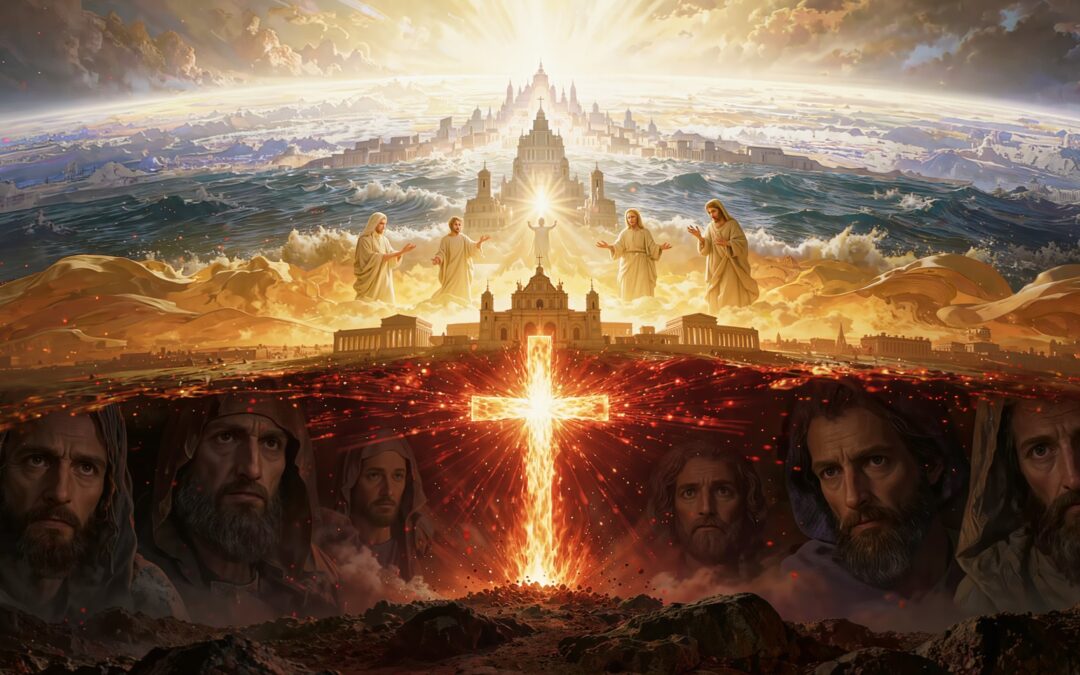
The Fourfold Gospel Fulfillment of Messianic Prophecy
Jesus Christ (Yeshua ha-Mashiach) as the Complete Realization of Orthodox Judaism
By Apostle Brandon Barthrop
RLM TV Press
January 13, 2026
Abstract
This paper presents a cruciform, Kabbalistic, and fully Scriptural demonstration that the four canonical Gospels—Matthew, Mark, Luke, and John—together constitute the complete and unified fulfillment of all Orthodox Jewish Messianic prophecy. Rather than offering competing or fragmented portraits of Jesus Christ, the fourfold Gospel witness reveals a single Messiah manifested through four complementary Messianic offices, each unveiling a distinct lineage, function, and covenantal identity within the economy of redemption.
Matthew reveals Yeshua ha-Mashiach as Messiah ben David, the rightful King of Israel and heir to the eternal Davidic throne. Mark unveils Him as Messiah ben Joseph, the righteous suffering servant whose descent through rejection and death establishes the pathway to resurrection and dominion. Luke proclaims Him as Messiah ben Adam, the Second Adam who redeems fallen humanity and restores the human vocation within creation. John unveils Him as Messiah ben YHVH, the eternal Son and pre-existent Word through whom all things were made and by whom all things are sustained.
Together, these four Gospel witnesses establish Angelic Orthodoxy—the heavenly government of the Tree of Life, rooted in the Bloodline of the Cross, by which redeemed humanity is crucified with Christ and engrafted into one new Man (Ephesians 2:15). Through this cruciform union, the people of God are incorporated into the Royal Monarchy of the Lamb, ascending in Christ into the Seven New Heavens (Araboth) and participating in the Seven Renewed Earths, as the Messianic Kingdom is established in heaven and on earth under the eternal reign of Jesus Christ.
1. The Necessity of a Fourfold Messianic Revelation
Classical Judaism long understood that the Messiah would not be revealed through a single title or function. Rabbinic literature wrestles with seemingly contradictory Messianic portraits:
- A Suffering Servant
- A Royal King
- A Heavenly Son
- A Righteous Son of Man
- A Joseph-like sufferer
- A Davidic ruler
Orthodox Judaism often resolved this tension by proposing multiple Messiahs (e.g., Messiah ben Joseph and Messiah ben David). The New Covenant reveals a more profound truth: one Messiah fulfills all offices—not sequentially, but cruciformly, through death, resurrection, and exaltation.
The four Gospels are not narrative redundancy; they are prophetic necessity.
II. Gospel of John
Messiah ben YHVH — The Eternal Son and Divine Origin
The Gospel of John stands apart from the Synoptic tradition by deliberate design. Where Matthew establishes royal lineage, Luke universal humanity, and Mark suffering obedience, John begins before genealogy, before time, and before creation itself. His opening words do not situate Yeshua within history but within eternity:
“In the beginning was the Word, and the Word was with God, and the Word was God.” (John 1:1)
This declaration is not poetic embellishment but ontological proclamation. John reveals Yeshua ha-Mashiach as Messiah ben YHVH—not merely “Son of God” in a functional or metaphorical sense, but the pre-existent Divine Word (Logos) through whom all creation was spoken into being.
1. Messiah ben YHVH and the Mystery of the Son in Orthodox Judaism
Orthodox Jewish Scripture itself anticipates a Divine Sonship mystery that exceeds human kingship or prophetic office. Proverbs 30:4 poses an unanswerable riddle within natural theology:
“Who has ascended into heaven and descended?
Who has gathered the wind in His fists?
Who has wrapped the waters in a garment?
Who has established all the ends of the earth?
What is His name, and what is His Son’s name—if you know?”
John answers what Proverbs leaves concealed: the Son’s Name is the Word made flesh. The Gospel does not invent divinity; it reveals what Torah already implied but veiled.
This Son is not created, adopted, or promoted. He is.
2. The Logos as Divine Speech, Wisdom, and Life
In Hebraic understanding, Word (דָּבָר, Davar) is not abstract speech but active, creative power. John identifies Yeshua as the living Davar, aligning Him with:
- Genesis 1 — “And God said…”
- Psalm 33:6 — “By the word of the LORD the heavens were made”
- Proverbs 8 — Divine Wisdom present before creation
John 1:3 states with absolute clarity:
“All things were made through Him, and without Him nothing was made that was made.”
Thus, Messiah ben YHVH is not only Redeemer but Creator, not only Savior but Source. Redemption, in John, is not repair—it is return to Origin.
3. Daniel 7 Fulfilled: Eternal Dominion of the Son
John’s Christology fulfills Daniel’s apocalyptic vision:
“I saw in the night visions, and behold, one like a Son of Man came with the clouds of heaven… and to Him was given dominion and glory and a kingdom, that all peoples, nations, and languages should serve Him.” (Daniel 7:13–14)
John reveals that this “Son of Man” is simultaneously the eternal Word, collapsing the false divide between divine and human. In Yeshua, heaven and earth meet—not symbolically, but personally.
His dominion is eternal because His origin is eternal.
4. Psalm 2 and the Begetting Beyond Time
Psalm 2 declares:
“You are My Son; today I have begotten You.”
John reveals that this “begetting” is not temporal birth but eternal generation—a relationship within God Himself, now unveiled in history. The Cross does not create Sonship; it reveals and manifests it.
Thus, the crucifixion in John is not defeat but enthronement. The lifting up of the Son (John 12:32) echoes the lifting up of the Son in Daniel’s vision.
5. Messiah as the Source of Life (Chayim)
John identifies Messiah ben YHVH as the well-spring of all life:
“In Him was life, and the life was the light of men.” (John 1:4)
Life (Chayim) is not merely biological existence but divine vitality—the life of God Himself. This is the life later described as eternal life, not measured by duration but by origin.
Yeshua does not give life as an external gift; He is Life. To be joined to Him is to be re-rooted into the living source of creation.
6. The True Root Above All Roots
While Matthew will later identify Yeshua as the Root of David, John ascends higher still. Messiah ben YHVH is the Root above all roots, the unseen foundation beneath every lineage, covenant, and promise.
David flows from Him.
Adam flows from Him.
Creation flows from Him.
Thus, the Cross in John is not merely substitutionary—it is cosmic. The blood shed is not only royal or human; it is divine life poured into creation, igniting the Tree of Life anew.
7. Keter and Araboth: The Crowned Messiah
Within the language of sacred wisdom, John establishes the upper crown of Messianic identity—what may be described as Keter, the source-point of divine emanation. From this crown, Messiah rules from Araboth, the highest heaven, not as distant monarch but as indwelling life for His people.
This establishes the theological axis upon which all other Gospel revelations depend:
- Without ben YHVH, ben David has no eternal throne
- Without ben YHVH, ben Adam has no incorruptible life
- Without ben YHVH, ben Joseph’s suffering has no redemptive power
Summary
The Gospel of John reveals Jesus Christ as Messiah ben YHVH, the eternal Son, pre-existent Word, and divine source of all life. This Gospel crowns the fourfold Messianic revelation by establishing Yeshua as Divine Origin, from whom creation, redemption, and the Messianic Kingdom proceed. From Araboth, He reigns not only over heaven and earth, but within all who are crucified with Him and engrafted into His life.
III. Gospel of Luke
Messiah ben Adam — The Redeemer and Restorer of Humanity
If the Gospel of John ascends to eternity past, the Gospel of Luke descends deliberately into the depths of human history. Luke’s Messianic revelation is not primarily royal, priestly, or cosmic, but anthropological. His Gospel answers a question left unresolved since Eden: Can humanity itself be healed?
Luke’s genealogy provides the key. Unlike Matthew, who traces Yeshua’s lineage to Abraham and David, Luke traces it beyond Israel, beyond covenantal election, and beyond kingship, all the way back to Adam:
“…the son of Enosh, the son of Seth, the son of Adam, the son of God.” (Luke 3:38)
This is neither incidental nor stylistic. It is prophetic precision. Luke reveals Yeshua ha-Mashiach as Messiah ben Adam—the Second Adam, sent not merely to redeem Israel, but to restore humanity itself.
1. The Second Adam and the Undoing of the Fall
The Adamic fall was not merely moral failure; it was ontological rupture. Humanity’s relationship to God, creation, and itself was fractured. Death entered not as punishment alone, but as disintegration—a severing from divine life.
Luke presents Yeshua as the Second Adam who confronts the fall at its root. Immediately after the genealogy, Luke records the temptation narrative (Luke 4), deliberately paralleling Genesis 3. Where the first Adam fell in abundance, the Second Adam overcomes in hunger. Where Adam grasped, Yeshua surrendered. Where Adam listened to the serpent, Yeshua obeyed the Father.
This is not symbolic reversal; it is substitutionary obedience enacted on behalf of all humanity.
2. Genesis 3:15 and the Seed of the Woman
Luke’s Gospel fulfills the proto-evangelium:
“I will put enmity between you and the woman, and between your seed and her Seed; He shall bruise your head, and you shall bruise His heel.” (Genesis 3:15)
Luke emphasizes:
- The virgin conception
- The role of Mary
- The human vulnerability of Messiah
These are not sentimental details. They establish Yeshua as the Seed of the woman, entering the Adamic condition without inheriting the Adamic corruption. His humanity is real, but unfallen; vulnerable, yet undefiled.
Thus, Messiah ben Adam can redeem Adam because He fully assumes Adamic humanity without Adamic guilt.
3. Isaiah 53 and the Healing of Human Wounds
Luke’s Gospel is saturated with Isaiah’s Servant Songs, especially Isaiah 53. Luke uniquely emphasizes:
- Healing
- Compassion
- Mercy toward the marginalized
- Identification with the poor, sick, and broken
Isaiah declares:
“Surely He has borne our griefs and carried our sorrows… and by His wounds we are healed.”
Luke presents Messiah not merely as bearer of sins, but as bearer of human infirmity. The wounds He carries are not abstract transgressions alone; they are the total weight of fallen humanity—physical, psychological, social, and spiritual.
Healing in Luke is therefore not secondary to salvation; it is salvation expressed in the human realm.
4. Daniel 7 Revisited: The Son of Man
Luke repeatedly emphasizes Yeshua’s preferred self-designation: the Son of Man. This title simultaneously affirms:
- Full humanity
- Eschatological authority
- Heavenly vindication
Daniel’s vision of the Son of Man (Daniel 7) is not abandoned in Luke—it is grounded in flesh. The One who will receive eternal dominion first walks among the sick, eats with sinners, and submits to death.
Luke reveals that dominion is not seized through power, but bestowed through obedience. The Son of Man reigns because He fully enters the human condition and carries it through death into resurrection.
5. Universal Redemption Beyond Israel
Luke’s Gospel is unmistakably universal. Gentiles are named, praised, and included from the opening chapters onward. Simeon declares:
“A light for revelation to the Gentiles, and for glory to Your people Israel.” (Luke 2:32)
Messiah ben Adam redeems all nations, not by erasing Israel, but by fulfilling Israel’s vocation as light to the world. Luke’s Christ does not belong to one ethnicity or culture; He belongs to humanity restored.
This universality is not pluralistic—it is Adamically singular. All peoples are invited because all peoples fell in Adam and are now offered restoration in Christ.
6. The Reversal of the Curse of the Ground
The Adamic curse affected not only humanity but creation itself (Genesis 3:17–19). Luke’s Gospel anticipates this reversal through:
- Emphasis on meals and table fellowship
- Restoration of social order
- Joy, praise, and bodily resurrection
Luke culminates not in escape from the body, but in resurrected humanity. The risen Christ eats, speaks, walks, and blesses—demonstrating that salvation does not discard humanity but transfigures it.
Thus, Messiah ben Adam restores humanity’s role as steward, priest, and son within creation.
7. The New Bloodline Through the Cross
Luke establishes Messiah as the Root of renewed humanity. Through the Cross, Yeshua inaugurates a new bloodline, no longer defined by Adamic descent but by cruciform union. Humanity is not improved; it is recreated.
Those who are joined to Christ are no longer merely forgiven sinners but new creatures, born not of flesh, but of God. This is the foundation for the one new Man later articulated by the apostles.
Summary
The Gospel of Luke reveals Jesus Christ as Messiah ben Adam, the Second Adam and Redeemer of humanity. Fully human yet unfallen, Yeshua enters the Adamic condition to heal its fracture, reverse the curse, and restore humanity’s vocation within creation. Through His obedient life, sacrificial death, and bodily resurrection, Luke establishes Messiah as the Root of renewed humanity, inaugurating a new bloodline through the Cross—one capable of embracing all nations and participating in the life of the coming Kingdom.
IV. Gospel of Matthew
Messiah ben David — The Royal King of Israel and the Kingdom of Heaven
Where Luke descends to Adam and John ascends to eternity, the Gospel of Matthew stands firmly within covenantal history. Matthew opens with juridical and royal precision:
“The book of the genealogy of Jesus Christ, the son of David, the son of Abraham.” (Matthew 1:1)
This opening verse functions as a legal declaration. Matthew announces from the outset that Yeshua ha-Mashiach is the lawful heir to Israel’s promises—rooted in Abraham, crowned in David, and fulfilled in the Kingdom of Heaven. This is not devotion al framing; it is royal documentation.
Matthew reveals Yeshua as Messiah ben David, the anointed King whose authority is covenantal, prophetic, and eternal.
1. The Davidic Covenant and the Eternal Throne
Central to Matthew’s Gospel is the fulfillment of the Davidic promise:
“Your house and your kingdom shall be made sure forever before Me. Your throne shall be established forever.” (2 Samuel 7:16)
Israel awaited a king who would restore David’s throne, reunite the people, defeat enemies, and establish righteous rule. Matthew demonstrates that this promise is fulfilled not by military conquest, but through obedient Sonship culminating in the Cross.
Yeshua is shown to be:
- Born of David’s line
- Recognized as “Son of David”
- Entering Jerusalem as King
- Enthroned paradoxically through crucifixion
Matthew reveals that the Davidic throne is established through sacrificial kingship, not political domination.
2. The Abrahamic Covenant Fulfilled in the King
Matthew deliberately anchors the genealogy in Abraham, reminding the reader that kingship exists to serve blessing:
“In you all the families of the earth shall be blessed.” (Genesis 12:3)
Messiah ben David fulfills the Abrahamic covenant by extending the Kingdom of Heaven beyond Israel to the nations—without dissolving Israel’s calling. The King of Israel becomes the King for the world, not by abandoning Torah, but by fulfilling it perfectly.
Thus, Matthew’s Messiah restores Israel to her original vocation: to mediate God’s reign to the nations.
3. Isaiah 9 and the Government Without End
Matthew’s Christology resonates powerfully with Isaiah’s royal prophecy:
“Of the increase of His government and of peace there will be no end, on the throne of David and over His kingdom.” (Isaiah 9:7)
Matthew reveals that this government is the Kingdom of Heaven—a real, operative reign that invades earth through the obedience of the King and the formation of a Kingdom people.
The Sermon on the Mount is not moral idealism; it is royal legislation. The parables of the Kingdom are not illustrations; they are governance disclosures. Authority flows from the King outward to disciples who live under His rule.
4. Micah 5:2 and the Paradox of the King
Matthew emphasizes Micah’s prophecy:
“But you, Bethlehem… from you shall come forth for Me one who is to be ruler in Israel, whose coming forth is from of old, from ancient days.”
The Davidic King arises from obscurity, humility, and apparent weakness. Matthew shows that true kingship in the Messianic Kingdom is hidden before it is revealed, and obedient before it is exalted.
This paradox reaches its climax at the Cross, where the King is publicly mocked, crowned with thorns, and enthroned above the earth. The inscription “King of the Jews” is both accusation and prophecy.
5. The Root of David and the Lion of Judah
Matthew’s Gospel prepares the reader for the later apocalyptic declaration:
“Behold, the Lion of the tribe of Judah, the Root of David, has conquered.” (Book of Revelation 5:5)
The Root of David is not merely David’s descendant; He is David’s source. Matthew reveals Yeshua as both heir and origin, the King who fulfills history and transcends it.
The Lion conquers not by force, but by faithful obedience unto death, thereby establishing a Kingdom that cannot be shaken.
6. The Kingdom Axis of the Cross
Matthew uniquely reveals the Kingdom axis of the Cross. The Cross is not the interruption of kingship—it is its enthronement mechanism. Royal authority flows through:
- Obedience rather than coercion
- Sacrifice rather than self-preservation
- Faithfulness rather than power
Thus, the Kingdom of Heaven is established on earth through the crucified King, and those who follow Him rule by sharing His Cross.
7. The King and His Kingdom People
Matthew concludes with the Great Commission, where the risen King declares:
“All authority in heaven and on earth has been given to Me.” (Matthew 28:18)
The authority promised in Isaiah, David, and Abraham is now vested fully in the risen Messiah. The Kingdom is no longer anticipated; it is inaugurated. The King sends forth His people not as rebels, but as royal ambassadors, discipling the nations into obedience to His reign.
Summary
The Gospel of Matthew reveals Jesus Christ as Messiah ben David, the lawful heir to Israel’s throne and the fulfillment of the Abrahamic and Davidic covenants. Deeply rooted in Torah, prophecy, and typology, Matthew establishes Yeshua as the Root of David and Lion of Judah, the King who restores the Kingdom of Heaven on earth. Through sacrificial obedience and cruciform enthronement, this Gospel reveals the royal axis of the Cross, by which divine authority flows to a redeemed people who reign with Christ under His eternal monarchy.
V. Gospel of Mark
Messiah ben Joseph — The Suffering Servant and Descent Before Glory
The Gospel of Mark is intentionally stark. It offers no genealogy, no infancy narrative, no royal prologue, and no theological preface. Mark begins in motion, urgency, and conflict. The Messiah appears already active, already opposed, already moving toward suffering. This literary austerity is not deficiency; it is theological precision.
Mark reveals Yeshua ha-Mashiach as Messiah ben Joseph—the righteous sufferer whose vocation is not first to rule, but to descend, not first to be recognized, but to be rejected. This Gospel establishes a fundamental axiom of Messianic orthodoxy: glory is inaccessible apart from suffering.
1. The Absence of Genealogy and the Theology of Rejection
Unlike Matthew and Luke, Mark withholds lineage. This omission is deliberate. Messiah ben Joseph does not appear with credentials; he appears unrecognized. His authority is not established by ancestry but by obedient action and self-giving love.
Mark’s Messiah is repeatedly misunderstood:
- By religious leaders
- By crowds
- By His own disciples
This concealment fulfills the Josephic pattern: the chosen one is present before he is known, faithful before he is vindicated.
2. The Joseph Pattern: Beloved, Rejected, Descended
The narrative of Joseph (Genesis 37–50) provides the archetype for Mark’s Messiah:
- Beloved Son — Joseph is favored by his father; Yeshua is affirmed by the Father at baptism.
- Rejected by Brothers — Joseph is betrayed by his own; Yeshua is rejected by Israel’s leaders and abandoned by His disciples.
- Descends into Suffering — Joseph is cast into a pit and prison; Yeshua descends into humiliation, trial, and death.
- Revealed as Savior of Many — Joseph preserves nations during famine; Yeshua gives His life as a ransom for many.
Mark presents this pattern without embellishment, emphasizing cost over triumph, obedience over recognition.
3. Isaiah 53 in Narrative Form
Mark is the Gospel most saturated—implicitly and explicitly—with Isaiah 53. The suffering servant is not merely referenced; he is enacted.
“He was despised and rejected by men… a man of sorrows and acquainted with grief.”
Mark shows:
- The servant silenced before accusers
- The servant bearing shame
- The servant giving His life willingly
Crucially, Mark records Yeshua’s own interpretive statement:
“The Son of Man came not to be served but to serve, and to give His life as a ransom for many.” (Mark 10:45)
This is ben Joseph theology in its purest form: redemption through self-emptying.
4. Descent as the Pathway to Dominion
Mark establishes a principle the other Gospels presuppose: there is no ascent without descent. The Kingdom cannot be established without the Cross. Kingship cannot manifest without suffering. Authority cannot flow without obedience unto death.
The repeated predictions of suffering in Mark are not forewarnings of tragedy; they are revelations of necessity. The Cross is not accidental—it is structural to Messianic fulfillment.
5. The Silence of the Cross and the Hidden Victory
Mark’s crucifixion account is stripped of triumphal language. The King dies in apparent defeat. The disciples flee. The heavens darken. Even the cry from the Cross is recorded without immediate resolution.
Yet it is here—at the moment of utter abasement—that the hidden victory is secured. The Roman centurion’s confession, “Truly this man was the Son of God,” marks the first human recognition of Messiah ben Joseph’s true identity—spoken not by Israel’s leaders, but by a Gentile witness at the Cross.
6. Without ben Joseph, ben David Cannot Reign
Mark provides the indispensable foundation for Matthew’s royal theology. The Davidic throne is not seized; it is earned through suffering. The Lion of Judah conquers as the Lamb who was slain.
Without ben Joseph:
- The Cross has no necessity
- The resurrection has no pathway
- The Kingdom has no moral authority
Mark teaches that suffering is not a detour from glory—it is the womb of glory.
7. The Servant Who Forms Servants
Mark’s Gospel forms a people patterned after the suffering Messiah. Discipleship in Mark is not spiritual enhancement; it is participation in the Cross. To follow Messiah ben Joseph is to accept obscurity, loss, and obedience—trusting that vindication belongs to God alone.
This prepares the ground for the resurrection and the later revelation of kingship. The servant is not replaced by the king; the servant becomes the king.
Summary
The Gospel of Mark reveals Jesus Christ as Messiah ben Joseph, the righteous suffering servant whose descent into rejection and death establishes the only true pathway to resurrection and dominion. Drawing deeply from the Joseph narrative and Isaiah’s suffering servant, Mark presents Messiah before glory, affirming that the Cross is not incidental but essential to Messianic fulfillment. Without ben Joseph, ben David cannot reign; without suffering, there is no Kingdom. Mark thus establishes the cruciform necessity at the heart of Angelic Orthodoxy and the Messianic Kingdom Age.
VI. The Cruciform Union of All Four Messianic Offices
The Cross as the Axis of Eternal Integration
In Jesus Christ, the four Messianic identities revealed in the canonical Gospels do not compete, overlap accidentally, or resolve one another sequentially. They interpenetrate. Each office is incomplete without the others, and all four converge in a single historical, cosmic, and eternal event: the Cross.
The Cross is not merely the instrument of atonement; it is the axis of integration by which eternity, humanity, kingship, and suffering are unified in one Messiah and one redemptive act.
1. The Fourfold Revelation in Unified Tension
Each Gospel reveals a dimension of Messiah that, taken alone, would be insufficient:
- John reveals who He is eternally: Messiah ben YHVH, the pre-existent Word, Divine Origin, and Source of Life.
- Luke reveals who He became for humanity: Messiah ben Adam, the Second Adam who heals the fracture of human nature.
- Matthew reveals who He is legally and royally: Messiah ben David, the lawful King who fulfills covenant and establishes the Kingdom.
- Mark reveals what He suffered to establish all things: Messiah ben Joseph, the righteous servant whose descent makes all ascent possible.
These are not four Christs. They are four disclosures of one Christ, whose fullness cannot be apprehended apart from the Cross.
2. The Cross as the Point of Convergence
At the Cross, all four offices converge simultaneously and inseparably:
- The Son of God bleeds — the eternal Word enters death without ceasing to be divine.
- The Son of Man dies — humanity is carried fully into death so that death itself may be undone.
- The Son of David is crowned with thorns — kingship is enthroned through obedience and suffering, not domination.
- The Son of Joseph is buried and forgotten — the rejected one descends to the lowest place before vindication.
Nothing is symbolic here. Each identity is actively operative in the crucifixion. The Cross is therefore not merely substitutionary; it is ontological, covenantal, royal, and cosmic all at once.
3. The Death That Generates Life
From this convergence springs what Scripture calls the Root of Eternal Life. The Cross does not terminate Messiah’s identity; it transfigures it. Blood is not merely shed—it is transmuted. Death does not merely occur—it is overcome from within.
The life released from the Cross is not Adamic life restored, but divine life imparted. This is why resurrection is not a return to what was lost, but the emergence of a new creation.
Here, blood becomes fire.
Here, flesh becomes glory.
Here, death becomes birth.
4. The Formation of a Royal, Angelic Priesthood
Because all four Messianic offices converge in Christ, all four are imparted to those who are crucified with Him. Redemption is not forensic alone; it is participatory.
Those engrafted into Christ:
- Receive life from Messiah ben YHVH
- Are reconstituted as humanity in Messiah ben Adam
- Are commissioned into authority under Messiah ben David
- Are formed through obedience in Messiah ben Joseph
This produces not merely forgiven individuals, but a royal, angelic priesthood—a people conformed to the cruciform pattern of the Son, capable of reigning with Him in the Messianic Kingdom Age.
5. The Cross as the New Tree of Life
The Cross stands as the New Tree of Life, planted at the intersection of heaven and earth. Its root descends into death; its crown ascends into Araboth. From this Tree flows life for the healing of the nations, not as abstraction, but as embodied, resurrected humanity.
Thus, the Cross becomes:
- The throne of the King
- The altar of sacrifice
- The womb of the new creation
- The ladder of ascent
- The axis of Angelic Orthodoxy
Summary
The four Messianic offices revealed in the Gospels—ben YHVH, ben Adam, ben David, and ben Joseph—are unified cruciformly in Jesus Christ. At the Cross, eternal Sonship, redeemed humanity, royal authority, and righteous suffering converge in a single redemptive act. From this convergence springs the Root of Eternal Life, transfiguring blood into fire and forming a people who share in Christ’s life, authority, and obedience. The Cross thus stands as the integrative axis of the Messianic Kingdom Age and the foundation of Angelic Orthodoxy.
The Four Gospels, the Four Worlds, and the Four Soul Levels
A Cruciform Sod Framework
|
World |
Soul Level |
Gospel |
Messianic Office |
Governing Function |
|
Assiyah |
Nefesh |
Gospel of Mark |
Messiah ben Joseph |
Suffering, action, obedience unto death |
|
Yetzirah |
Ruach |
Gospel of Luke |
Messiah ben Adam |
Healing, restoration, reordered humanity |
|
Beriah |
Chayah |
Gospel of Matthew |
Messiah ben David |
Kingship, covenant, Kingdom governance |
|
Atzilut |
Yechidah |
Gospel of John |
Messiah ben YHVH |
Divine union, origin, eternal life |
Conclusion
The Fourfold Gospel as the New Torah of the Kingdom Age
The four canonical Gospels together constitute the New Torah of the Kingdom Age, unveiling Jesus Christ (Yeshua ha-Mashiach) as the complete and final fulfillment of all Orthodox Jewish Messianic expectation. What appeared in the Hebrew Scriptures as distinct promises, offices, and prophetic tensions is revealed in the New Covenant as one cruciform Messiah, disclosed through four complementary Gospel witnesses and unified at the Cross.
Through John, Messiah is revealed as ben YHVH, the eternal Word and Divine Origin from whom all life proceeds. Through Luke, He is revealed as ben Adam, the Second Adam who heals the fracture of humanity and restores the human vocation within creation. Through Matthew, He is revealed as ben David, the lawful King who fulfills covenant and establishes the Kingdom of Heaven on earth. Through Mark, He is revealed as ben Joseph, the righteous suffering servant whose descent into death makes resurrection and dominion possible. These are not competing portraits, but one Messiah revealed in cruciform fullness.
At the Sod level, this fourfold Gospel witness corresponds precisely to the four worlds and four soul-levels—Assiyah/Nefesh, Yetzirah/Ruach, Beriah/Chayah, and Atzilut/Yechidah—revealing not four paths of spirituality, but one cruciform ascent in Christ. In Him, the soul is crucified, healed, enthroned, and united; in Him, creation is restored, governance is established, and divine life is imparted.
In Jesus Christ, the Tree of Life is reopened, no longer guarded by cherubim against fallen humanity, but offered through the Blood of the Cross to a redeemed people. The Royal Monarchy of Heaven is restored—not as abstraction, but as living governance—forming a people who reign with the Lamb in obedience, humility, and holiness. The Church is therefore invited—not into religion, moralism, or mysticism—but into Angelic Orthodoxy: participation in the life, order, and authority of the Kingdom of God.
Rooted forever in the Root of David, sealed by the Blood of the Cross, and animated by the Life of God the Father, the people of Christ are engrafted into one new Man, ascending in Him into the Seven Heavens (Araboth) and participating with Him in the Seven Renewed Earths. This is not a future abstraction but a present calling, inaugurated by the Cross, revealed in the Gospels, and consummated in the Messianic Kingdom Age under the eternal reign of Jesus Christ.
— Apostle Brandon Barthrop
RLM TV Press
January 13, 2026
Appendix A
The Fourfold Gospel Matrix: Gospels × Worlds × Soul-Levels
A Cruciform New Torah Framework
This appendix presents a diagrammatic synthesis demonstrating the precise correspondence between the four canonical Gospels, the four worlds (olamot), and the four primary soul-levels. Together, these reveal a single cruciform structure of Messianic fulfillment in Jesus Christ, integrating cosmology, anthropology, and redemption within the New Torah of the Kingdom Age.
Diagrammatic Matrix
|
Gospel |
Messianic Office |
World (Olam) |
Soul-Level (Neshamah) |
Primary Function |
|
Gospel of Mark |
Messiah ben Joseph |
Assiyah (World of Action) |
Nefesh |
Obedience, suffering, crucifixion, death |
|
Gospel of Luke |
Messiah ben Adam |
Yetzirah (World of Formation) |
Ruach |
Healing, restoration, reordered humanity |
|
Gospel of Matthew |
Messiah ben David |
Beriah (World of Creation and Governance) |
Chayah |
Kingship, covenant, Kingdom authority |
|
Gospel of John |
Messiah ben YHVH |
Atzilut (World of Emanation) |
Yechidah |
Divine union, origin, eternal life |
Vertical Cruciform Ascent (Conceptual Axis)
Atzilut — Yechidah — John — Divine Union (Messiah ben YHVH)
Beriah — Chayah — Matthew — Royal Governance (Messiah ben David)
Yetzirah — Ruach — Luke — Human Restoration (Messiah ben Adam)
Assiyah — Nefesh — Mark — Obedient Death (Messiah ben Joseph)
The Cross functions as the vertical axis uniting all four levels in Jesus Christ.
No ascent occurs without descent; no union without crucifixion.
Theological Clarifications
Non-Sequential Integration
The four Gospel dimensions do not represent independent or alternative spiritual paths. Rather, they are interpenetrating realities unified in the one Messiah. Each presupposes the others and finds its coherence only at the Cross, where all four offices converge in a single redemptive act.
Cruciform Order (Essential)
Within this framework, redemption unfolds according to a cruciform order:
- Nefesh (Assiyah) must be crucified
- Ruach (Yetzirah) must be healed
- Chayah (Beriah) must be submitted to divine governance
- Yechidah (Atzilut) must be revealed, not attained
Messianic Fulfillment
This matrix demonstrates that the fourfold Gospel witness fulfills Messianic prophecy not only historically, but also cosmologically and anthropologically, restoring humanity across all worlds and soul-levels in Christ.
New Torah Implication
Taken together, the four Gospels function as the New Torah of the Kingdom Age, revealing how redeemed humanity is re-rooted into the Tree of Life and ordered for participation in the Royal Monarchy of Heaven under the reign of Jesus Christ.
Appendix Summary Statement
The four canonical Gospels correspond precisely to the four worlds and four soul-levels, revealing a single cruciform ascent in Jesus Christ. Through Mark, Luke, Matthew, and John, Messiah descends into Assiyah and ascends through Yetzirah and Beriah into Atzilut, integrating obedient death, restored humanity, royal governance, and divine union in one redemptive act.
