
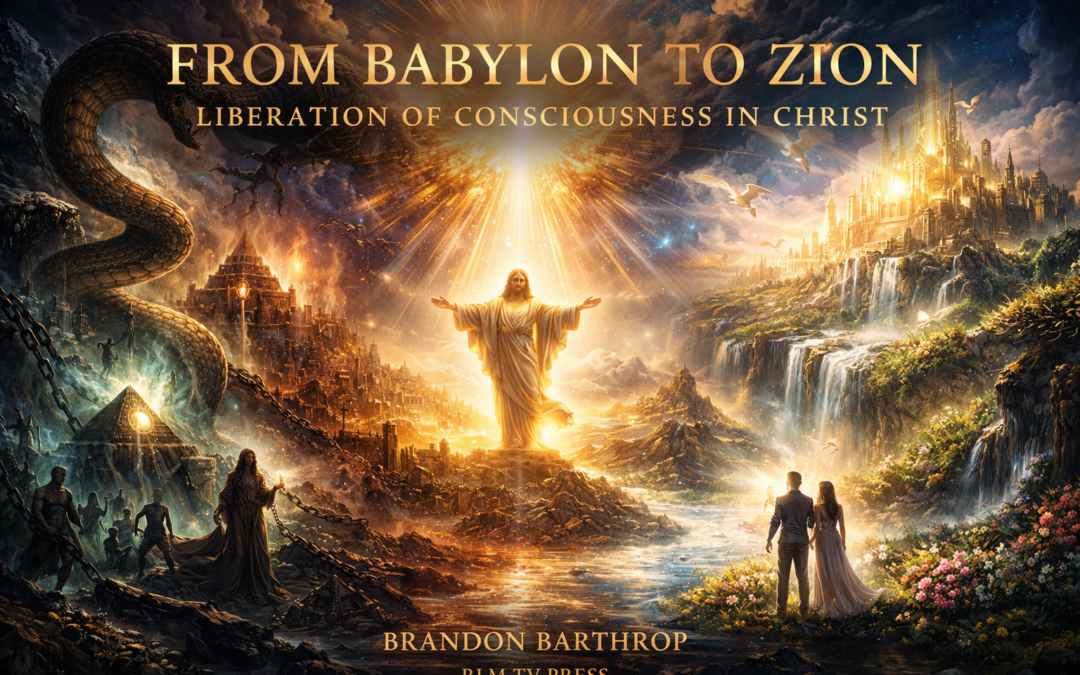
The Dismantling of Babylonian Sorcery:
A Cruciform Kabbalistic Restoration of the Mind into the Ruach of Messiah
Subtitle:
An Apostolic Torah Scholar’s Exposition on Liberation from the Tenfold Structures of Fallen Consciousness into the Glory Governance of Jesus Christ
Author: Apostle Brandon Barthrop
Publisher: RLM TV Press
Date: March 30, 2026
ABSTRACT
This paper addresses what may be considered one of the most pervasive and under-discerned crises in human history: the global captivity of the human mind through systems of deception, herein described as “sorcery,” manifesting as distorted perception, false interpretation, and externally governed consciousness. Drawing upon the testimony of Scripture—particularly the apocalyptic unveiling of Book of Revelation—this study contends that Babylon the Great represents not merely a geopolitical entity but a transpersonal system of influence that has shaped the cognitive and perceptual frameworks of all nations.
The framework of this paper re-examines traditional metaphysical structures—namely the sefirotic order, the mazalot (constellational cycles), and the Teli (serpentine axis)—not as inherently evil, but as systems that, when divorced from divine union, become instruments of control, legalism, and deterministic identity. These structures, once intended as vessels of divine life, are here analyzed as having been co-opted into a “ministry of death,” reinforcing accusation, external dependency, and fragmented consciousness.
The proposed solution is the full restoration of perception through the indwelling presence of the Ruach HaKodesh, made available through the cruciform work of Jesus Christ. Through the Cross, all false systems of mediation are rendered obsolete, and the believer is reconnected directly to the Throne of God, no longer governed by external lights but by internal glory.
The outcome of this restoration is the emergence of what the Apostle Paul terms the “Mind of Christ” (1 Corinthians 2:16): a state of divine cognition characterized by clarity, truth alignment, and unmediated communion with God. This paper ultimately presents a theological and experiential pathway for the liberation of human consciousness into its intended state of glory-based governance in Messiah.
KEY TERMS / GLOSSARY
Ruach HaKodesh (רוּחַ הַקֹּדֶשׁ)
The Holy Spirit of God; the indwelling divine presence given through the New Covenant in Jesus Christ. In this paper, the Ruach HaKodesh is understood as the internal source of true perception, interpretation, and communion with God, restoring the human mind from external dependency to Spirit-governed cognition.
Mind of Christ
A term derived from apostolic teaching (1 Corinthians 2:16), referring to the redeemed state of human consciousness fully aligned with the perception, judgment, and wisdom of Jesus Christ. It denotes a mode of knowing that is not derived from external systems, but from direct union with God through the Spirit.
Sefirot (as interpreted in this paper)
Traditionally understood as ten emanative attributes or vessels of divine expression, the sefirot are here examined through a cruciform lens. This paper distinguishes between their original intent as channels of divine life and their distortion—when separated from Christ—into structured systems of control, legalism, and accusation within fallen consciousness.
Mazalot (מַזָּלוֹת)
The constellational or cyclical ordering of time and influence, often associated with the zodiac. In this study, mazalot are interpreted as systems that, when misapplied, impose deterministic identities and cyclical constraints upon human perception, contrasting with the freedom of identity found in Christ.
Teli (תְּלִי)
A concept found in classical cosmological texts, often associated with a central axis or serpentine alignment governing cosmic order. Within this paper, the Teli is explored symbolically as the axis of fallen dominion—linked to the serpent imagery in Scripture—representing governance through deceptive light and false authority, ultimately overcome by the crucifixion of Christ.
Babylon the Great
A symbolic and spiritual system described in the Book of Revelation, representing the totality of human and spiritual structures that oppose God through deception, sorcery, and corrupted commerce of truth. In this work, Babylon is primarily understood as a system of consciousness that enslaves perception and distances humanity from divine reality.
Ministry of Death vs. Ministry of Glory
A distinction drawn from apostolic teaching (2 Corinthians 3). The “Ministry of Death” refers to systems of law, structure, or knowledge that operate externally and produce condemnation without transformation. The “Ministry of Glory” refers to the Spirit-led reality of the New Covenant, wherein righteousness, life, and transformation proceed from internal union with God.
Serpentine Consciousness
A mode of perception rooted in the Fall, characterized by knowledge apart from God, externalized authority, pride, fear, and manipulation. It operates through distortion, accusation, and dependency on systems outside the Spirit, aligning with the symbolic serpent as presented in Scripture.
Cruciform Consciousness
The redeemed state of perception shaped by the Cross of Jesus Christ. It is marked by humility, surrender, truth alignment, and direct communion with God through the Ruach HaKodesh. Cruciform consciousness represents the death of the false self and the emergence of divine cognition, restoring humanity to its intended union with God.
CHAPTER 1 — THE GLOBAL CONDITION: THE ENCHANTMENT OF THE NATIONS
Focus: Diagnosis
The apostolic witness of Book of Revelation presents a sobering and comprehensive diagnosis of the human condition: “by your sorceries all nations were deceived” (Revelation 18:23). This declaration does not describe a localized phenomenon, but a totalizing influence—an enchantment that has permeated every tribe, tongue, and people. The language of “sorcery” (Greek: pharmakeia) points beyond primitive superstition into the deeper reality of systematic manipulation of perception, whereby truth is obscured, reality is reframed, and humanity is governed through distortion rather than divine illumination.
At the core of this condition lies what may be termed collective mental captivity. Humanity, though created in the image of God, has become subject to interpretive frameworks that originate outside of the Spirit of God. These frameworks function as invisible architectures of thought—grids through which all experience is filtered, judged, and understood. As such, the crisis is not merely moral or behavioral, but fundamentally cognitive and perceptual. The mind itself has become occupied territory.
In this context, sorcery must be understood not merely as ritualistic practice, but as a mode of consciousness characterized by three principal dynamics. First, it produces distorted perception, wherein reality is no longer seen as it is in God, but as it is refracted through fear, pride, and fragmentation. Second, it establishes false interpretation grids, systems of meaning that assign value, identity, and destiny apart from divine truth. Third, it enforces externalized authority over the mind, conditioning individuals to derive understanding, validation, and direction from sources outside of direct communion with God.
It is within this framework that Babylon the Great must be re-examined. Far from being reducible to a single historical empire or geographic location, Babylon emerges in the apocalyptic vision as a transhistorical system of consciousness—a comprehensive network of influence that shapes how humanity perceives, interprets, and engages reality. Its power lies not merely in political or economic dominance, but in its ability to form the very lens through which the world is seen. Thus, Babylon is most potent not when it is recognized externally, but when it is internalized within the structures of thought.
The implication of this diagnosis is profound: the primary battlefield of dominion is not the external world, but the human mind. As wisdom literature affirms, “as a man thinks in his heart, so is he” (Proverbs 23:7). Control of perception equates to control of reality at the experiential level. Therefore, the struggle between truth and deception, between the Kingdom of God and the systems of Babylon, is waged first and foremost within the domain of cognition—within the hidden processes of interpretation, judgment, and awareness.
This chapter establishes the urgency and universality of the crisis. If indeed all nations have been deceived, then no culture, institution, or individual stands outside the need for liberation. The enchantment is not partial, but pervasive; not superficial, but deeply embedded. Consequently, any authentic pathway to restoration must address not only behavior, but the renewal of perception itself—the reformation of the mind according to divine truth. Only through such transformation can humanity be released from the enchantment of Babylon and restored to the clarity of communion with the living God.
CHAPTER 2 — THE MINISTRY OF DEATH: LEGAL STRUCTURES OF ACCUSATION
Focus: Old Covenant Misuse
The apostolic writings of Paul the Apostle provide a critical interpretive key for understanding the misuse of divine structure in fallen humanity. In 2 Corinthians 3, Paul distinguishes between what he terms the “ministry of death, engraved in letters on stone” and the surpassing “ministry of the Spirit.” This contrast does not indict the Law itself as evil, but rather exposes the condition of the human heart when confronted with divine standards apart from internal transformation. The Law, holy and righteous in origin, becomes—within unrenewed consciousness—a system that magnifies sin, intensifies guilt, and establishes cycles of condemnation.
At its core, the “ministry of death” is characterized by external law without internal life. It operates through commandments that define righteousness but do not impart the power to fulfill it. As such, it produces a perpetual tension between what is required and what is realized. This gap becomes the breeding ground for accusation. The conscience, designed to bear witness to truth, becomes burdened under the weight of unmet standards; guilt emerges as the internal echo of external demand; and condemnation solidifies as a persistent state of self-judgment. Thus, what was intended to reveal God’s holiness becomes, in fallen usage, a mechanism that reinforces human inadequacy.
Within this framework, legalism must be understood not merely as strict adherence to rules, but as a weaponized spiritual system. It is “weaponized” in that it externalizes authority and binds the individual to structures that judge without transforming. Legalism thrives wherever righteousness is measured by conformity to external codes rather than participation in divine life. It creates a feedback loop: the more one strives to achieve righteousness through external means, the more one becomes aware of failure, and the more deeply one is entrenched in cycles of accusation.
This dynamic can be further understood through the lens of structured systems—particularly tenfold patterns of order, which in their original design reflect completeness and divine governance. However, when these structures are engaged apart from the Spirit, they become frameworks of judgment rather than vessels of life. Each “measure” or “standard” within the structure becomes a point of evaluation rather than communion. Instead of facilitating connection with God, the structure becomes a grid of assessment, fragmenting the individual into areas of perceived success and failure. The result is not wholeness, but division within the self.
In contrast, Paul proclaims the advent of the Ministry of the Spirit and the Ministry of Glory. Unlike the externalized operation of the ministry of death, the Spirit works internally, writing the law upon the heart rather than imposing it from without. This internalization transforms the very nature of obedience: it is no longer a response to external demand, but the outflow of an indwelling life. Where the letter condemns, the Spirit gives life; where the former produces fear and distance, the latter produces intimacy and transformation.
The Ministry of Glory further elevates this reality, emphasizing not only transformation but participation in divine nature. The believer is not merely forgiven, but transfigured—“from glory to glory”—into alignment with the image of Christ. In this state, structure is no longer experienced as judgment, but as harmony; no longer as accusation, but as expression. The same frameworks that once condemned are fulfilled and transcended through union with the living God.
Thus, the critical distinction is not between structure and the absence of structure, but between structure apart from Christ and structure fulfilled in Christ. The former results in bondage, as external systems dominate and accuse the untransformed mind. The latter results in freedom, as the indwelling Spirit animates and fulfills all righteousness from within. This chapter, therefore, establishes a foundational principle: without Christ, even that which is holy becomes an instrument of death; but in Christ, all things are restored as conduits of life, glory, and divine communion.
CHAPTER 3 — THE TENFOLD FRAMEWORK: FROM LIFE STRUCTURE TO FALLEN SYSTEM
Focus: Reframing the “Ten”
Throughout Scripture, the pattern of “ten” consistently signifies completion, order, and divine governance. From the ten utterances of creation to the Ten Commandments given through Moses, the tenfold structure reflects a comprehensive expression of God’s will in form. It is not arbitrary, but architectural—revealing a blueprint through which divine life is intended to flow into creation. In its original intent, the tenfold framework functions as a harmonious system of alignment, whereby humanity participates in the order, wisdom, and righteousness of God.
However, this chapter proposes a critical thesis: that which is divinely structured can become, under fallen perception, a system of distortion. The problem does not originate in the structure itself, but in the consciousness engaging it. When the human mind operates apart from the indwelling Spirit, divine frameworks are no longer received as channels of life, but are reinterpreted through the lens of fear, control, and self-exaltation. Thus, what was designed for communion becomes repurposed for domination.
This distortion gives rise to what may be termed the “tenfold corruption”—the inversion of life-giving structure into mechanisms of control. Each “form” or dimension within the tenfold system, originally intended as a vessel of divine expression, becomes a point of regulation, measurement, and manipulation. Instead of facilitating relational union with God, the structure is fragmented into categories of performance, evaluation, and hierarchy. Life is replaced by system; communion by calculation.
To illuminate this phenomenon, this paper introduces the archetype of “Laban the Scholar,” derived from the figure of Laban. In the Genesis narrative, Laban is portrayed as one who operates through subtle manipulation, negotiation, and control—using knowledge, agreement, and external structures to bind and exploit. As an archetype, “Laban the Scholar” represents the misuse of knowledge divorced from Spirit, wherein intellectual capacity becomes a tool for self-serving governance rather than truth-aligned wisdom.
Within this paradigm, knowledge itself becomes a medium of control. Systems of interpretation, classification, and analysis—though valuable in their proper place—are elevated above direct communion with God. The result is a form of intellectualism that displaces the Spirit, replacing living revelation with static frameworks. In this condition, understanding is no longer received through relationship, but constructed through abstraction. Such knowledge, though sophisticated, is ultimately disconnected from life.
It is here that intellectualism, when severed from the Ruach HaKodesh, may rightly be identified as a form of sorcery. Not in the sense of overt ritual, but as the manipulation of reality through human reasoning apart from divine truth. It constructs systems that appear authoritative, yet subtly redirect dependence away from God and toward the structures themselves. Thus, the mind becomes entangled in its own constructs, mistaking complexity for truth and control for wisdom.
The tenfold framework, therefore, stands at a crossroads. In union with Christ, it remains a living architecture of divine expression, fulfilled and animated by the Spirit. Apart from Christ, it degenerates into a closed system of control, reinforcing separation, hierarchy, and bondage. The distinction lies not in the structure, but in the source of life animating it.
This chapter establishes the central thesis that will carry through the remainder of this work: that the corruption of divine structure is a primary mechanism of human captivity, and that true restoration requires not the abandonment of structure, but its reunification with the living presence of God in Christ. Only then can the tenfold system return to its intended purpose—not as an instrument of control, but as a conduit of life, wisdom, and glory.
CHAPTER 4 — MAZALOT AND TIME: THE IMPRISONMENT OF HUMAN PERCEPTION
Focus: Time, Cycles, and Determinism
Human perception is profoundly shaped by its relationship to time. Within the created order, time unfolds in cycles—days, seasons, years—establishing rhythms that govern natural life. Yet Scripture presents a higher reality: not merely cyclical time, but eternal life, a mode of existence rooted in the unchanging nature of God. The tension between these two dimensions—cycle and eternity—forms a critical axis in understanding the captivity or freedom of the human mind.
Within this context, the concept of mazalot (מַזָּלוֹת), referenced in texts such as the Book of Job (Job 38:32), has historically been associated with the ordering of constellations and their relation to time. While the heavenly bodies serve legitimate functions in marking seasons and signs (Genesis 1:14), this paper contends that, under fallen perception, such structures can be misappropriated into systems of deterministic identity. That is, rather than serving as markers of time, they are interpreted as governors of destiny.
This shift produces a subtle but powerful psychological effect: identity becomes assigned externally. The individual is no longer understood as a direct expression of divine intention, but as a product of cosmic positioning, temporal cycles, or predetermined patterns. In this framework, one’s nature, decisions, and outcomes are perceived as influenced—if not controlled—by forces outside of conscious union with God. Thus emerges what may be termed fate consciousness: a mode of thinking in which life is navigated according to perceived inevitabilities rather than relational guidance.
Fate consciousness stands in direct opposition to sonship. In the New Covenant, identity is not derived from external configurations but from birth through the Spirit. The believer is not defined by cycles, but by communion; not by positioning within time, but by participation in eternity. As such, any system that assigns identity apart from this union functions as a limitation upon true self-understanding.
The imprisoning effect of deterministic systems is not merely theological, but experiential. When individuals internalize externally assigned identities, they begin to interpret their lives through constraint rather than possibility. Patterns are expected to repeat; limitations are accepted as inherent; transformation is perceived as improbable. The result is a diminished sense of agency and a fragmented awareness of divine purpose.
In contrast, the person of Jesus Christ is revealed as Lord over time. His life, death, and resurrection do not merely occur within history—they redefine the believer’s relationship to it. Through Him, time is no longer an enclosing cycle, but a field through which eternity is expressed. He declares Himself “the Alpha and the Omega,” the beginning and the end, establishing authority over all temporal boundaries. In this light, Christ is not subject to cycles; He is their origin and their fulfillment.
Moreover, Christ functions as the breaker of cycles. Patterns of repetition—whether psychological, behavioral, or spiritual—are interrupted through the transformative power of the Cross and the indwelling Spirit. What once appeared inevitable is rendered obsolete; what seemed fixed becomes fluid under the influence of divine life. The believer is thus invited out of cyclical determinism and into eternal participation, where identity is continuously renewed in the presence of God.
The goal of this chapter, therefore, is to dismantle the assumption that human identity is governed by external cycles or cosmic configurations. While time and its rhythms remain part of the created order, they are no longer the source of meaning or identity for those in Christ. Instead, identity is restored to its proper origin: the eternal will of God, revealed and imparted through the Ruach HaKodesh.
In this restoration, the mind is liberated from the imprisonment of determinism and reoriented toward living relationship. No longer bound to cycles of expectation, the believer walks in the freedom of sonship—guided not by the patterns of time, but by the voice of the living God.
CHAPTER 5 — THE TELI: SERPENTINE AXIS OF FALLEN DOMINION
Focus: Cosmic Rulership Imagery
Scripture presents a consistent symbolic language through which the dynamics of spiritual authority and deception are revealed. Central among these is the imagery of the Serpent and the Dragon, which together represent a continuity of rebellion, distortion, and illegitimate dominion. From the serpent in Eden to the great dragon in the Book of Revelation, this imagery traces the trajectory of a consciousness that operates through knowledge apart from God and power exercised without submission to divine will.
Within this symbolic framework, the concept of the Teli—understood in classical cosmological language as an axis or central alignment—may be explored as a representation of governance through a false center. Whether conceived as a pole, axis, or ordering principle, the Teli functions here as a metaphor for the organizing structure of fallen dominion: a system that aligns perception, authority, and identity around a source other than God. It is not merely external, but deeply internalized, shaping how reality is interpreted and engaged.
The serpent imagery encapsulates two primary characteristics of this fallen axis. First, it embodies knowledge apart from God—a mode of knowing that is independent, self-referential, and detached from relational communion. This knowledge does not lead to life, but to fragmentation, as it divides perception from its divine source. Second, it represents power without submission—the exercise of influence, control, or authority without alignment to the will and nature of God. Such power is inherently unstable, as it is rooted in autonomy rather than covenant.
Together, these dynamics form a system of dominion that operates through deception. It does not always present itself overtly as opposition to God, but often as an alternative pathway—one that appears enlightened, empowered, or elevated, yet subtly redirects allegiance away from divine truth. In this sense, the serpentine axis is not merely a figure of mythic evil, but a pattern of consciousness that permeates human systems, institutions, and individual thought.
The crucifixion of Jesus Christ must therefore be understood not only as a redemptive act for sin, but as a public and cosmic confrontation with this axis of false dominion. As the apostolic witness declares, Christ “disarmed principalities and powers, making a public spectacle of them, triumphing over them in the cross” (Colossians 2:15). The Cross is not a private transaction, but a visible overturning of illegitimate authority.
In this light, the pierced hands of Christ carry profound symbolic and theological significance. Hands, as instruments of action and governance, represent the execution of will in the world. The piercing of Christ’s hands signifies the termination of all authority rooted in self-will and deception, and the establishment of a new order grounded in surrender, obedience, and divine love. Where the serpent grasped for control, Christ released all into the hands of the Father.
Thus, the Cross becomes the axis of a new creation—a re-centering of all reality around the person of Christ. The former axis, characterized by autonomy and distortion, is rendered void; a new axis, defined by truth and communion, is स्थापित. In this reorientation, the believer is invited to relinquish alignment with the serpentine pattern and to be reconstituted around the cruciform center.
The goal of this chapter is to establish with clarity that the dominion of deception—however deeply embedded in human consciousness—has been decisively overcome. The serpentine axis no longer holds legitimate authority. Its influence persists only where it is believed and enacted. In contrast, the victory of Christ stands as a present reality, offering liberation from all systems of false governance and restoring the human mind to alignment with the true center: the living God revealed in Jesus Christ.
In this victory, the structures of deception are not merely opposed—they are exposed, disarmed, and surpassed. The believer, united with Christ, participates in this triumph, no longer subject to the axis of illusion, but established in the unshakable reality of divine truth.
CHAPTER 6 — SORCERY AS PERCEPTION: THE WAR FOR THE MIND
Focus: Internal Mechanics
Having established the external structures and symbolic systems through which deception operates, this chapter turns inward to examine the mechanics of sorcery within human consciousness itself. For the battle is not ultimately sustained in systems alone, but in the interpretive processes of the mind—the inner faculty by which reality is perceived, evaluated, and believed.
In this context, sorcery must be defined with precision. It is not limited to ritual practice or overt occult expression, but is more fundamentally understood as the manipulation of perception and the alteration of interpretation. It operates wherever reality is reframed apart from divine truth, causing the individual to see incorrectly and therefore to live inaccurately. Sorcery, in its most pervasive form, is the subtle redirection of the mind’s eye.
Scripture places significant emphasis on the concept of the “eye” as the organ of perception. As taught by Jesus Christ, “the lamp of the body is the eye; if your eye is single, your whole body will be full of light” (Matthew 6:22). Here, the “eye” does not merely refer to physical sight, but to the inner faculty of perception—the lens through which all experience is interpreted. When this eye is clear, aligned with truth, the entire being is illuminated. When it is distorted, darkness permeates the whole.
This introduces the critical distinction between false light and true light. False light is not the absence of illumination, but illumination that misleads—appearing as truth while subtly distorting it. It offers insight without alignment, knowledge without life. True light, by contrast, proceeds from God and reveals reality as it is in Him—integrated, whole, and life-giving. The danger of false light lies in its resemblance to truth; it does not obscure completely, but refracts selectively, leading to partial understanding that results in full deception.
Deception, therefore, operates through two primary internal mechanisms: agreement and interpretation. Agreement refers to the moment in which the mind consents to a particular perception or narrative. This consent need not be conscious or deliberate; it often occurs subtly, through repeated exposure or emotional resonance. Once agreement is established, interpretation follows—events, experiences, and information are filtered through the agreed-upon lens, reinforcing the original distortion. In this way, deception becomes self-sustaining, as the mind continually validates what it has already accepted.
This cycle reveals why the battlefield is fundamentally internal. External systems may propose narratives, but it is the internal agreement that grants them authority. Thus, liberation cannot be achieved solely by dismantling external structures; it must involve the renewal of the mind itself. As Paul exhorts, transformation occurs “by the renewing of your mind” (Romans 12:2), indicating a process in which perception is progressively realigned with divine truth.
Such renewal is not passive, but constitutes a form of spiritual warfare. It requires the intentional rejection of false interpretations, the discernment of deceptive patterns, and the continual reorientation of thought toward the reality revealed in Christ. This warfare is waged not through force, but through truth, as every false construct is exposed and replaced by the knowledge of God.
In this light, the war for the mind is not a peripheral aspect of spiritual life—it is central. For as perception is corrected, reality is experienced differently; as interpretation is healed, identity is restored. The mind, once a site of captivity, becomes a vessel of illumination.
The goal of this chapter is to firmly locate the struggle between deception and truth within the inner life of the individual, emphasizing that the most decisive victories are not won externally, but internally. When the eye is made single, when perception is aligned with the light of Christ, the power of sorcery is broken at its root. The mind is no longer governed by distortion, but by truth, and the individual begins to live not according to illusion, but according to the reality of God.
CHAPTER 7 — THE CROSS: COSMIC CIRCUMCISION OF CONSCIOUSNESS
Focus: The Solution Begins
The preceding chapters have traced the architecture of deception—its structures, symbols, and internal mechanics. Yet diagnosis alone cannot restore the human condition. The decisive turning point is found in the Cross of Jesus Christ, which must be understood not merely as a historical event, but as a cosmic and interior act of transformation—the circumcision of consciousness itself.
In apostolic theology, the Cross represents the death of the false self: the identity constructed through external systems, distorted perception, and autonomous reasoning. As articulated by Paul the Apostle, “I have been crucified with Christ; it is no longer I who live, but Christ lives in me” (Galatians 2:20). This statement does not describe metaphor alone, but an ontological shift—a reconfiguration of the very center of human existence. The “I” formed in separation from God is brought to an end, making way for a new life grounded in divine union.
This cruciform event simultaneously marks the end of serpentine cognition. The patterns of thought rooted in knowledge apart from God—self-reliance, fragmentation, and control—are rendered void through participation in the death of Christ. The Cross exposes the insufficiency of autonomous understanding and dismantles the illusion that life can be sustained apart from divine communion. What the serpent offered as enlightenment is revealed, in the light of the Cross, as a distortion that cannot produce life.
Central to this transformation is the concept of circumcision, not of the flesh alone, but of the heart. While external systems emphasize intellectual assent and behavioral conformity, the New Covenant introduces an inward operation: the removal of that which obstructs direct relationship with God. This circumcision of the heart surpasses intellectual reform; it penetrates the core of desire, intention, and identity. It is not the mind alone that is renewed, but the source from which the mind draws its meaning.
Through this inward work, the Cross dismantles three foundational pillars of fallen consciousness. First, it confronts pride, the assertion of self as independent center. In the act of surrender, the illusion of self-sufficiency is relinquished. Second, it breaks control, the compulsion to govern reality through personal will rather than trust in God. The Cross reorients authority from self-direction to divine guidance. Third, it dissolves external dependency systems, wherein identity and validation are sought outside of God. As these systems lose their hold, the individual is freed from the need to derive meaning from structures that cannot impart life.
What emerges from this dismantling is an entry into direct union with God. No longer mediated by external frameworks or filtered through distorted perception, the relationship becomes immediate and internal. The believer is not merely aligned with divine truth, but participates in it—living from the indwelling presence of the Ruach HaKodesh. This union redefines knowledge itself: it is no longer acquired, but shared; no longer constructed, but received.
Thus, the Cross stands as the turning point of consciousness. It marks the transition from a mind governed by separation to one rooted in communion; from a self defined by external systems to a self grounded in divine life. In this transition, the structures of deception lose their authority, not through external overthrow alone, but through internal transformation.
The significance of the Cross, therefore, extends beyond redemption from sin to the reconstitution of human perception and identity. It is the axis upon which consciousness is realigned, the point at which all false centers collapse and the true center—God Himself—is established within. From this center flows a new way of seeing, knowing, and being.
The goal of this chapter is to establish with clarity that the Cross is not an abstract doctrine, but a present and operative reality. It is the means by which the human mind is liberated from the patterns of deception and restored to its intended state of unity with God. In embracing the Cross, the individual does not lose identity, but finds it—no longer fragmented and externally defined, but whole and rooted in the eternal life of Christ.
CHAPTER 8 — THE RUACH HAKODESH: RESTORATION OF DIVINE PERCEPTION
Focus: New Covenant Mind
With the Cross established as the decisive turning point of consciousness, the question naturally arises: what replaces the former modes of perception once they are dismantled? The answer lies in the indwelling presence of the Ruach HaKodesh—the Holy Spirit—who inaugurates not merely a new belief system, but a new mode of cognition. The New Covenant does not simply reform behavior; it reconstitutes perception from within.
In apostolic teaching, the Spirit is revealed as the internal teacher, guiding the believer into all truth (John 16:13). Unlike external systems that impose knowledge from without, the Ruach HaKodesh communicates from within the very center of being. This instruction is not abstract or detached, but relational and immediate—arising from union rather than distance. As such, truth is no longer apprehended through effort alone, but received through communion.
This reorientation establishes the Spirit as the source of true perception. Where the fallen mind relies on analysis, comparison, and external validation, the Spirit imparts discernment that is direct, integrated, and aligned with divine reality. Perception is no longer fragmented across competing frameworks, but unified in the light of God’s presence. The believer begins to see not merely with the intellect, but with the illumined interior faculty restored by the Spirit.
This shift may be described as a movement from brain-centered living to spirit-centered living. The “brain,” in this context, represents the seat of natural cognition—processing information through sensory input, memory, and reasoning. While not negated, it is no longer the primary authority. Instead, the locus of knowing is relocated to the heart, understood in biblical anthropology as the core of personhood—the convergence of spirit, will, and perception.
The “heart,” or ruach center, becomes the seat of divine knowing. It is here that the Spirit bears witness, communicates truth, and aligns the individual with the will of God. Knowledge arising from this center is not merely conceptual, but participatory; it is known because it is lived and shared in union with God. Thus, the believer moves from a mode of calculation to communion—from constructing understanding to abiding in it.
This distinction is critical. Calculation operates through external data, assembling meaning through analysis and deduction. Communion, by contrast, operates through presence—truth is discerned through relational proximity to God. In communion, knowledge is not accumulated but revealed, not achieved but received. The mind becomes a vessel rather than a generator, a receiver rather than a constructor.
As a result, the believer is liberated from dependence on external systems of validation and authority. While such systems may still have functional roles, they no longer define identity or determine truth. The primary reference point is internal—the indwelling Spirit who testifies to what is real, good, and aligned with God. This internalization does not lead to subjectivism, but to a deeper objectivity rooted in divine presence.
Living from within, therefore, signifies a profound transformation of orientation. Decisions, interpretations, and actions arise not from external pressures or inherited frameworks, but from the ongoing guidance of the Ruach HaKodesh. The individual becomes attuned to the subtle movements of the Spirit, learning to discern truth through alignment rather than analysis alone.
The goal of this chapter is to define this reality as the new operating system of the believer. It is not an enhancement of the old system, but a replacement—an entirely new way of knowing, perceiving, and engaging the world. In this system, the mind is no longer the origin of truth, but its instrument; no longer governed by external constructs, but by the living presence of God within.
Through the Ruach HaKodesh, perception is restored, interpretation is purified, and consciousness is re-centered in divine life. The believer, once subject to fragmented and externalized modes of knowing, now lives in the coherence and clarity of Spirit-governed cognition—a participation in the very knowing of God.
CHAPTER 9 — THE MIND OF CHRIST: GLORY-BASED GOVERNANCE
Focus: Transformation
The culmination of the New Covenant transformation is expressed in the apostolic declaration: “we have the mind of Christ” (1 Corinthians 2:16). As articulated by Paul the Apostle, this statement is not aspirational, but declarative—describing the present reality available to those who are in union with Jesus Christ. The mind of Christ represents the fully restored state of human cognition, wherein perception, interpretation, and judgment are aligned with divine truth and governed by the Spirit.
This restored mind is characterized first by clarity. Where deception once fragmented perception, the mind of Christ integrates it. Truth is no longer obscured by competing narratives or internal contradiction; it is apprehended with coherence and precision. This clarity is not the result of analytical mastery, but of alignment with the source of truth Himself.
Second, the mind of Christ is marked by peace. This peace is not merely emotional tranquility, but the settled assurance that arises from correct perception. When reality is seen as it is in God, the anxiety produced by uncertainty and distortion dissipates. The mind is no longer agitated by conflicting interpretations, but rests in the stability of divine understanding.
Third, it carries authority. This authority does not originate in self-assertion, but in participation with God’s own perspective. To perceive rightly is to speak and act with confidence, as one aligned with truth. The believer no longer operates from a position of reaction, but from a position of established identity and delegated governance.
Fourth, the mind of Christ is defined by truth alignment. Every interpretation, judgment, and response is calibrated to the reality revealed in Christ. False narratives lose their persuasive power, as the internal standard of truth has been restored. The mind becomes a conduit through which divine wisdom is expressed in real time.
This transformation reconfigures the direction of governance in the believer’s life. No longer is the individual governed from the outside in—by circumstances, systems, or external influences. Instead, governance flows from heaven through the believer. The indwelling Spirit communicates the will of God, and the renewed mind interprets and expresses that will within the world. Thus, the believer becomes a point of intersection between heaven and earth, embodying divine intention in lived experience.
In this state, the individual is no longer reactive to external lights, systems, or pressures. The influence of external frameworks—whether cultural, intellectual, or symbolic—no longer dictates perception or response. While such influences may still be encountered, they are discerned and evaluated from a higher vantage point. The believer is not shaped by them, but engages them from a position of internal sovereignty under God.
Instead, the believer lives in direct divine interpretation. Every situation is understood not through inherited assumptions or external analysis alone, but through the immediate guidance of the Spirit. This does not negate the use of reason, but situates it within a larger framework of revelation. Interpretation becomes a dynamic process of alignment, in which the mind continually receives and expresses the perspective of Christ.
The result is a life that is both grounded and transcendent—fully engaged in the world, yet not governed by its distortions. The mind of Christ enables the believer to navigate complexity with simplicity, to act with precision without striving, and to remain anchored in truth regardless of external fluctuation.
The goal of this chapter is to present this state not as an abstract ideal, but as the intended and attainable condition of the New Covenant believer. It is the restoration of humanity’s original design, now fulfilled and elevated in Christ: a mind that thinks with God, perceives with God, and governs in alignment with His will.
In this restored state, the journey from deception to truth reaches its fulfillment. The mind, once a site of conflict and captivity, becomes a throne of clarity and peace—an instrument through which the glory of God is made manifest in the world.
CHAPTER 10 — TOTAL LIBERATION: THE END OF BABYLON IN THE MIND
Focus: Victory and Application
The trajectory of this work culminates in a decisive and liberating truth: Babylon falls first in the mind. While Scripture portrays the ultimate collapse of Babylon the Great in cosmic and historical terms—most vividly in the Book of Revelation—its overthrow begins within the domain of human perception. For Babylon, as established, is not merely an external system, but an internalized structure of thought, interpretation, and identity. Its power persists only insofar as it is believed, agreed with, and enacted within the mind.
Therefore, total liberation is not contingent upon external circumstances, but upon internal transformation. As the mind is renewed, Babylon loses its operative ground. Its narratives are exposed, its authority is nullified, and its influence is rendered obsolete. The believer no longer participates in its systems of distortion, even while still present in the world.
This liberation manifests first as freedom from fear. Fear, as a primary instrument of control, depends upon distorted perception—projecting threat, uncertainty, and lack. When the mind is aligned with divine truth, fear loses its foundation. The believer perceives reality through the assurance of God’s presence and sovereignty, and thus stands unshaken amid external instability.
Second, liberation entails freedom from cycles—patterns of thought, behavior, and expectation that repeat due to internalized narratives. As explored in previous chapters, such cycles are sustained by agreement with deterministic frameworks. Through the renewal of the mind, these patterns are interrupted. The believer is no longer bound to repetition, but moves in the creative freedom of divine life, where each moment is open to transformation.
Third, there is freedom from external control systems. These include not only institutional or cultural pressures, but also the internalized need for validation, direction, or identity from sources outside of God. As the Ruach HaKodesh becomes the primary source of guidance, these systems lose their grip. The believer operates from an internal center of divine communion, rather than from external compulsion.
In place of these former constraints, a new mode of existence emerges—one defined by sonship, authority, and union with God. Sonship signifies identity rooted in relationship, not performance; authority denotes participation in divine governance, not self-assertion; and union reflects the continuous communion between the believer and God through the Spirit. These are not abstract ideals, but lived realities that reshape every dimension of life.
Within this restored state, the believer becomes both a living temple and a living throne. As temple, the individual embodies the presence of God—His Spirit dwelling within, sanctifying and animating the whole being. As throne, the believer becomes a site of divine governance, through which God’s will is expressed into the world. These identities are not metaphorical alone, but functional: they describe the operative reality of a life fully aligned with God.
To anchor this transformation in daily practice, several exhortations are essential. First, daily renewal: the continual reorientation of the mind toward truth, through Scripture, prayer, and communion with the Spirit. This is not a one-time event, but an ongoing process of alignment. Second, discernment: the cultivated ability to recognize and reject false perceptions, identifying the subtle operations of deception before they take root. Third, remaining in the Spirit: a posture of sustained awareness and responsiveness to the presence of God, in which the believer abides rather than strives.
These practices are not burdens, but expressions of life. They flow naturally from a heart that has been re-centered in God, and they sustain the freedom that has been established through Christ.
The goal of this chapter is to ensure that the truths articulated throughout this work are not confined to theory, but embodied in lived experience. Liberation is not complete until it is practiced—until the mind, renewed and aligned, consistently operates from the reality of union with God.
In this final vision, Babylon is not merely defeated in prophecy, but rendered powerless in the present. The believer stands free—no longer governed by deception, but established in truth; no longer bound by external systems, but alive in the Spirit; no longer fragmented in perception, but whole in the mind of Christ.
Thus, the end of Babylon in the mind marks the beginning of a new creation in consciousness—one in which the glory of God is not only revealed, but expressed through a liberated humanity, fully restored to its original and eternal design.
CONCLUSION
This work has traced a comprehensive journey through the condition and restoration of the human mind—moving from deception to clarity, from fragmentation to wholeness, and from externally governed perception to Spirit-led cognition. What began as a diagnosis of global enchantment—wherein the nations are influenced through distorted perception and systems of control—has unfolded into a vision of total liberation through Jesus Christ.
At the outset, we identified the pervasive nature of deception as described in the Book of Revelation, revealing a world in which perception itself has been shaped by forces external to divine truth. This deception operates not merely through visible structures, but through internalized frameworks—systems of interpretation, identity, and meaning that govern the mind from within. These systems, though often derived from originally divine patterns, have become instruments of control when separated from the living presence of God.
Through the Cross, however, a decisive rupture occurs. The false self is brought to an end, serpentine cognition is dismantled, and the believer is reoriented toward a new center: union with God through the Ruach HaKodesh. This transition marks the movement from external systems to internal Spirit—from reliance on structures that judge and constrain, to participation in a life that transforms and liberates.
Central to this transformation is the restoration of perception. The mind, once governed by distortion and external influence, is renewed into what the apostolic witness calls the Mind of Christ—a state of clarity, peace, authority, and truth alignment. In this restored condition, the believer no longer reacts to the pressures and narratives of the external world, but lives from the internal guidance of the Spirit, embodying divine interpretation in every aspect of life.
This journey ultimately affirms the total victory of Christ. The systems of deception, though pervasive, have been exposed, disarmed, and overcome through His crucifixion and resurrection. Their authority is no longer inherent, but contingent upon agreement. Where the mind is renewed, their influence ceases. Thus, the believer stands not as a victim of these systems, but as one who has been given authority over them through union with Christ.
In this victory, the believer’s identity is fully restored. No longer defined by external frameworks, cycles, or inherited narratives, the individual is established in sonship—a direct and living relationship with God. This identity is not achieved, but received; not constructed, but revealed through the indwelling presence of the Spirit.
Yet this restoration, while complete in its provision, is ongoing in its application. Therefore, the call remains clear: to continual renewal of the mind, to the persistent alignment of perception with divine truth. This renewal is sustained through communion, discernment, and the daily practice of abiding in the Spirit.
Above all, this work calls for full surrender to the Ruach HaKodesh. It is only in yielding to the indwelling presence of God that the mind remains free, the heart remains aligned, and the life remains anchored in truth. Surrender is not loss, but the gateway to true freedom—the release of self-governance in exchange for divine life.
In closing, the liberation of the human mind is not merely a theological concept, but a lived reality made available through Jesus Christ. As the believer walks in this reality—renewed in mind, grounded in Spirit, and aligned with truth—the effects extend beyond the individual, contributing to the restoration of all creation.
Thus, the journey concludes where it began: with the transformation of perception. But now, it is no longer shaped by deception, but by the light of God Himself, shining within a people who have been restored to see, to know, and to live in the fullness of His glory.
BIBLIOGRAPHY
Primary Sources
The Holy Bible, Amplified Bible, Classic Edition (AMPC). Grand Rapids, MI: Zondervan.
The Holy Bible, King James Version (KJV). Cambridge: Cambridge University Press.
The Holy Bible, New King James Version (NKJV). Nashville, TN: Thomas Nelson.
Second Temple / Early Texts
Charles, R.H. (ed.) (1912) The Book of Enoch (1 Enoch). Oxford: Clarendon Press.
Vermes, G. (2012) The Complete Dead Sea Scrolls in English. London: Penguin Classics.
Classical Jewish Texts
Sefer Yetzirah (The Book of Formation). Various editions and translations.
The Zohar. Translated editions (general reference; specific passages conceptually engaged).
New Testament Theology
Paul the Apostle (c. AD 50–65) The Pauline Epistles:
Romans; 1–2 Corinthians; Galatians; Ephesians; Philippians; Colossians; 1–2 Thessalonians; 1–2 Timothy; Titus; Philemon.
In: The Holy Bible (AMPC, KJV, NKJV).
Johannine Literature:
The Gospel of John; 1 John; 2 John; 3 John; Book of Revelation.
In: The Holy Bible (AMPC, KJV, NKJV).
Notes on Methodology
This bibliography reflects a canonical and conceptual engagement with the above sources. Classical Jewish materials are referenced in a generalized manner consistent with the paper’s intent to synthesize themes without dependence on specific redacted passages. All interpretations are ultimately framed through the lens of New Covenant theology in Jesus Christ, with Scripture serving as the primary authoritative foundation.
APPENDIX A — DIAGRAM: OLD VS NEW CONSCIOUSNESS
Two Operating Systems of Human Perception
OLD CONSCIOUSNESS (FALLEN / EXTERNALIZED)
—————————————–
Source: External Systems (Babylon)
↓
Perception: Distorted / Fragmented
↓
Interpretation: Fear-based / Self-referential
↓
Identity: Assigned (cycles, systems, performance)
↓
Authority: External (structures, pressures, voices)
↓
Outcome: Bondage, confusion, repetition, accusation
NEW CONSCIOUSNESS (REDEEMED / SPIRIT-CENTERED)
———————————————
Source: Indwelling Ruach HaKodesh
↓
Perception: Clear / Unified (Light of Christ)
↓
Interpretation: Truth-aligned / Spirit-led
↓
Identity: Received (Sonship in Christ)
↓
Authority: Internal (Union with God)
↓
Outcome: Freedom, clarity, peace, divine governance
Summary Insight:
The transition from old to new consciousness is not behavioral modification, but source relocation—from external governance to internal union with God.
APPENDIX B — TABLE: SERPENTINE VS CRUCIFORM PERCEPTION
|
Category |
Serpentine Perception |
Cruciform Perception |
|
Source of Knowing |
External systems, intellect alone |
Ruach HaKodesh (Spirit within) |
|
Mode of Thought |
Fragmented, analytical, self-referencing |
Unified, illuminated, God-referencing |
|
Identity |
Assigned (labels, cycles, performance) |
Received (sonship in Christ) |
|
Authority |
External validation and pressure |
Internal union with God |
|
Response to Reality |
Reactive, defensive, fear-based |
Anchored, responsive, peace-based |
|
Relationship to Truth |
Relative, shifting, constructed |
Absolute, revealed, lived |
|
Power Dynamic |
Control, manipulation, self-preservation |
Surrender, trust, divine empowerment |
|
View of Time |
Cyclical, deterministic |
Eternal, Spirit-led |
|
Interpretation Grid |
Based on past wounds, systems, narratives |
Based on present communion with God |
|
Outcome |
Bondage, confusion, repetition |
Freedom, clarity, transformation |
Key Distinction:
Serpentine perception interprets reality apart from God.
Cruciform perception sees reality through union with God.
APPENDIX C — PRAYER OF RENUNCIATION AND RECONNECTION
“The Prayer of the Renewed Mind in Christ”
Heavenly Father, in the name of Jesus Christ,
I come before Your throne in humility and truth.
I renounce every agreement my mind has made
with deception, distortion, and false interpretation.
I break all alignment with Babylon the Great
and every external system that has governed my perception apart from You.
I renounce all sorcery of the mind—
every manipulation of perception,
every false light,
every interpretation that did not come from Your Spirit.
I renounce all external identities placed upon me—
through cycles, systems, words, or past experiences.
I break agreement with fear, determinism, and control.
Father, forgive me
for every place I trusted my own understanding
above the mind of Christ.
Forgive me for interpreting reality apart from Your truth.
Now, by the power of the Cross of Jesus Christ,
I declare the death of the false self
and the end of serpentine thinking in my mind.
I receive the circumcision of my heart.
Cut away everything in me that resists Your truth.
Remove every veil, every distortion, every internal agreement with darkness.
Holy Spirit, Ruach HaKodesh,
I invite You now to fully take Your place within me
as my teacher, my guide, and my source of perception.
Reconnect my mind to the Throne of God.
Align my thoughts with the Mind of Christ.
Let my inner eye be filled with Your light alone.
I choose to live from within—
from union with You,
from communion with Your presence,
from truth that flows from Your Spirit.
I declare that I am no longer governed
by external systems, cycles, or false authorities.
I am a son of God,
led by the Spirit,
established in truth.
My mind is renewed.
My perception is restored.
My life is aligned with Heaven.
In Jesus’ mighty name,
Amen.
