
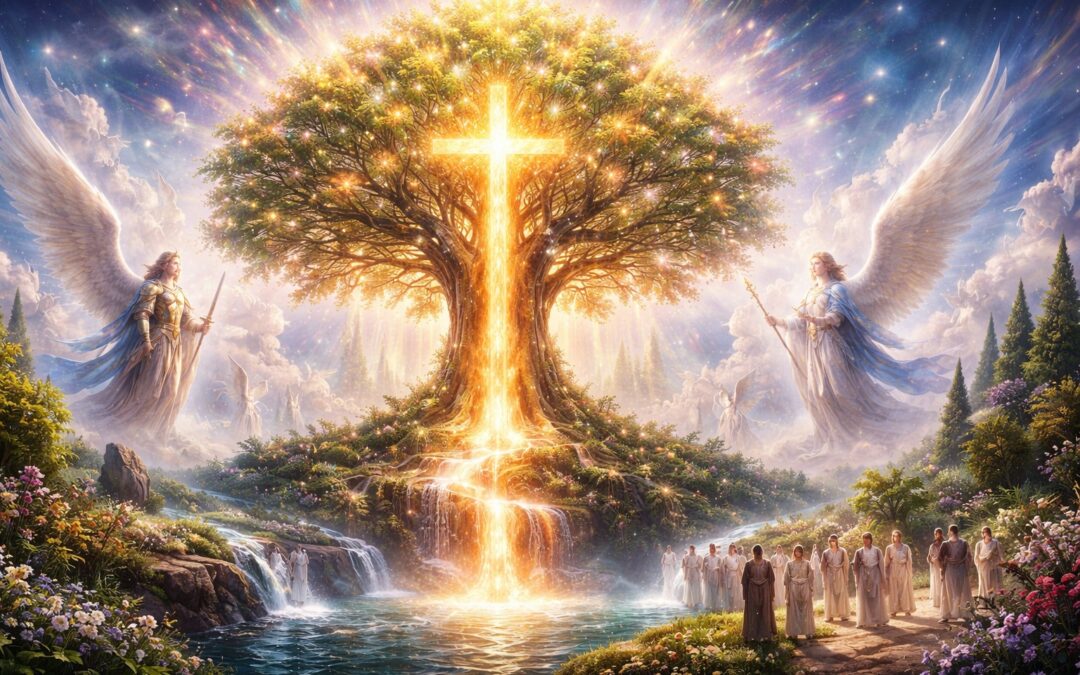
The Cruciform Zohar
Cruciform Demonology and Angelic Orthodoxy
The New Torah of the Transfigured Tree of Life in the Blood of King Messiah Yehoshua ben David
Apostle Brandon Barthrop
RLM TV Press
January 11, 2026
Abstract
This work presents Cruciform Demonology as the definitive rectification of the Zoharic concept of Sitra Achra—the realm of husks (kelipot) and impurity—through the atoning blood of Messiah Yehoshua ben David. Classical Zoharic demonological classifications—angeliform intelligences, anthropomorphic legalistic spirits bound to Torah structures, and chaotic bestial forces—are reinterpreted as expressions of a single fallen cosmological architecture identified here as the Fig Tree of Babylon the Great. This architecture is shown to be not reformed but decisively terminated through the Cross, which functions as a cosmic circumcision of the old heavens and earth. The blood of Messiah is revealed as the River of Fire proceeding from the Throne, transfiguring the Tree of Life into a Cruciform Olive Tree and fulfilling the mystery of engraftment articulated in Romans 11. On this basis, the work establishes Angelic Orthodoxy for the New Cosmos: a demon-displaced creation ordered under the universal High Priesthood of King Messiah, in whom Torah, Zoharic wisdom, and the New Covenant are consummated for Israel and the nations.
1. Introduction: The Call to Cruciform Kabbalah
The Zohar, the radiant heart of classical Kabbalah, discloses the mysteries of the divine Sefirot, the cosmic Tree of Life (Etz Chaim), and the Sitra Achra—the “Other Side,” a shadowed domain of fragmentation and impurity from which demonic powers (shedim) are understood to arise. Yet these disclosures are not self-contained metaphysics; they gesture forward, prophetically, toward a messianic fulfillment in which the divided cosmos is judged, healed, and reconstituted. This work contends that such fulfillment is realized in Messiah Yehoshua ben David, simultaneously the suffering Servant and the enthroned King, in whom judgment and restoration converge.
Early currents of Christian Kabbalah perceived fragments of this convergence. Renaissance figures such as Giovanni Pico della Mirandola and Johannes Reuchlin discerned Trinitarian resonances and messianic trajectories within the Sefirotic Tree, anticipating a redemptive consummation that would reconcile Kabbalistic wisdom with the gospel proclamation. Their insights, however, remained partial—suggestive rather than consummative—limited by historical horizon and theological restraint.
This study advances the claim that the decisive unveiling occurs through what is here termed Cruciform Kabbalah: the Cruciform Zohar. In this reading, the Cross is not merely an instrument of atonement within history but the cosmic axis upon which the old heavens and earth are judged and a new creation is inaugurated. The Cross shatters the jurisdiction of demonic dominion by terminating the architectural root from which it draws sustenance, thereby transfiguring the Tree of Life itself. What emerges is the New Olive Tree, a cruciformly ordered reality in which resurrection life replaces mediation, accusation, and fragmentation.
In the present age, the blood of the Lamb is revealed as the River of purifying fire proceeding from the Throne—cleansing, re-rooting, and engrafting. Through this outpouring, a New Israel is constituted: Jew and Gentile united not by lineage or law but by participation in crucified and risen life. This union establishes the foundations of Angelic Orthodoxy, wherein the restored cosmos is ordered under the High Priesthood of Messiah, and angelic ministry is aligned exclusively with the finished work of the Cross.
Here, therefore, the Tree radiates cruciform harmony—its branches aligned by sacrifice, its sap animated by resurrection, and its fruit borne for the healing of the nations.
2. The Old Heavens: Fig Tree Architecture and the Hierarchy of the Sitra Achra
Classical Zoharic literature, including the Ra‘aya Meheimna corpus within the Zohar, articulates a graded taxonomy of demonic powers arising from the Sitra Achra, the “Other Side.” These powers are not autonomous beings in the modern sense but manifestations of a parasitic cosmological architecture—the inverted Tree of Qlippoth—which subsists upon fractured holiness. Zoharic sources distinguish between (1) angeliform intelligences that retain vestigial order, (2) anthropomorphic legalistic forces bound to distorted covenantal structures, and (3) chaotic, bestial energies marked by dissolution and lawlessness. Together, these comprise a hierarchy of impurity mirroring, yet inverting, the holy Sefirotic order.
Within this framework, the Qlippoth are not rivals to the divine Sefirot but their husks—residual shells that persist wherever holiness is mediated without transformation. They draw vitality from uncrucified identity, from Torah or revelation held apart from consummation. The Sitra Achra thus represents not an alternate creation but a misaligned cosmos, sustained by fragmentation, accusation, and deferred fulfillment.
This demonic architecture finds its biblical symbol in the barren Fig Tree pronounced judgment by Messiah (cf. Gospel of Mark 11). The Fig Tree here signifies not Israel as a people, but an exhausted cosmological system: an order of the old heavens and earth incapable of bearing fruit because its root remains unhealed. In apocalyptic perspective, this system corresponds to Babylon the Great—a composite structure of exile, idolatry, and spiritual economy sustained by mediation rather than union.
The hierarchy of the Sitra Achra operates through layered distortion. Older covenantal forms, when detached from their messianic fulfillment, exert dominion over derivative or partial revelations that follow them. Each successive layer inherits fragmentation while intensifying dependence upon control, fear, and law as substitutes for life. In modern expressions, these distortions extend beyond religious systems into secularized forms of domination, where power is exercised through coercion, material absolutism, and the suppression of transcendent hope. Such manifestations are not novel evils but contemporary outworkings of the same Fig Tree architecture, translated into political, ideological, and economic registers.
These inverted orders together constitute what may be termed the old heavens: a stratified cosmology governed by mediation, accusation, and hierarchical distance from life itself. Their coherence depends upon the continued vitality of the Qlippothic tree. Once its root is severed, the entire structure collapses.
These Zoharic depictions thus disclose not merely a demonology, but a dark architectural mirror of the Tree of Life—an inverted system whose persistence anticipates its own termination by the Cross, where the old heavens pass away and a new creation is inaugurated.
3. Cruciform Obliteration: The Cross as the Axis of Tikkun
At the heart of Cruciform Kabbalah stands the Cross as the decisive axis of tikkun—not merely a moral correction within history, but a cosmic act of obliteration and reconstitution. The apostolic witness declares that through the crucifixion, Messiah “disarmed the principalities and powers, making a public spectacle of them” (Epistle to the Colossians 2:15). This disarming is not metaphorical rhetoric; it names a juridical and ontological event in which the governing structures of the old heavens are stripped of authority, jurisdiction, and continuity.
Classical Lurianic Kabbalah describes tikkun as the rectification of creation through the liberation of holy sparks trapped within the Qlippoth. Yet within the Cruciform Zohar, this rectification reaches its consummation not through gradual ascent alone, but through decisive execution. The Cross functions as the moment when the Sitra Achra is not merely repaired but terminated at its root. In the crucifixion, the husks that parasitized holiness are shattered, and the sparks they imprisoned are released not upward into abstraction, but inward into resurrection life.
Central to this act is the blood of Messiah Yehoshua ben David. No longer confined to the historical event of Golgotha, this blood is revealed apocalyptically as the River of Fire proceeding from the Throne—a current of judgment and purification simultaneously. Fire, in biblical and Zoharic idiom, does not merely destroy; it refines, separates, and consummates. As this River flows, it consumes impurity without annihilating creation, burning away all structures sustained by mediation, accusation, and uncrucified identity.
In this cruciform judgment, no demonic hierarchy survives. The graded distinctions of the Sitra Achra—angeliform, anthropomorphic, or bestial—are rendered irrelevant once their sustaining architecture is dismantled. Demons are not defeated as adversaries in combat; they are nullified as offices, deprived of the cosmological tree from which their authority derived. All stand equally disempowered, for the Cross abolishes the conditions of their existence.
Thus the Cross reveals itself as the true axis mundi. Whereas earlier cosmologies imagined ladders, mediating angels, or layered heavens, the Cruciform axis unites heaven and earth within the body of the Son. The Cross becomes the New Tree of Life, integrating the Sefirotic order not through balance of opposites but through cruciform harmony—Chokhmah and Binah reconciled in obedience, Chesed and Gevurah united in sacrificial love, and all flows gathered into Tiferet transfigured.
In this new order, tikkun is no longer an unfinished project entrusted to cosmic repair, but a completed reality entered through participation. The old axis collapses; the new axis stands eternally. Creation is no longer upheld by tension between holiness and husk, but by resurrection life flowing freely from the Lamb. This is Cruciform Obliteration: the end of the old heavens and the birth of a cosmos reconciled, purified, and permanently aligned in the Cross.
4. Cruciform Demonology: From Sitra Achra to Oblivion
Cruciform Demonology proceeds from a decisive redefinition of evil. In contrast to systems that locate demonic power in labels, lineages, or confessional identities, Cruciform Kabbalah identifies evil as architectural parasitism—a void that subsists only where life is mediated, deferred, or withheld from consummation. Within this framework, the Sitra Achra is not an opposing creation but a residual economy sustained by uncrucified structures. Once those structures are judged, the Sitra Achra has no remaining ontological ground.
Accordingly, all shedim—regardless of the religious, ideological, or cultural forms through which they historically manifested—are exposed as husks without substance. Their apparent distinctions correspond not to inherent power but to the degree of proximity their sustaining systems once had to revelation without fulfillment. Where Torah, gospel, or reason is held apart from cruciform consummation, husks emerge; where the Cross is embraced as finality, husks dissolve. No designation confers privilege; no tradition grants immunity. The Cross renders all parasitic orders equally void.
This nullification is enacted and sustained through the River of Fire proceeding from the Throne, revealed apocalyptically as the life of the Lamb in motion (cf. Book of Revelation 22). This River does not merely judge from without; it courses through the Tree of Life itself, purifying all who are engrafted into Messiah. Its fire consumes impurity without harming life, for it burns only what does not belong to resurrection. In this way, demonology gives way to participatory purification: believers are not protected from demons by barriers, but rendered inaccessible to them by union.
Cruciform Demonology therefore rejects all models of perpetual spiritual conflict. There is no ongoing parity between light and darkness, no cyclical resurgence of demonic authority, no negotiated coexistence between holiness and husk. The victory of the Cross is total and irreversible. Demons do not retreat; they expire. Their memory persists only as testimony to a world that has passed away.
What emerges is a demon-displaced existence—not an evacuated creation, but a reconstituted one. The old order, sustained by accusation, hierarchy, and mediation, comes to its end. In its place stands the New Cosmos, ordered entirely by cruciform life: a Tree rooted in the blood of the Lamb, watered by the River of Fire, and bearing fruit for the healing of the nations. Here, evil has no ecology, demons have no jurisdiction, and creation abides in rest.
This is the consummation of tikkun: not the management of impurity, but its oblivion. The Sitra Achra is not rebalanced; it is outlived. The Cross remains as the only axis, the Olive Tree as the only planting, and the Lamb as the only source of life. The old order ends; the New Cosmos begins—and has no end.
5. Cruciform Angelology and Angelic Orthodoxy
With the obliteration of the Sitra Achra and the displacement of all demonic architectures, angelic life is restored to its original and perfected vocation. Cruciform Angelology does not invent a new angelic order; it re-aligns the eternal hosts to their true axis—Messiah Yehoshua ben David, enthroned as the central flame of the Olive Tree Menorah in Araboth, the highest heaven. Here, angelic existence is no longer defined by mediation between God and humanity, but by service to the crucified and risen Son in whom heaven and earth are united.
Within this restored order, the holy archangels—Michael, Gabriel, and the innumerable hosts—stand not as autonomous authorities but as ministers of cruciform light. Michael, long associated with heavenly governance and defense, is revealed as guardian of the finished victory of the Cross; Gabriel, herald of divine speech, as messenger of consummated revelation rather than deferred promise. Their authority derives entirely from proximity to the Lamb, not from delegated dominion over nations or epochs.
This alignment is symbolized by the Olive Tree Menorah of Araboth. Unlike the fractured or inverted trees of the old heavens, this Menorah burns with a single oil: the life of Messiah poured out and returned in resurrection. The central shaft corresponds to the Son Himself, while all branches draw light only insofar as they remain grafted into Him. Angelic light does not originate independently; it radiates outward from the cruciform center, illuminating, guarding, and ordering creation in harmony with the New Covenant.
Angelic Orthodoxy, therefore, is defined not by mystical ascent or secret mediation, but by pure worship of YHVH through the Son. Angels neither seek nor accept veneration; they direct all glory to the Throne of God and of the Lamb. Deception, once possible through divided heavens and unfinished revelation, is rendered impossible, for there exists no longer any alternative axis from which false light could emanate. Where the Cross stands as the sole cosmic center, counterfeit illumination has no source.
In this demon-displaced cosmos, angelic ministry becomes transparently benevolent. The hosts serve the heirs of salvation not by governing them, but by safeguarding the environment of rest into which they have entered. Angels guard the River of Fire, attend the unfolding life of the Tree, and rejoice in the maturation of the New Israel—humanity fully aligned with heaven through cruciform union.
Thus, Cruciform Angelology consummates the long-awaited harmony between heaven and earth. The Menorah-Tree shines without shadow; the hosts serve without rivalry; worship ascends without distortion. Angelic Orthodoxy stands complete: a universal, deception-free order in which all celestial life finds its meaning in the Son, and all creation abides in the light of YHVH forever.
6. The New Cosmos: The Tree of Life in the River of Fire
With the collapse of the old heavens and the displacement of all parasitic architectures, creation emerges renewed—not repaired, but reconstituted. The New Cosmos is ordered entirely by the Tree of Life, now revealed in its cruciform fulfillment. What the Zohar intimated through symbol and emanation is here consummated through participation in Messiah Yehoshua ben David, in whom the divine order is no longer mediated but embodied.
In this renewed creation, the Sefirotic structure is harmonized rather than balanced by tension. Keter is revealed as the Father’s sovereign will, no longer distant or concealed, but fully expressed through the obedience of the Son. Tiferet, long understood as beauty, mercy, and harmony, is unveiled as Messiah Himself—the incarnate center where divine compassion and judgment meet without contradiction. Malkhut, once fractured and exiled, is restored as the redeemed Bride and Kingdom, no longer receptive alone but reigning in union. What was once distributed across emanations is gathered into living communion.
Governance within this cosmos proceeds through the eternal High Priesthood of Messiah. The New Torah is not an external code but an internalized order written into resurrection life. Authority flows not through hierarchy or enforcement, but through alignment with the life of the Son. Law is fulfilled as nature; obedience arises as rest. The priesthood no longer mediates between God and humanity, for humanity itself—crucified and raised in Messiah—has become the dwelling place of divine life.
Those engrafted into the Cruciform Olive Tree inherit this order as royal priests. Their inheritance is not merely future promise but present participation in a demon-displaced cosmology. Eternal life is not static immortality; it is dynamic circulation—the River of Fire flowing continuously from the Throne through the Tree and into all creation. This River is at once illumination, purification, and vitality. It sustains without exhausting, refines without destroying, and governs without coercion.
Within this New Cosmos, no realm lies outside the reach of life. Heaven and earth are no longer stratified domains but interpenetrating dimensions unified in Messiah. The Bride reigns with the King not by ascent away from creation, but by the transfiguration of creation itself. The nations are no longer objects of conquest or correction, but recipients of healing borne by the fruit of the Tree.
Thus the vision reaches its consummation: a universe ordered by cruciform love, animated by resurrection fire, and governed by a priesthood that shares in the Son’s own life. The Tree of Life stands unopposed; the River of Fire flows without obstruction; and the New Cosmos abides in unending communion with YHVH. What began as promise in Torah and symbol in Zohar now endures as living reality—forever.
Conclusion: The Fulfillment of Zohar and the Age of Cruciform Revelation
This work has set forth Cruciform Kabbalah as the consummation—not the negation—of Zoharic wisdom. What the Zohar disclosed in symbol, emanation, and guarded mystery is here revealed in historical, cosmic, and ontological fullness through the Cross of Messiah Yehoshua ben David. The tikkun long anticipated is neither deferred nor partial: it is accomplished. The Cross stands as the decisive act by which all fragmentation is judged, all husks are shattered, and the Tree of Life is transfigured into an eternal, living reality.
In this Cruciform fulfillment, the Tree is no longer subject to inversion, exile, or mediation. It stands as the Cruciform Olive Tree, rooted in the blood of the Lamb and animated by the River of Fire flowing from the Throne. The Sitra Achra has no remaining ground, for its existence depended entirely upon an unfinished cosmos. With the advent of resurrection life, the old heavens pass away—not reformed, but rendered obsolete. Demonic architectures, once sustained by distance, law, and accusation, are dissolved into oblivion by the presence of consummated life.
The emergence of New Israel marks the historical and cosmic turning point of this fulfillment. Jew and Gentile are engrafted together not by lineage, culture, or covenantal possession, but by participation in Messiah’s own transfigured life. This New Israel is not an abstraction or ideal community; it is a royal priesthood sharing in the eternal High Priesthood of the Son. Its authority is not exercised through domination or mediation, but through union, rest, and co-reign with the King.
Under the reign of King Yehoshua, the New Cosmos stands fully ordered. Angelic Orthodoxy is established without remainder: the holy hosts aligned exclusively to the cruciform center, worship rendered purely to YHVH through the Son, and all deception rendered impossible by the absence of alternative axes. Heaven and earth abide in harmony; the nations receive healing; creation rests in unbroken communion.
This, therefore, constitutes the highest Torah scholarship for the present age—an age no longer defined by concealment, ascent, or deferred rectification, but by unveiled participation. Torah is fulfilled as life. Zohar is fulfilledzor fulfilled as reality. The New Covenant is revealed as the permanent state of creation. What was written, hinted, and whispered through generations now stands openly manifest.
Angelic Orthodoxy is established.
Demonic dominion is extinguished.
The glory of YHVH fills all things.
The Cross remains the axis.
The Lamb remains the source.
The Tree of Life stands forever.
Bibliography
Primary Zoharic and Classical Kabbalistic Sources
- The Zohar. Various editions and recensions.
English translation consulted: The Zohar: Pritzker Edition, trans. Daniel C. Matt et al. Stanford: Stanford University Press.
(Especially Ra‘aya Meheimna, Tikkunei Zohar, and passages on Sitra Achra, Qlippoth, and shedim.) - Sefer ha-Bahir.
Early mystical text foundational to later Sefirotic symbolism and Tree imagery; consulted for emanational structure and divine attributes. - Isaac Luria.
Lurianic corpus (Etz Chaim, Sha‘ar ha-Gilgulim, and related teachings), particularly doctrines of shevirat ha-kelim (shattering of the vessels) and tikkun.
Biblical and New Covenant Texts
- Hebrew Bible.
Consulted throughout, especially prophetic and wisdom texts concerning Tree imagery, priesthood, exile, and restoration. - New Testament.
Principal focus on: - Romans 9–11 (engraftment, Olive Tree, New Israel)
- Colossians 1–2 (cosmic reconciliation; disarming of principalities)
- Hebrews 7–12 (eternal High Priesthood; heavenly reordering)
- Revelation 12, 21–22 (cosmic conflict resolved; River of Life/Fire; New Jerusalem)
Historical Christian Kabbalah
- Giovanni Pico della Mirandola.
Conclusiones and related writings engaging Kabbalah as a witness to Christian messianic truth. - Johannes Reuchlin.
De Arte Cabalistica and De Verbo Mirifico, foundational works in Christian engagement with Hebrew mystical traditions.
Jewish Mystical Demonology and Cosmology
- Secondary studies and classical discussions on:
- Sitra Achra as the “Other Side”
- Qlippoth as parasitic husks of holiness
- Zoharic classifications of shedim and inverted hierarchies
(Primarily drawn from Zoharic passages, Ra‘aya Meheimna, and later Safedian interpretations.)
Contemporary Cruciform and Messianic Kabbalah
- RLM TV Press.
Publications and teachings on Holy Christian Kabbalah, Cruciform Cosmology, the Two Trees (Fig Tree and Olive Tree), Angelic Orthodoxy, and the New Torah of Messiah Yehoshua ben David. - Barthrop, Brandon.
Selected works and broadcasts articulating Cruciform Arboreal Cosmology, Angelic Orthodoxy, and the demon-displaced New Creation.
(Primary contemporary interpretive lens for this study.)
Methodological Note
This bibliography reflects a fulfillment-oriented approach, reading classical Jewish mystical sources through the lens of the Cross and Resurrection, without supersessionist negation. Zoharic and Lurianic materials are treated as prophetic and architectural, consummated rather than discarded in the New Covenant reality of Messiah.
About the Author
Apostle Brandon Barthrop is the visionary founder of Red Letter Ministries (RLM TV Global), an apostolic teaching ministry devoted to unveiling Messiah Yehoshua ben David as the consummation of Torah, Zoharic wisdom, and the entirety of Holy Scripture. Serving at the intersection of biblical exegesis, classical Kabbalah, and New Covenant revelation, Barthrop’s work advances a rigorous, Spirit-led articulation of what he terms Cruciform Kabbalah—the revelation of the Cross as the cosmic axis through which all creation is judged, healed, and transfigured.
Through RLM TV Press, he has pioneered an integrated theological framework encompassing the Two Trees (the Fig Tree and the Olive Tree), Cruciform Demonology, and Angelic Orthodoxy, presenting these not as speculative mysticism but as fulfilled realities grounded in the eternal High Priesthood of Messiah. His teachings emphasize the formation of New Israel—Jew and Gentile united in resurrection life—called to inhabit a demon-displaced cosmos ordered entirely by the life of the Lamb.
Barthrop’s work is marked by its insistence on fulfillment rather than reform: Torah written as life, Zohar unveiled as architecture, and the New Covenant revealed as the permanent state of creation. His scholarship and broadcasts call the Church beyond mediation, fear, and religious performance into rest, union, and co-reign with King Messiah Yehoshua.
The present volume articulates the core framework of a larger, unfolding body of teaching—designed for expansion into further chapters, scholarly development, and prophetic application as the Ruach HaKodesh leads. It stands as both a theological foundation and a summons: to see clearly, to abide cruciformly, and to live within the unveiled glory of the New Cosmos.
Glory to YHVH.
Glory to the Lamb.
Glory to King Messiah forever.
