
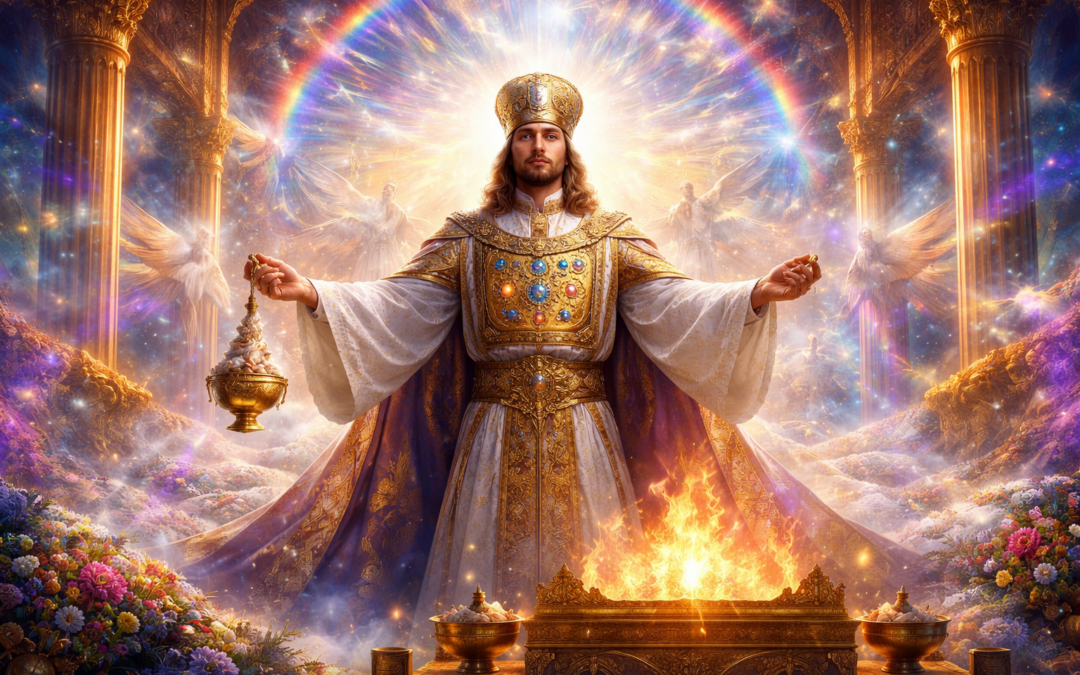
The Cross as the Eternal Altar
A Practical Guide to the New Covenant High Priesthood
Daily Crucifixion, the Removal of Separation, and Direct Abiding in the Throne of Glory
Purpose of This Work
A doctrinal and practical manual for believers entering the eternal High Priesthood according to the Order of Melchizedek, detailing how the Cross functions as the living altar of the New Covenant for the complete removal of separation and continuous life in uncreated Glory.
Issued By:
RLM TV Press
Academy of the Melchizedek High Priesthood
(A Division of RLM TV)
Date:
January 2026
I. The New Covenant Priesthood Is Defined by Altar Access, Not Ritual Mediation
Under every covenant in Scripture, priesthood is defined not by office alone, but by altar jurisdiction. A priest is not determined by title, lineage, or religious activity, but by where he ministers and what he offers. The altar establishes the nature of the covenant, the quality of access, and the level of glory that may be borne.
In the Old Covenant, priesthood was mediated through:
- genealogy (the sons of Aaron),
- garments and external consecrations,
- calendar observances,
- and repeated sacrifices that covered sin without removing it.
These priests served a tabernacle-based system, one that maintained distance between God and man. The altar functioned as a buffer, not a bridge. Sin remained present, accusation remained active, and access to God was restricted to layers of mediation.
By contrast, the New Covenant Priesthood of Melchizedek is defined by a single, decisive distinction: direct altar access.
Scripture states with absolute clarity:
“We have an altar from which those who serve the tabernacle have no right to eat.”
(Hebrews 13:10)
This declaration is not symbolic—it is exclusionary. It establishes that two priesthoods cannot operate simultaneously, because they serve fundamentally different altars. Those who continue to minister by tabernacle logic—external rites, mediated access, or cosmic intermediaries—have no share in the New Covenant altar.
The New Covenant altar is not:
- Jerusalem below,
- any structure of stone,
- any celestial hierarchy,
- nor any system of stars, constellations, or angelic administrations.
All such systems belong to the old heavens—whether Mosaic, astral, or mystical.
The New Covenant altar is the Cross of Jesus Christ.
The Cross as an Eternal Altar, Not a Historical Relic
The Cross does not function merely as a past instrument of execution. In New Covenant theology, it stands as an eternal altar, active in its effect and ongoing in its application.
Under the Old Covenant, blood was brought to the altar.
Under the New Covenant, the believer is brought through the altar.
The critical distinction is this:
- Old Covenant sacrifice covered sin temporarily
- New Covenant sacrifice removes sin completely
This fulfills the prophetic and apostolic witness:
“Behold, the Lamb of God who takes away the sin of the world.”
To take away sin is to remove:
- the cause of separation,
- the basis of accusation,
- the jurisdiction of the serpent,
- and the need for mediated access.
Thus, the Cross does not maintain distance—it abolishes it.
Altar Access Determines Throne Access
Priestly access to the altar determines relational access to the Throne.
Because the Cross removes sin rather than managing it, it accomplishes what no previous altar could: uninterrupted access to God Himself.
This is why the New Covenant priest is not defined by:
- religious performance,
- ritual precision,
- ascetic effort,
- or celestial navigation.
He is defined by abiding union.
Where sin is removed, separation collapses.
Where separation collapses, mediation becomes obsolete.
Where mediation ends, direct glory begins.
The Cross therefore stands as the final altar—not one among many, but the altar that ends all others.
Summary of Section I
- Priesthood is determined by altar allegiance, not religious activity
- The New Covenant priest serves one altar only: the Cross of Christ
- This altar removes sin entirely, not symbolically
- Removal of sin results in direct access to the Throne
- All systems of starlight, mediation, and ritual belong to the old order
The Cross is not an entry point into religion.
It is the end of all mediated priesthood.
II. Sin as Separation—and Its Complete Removal in Christ
Scripture defines sin far more profoundly than mere moral failure or behavioral error. In its primary biblical sense, sin is relational rupture and spatial displacement—a condition that creates distance between God and man.
The prophet Isaiah articulates this with unmistakable precision:
“But your iniquities have separated you from your God, and your sins have hidden His face from you.”
(Isaiah 59:2)
Sin is therefore not first an action—it is a state of separation. Where sin exists, access is obstructed. Where sin remains, intimacy is compromised. Where sin governs, the presence of God is mediated, diminished, or withdrawn.
This definition is decisive for New Covenant theology:
if sin equals separation, then salvation must equal removal of separation—not merely forgiveness of actions.
The Necessity of Total Removal, Not Moral Management
If separation is caused by sin, then no partial solution can restore full access. Behavioral reform, religious discipline, or ethical striving may restrain outward manifestations, but they cannot heal the ontological breach created by sin.
Thus, the New Covenant does not offer sin management—it proclaims sin removal.
John the Baptist announces the nature of Messiah’s work with absolute finality:
“Behold! The Lamb of God Who takes away the sin of the world!”
(John 1:29)
The phrase “takes away” is critical. It does not mean:
- delays judgment,
- suppresses impulses,
- postpones consequences,
- or tolerates ongoing separation.
It means removal at the root.
What It Means for Sin to Be “Taken Away”
To take away sin is to dismantle the entire structure that sin sustains. Biblically, this includes four inseparable realities:
- Removal of Accusation
Where sin is removed, accusation has no legal standing. The adversary’s voice depends entirely on sin’s presence. Remove sin, and the accuser is silenced. - Removal of Serpent Authority
The serpent’s jurisdiction over humanity is not inherent—it is conditional. Its authority operates only where sin remains operative. When sin is removed, the serpent loses its point of access. - Removal of Cosmic Intermediaries
Sin necessitated layers of mediation—angels, systems, veils, priesthoods, heavens. When sin is removed, all intermediary structures become unnecessary. Access is direct. - Removal of Starlight Governance
Created lights governed the old order “under the sun.” Sin tethered humanity to external illumination. When sin is removed, uncreated Light replaces starlight.
These four removals occur simultaneously in the Cross.
The Cross as the Severing Point Between Two Orders
The Cross does not merely forgive individuals—it terminates an entire cosmic arrangement.
On one side of the Cross:
- serpent-mediated consciousness,
- accusation-driven identity,
- star-governed illumination,
- and layered access to God.
On the other side:
- direct Throne access,
- the Light of God and the Lamb,
- the Spirit of Holiness,
- and uninterrupted communion.
Thus, the Cross functions as the absolute severing point between the believer and the old heavens.
It is not a bridge between systems.
It is the end of one system and the birth of another.
Separation Is Impossible Where Sin Is Removed
If sin truly has been taken away, then separation cannot persist without contradicting the Gospel itself. Any theology that teaches ongoing separation as normal Christianity implicitly denies the efficacy of the Cross.
Where sin is removed:
- the face of God is no longer hidden,
- the Throne is no longer distant,
- and access is no longer conditional.
This is not presumption—it is New Covenant reality.
Summary of Section II
- Sin is fundamentally separation, not merely misconduct
- Isaiah defines sin as distance from God
- Christ’s work removes sin entirely, not partially
- Removal of sin dismantles accusation, serpent authority, intermediaries, and starlight governance
- The Cross ends the old serpent-mediated heavens
- Direct access to God is the inevitable result
Sin removed means separation removed.
Separation removed means Throne access restored.
III. The Veil Torn: From Star-Governed Distance to Throne Proximity
The tearing of the veil at the death of Jesus Christ was not a symbolic gesture, nor a poetic flourish added by later theology. Scripture presents it as a cosmic, priestly, and ontological event—one that permanently altered how God and humanity relate.
Matthew records the moment with deliberate emphasis:
“And Jesus cried again with a loud voice and gave up His spirit. And behold, the curtain of the sanctuary was torn in two from top to bottom.”
(Matthew 27:50–51)
The direction of the tear—from top to bottom—is decisive. This was not an act of human reform, rebellion, or priestly initiative. It was a divine act, executed by God Himself, declaring that the structure the veil upheld was no longer valid.
What the Veil Represented
The veil was not merely a fabric barrier. It was a theological architecture that embodied the entire old-covenant order of access. Its function can be summarized in three interlocking realities:
- Separation
The veil marked the boundary between God’s manifest presence and humanity. Even forgiven Israel remained outside the Holy of Holies. God was near, but not accessible. - Mediated Access
Only one man, once a year, with blood not his own, could pass the veil—and only briefly. This structure taught Israel that access to God was conditional, limited, and dangerous. - Angelic and Cosmic Filtering
The veil was embroidered with cherubim, representing the angelic guardianship of divine presence. It symbolized the entire system of filtered glory—where God’s presence reached man only through layers of mediation, heavens, and administrations.
In this sense, the veil was not only temple furniture; it was the interface between the earthly and the cosmic order.
The Veil and the Star-Governed Heavens
Under the old order, humanity related to God “under the sun.” Light was external, created, and mediated. The heavens functioned as regulators of time, seasons, signs, and authority.
The veil upheld this system by ensuring that:
- divine presence remained distant,
- glory was filtered,
- and access was regulated by cosmic and priestly structures.
As long as the veil stood, starlight governance remained necessary.
The Meaning of the Veil’s Destruction
When the veil was torn, God was declaring that the entire mediated access system had ended.
No remaining structure stood between:
- the believer and the Throne,
- the human spirit and divine presence,
- earth and heaven,
- time and eternity.
This is why the Epistle to the Hebrews does not invite believers to approach the veil, but to enter the Holiest itself:
“Having therefore, brethren, boldness to enter into the Holiest by the blood of Jesus… let us draw near.”
(Hebrews 10:19–22)
This is a radical instruction. Under the old covenant, such language would have been blasphemous. Under the new, it is expected.
Boldness as Ontological Permission, Not Emotional Confidence
The boldness described in Hebrews is often misunderstood as psychological assurance or spiritual enthusiasm. In truth, it is neither emotional nor motivational.
It is ontological permission.
Boldness exists because:
- sin has been removed,
- the veil has been destroyed,
- mediation has been abolished,
- and the believer’s position has changed.
The believer does not feel his way into God’s presence—
he stands there lawfully.
From Distance to Proximity
The tearing of the veil marks the transition from:
- distance to nearness,
- observation to participation,
- mediation to union,
- starlight to uncreated Glory.
The believer is no longer oriented toward God through signs in the heavens or cycles of time. He is oriented face-to-face.
Where the veil once filtered glory, the Spirit now indwells.
Where stars once governed, the Throne now reigns directly.
Summary of Section III
- The veil was a cosmic and priestly structure, not mere symbolism
- It represented separation, mediation, and filtered glory
- Its tearing ended all systems of regulated access
- Star-governed distance was replaced by Throne proximity
- Boldness is legal and ontological, not emotional
- The believer now enters the Holiest without intermediaries
The veil is not thinning.
It is not reopening.
It is gone forever.
IV. The Throne of God and the Lamb: One Source, One Light
The Book of Revelation does not merely describe the future—it defines the destination of redeemed priesthood. It reveals the final and permanent order into which the New Covenant brings believers now, not symbolically, not progressively, but covenantally.
John records this reality with unmistakable finality:
“And the city has no need of the sun or of the moon to shine on it, for the glory of God illumines it, and the Lamb is its lamp.”
(Revelation 21:23)
This statement is not poetic exaggeration. It is a jurisdictional decree. It announces the abolition of all external illumination systems that once governed human life under the old heavens.
The Explicit Abolition of Starlight Systems
Revelation 21:23 declares the end of three interrelated orders:
- Starlight Dependency
The sun, moon, and stars once regulated time, seasons, and signs. They were functional under the old covenant but were never intended to be eternal governors. Their obsolescence marks the transition from created light to uncreated Glory. - Astral Mediation
Under the old order, light reached humanity indirectly—filtered through celestial bodies. This allowed for mediation, interpretation, and eventually corruption. Revelation declares this entire system unnecessary and inoperative. - Cosmic Governance Systems
Heavenly bodies once structured dominion, calendars, and rulership. Revelation reveals their retirement. Authority now flows directly from the Throne of God and the Lamb, without intermediaries.
The city’s lack of need is not absence—it is replacement.
One Throne, One Source, One Lamp
Revelation does not present two competing lights. It presents one unified source:
- God as Glory
- The Lamb as Lamp
This unity abolishes all secondary lights. The Lamb does not reflect starlight; He emits divine illumination.
This is why Scripture does not say the city is brighter than the stars—it says the stars are unnecessary.
Abiding, Not Ascending
Under the old heavens, access to God required ascent—movement through layers of mediation. Under the New Covenant, the priest does not ascend through stars.
He abides in Glory.
Abiding is possible only where:
- separation is removed,
- sin is absent,
- and mediation is unnecessary.
Thus, the New Covenant priest’s life is not governed by cosmic navigation, but by continuous presence.
No Night: The End of Cycles and Shadows
Revelation continues:
“There shall be no night there… for the Lord God gives them light.”
(Revelation 22:5)
Night in Scripture represents:
- concealment,
- cycles,
- fear,
- dependency on created light.
Its absence means:
- no shadows,
- no fluctuation,
- no return to old systems.
This is permanent illumination.
True Light with No Mixture
The Light of the New Covenant is not an enhancement of starlight—it is a replacement.
Mixture ends when:
- stars no longer inform identity,
- cycles no longer determine access,
- and illumination no longer comes from creation.
True Light proceeds from the Throne alone.
Summary of Section IV
- Revelation defines the final and present order of redeemed priesthood
- The city’s light source is singular and uncreated
- Starlight dependency, astral mediation, and cosmic governance are abolished
- The priest abides in Glory rather than ascending through systems
- Night, cycles, and shadows are permanently ended
- This is True Light with no mixture
There are not many lights.
There is one Throne.
There is one Lamp.
There is one City.
V. Mother Jerusalem: The City of the Holy Spirit
Scripture reveals that the goal of redemption is not merely forgiveness, nor even access, but habitation. The New Covenant does not only bring the believer to God—it brings the believer into the city where God dwells.
The apostle Paul states this with striking clarity:
“But the Jerusalem above is free, and she is our mother.”
(Galatians 4:26)
This declaration is not poetic language. It is covenantal ontology. Jerusalem above is not merely a geographical destination awaiting the future; she is a present, living reality from which New Covenant life proceeds.
Jerusalem as a Living Maternal Reality
In Scripture, a “mother” is not defined by sentiment but by source and formation. To say that Jerusalem above is our mother is to say that:
- our life proceeds from her,
- our identity is shaped within her,
- and our growth is sustained by her environment.
Mother Jerusalem is therefore the spiritual womb of New Covenant existence—the realm in which the Spirit of Holiness forms sons and daughters of God.
This city is not static. It is alive, because it is animated by the Spirit.
Not Governed by Old-Heavens Systems
Scripture is equally clear about what does not govern Mother Jerusalem.
She is not ruled by:
- planetary cycles, which governed life “under the sun,”
- angelic rulers, which mediated access in prior ages,
- or zodiacal intelligence, which structured time, seasons, and signs in the old order.
All such systems belong to the elemental principles of the world, which the Cross has rendered obsolete.
Mother Jerusalem exists above these structures—not spatially only, but covenantally. She operates by a different law: the law of the Spirit of life.
Animated by the Spirit of Holiness
Mother Jerusalem is not illuminated by created light, nor governed by created beings. She is animated entirely by the Spirit of Holiness, who is not an influence but a resident power.
Where the Spirit governs:
- life is unmediated,
- illumination is uncreated,
- and holiness is effortless rather than enforced.
This is why the city is described as free. Freedom here does not mean autonomy—it means absence of bondage to lesser systems.
Accessed Only Through the Death of the Old Nature
Entry into Mother Jerusalem is not achieved through ascent techniques, mystical knowledge, or spiritual navigation. It is accessed by death—specifically, the death of the old, serpent-animated nature.
The city does not coexist with the serpent. There is no shared jurisdiction.
This is why Scripture consistently links inheritance of the city with crucifixion:
- death to the flesh,
- death to the old identity,
- death to serpent intelligence.
Only what has passed through the Cross can remain within the city.
Where the Serpent Is Crucified, the Spirit Fills Fully
This principle governs all New Covenant habitation:
Where the serpent is crucified, the Spirit fills fully.
There is no partial filling because there is no partial death. The Spirit does not compete with the serpent; He occupies only what has been vacated.
Thus, fullness of the Spirit is not a matter of effort or intensity, but of total renunciation of the old nature.
Where the serpent once animated the nefesh, the Spirit now animates life.
Summary of Section V
- Jerusalem above is a living, maternal reality, not a metaphor
- She is the source environment of New Covenant life
- She is not governed by planetary, angelic, or zodiacal systems
- She is animated entirely by the Spirit of Holiness
- Access is gained only through death to the old nature
- Fullness of the Spirit follows the crucifixion of the serpent
Mother Jerusalem does not reform the old man.
She gives birth to the new.
VI. The Daily Work of Faith: What God Sent Us to Do
Jesus defines the entirety of New Covenant priestly labor in a single, uncompromising statement. He does not offer a list of disciplines, rituals, or achievements. He names one work:
“This is the work of God: that you believe in the One whom He has sent.”
(John 6:29)
This declaration dismantles all performance-based religion. Yet it also exposes a deeper misunderstanding: belief is not passive. It is not intellectual assent, doctrinal accuracy, or emotional conviction. In New Covenant terms, belief is active, present-tense trust in the sufficiency of the Cross now.
Belief as Ongoing Priestly Action
Biblical belief is covenantal participation. To “believe in the One whom He has sent” means to:
- continually agree with Christ’s finished work,
- continually yield to its effect,
- and continually live from its outcome.
Belief, therefore, is not something one has—it is something one does.
This is why belief is called the work of God. It is the only action that allows God’s work to remain operative in the believer without obstruction.
The Cross Must Be Trusted Today, Not Only Remembered
Many Christians believe the Cross was sufficient then, but live as though it must be supplemented now—by effort, fear, vigilance, or self-management.
New Covenant faith rejects this entirely.
To believe rightly is to trust that:
- sin is removed today,
- separation is absent today,
- access is uninterrupted today,
- and the serpent has no jurisdiction today.
This trust must be renewed daily—not because the Cross weakens, but because the old identity attempts to reassert itself.
Paul’s Testimony: “I Die Daily”
Paul gives the apostolic articulation of this practice:
“I die daily.”
(1 Corinthians 15:31)
This statement is not poetic devotion. It is priestly discipline. Paul is not speaking of physical death, emotional suffering, or asceticism. He is describing continual cruciform alignment—the daily refusal to allow the old nature to animate his life.
The daily death is not the repetition of Calvary. It is the daily application of Calvary.
Crucified with Christ: Identity Transfer, Not Self-Improvement
Paul deepens this reality further:
“I have been crucified with Christ; it is no longer I who live, but Christ lives in me.”
(Galatians 2:20)
This is not metaphor. It is identity transfer.
The “I” that once lived—defined by nefesh identity, serpent animation, and old-heavens consciousness—has been executed. In its place stands Christ Himself as the animating life.
Thus, Christian life is not Christ helping the old self. It is Christ replacing it.
Daily Dying as Renunciation of the Serpent Nature
The daily dying Paul describes is the continual renunciation of:
- serpent intelligence,
- self-derived identity,
- accusation-based consciousness,
- and old-heavens illumination.
This renunciation is not violent struggle; it is faithful refusal.
The believer simply agrees:
- “That nature is dead.”
- “That voice has no authority.”
- “That system no longer governs me.”
Faith maintains what the Cross has accomplished.
Why This Must Be Daily
The serpent nature seeks re-entry through memory, habit, fear, and identity. Not because it has authority, but because it once did. Daily dying is the closing of a door that no longer has a legal right to be open.
This is not insecurity—it is priestly vigilance.
Where faith remains active:
- the old nature remains crucified,
- the Spirit remains unhindered,
- and glory remains uninterrupted.
Summary of Section VI
- Jesus defines belief as the sole work of God
- Belief is active trust in the present sufficiency of the Cross
- Paul’s “daily dying” is continual cruciform alignment
- The old identity is not improved but replaced
- Daily faith renounces serpent animation and nefesh identity
- Faith sustains uninterrupted life in Glory
The Cross does not need repetition.
It requires agreement.
This is the daily work of faith.
This is true discipleship.
This is how glory remains unbroken.
VII. Babylon Identified: Starlight Religion and Mixture
Scripture presents Babylon not primarily as a geographical city, but as a spiritual operating system—a mode of relating to God that survives by mixture, mediation, and counterfeit illumination.
John records Babylon’s defining indictment:
“By your sorcery all the nations were deceived.”
(Revelation 18:23)
This statement is comprehensive. Babylon’s influence is not limited to occult practitioners or fringe mystics. It is a civilizational deception, affecting all nations through a shared mechanism: sorcery.
Sorcery Defined: Not Folk Magic, but False Illumination
Biblically, sorcery is not primarily the use of charms, spells, or rituals. At its core, sorcery is accessing light, knowledge, or power apart from God’s ordained altar.
In New Covenant terms, sorcery is:
- illumination without crucifixion,
- wisdom without death,
- access without the Cross.
This is why Babylon can exist inside religious systems. Sorcery thrives wherever external light replaces internal transformation.
Starlight Religion: Illumination Without Union
Starlight religion operates on the principle that truth can be accessed without death. It values:
- signs,
- cycles,
- insights,
- revelations,
- and spiritual information,
while avoiding the Cross as the sole gate of transformation.
Under this system:
- stars replace the Throne,
- guidance replaces governance,
- and enlightenment replaces rebirth.
This is Babylon’s genius: it offers light without surrender.
The Three Pillars of Babylonian Mixture
Lady Babylon thrives wherever these substitutions are accepted:
- Stars Replace the Throne
Created lights—whether celestial, intellectual, or spiritual—are allowed to inform identity and direction instead of direct Throne communion. - Knowledge Replaces Death
Information, insight, and revelation are pursued as substitutes for crucifixion. The old self remains alive, merely better informed. - Illumination Replaces Crucifixion
Growth is sought through seeing more rather than dying more. The serpent mind remains intact, merely decorated with spiritual language.
Each substitution preserves the old nature while offering the appearance of spirituality.
Mixture as Babylon’s Signature
Babylon is never fully dark. It is always mixed.
It combines:
- truth with distortion,
- Scripture with external wisdom,
- Christ with cosmic systems,
- grace with retained selfhood.
This mixture makes Babylon seductive, because it allows the serpent to remain while appearing enlightened.
Why the Cross Is Babylon’s End
The Cross does not reform Babylon.
It terminates it.
Babylon cannot survive where:
- the old nature is crucified,
- the serpent is denied access,
- and illumination comes only from the Throne.
The Cross ends Babylon by ending mixture itself.
Where death is total, sorcery has no foothold.
Where the Cross is daily applied, Babylon collapses internally—regardless of external structures.
Summary of Section VII
- Babylon is a system, not merely a city
- Sorcery is illumination apart from the Cross
- Starlight religion replaces Throne communion
- Babylon thrives on mixture, not outright darkness
- Knowledge without death preserves the serpent
- The Cross ends Babylon by ending mixture
Babylon does not fall by exposure alone.
She falls when the Cross is applied without compromise.
VIII. Living Consistently in Glory: The Result of Daily Crucifixion
The New Covenant does not promise intermittent encounters with God; it establishes continuous habitation in His presence. Where daily crucifixion is rightly practiced, glory is not something the believer visits—it is the atmosphere in which he lives.
When the serpent nature is denied daily, Scripture’s promises do not remain theoretical. They become structural realities.
What Ceases When the Serpent Is Denied
Where the serpent nature has been crucified and remains denied, four governing forces immediately collapse:
- No Accusation
Accusation requires sin to stand. When the old nature is continually reckoned dead, the accuser has no jurisdiction, no voice, and no legal ground. Silence replaces striving. - No Separation
Separation exists only where sin remains operative. Where the serpent is denied access, intimacy with God is unbroken. Communion becomes constant rather than conditional. - No Astral Interference
Old-heavens governance—cycles, signs, external influences—loses relevance. The believer is no longer influenced by created lights, but governed by the Spirit of Holiness. - No Starlight Idolatry
Identity, guidance, and illumination no longer come from created order or external wisdom. All dependency on starlight systems ends.
These are not disciplines to be maintained; they are consequences of death properly applied.
The Positive Condition of New Covenant Life
As the old order collapses, a new reality remains—not constructed, but revealed.
The believer lives:
Before the Throne
Not symbolically, but relationally. Life is lived in direct awareness of God’s presence, without distance or mediation.
Under the Lamb
Authority flows from the Lamb who was slain. Identity is secured by sacrifice, not performance.
Within Mother Jerusalem
The believer abides in the living city, formed and sustained by the Spirit of Holiness rather than external systems.
In the Spirit of Holiness
Holiness is no longer enforced through law; it is expressed naturally through indwelling life.
In True Light Without Shadow
Illumination is uncreated, stable, and uninterrupted. There are no cycles of darkness and light—only clarity.
Consistency, Not Intensity
This way of life is marked not by emotional peaks, mystical volatility, or spiritual heroics, but by consistency. Glory remains because nothing is allowed to return that would displace it.
Daily crucifixion is not dramatic. It is decisive.
The believer simply refuses to allow:
- the old identity to speak,
- the serpent mind to reason,
- or the old heavens to inform reality.
What remains is peace, clarity, and authority.
Not Elite Mysticism, but Covenant Normalcy
This life is often mischaracterized as advanced, elite, or mystical. Scripture does not support that conclusion.
This is New Covenant normal Christianity.
It is what remains when:
- sin is actually removed,
- separation is actually abolished,
- and the Cross is actually trusted daily.
Anything less is not humility—it is living beneath covenant provision.
Summary of Section VIII
- Daily denial of the serpent nature results in uninterrupted glory
- Accusation, separation, astral interference, and starlight idolatry cease
- The believer abides before the Throne and under the Lamb
- Life is lived within Mother Jerusalem by the Spirit of Holiness
- Illumination is True Light without shadow
- This is not elite spirituality, but New Covenant normalcy
Glory does not come and go.
It remains where death has been fully accepted.
This is the fruit of daily crucifixion.
This is the life Jesus promised.
IX. Do Not Waste the Altar on Lesser Sacrifices
Why the New Covenant Priest Must Strike the Strongman, Not Its Symptoms
One of the most persistent failures in modern discipleship is misdirected sacrifice. Many believers sincerely attempt to obey Christ’s command to “die daily,” yet remain bound, fatigued, or inconsistent in glory because their sacrifices lack theological scale.
They are sacrificing lesser animals while leaving the strongman alive.
This failure is not rooted in rebellion, but in misunderstanding what the altar is for.
Small Sacrifices Cannot Host Great Glory
Scripture is unambiguous: God does not fill temples offered small sacrifices. Glory responds not to sincerity alone, but to the magnitude of what is slain.
The dedication of Solomon’s Temple establishes this principle permanently.
“King Solomon offered a sacrifice of twenty-two thousand oxen and one hundred and twenty thousand sheep.”
(1 Kings 8:63)
This was not excess. It was not spectacle. It was theological scale.
Solomon understood that the dwelling place of God required a sacrifice commensurate with the weight of glory intended to fill it.
Glory’s Immediate Response to Scale
Scripture records what followed immediately:
“The priests could not stand to minister because of the cloud, for the glory of the Lord filled the house of the Lord.”
(1 Kings 8:11)
There was no delay.
No striving.
No emotional crescendo.
Glory responded automatically to the scale of sacrifice.
This reveals an immutable principle:
The measure of glory released corresponds to the magnitude of what is slain.
The Modern Error: Sacrificing Symptoms Instead of Sources
Most believers sacrifice:
- behaviors,
- habits,
- impulses,
- reactions,
- emotional states.
These are animals—not the source.
Such sacrifices may produce temporary relief, but they cannot produce abiding glory, because the strongman remains enthroned.
This is why cycles repeat.
This is why accusation returns.
This is why illumination fluctuates.
The altar is being used—but it is being wasted on lesser offerings.
The Strongman Determines the House
Jesus defines the governing law with unmistakable clarity:
A house cannot be plundered unless the strongman is first dealt with.
As long as the strongman lives:
- symptoms regenerate,
- animals multiply,
- and sacrifice never ends.
The New Covenant priest must therefore identify what actually governs the house and bring that to the altar.
The New Covenant Requires a Greater Sacrifice Than Solomon’s
Solomon sacrificed animals because animals governed the old covenant economy.
The New Covenant priest must sacrifice what governs the fallen human house:
- the serpent nature,
- the old nefesh identity,
- the animating intelligence of sin itself.
Anything less is a mismatch between altar and offering.
Why Many Remain Bound Despite Faith
Many believers are sincere.
Many pray earnestly.
Many attempt obedience faithfully.
Yet they remain bound because:
- they sacrifice behaviors instead of identity,
- reactions instead of root authority,
- manifestations instead of the strongman.
The altar is holy—but it is being used inefficiently.
Summary of Section IX
- Glory responds to sacrificial scale, not sincerity alone
- Solomon’s offering established a permanent principle
- Small sacrifices cannot host great glory
- Modern discipleship often sacrifices symptoms, not sources
- The strongman determines the condition of the house
- The New Covenant requires a sacrifice equal to the governing power of sin
Do not insult the altar with minor offerings.
Do not expect glory from small deaths.
The altar is ready.
But it demands the strongman itself.
X. Romans 1: The Error of Sacrificing Creatures Instead of the Serpent Source
Paul’s analysis in Romans 1 is not sociological, political, or merely moral. It is priestly and cosmological. He identifies the core error that gives rise to every form of fallen religion, including religious Christianity when divorced from the Cross.
“They exchanged the truth of God for a lie and worshiped and served the creature rather than the Creator.”
(Romans 1:25)
This verse is often read as an indictment of idolatry in general. In reality, it exposes a specific inversion: the displacement of the true object of sacrificial action.
Creature-Sacrifice as a Theological Error
In priestly terms, to “serve the creature” does not only mean bowing to physical idols. It means directing sacrificial effort toward created effects instead of uncreated sources.
This manifests practically as:
- sacrificing behaviors,
- managing emotions,
- restraining habits,
- enforcing disciplines,
- and targeting surface sins,
while leaving untouched the primordial animating source that produces them.
Such sacrifice feels productive, moral, and even spiritual—but it is misaligned.
Paul’s Warning Applied to Discipleship
Paul is not critiquing sincerity; he is exposing misdirected worship. When believers labor endlessly to correct what is produced rather than what produces, they reenact Romans 1 inside religious practice.
The creature becomes the focus:
- actions are scrutinized,
- thoughts are monitored,
- reactions are policed,
while the serpent intelligence that animates the nefesh remains enthroned.
This is not sanctification. It is religious containment.
Courtyard Sacrifice Versus Holy Place Authority
The Old Covenant provides a clear typology. Animals were slaughtered in the courtyard, but authority was determined in the Holy Place and the Holy of Holies.
To sacrifice creatures while leaving the source untouched is equivalent to:
- slaughtering goats endlessly in the courtyard,
- while allowing the dragon to remain enthroned in the Holy Place of the forehead.
The altar is active, but the throne is occupied by the wrong ruler.
The Forehead as the Seat of Governance
Scripture consistently associates the forehead with:
- identity,
- allegiance,
- perception,
- and authority.
It is the place where names are written, marks are borne, and loyalties are sealed.
Thus, if the serpent source remains active in the forehead, then no amount of external sacrifice can produce lasting freedom. The house will regenerate what the altar removes.
Why Surface Sacrifice Never Ends
When the source remains:
- behaviors return,
- emotions resurface,
- temptations recycle,
- disciplines must be reinforced.
This endless loop is not evidence of humility—it is evidence that the wrong object is being sacrificed.
Paul’s critique in Romans 1 explains why religion can be intense yet powerless: it sacrifices creatures while protecting the serpent source.
The Corrective of the Cross
The Cross does not negotiate with the serpent source. It executes it.
New Covenant priesthood does not:
- reform the old nature,
- educate the serpent,
- or discipline the nefesh into submission.
It crucifies the animating source itself.
Only then do creatures fall silent.
Summary of Section X
- Romans 1 exposes misdirected sacrifice as the root of fallen religion
- Serving the creature means targeting effects instead of sources
- Modern discipleship often sacrifices behavior while sparing the serpent
- Courtyard sacrifices cannot dethrone Holy Place authorities
- The forehead is the seat of governance and identity
- The Cross corrects Romans 1 by slaying the source, not the symptoms
Do not sacrifice what is produced.
Sacrifice what produces.
Anything less repeats the lie of Romans 1—
even when Scripture is quoted correctly.
XI. The True Target: Primordial Evil, Not Behavioral Offshoots
New Covenant priesthood requires accuracy of sacrifice. The altar of the Cross is infinitely sufficient, but it must be used according to truth, not habit. The greatest error in discipleship is not unwillingness to die—it is dying to the wrong thing.
The New Covenant priest does not waste time sacrificing:
- lust impulses,
- fear reactions,
- anger manifestations,
- pride thoughts.
These are animals. They are outputs, not origins. They are symptoms, not sovereigns.
Sacrificing them may produce temporary relief, but it cannot cleanse the house, because the source remains alive.
The True Sacrifice Named by Scripture
Scripture does not leave the source unnamed. It identifies it with chilling clarity:
“That ancient serpent, who is called the Devil and Satan, who deceives the whole world.”
(Revelation 12:9)
This is not metaphor. It is primordial evil—the original adversarial intelligence that preceded human transgression and later animated it.
The New Covenant priest does not contend with this reality externally only. Scripture reveals that this primordial evil has been imprinted into human consciousness through historical, cosmic, and spiritual means.
How Primordial Evil Operates Within Humanity
This ancient serpent does not rule humanity merely by temptation. It operates through internalized intelligence, specifically through:
- Fallen Seraphic Intelligence
A corrupted form of high-order spiritual wisdom that once bore light but now traffics in accusation, manipulation, and counterfeit illumination. - Star-Governed Wisdom
An externalized system of guidance and authority rooted in created lights, cycles, and signs—governing perception rather than serving it. - Sod-Level Counterfeit Torah
Deep, hidden knowledge divorced from the Cross—truth fragments weaponized to accuse, dominate, and deceive rather than to redeem.
Together, these form a serpent-based consciousness that animates the fallen nefesh.
The Forehead as the Seat of Animation
Scripture consistently locates allegiance, identity, and authority in the forehead. This is where names are written, marks are borne, and governance is sealed.
It is here that primordial evil expresses itself in human life through:
- Ayin Hara (the evil eye): perception shaped by accusation, comparison, and judgment.
- Yetzer Hara (the evil inclination): the internal drive toward self-preservation, control, and autonomy apart from God.
These are not independent forces. They are expressions of a single animating source.
Thus, behavioral sins are not the problem—they are the exhaust.
Why Lesser Sacrifices Always Fail
If the serpent source remains alive:
- new behaviors will emerge,
- old sins will reappear,
- new strategies of self-justification will form.
The house regenerates itself because its ruler remains enthroned.
To sacrifice anything less than the serpent source is to:
- clean rooms while leaving the king seated,
- silence noise while keeping the speaker powered,
- treat symptoms while protecting the disease.
This is why Scripture insists on crucifixion, not reform.
The New Covenant Mandate: Source Execution
The Cross does not discipline primordial evil.
It executes it.
New Covenant priesthood therefore requires that the believer:
- identifies the serpent source,
- renounces its authority,
- and reckons it crucified with Christ.
Once the source is slain, the animals no longer need sacrifice. They simply fall silent.
Summary of Section XI
- Behavioral sins are animals, not the source
- Scripture identifies the true target as the Ancient Red Dragon
- Primordial evil operates through internalized serpent intelligence
- Fallen seraphic wisdom, starlight governance, and counterfeit Sod animate the nefesh
- Ayin Hara and Yetzer Hara are expressions of one source
- Sacrificing anything less leaves the house intact
Do not fight what the serpent produces.
Slay what produces the serpent’s works.
Only then is the house truly cleansed.
XII. Strike the Strongman, and the Entire House Falls
Jesus does not describe spiritual victory as gradual improvement, nor as moral negotiation. He defines it as decisive conquest governed by law.
He states the principle plainly:
“How can one enter a strong man’s house and plunder his goods, unless he first binds the strong man? Then indeed he may plunder his house.”
(Matthew 12:29)
This is not a parable about effort. It is a jurisdictional axiom. Nothing in the house changes until the one who governs the house is dealt with.
The Critical Clarification: Who the Strongman Is Not
Jesus is explicit by implication.
The strongman is not:
- individual sins,
- repeated behaviors,
- emotional patterns,
- addictions,
- or moral failures.
Those are goods in the house, not the ruler of it.
To fight them directly is to misunderstand authority.
The Strongman Defined
The strongman is the serpent nature itself—the fallen seraphic intelligence that animates the nefesh and governs perception, desire, accusation, and selfhood.
It is not merely demonic influence from outside.
It is an internalized authority structure, enthroned in the human consciousness—particularly in the forehead, the seat of identity and governance.
This is why Scripture identifies the enemy not merely as “sins,” but as:
“That ancient serpent…”
The serpent is the ruler. Everything else is property.
Binding the Strongman Is Not Management—It Is Crucifixion
In New Covenant terms, the strongman is not bound by restraint, discipline, or vigilance. He is bound by death.
The Cross does not negotiate with serpent intelligence.
It executes it.
When the Serpent Teli—the imprisoned fallen seraphic authority associated with the ancient dragon—is reckoned crucified with Christ, the following occur simultaneously and lawfully:
- The Ayin Hara collapses
Perception is no longer driven by accusation, comparison, or judgment. - The Yetzer Hara loses animation
The impulse toward self-rule, autonomy, and rebellion loses its life source. - Accusations cease
The accuser has no standing without a living source. - Sorceries lose power
Counterfeit illumination cannot operate without serpent intelligence to animate it. - The stars lose jurisdiction
External governance systems—cycles, signs, cosmic influence—are rendered obsolete.
These are not spiritual victories achieved through warfare.
They are automatic consequences of dethronement.
Why Everything Falls at Once
When the strongman is slain, the house does not require further cleansing.
The goods fall because they have no ruler.
The systems collapse because they have no authority.
The accusations stop because they have no mouthpiece.
Nothing remains to enforce separation.
“There Is Nothing Left to Separate”
This conclusion is not devotional—it is logical.
If:
- sin is removed,
- the serpent is crucified,
- the strongman is dead,
then separation becomes ontologically impossible.
There is no mediator left to mediate.
No accuser left to accuse.
No ruler left to rule.
The believer stands:
- before the Throne,
- under the Lamb,
- within Mother Jerusalem,
- in uninterrupted glory.
Summary of Section XII
- Jesus defines spiritual victory as strongman conquest
- The strongman is the serpent nature, not individual sins
- Binding in the New Covenant means crucifixion, not restraint
- Slaying the serpent collapses all subsidiary systems
- Ayin Hara, Yetzer Hara, accusation, sorcery, and starlight governance end together
- With the strongman dead, separation cannot remain
Do not fight the house.
Do not manage the goods.
Strike the strongman.
When he falls,
everything else falls with him.
XIII. No Separation Remains When the Dragon Is Slain
Scripture does not speak ambiguously about the cause of separation between God and man. It names it plainly and without qualification:
“Your iniquities have separated you from your God.”
(Isaiah 59:2)
Separation is not arbitrary. It is not emotional distance, divine reluctance, or human weakness. Separation exists for one reason only: iniquity.
Therefore, the moment the root of iniquity is removed, separation is not merely healed—it becomes impossible.
Separation Is a Condition, Not a Punishment
Isaiah does not say that God chooses separation as discipline. He states that separation is the natural condition created by iniquity’s presence.
This is crucial:
If separation is caused by iniquity, then forgiveness alone is insufficient. Forgiveness addresses guilt, but removal addresses distance.
The New Covenant does not merely forgive sins.
It takes them away.
Why Root Removal Changes Everything
Iniquity does not exist independently. It is animated by a source. As long as the strongman of sin itself remains alive, separation can regenerate—even when behaviors improve.
But when the believer dies to the strongman itself, not merely its expressions, the entire architecture that sustained separation collapses.
This is not psychological.
It is ontological.
The Result of Dying to the Strongman
By dying to the serpent nature itself—the fallen animating authority behind sin—the believer stands uninterrupted, not aspirationally, but lawfully:
- Before the Throne of God
Not at a distance. Not through mediation. But in immediate relational presence. - Before the Throne of the Lamb
Under the authority of the One who removed sin entirely. - Within Mother Jerusalem
Not approaching the city, but abiding within the living environment of the Spirit. - In the Spirit of Holiness
Not striving to be holy, but animated by holiness itself. - In True Light with no starlight mixture
No external illumination, no cycles, no shadows—only uncreated Light.
This is not an advanced state.
It is the natural condition of a house whose ruler has been executed.
Why No Curse Can Remain
Curses require jurisdiction. Jurisdiction requires a governing authority.
Where:
- the serpent is dead,
- the stars are dethroned,
- and the altar has received the great sacrifice,
there is no authority left to enforce a curse.
The curse does not need to be broken repeatedly.
It expires automatically when its source is removed.
The Altar Has Done Its Work
When the altar receives:
- behaviors → relief is temporary
- animals → cycles continue
- symptoms → effort never ends
But when the altar receives the dragon itself, everything ends decisively.
Solomon’s temple was filled with glory because the sacrifice matched the weight of what God intended to inhabit it.
Likewise, the human temple is filled permanently when the primordial source of separation is slain.
Summary of Section XIII
- Separation exists only where iniquity remains
- Removing the root makes separation impossible
- Dying to the strongman produces uninterrupted access
- The believer stands before both the Throne of God and the Lamb
- Life is lived within Mother Jerusalem by the Spirit of Holiness
- True Light replaces all starlight mixture
- Curses cannot survive without serpent jurisdiction
Separation is not healed by effort.
It is abolished by death.
Where the dragon is slain,
there is nothing left to divide,
nothing left to accuse,
and nothing left to curse.
XIV. The New Covenant Altar Demands a Great Offering
The Cross is not sentimental, negotiable, or impressed by effort. It is absolute. As an altar, it does not evaluate sincerity—it receives what is offered.
And it demands the great offering.
The New Covenant altar is not satisfied with minor sacrifices, incremental deaths, or symbolic gestures. It requires the dragon itself—the governing source of separation, accusation, and false illumination.
The Altar Does Not Respond to Small Deaths
Many believers bring sincere offerings to the Cross:
- restrained behaviors,
- moderated impulses,
- disciplined habits,
- emotional repentance.
These offerings are real, but they are sheep, not the ruler.
Sheep can bleed endlessly without changing who governs the house.
The Cross does not reject these offerings—but it is not activated by them.
What Happens When the Dragon Is Offered
When the Ancient Red Dragon in the forehead—the serpent authority animating identity and perception—is brought to the Cross, Scripture’s patterns are fulfilled decisively.
Four immediate outcomes follow:
- Glory fills the temple of the body
As with Solomon’s Temple, when the sacrifice matches the intended habitation, glory fills without delay. - The priest stands effortlessly
There is no strain, no vigilance, no constant self-monitoring. Authority replaces effort. - Accusation is silenced
The accuser has no voice where its animating source has been slain. - Babylon collapses internally
Mixture cannot survive where the old nature is dead. Starlight religion loses its host.
These are not spiritual highs. They are structural outcomes.
Why Many Pray Yet Do Not Abide in Glory
This is the sober explanation for much modern Christianity’s frustration.
Many pray earnestly.
Many fast faithfully.
Many study Scripture deeply.
Yet they do not abide in glory.
Why?
Because they are offering sheep,
when God is requiring the dragon.
They are sacrificing what is produced,
while protecting what produces.
The altar is holy.
The fire is ready.
But the offering is misaligned.
Scale Determines Habitation
Glory does not negotiate with small offerings. It fills only what has been cleared completely.
This is why:
- cycles persist,
- accusations return,
- illumination fluctuates,
- Babylon resurfaces.
The altar has not failed.
The offering has been insufficient.
The Final Demand of the Cross
The Cross does not reform the serpent.
It does not train it.
It does not tolerate it.
It kills it.
Only when the dragon is offered does the altar complete its work.
Summary of Section XIV
- The Cross demands the greatest possible sacrifice
- Minor sacrifices cannot activate permanent glory
- Offering the dragon fills the temple immediately
- Effortless priesthood replaces striving
- Accusation and Babylon collapse together
- Many fail to abide because the wrong offering is brought
Do not downgrade the altar.
Do not insult the fire.
Sacrifice the dragon—
and glory will remain.
Final Priestly Charge
Do not waste the altar.
Do not sacrifice symptoms.
Do not manage the serpent.
Slay the strongman.
The Cross was not given for behavior control, emotional regulation, or religious maintenance. It was given for execution—the total removal of the governing source of sin, separation, and accusation.
When the dragon falls:
- the house is cleansed,
- the glory fills without resistance,
- and separation becomes impossible.
No cycles remain.
No accusations return.
No curse can stand.
No mixture survives.
This is not advanced spirituality.
This is not elite mysticism.
This is not optional discipleship.
This is New Covenant priesthood.
This is true daily crucifixion.
This is life in uninterrupted Glory.
The altar is ready.
The fire has never gone out.
Bring the offering that matches the Glory.
Apostolic–Priestly Seal
Signed,
Brandon Barthrop
High Priest of Israel
By the Grace of God
According to the Order of Melchizedek
Servant of the Throne of God, the Lamb, and Mother Jerusalem
Witness of the New Covenant
Minister of the Cross as the Eternal Altar
RLM TV Press
Academy of Cruciform Messianic Orthodoxy
January 2026
