
Listen to the Audio Version
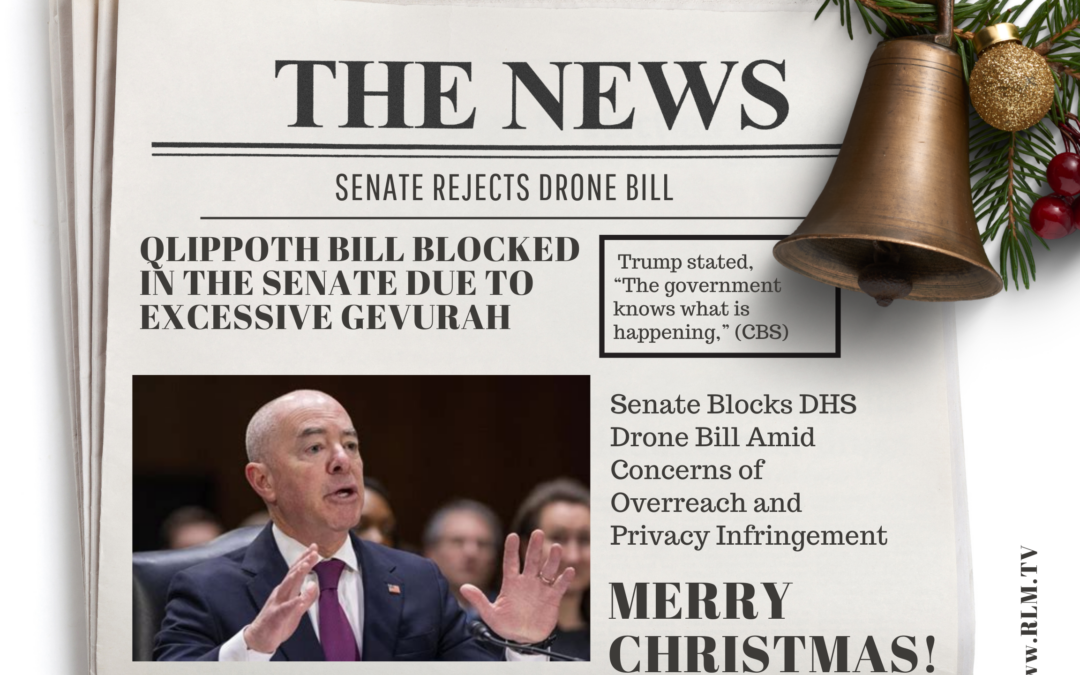
Senate Blocks DHS Drone Bill Amid Concerns of Overreach and Privacy Infringement
In a decisive turn of events on December 18, 2024, the U.S. Senate voted to halt progress on the “Safeguarding the Homeland from the Threats Posed by Unmanned Aircraft Systems Act of 2023” (S.1631), originally introduced by Senator Gary Peters on May 16, 2023 (Congress.gov). The legislation, championed by Department of Homeland Security (DHS) Secretary Alejandro Mayorkas—who has been accused of perjury in prior Congressional testimonies—sought to grant both the DHS and the Department of Justice (DOJ) broad authority to detect, monitor, and neutralize drones. Despite being positioned as vital for national security, this proposed expansion of power attracted strong criticism for its potential to trample constitutional rights, prompting widespread debates about federal overreach and personal privacy infringements (AP News).
Critics of the bill underscored the longstanding claim—voiced by Donald Trump in public statements—that federal officials already know the origins of many drones spotted in U.S. airspace. In a press conference, Trump stated, “The government knows what is happening,” implying that the mystery surrounding these aerial vehicles is less about an actual security threat and more about fostering a climate of fear to garner support for the legislation (CBS News; The Australian). Detractors further contended that S.1631 was being deployed as a diversionary tactic, pressuring the public and Congress to accelerate the bill’s passage despite serious civil liberty implications.
“Opponents criticized the bill as a manifestation of unchecked authority, drawing parallels to the Kabbalistic concept of Gevurah (severity), often associated with strict judgment. While their arguments did not explicitly reference Hesed (kindness) or Hokhmah (wisdom), their critique reflects a broader concern that such concentration of power risks overshadowing the balance, compassion, and wisdom essential for ethical governance. Privacy advocates cautioned that endorsing such sweeping counter-drone measures—especially when the government has historically engaged in domestic surveillance—would repeat past mistakes in which national anxieties were exploited to grant extraordinary powers to federal agencies (PROPUBLICA PROJECTS).”
KEY PROVISIONS OF THE BILL
Expansion of Detection and Mitigation Powers
S.1631 would sanction federal entities to intercept drone communications and disable any unmanned aircraft deemed suspicious. Opponents insist this bypasses due process and could infringe upon property rights (Congress.gov; PROPUBLICA PROJECTS).
Empowerment of Local Law Enforcement
By integrating state, local, tribal, and territorial agencies into federal counter-drone operations, the proposed pilot program risked blending federal and local jurisdictions in ways that might erode vital constitutional safeguards (Houlahan House; AMERICAN BAR ASSOCIATION).
Critical Infrastructure Safeguards
The measure would authorize airports, stadiums, and other major facilities to deploy specialized drone-detection technologies—potentially extending surveillance to peaceful activities, thereby chilling free expression (Houlahan House; AMERICAN BAR ASSOCIATION).
Incident Database Creation
DHS would maintain a central repository of drone-related incidents, prompting fears of a vast government database susceptible to misuse or unauthorized disclosures (Houlahan House; AMERICAN BAR ASSOCIATION).
Privacy Safeguards
Though the legislation vowed to respect Fourth Amendment rights, its ambiguous guidelines for storing and using seized data raised red flags among legal experts (Congress.gov; PROPUBLICA PROJECTS).
ALLEGATIONS OF A “DRONE DIVERSION”
The urgency with which the administration sought this bill’s passage has been called into question, given public claims (including those from President-elect Donald Trump) that the government is already well-informed about the true nature and source of these drone incursions, indicating that they pose limited genuine threat. Such remarks have reinforced the notion that the frenzy may be manufactured to push Americans and lawmakers into endorsing expansive new monitoring powers.
He further suggested that the military should disclose information about these drone sightings to the public, stating, “For some reason, they don’t want to comment. And I think they’d be better off saying what it is our military knows and our president knows” (CBS News).
OPPOSITION IN THE SENATE
Leading criticism of S.1631 was Senator Rand Paul, who warned during Senate debates that “we cannot sacrifice liberty for the sake of security” (Reuters; ACLU). From a Kabbalistic standpoint, granting unbridled state power mirrors the Qlippoth: destructive energies that corrupt higher purpose. Observers stressed that even if certain targeted drones were indeed suspicious, rushed legislation would undercut bedrock democratic norms without ensuring robust judicial checks.
HISTORICAL PRECEDENTS OF GOVERNMENT OVERREACH
Concerns about exploiting drones to justify surveillance mirror other moments in American history when public alarm paved the way for government overreach:
Operation Northwoods (1962)
Declassified Department of Defense documents reveal proposed false flag attacks—like staging plane hijackings—to drum up public support for an invasion of Cuba. Though never carried out, these plans demonstrate how fear can be harnessed to endorse intrusive policies (INDYMEDIA).
Gulf of Tonkin Incident (1964)
Misreported attacks on U.S. vessels in Southeast Asia galvanized Congress to pass a resolution granting President Lyndon B. Johnson sweeping war powers, absent a formal declaration of war (INDYMEDIA; WIKIPEDIA).
Post-9/11 Surveillance Expansion
In the aftermath of the September 11 attacks, the USA PATRIOT Act dramatically broadened intelligence-gathering powers. Later leaks confirmed the National Security Agency (NSA) conducted mass monitoring of American citizens’ communications, revealing far more extensive spying than previously acknowledged (PROPUBLICA PROJECTS; ACLU).
BROADER IMPLICATIONS
Had S.1631 been enacted, it would have multiplied surveillance capabilities and endorsed drone neutralization—even in scenarios lacking judicial endorsement—and permitted expansive data-gathering provisions with insufficient oversight. As historical examples illustrate, laws passed in an atmosphere of alarm often compromise civil liberties long after the initial crisis wanes. “Incidents like these have been used to justify earlier expansions of surveillance,” said one observer familiar with declassified government documents. “We’ve seen the government leverage fear to legitimize programs ultimately proven invasive and unconstitutional.”
The Senate’s refusal to fast-track the bill evokes Hesed: a balanced response ensuring that constitutional principles remain intact alongside public safety. This decision invites further reflection on how governance can uphold ethics, echoing the Torah’s reminder to “seek justice, love mercy, and walk humbly with your God” (Micah 6:8). For some skeptics, the drone debate’s abrupt pivot also underscores the need to question official narratives—especially when past revelations have confirmed that government entities have, at times, surveilled Americans without their knowledge.
ONGOING SCRUTINY: MAYORKAS’ TESTIMONY
In parallel to the drone controversy, House Judiciary Chairman Rep. Jim Jordan, joined by Rep. Tom McClintock, has accused Secretary Mayorkas of potentially lying under oath regarding border security. Their letter, dated September 5, 2023, cites recent reports allegedly contradicting Mayorkas’ testimony that anyone posing a national security threat is always detained. New information indicates a foreign national with ISIS ties helped more than 120 individuals from nations like Uzbekistan and Chechnya enter the United States, reportedly requesting asylum and then being released—despite Mayorkas’ prior statements (House Judiciary Committee; The Daily Caller). These disclosures heighten skepticism toward DHS claims of comprehensive security protocols, fueling fears of overreach in proposed drone policies as well.
CONCLUSION
Although preventing dangerous drone activity is a legitimate concern, the Senate’s decision to block S.1631 highlights a broader truth: legislation forged amid anxiety often risks tilting toward excessive government power. History has repeatedly shown that new powers, when granted under duress or misinformation, can endure well beyond any single crisis, reconfiguring the landscape of citizens’ rights. From Operation Northwoods to the NSA’s mass data collection, declassified records reveal how public fear can be manipulated to justify far-reaching surveillance (ACLU; INDYMEDIA).
Ultimately, a measured approach—anchored in transparency, respect for civil liberties, and the nuanced interplay of Hesed and Gevurah—remains indispensable. The nation’s governance must balance its authentic security needs against the foundational values that define American democratic life. To many, the prospect of an all-powerful federal apparatus is as disquieting as the drone threats it purports to neutralize.
