
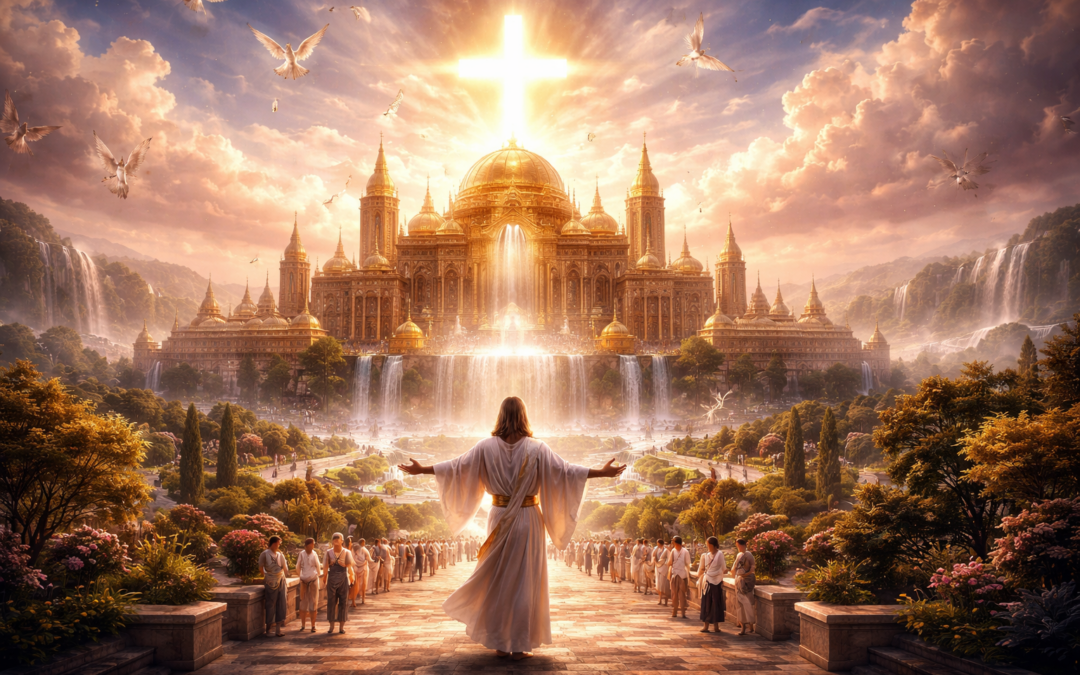
Cruciform Judaism
The Fulfillment of Sod-of-Sod Torah in Moshiach Yehoshua
Ontology, Cosmology, and the Anthropology of the New Heavens and New Earth
Author Brandon Barthrop
Publisher RLM TV Press Academy of Cruciform Judaism Minneapolis, Minnesota, USA
Abstract
This paper presents Cruciform Judaism as the final, eternal, and Messianic fulfillment of all Judaism at the Sod-of-Sod level of Torah—the level at which Torah no longer functions merely as law, symbol, or mystical map, but as ontological reality. At this deepest stratum, Torah governs not behavior alone but being itself; not religious order but cosmic order; not interpretation but incarnation.
Drawing from classical Jewish mystical ontology, cosmology, Temple theology, and prophetic anthropology—now unveiled through the revelation of Moshiach Yehoshua (Jesus Christ)—this work demonstrates that the Cross is not an interruption of Judaism, nor a later Christian innovation, but the hidden axis upon which Torah, Kabbalah, prophecy, and creation itself have always turned. What was concealed within the Torah’s deepest wisdom is now revealed openly in the crucified and risen Messiah.
Cruciform Judaism is shown to be the Kingdom-Age orthodoxy, wherein Torah is fulfilled not by preservation or reform, but by consummation. Kabbalah reaches its terminus not in endless ascent or emanational speculation, but in embodied union with the Living Torah. Prophecy is no longer deferred, Temple theology is no longer externalized, and anthropology is no longer governed by Adamic or animal frameworks. All are gathered into the cruciform life of the Son.
This fulfillment issues forth now from the Throne of YHVH Abba, the Throne of Moshiach Yehoshua, and the City of Ima Jerusalem—the Holy Spirit, who functions not merely as power or presence, but as the living, maternal City of God in which redeemed humanity dwells. From this triune throne-city flows the reality of the New Heavens and the New Earth, defined not by brighter stars or renewed cosmic mechanisms, but by uncreated Light, crucified being, and shared divine governance.
This paper establishes Cruciform Judaism as the final form and function of redeemed human anthropology, the end of stellar and angelic mediation, and the restoration of humanity as the living Temple of God. In this Kingdom Age, Judaism is not abolished, Christianity is not detached, and Kabbalah is not denied—but all are fulfilled, transformed, and eternally established in the Person of Moshiach Yehoshua.
Introduction
1. The Crisis of Judaism Without Messiah and Christianity Without Torah
The modern religious landscape reveals a profound dual crisis. On one side stands Judaism largely severed from its Messianic fulfillment—rich in Torah, tradition, and mystical depth, yet awaiting the ontological resolution promised by the prophets. On the other side stands Christianity frequently detached from Torah—proclaiming Messiah while often severing Him from the very covenantal, cosmological, and anthropological framework He came to fulfill.
Judaism without Messiah remains structurally unfinished. Its symbols persist, its calendar turns, its prayers ascend, yet the deepest promises of transformation—new hearts, indwelling glory, resurrected anthropology, and restored cosmic order—remain deferred. Torah is honored, but its ultimate telos is held at a distance. The result is a faith that preserves memory without consummation.
Christianity without Torah, however, suffers an equal and opposite distortion. Messiah is proclaimed, yet too often abstracted from Israel, Temple, covenant, and cosmic purpose. The Cross is reduced to legal pardon rather than ontological re-creation. Salvation becomes personal escape rather than covenantal fulfillment. Detached from Torah, Christianity risks becoming ahistorical, anti-cosmic, and anthropologically shallow.
Cruciform Judaism arises precisely at the point where these two crises are healed—not by compromise, but by fulfillment. Messiah does not abolish Torah, and Torah does not remain external to Messiah. In Moshiach Yehoshua, Torah reaches embodiment, and Messiah receives His proper Jewish, covenantal, and cosmic identity.
2. The Failure of Externalized Law, Mysticism, and Cosmology
At the Sod-of-Sod level, Torah was never intended to remain external—whether as law written on stone, mystical diagrams mapped in the heavens, or cosmological systems governing humanity from above. Externalized Torah, even when holy, inevitably produces distance between God and man.
Law external to the heart produces compliance without transformation. Mysticism external to the body produces knowledge without union. Cosmology external to humanity produces governance without sonship. In every case, what remains outside man ultimately governs him rather than indwelling him.
This externalization explains why law devolves into legalism, mysticism into sorcery, and cosmology into fatalism. Even sacred systems, when not fulfilled inwardly, become mechanisms of control rather than vehicles of life. The prophets foresaw this failure and declared its remedy: a Torah written within, a Spirit poured out, and a glory dwelling among—and within—redeemed humanity.
Cruciform Judaism confronts this failure directly. It proclaims that what remains outside must pass through death, and what is crucified must be raised within. Only through the Cross does Torah move from command to constitution, from diagram to DNA, from heavenly pattern to embodied life.
3. Sod-of-Sod Torah as the Domain of Ontology and Cosmology
Sod-of-Sod Torah does not primarily address ethics, rituals, or esoteric knowledge. It addresses being. At this depth, Torah governs the structure of existence itself—how heaven and earth relate, how divine life inhabits creation, and how humanity is constituted as a dwelling place for God.
Ontology answers the question: What is a human being? Cosmology answers the question: How does reality hold together? Sod-of-Sod Torah answers both, revealing that creation was designed for indwelling glory, not distant governance. Humanity was fashioned to host divine life, not merely obey divine instruction.
Without fulfillment, Sod-of-Sod Torah remains a map without arrival. With fulfillment, it becomes lived reality. Moshiach Yehoshua does not merely interpret Sod-of-Sod Torah; He is its embodiment. In Him, ontology is healed and cosmology is reordered—not by force, but by union.
4. Why Fulfillment—Not Correction—Is the Messianic Principle
Messianic fulfillment does not operate by revision or reform. Messiah does not correct Torah as though it were deficient; He fulfills it because it was prophetic. Torah was never wrong—it was unfinished.
Correction implies error. Fulfillment implies destiny.
The Messianic principle is therefore not replacement, abolition, or modification, but consummation. Every shadow anticipates substance. Every symbol awaits incarnation. Every command points toward a life capable of embodying it.
In the Cross, Torah reaches its appointed end—not as termination, but as completion. What could not be achieved through external command is accomplished through crucified union. Fulfillment is achieved not by greater effort, but by death and resurrection—by the end of Adamic being and the birth of new creation life.
5. The Emergence of Cruciform Judaism in the Kingdom Age
Cruciform Judaism emerges not as a historical novelty, but as an eschatological unveiling. It is the form Judaism takes when Messiah reigns from within His people and when the Kingdom of God is no longer anticipated but manifested.
The Kingdom Age is marked by internalized governance, shared throne life, and indwelling glory. In this age, Torah is no longer mediated through institutions alone, nor is Messiah encountered merely through confession. Both are lived as cruciform existence.
Cruciform Judaism names this reality: Judaism fulfilled in Messiah, Messiah revealed through Torah, and humanity restored as the living Temple of God. It is the orthodoxy of the New Heavens and New Earth, already breaking into history through the reign of Moshiach Yehoshua.
Chapter I – What Sod-of-Sod Torah Actually Governs
1. Sod-of-Sod as Ontological Reality, Not Symbolic Mysticism
Sod-of-Sod is not the realm of symbols, metaphors, or abstract speculation. It is the level of Torah where being itself is addressed. At this depth, Torah does not merely describe reality—it constitutes it. Sod-of-Sod governs what a thing is, how it exists, and how it participates in divine life.
When Sod-of-Sod is reduced to symbolism, it becomes detached from lived reality and devolves into intellectual mysticism. Symbols may inspire, but they do not transform. The prophets and sages understood Sod-of-Sod not as hidden information to be decoded, but as hidden life to be revealed.
Moshiach Yehoshua does not decode Sod-of-Sod Torah; He embodies it. In Him, the hidden depths of Torah are no longer concealed within texts, diagrams, or angelic administrations. They stand revealed as a living, crucified, resurrected human being. Ontology replaces interpretation. Life replaces speculation.
2. Torah as Cosmic Architecture
Torah is not merely instruction for Israel; it is the architectural blueprint of creation. Scripture repeatedly testifies that the world itself was formed through divine wisdom and word. At the Sod-of-Sod level, Torah is the structural grammar of heaven and earth—the order by which light, life, time, and being are sustained.
Yet architecture is not the same as habitation. A blueprint is not a dwelling. Prior to fulfillment, Torah functioned as cosmic design without final occupancy. Angels administered it, stars reflected it, and Israel stewarded it, but humanity had not yet become its living house.
The Cross marks the transition from architecture to habitation. In Moshiach Yehoshua, Torah is no longer suspended above creation as governing structure alone; it is installed within redeemed flesh. The cosmic design finds its dwelling place. Heaven and earth meet not in systems, but in a Person.
3. The Difference Between Interpretive Sod and Embodied Sod
Interpretive Sod seeks understanding through insight, correspondence, and mystical alignment. It maps relationships between worlds, symbols, numbers, letters, and celestial patterns. While lawful within its season, interpretive Sod remains external to the one who studies it.
Embodied Sod, by contrast, is Torah lived as crucified existence. It is not known by analysis but by participation. One does not stand beneath embodied Sod and observe; one is placed within it through death and resurrection.
The decisive difference lies here: interpretive Sod increases knowledge; embodied Sod transforms nature. The former can be studied without surrender; the latter requires the end of the self. This is why Messiah does not initiate disciples into techniques of ascent, but into a way of death.
4. Why Sod Without Crucifixion Becomes Sorcery
Any engagement with Sod-of-Sod Torah that bypasses crucifixion inevitably seeks power without death, light without surrender, and knowledge without transformation. This is the essence of sorcery.
Sorcery is not defined by evil intent but by illegitimate access—access to spiritual power apart from ontological transformation. When Sod is accessed through technique rather than through the Cross, the result is manipulation rather than union. Even holy truths, when not crucified, become instruments of control.
The Cross is therefore not optional to Sod-of-Sod Torah; it is its gate. Only crucified being can safely inhabit the deepest wisdom of God. In this way, Cruciform Judaism safeguards Torah’s highest mysteries by fulfilling them rather than exploiting them. Sod-of-Sod Torah does not belong to the clever or the powerful. It belongs to the crucified.
Chapter II – The Cross as the Hidden Axis of Torah
1. The Cross Concealed in Torah, Temple, and Prophecy
The Cross did not enter history as a foreign instrument imposed upon Israel’s Scriptures. It was concealed within Torah from the beginning, embedded as the structural axis around which covenant, sacrifice, priesthood, and prophecy revolved. What later appeared openly at Golgotha had long been present in pattern, shadow, and form.
Torah consistently reveals a vertical–horizontal intersection: heaven meeting earth, God meeting man, life passing through death. Altars stand between realms. Blood mediates ascent. Wood bears offering. Fire completes the exchange. These are not incidental motifs; they are the grammar of redemption written into Israel’s sacred life.
The Temple itself embodied this hidden axis. From the outer court to the Holy of Holies, from the altar of sacrifice to the mercy seat, every movement was cruciform—approach through death, cleansing through blood, ascent through mediated presence. Prophecy echoed the same logic: suffering preceding glory, death preceding resurrection, humiliation preceding enthronement.
The Cross therefore does not reinterpret Torah retroactively. It unveils what Torah was always saying at its deepest level.
2. The Akedah, the Bronze Serpent, and the Altar Pattern
The Akedah—the binding of Isaac—stands as one of the clearest revelations of the Cross hidden within Torah. A beloved son carries the wood of his own offering, ascends the mountain appointed by God, submits to death, and is returned as living promise. Though Isaac was spared, the pattern was established: covenant advances through willing self-offering.
The Bronze Serpent reveals the same cruciform logic. Lifted upon a pole between heaven and earth, the image of judgment becomes the means of healing. Death is confronted openly, elevated rather than hidden, and neutralized through divine command. The instrument of curse becomes the conduit of life.
The altar system gathers these revelations into daily practice. Every sacrifice reenacted the same truth: approach to God requires passage through death, substitution, and fire. The altar was not merely a place of ritual—it was the meeting point of heaven and earth, life and death, judgment and mercy.
These patterns were not placeholders awaiting removal. They were prophetic witnesses awaiting fulfillment.
3. Why the Cross Is the Eternal Torah Interface
An interface is the point at which two realms interact. The Cross functions eternally as the interface between God and creation, spirit and flesh, heaven and earth. Torah itself required such an interface, because divine holiness cannot be accessed directly by untransformed humanity.
Before Messiah, this interface operated through altars, priests, sacrifices, and angelic mediation. After Messiah, the interface is no longer external or repetitive. It is embodied once and for all in Moshiach Yehoshua.
The Cross does not cancel Torah’s interface; it perfects it. What was mediated temporarily through ritual is now mediated permanently through crucified and resurrected life. Access to God is no longer seasonal, institutional, or symbolic—it is ontological.
This is why the Cross remains eternal even in the New Heavens and New Earth. It is not a momentary solution to sin but the everlasting mode of divine–human communion.
4. The Cross as the True Tree of Life
In Eden, the Tree of Life stood at the center of creation, offering immortal participation in divine life. Humanity was barred from it not because the Tree failed, but because fallen being could not safely partake of eternal life.
The Cross is the Tree of Life reopened—not by bypassing death, but by passing through it. Where Adam reached for life without surrender, Moshiach offers life through obedience unto death. The wood of the Cross replaces the guarded Tree, not as a lesser substitute, but as its fulfilled form.
From this Tree flows living water, healing the nations and restoring creation. Its fruit is borne in crucified flesh; its leaves are the mercy extended through resurrection life. Access to the Tree is now granted not to the untested, but to the crucified and raised.
Thus the Cross stands at the center of the New Creation as it once stood hidden at the heart of Torah. It is the eternal axis upon which heaven and earth turn.
Chapter III – Moshiach Yehoshua as Fulfilled Kabbalah
1. The Sefirot Fulfilled, Not Preserved
The Sefirot were never intended to function as eternal, autonomous structures governing redeemed humanity. They served as revelatory vessels—channels through which divine light could be communicated, measured, and mediated within a fallen and untransformed creation. As such, they were provisional by design.
To preserve the Sefirot as permanent governance is to misunderstand their prophetic nature. Fulfillment does not discard them, but neither does it freeze them in place. Just as sacrifice is fulfilled in the Cross and priesthood in the Son, so the Sefirot are fulfilled in the incarnate Messiah. What was distributed across emanations is gathered into a single living Person.
In Moshiach Yehoshua, wisdom is no longer Chokhmah above man, understanding no longer Binah hovering over creation, mercy no longer Chesed mediated externally, and kingship no longer Malkut awaiting manifestation. All are fulfilled inwardly as the indwelling Christ. Preservation would imply incompletion; fulfillment declares arrival.
2. The End of External Emanation Governance
Emanation theology functioned lawfully within a world where divine life could not yet dwell fully within humanity. Governance therefore occurred through gradations—angels, luminaries, and Sefirotic structures administering light from without.
The incarnation ends this necessity. When divine life takes residence within human flesh, external governance gives way to internal union. Authority is no longer exercised over man through descending channels, but through shared life ascending from within Christ’s Body.
This is not the destruction of order, but its maturation. Just as childhood tutors give way to mature sonship, so emanational governance yields to participatory reign. The Kingdom does not abolish hierarchy—it internalizes it.
3. Moshiach as Living Ontology, Not a Node Within the Tree
One of the great errors of post-Messianic mysticism is the attempt to locate Messiah within the Tree of the Sefirot—as a harmonizing center, a perfected Tiferet, or an exalted mediator among emanations. Such positioning subtly subordinates Messiah to the very structures He fulfills.
Moshiach Yehoshua is not a node within the Tree; He is the reality toward which the Tree always pointed. The Tree was a map. Messiah is the destination. To place Him within the map is to mistake signpost for substance.
As living ontology, Moshiach does not merely balance divine attributes—He is their unified expression. Being itself is reconstituted in Him. Ontology is no longer abstract or distributed; it is personal, crucified, resurrected, and shareable.
4. Why Kabbalah Ends in Incarnation
All true Kabbalah presses toward embodiment. Wisdom that does not incarnate becomes detached from life and eventually corrupts into technique. The ultimate test of mystical truth is whether it can be lived without violating love, humility, and self-giving.
Incarnation is therefore not a departure from Kabbalah, but its climax. In Moshiach Yehoshua, divine wisdom does not remain in the heavens, nor does it circulate endlessly through symbolic structures. It takes flesh, enters death, and rises as glorified humanity.
Kabbalah that refuses incarnation inevitably seeks ascent without surrender and knowledge without death. Kabbalah that embraces incarnation finds its end—not as termination, but as fulfillment—in cruciform life.
Thus, Kabbalah does not culminate in higher diagrams, deeper secrets, or superior techniques. It culminates in the Person of Moshiach Yehoshua, in whom all wisdom dwells bodily.
Chapter IV – Ontological Redemption: From Being-in-Law to Being-in-Christ
1. Adamic Ontology and Fractured Being
Adamic humanity was created for union, not merely obedience. Before transgression, human being was integrated—spirit, soul, and body aligned under divine indwelling. Identity flowed from participation in God’s life rather than from external command. When Adam fell, the rupture was not primarily ethical; it was ontological. Being itself fractured.
This fracture produced divided existence: inward dissonance, outward striving, and dependence on external structures for order and meaning. Humanity did not merely do wrong; humanity became disordered. Law entered this condition as restraint and guidance, but not as cure. Torah could govern fractured being, but it could not heal it.
Adamic ontology is therefore characterized by distance—between God and man, between intention and action, between knowledge and life. Religion arises as humanity’s attempt to manage this distance. Ontological redemption requires not instruction, but re-creation.
2. Sin as Ontological Separation, Not Moral Failure
Sin is commonly reduced to moral infraction, yet Scripture consistently treats it as separation from life. Death enters not as punishment alone, but as consequence of disconnection from divine being. To frame sin merely as ethical failure is to underestimate its depth and overestimate the power of moral reform.
Ontological separation explains why law can expose sin but cannot remove it, why discipline can restrain behavior but cannot restore life, and why knowledge alone cannot heal the human condition. The problem lies not in what humanity does, but in what humanity is apart from God.
Redemption must therefore address being itself. Forgiveness without transformation leaves the fracture intact. Only reunion—life rejoined to Life—can resolve sin at its root.
3. The Cross as Ontological Circumcision
Circumcision in Torah signified covenantal belonging through the cutting away of flesh. At the Sod-of-Sod level, it pointed toward a deeper operation: the removal of Adamic being itself. The Cross accomplishes this circumcision not symbolically, but ontologically.
In the crucifixion of Moshiach Yehoshua, the old humanity is brought to its appointed end. Adamic ontology—defined by separation, self-preservation, and external law—is judged, cut off, and buried. This is not behavioral correction but existential termination.
Ontological circumcision means that the old self is not improved, educated, or spiritually upgraded. It is crucified. What remains is not Adam refined, but Christ revealed as new being.
4. New Covenant Being as Crucified Existence
The New Covenant does not introduce a new rule set; it introduces a new mode of existence. To be “in Christ” is not a metaphor—it is an ontological state. The believer’s life is now defined by participation in Messiah’s death and resurrection.
Crucified existence means that identity no longer arises from self-effort, lineage, or law observance, but from shared life with the crucified and risen Son. Obedience flows from union, not obligation. Righteousness emerges from indwelling life, not external enforcement.
This is the heart of ontological redemption: humanity no longer lives under Torah, but as fulfilled Torah in Christ. Being itself has changed. The fracture is healed not by repair, but by death and resurrection.
Chapter V – Cosmological Redemption: From Star Governance to Throne Governance
1. Mazalot as Pre-Cross Governance
Before the incarnation, death, and resurrection of Moshiach Yehoshua, creation was governed through mediated light. The Mazalot—constellations, luminaries, and appointed heavenly orders—functioned as lawful instruments within God’s providential design. They marked times and seasons, regulated rhythms, and served as governing signs within a creation not yet indwelt by uncreated life.
This governance was not pagan in origin, nor inherently idolatrous. It was a temporary stewardship assigned within a world awaiting redemption. Israel was given Torah precisely so that she might relate rightly to this cosmic order—neither worshiping the stars nor denying their function, but discerning their limits.
Mazalot governance belonged to a creation still external to divine indwelling. Light was reflected, not embodied. Authority descended from above, not shared from within.
2. The Lawful but Temporary Rule of Luminaries
The luminaries ruled lawfully only because humanity had not yet been restored ontologically. Where divine life does not yet dwell within man, governance must occur through external structures—angelic administrations, celestial cycles, and appointed powers.
Scripture consistently affirms this provisional rule. The heavens declare, measure, and witness—but they do not perfect. Their authority was real but limited, serving as custodians rather than heirs. Like the Law itself, the stars governed until the coming of maturity.
To absolutize luminary rule is therefore to mistake stewardship for sovereignty. The stars were never intended to reign forever. They awaited the moment when governance would pass from signs in the heavens to sons on the earth.
3. The Dethronement of Stellar Mediation
The Cross marks the decisive transfer of cosmic authority. When Moshiach Yehoshua entered death and emerged resurrected, the need for stellar mediation ended. Divine light no longer required reflection through created luminaries; it took residence within glorified humanity.
This is not annihilation of the heavens, but their subordination. The stars do not disappear; they lose their governing role. Mediation gives way to participation. What once ruled from above now serves beneath the throne of the Lamb.
Stellar mediation becomes obsolete not because it was evil, but because it was fulfilled. The Cross ends distance-based governance by establishing union-based reign.
4. The Lamb as the Light of the New Cosmos
The New Heavens are not brighter versions of the old order. They are defined by a different kind of light altogether. Scripture declares that the City has no need of sun or moon, for the glory of God illumines it, and the Lamb is its lamp.
This is not poetic exaggeration; it is ontological declaration. Light no longer arrives through created intermediaries. It proceeds directly from the Throne through the crucified and risen Messiah.
The Lamb as Light signifies the end of mediated cosmology. Creation is no longer governed by cycles, signs, or external powers, but by shared life with the Son. The cosmos itself is reordered around cruciform union. In this New Creation, humanity does not read the heavens for guidance. Humanity reigns with the Lamb from within the Throne.
Chapter VI – The New Heavens: Cruciform Cosmology
1. Why the New Heavens Are Not Upgraded Stars
The promise of the New Heavens does not describe an enhanced version of the existing celestial order. It announces the end of one mode of heaven and the emergence of another. Scripture does not speak of brighter luminaries, refined constellations, or improved astral systems, but of a heavens defined by the immediate presence of God.
To imagine the New Heavens as upgraded stars is to misunderstand redemption as renovation rather than re-creation. The former adjusts existing structures; the latter brings forth an entirely new order of being. The Cross does not repair the old heavens—it brings them to completion and supersedes them.
The former heavens were structured around mediated light and delegated governance. The New Heavens are structured around indwelling glory and shared reign. This is not a quantitative increase in light, but a qualitative transformation of what light is.
2. The End of Second-Heaven Administration
Second-heaven administration refers to the intermediary realm in which angelic powers, principalities, and delegated authorities governed creation in the absence of ontologically redeemed humanity. This administration was lawful within its appointed season, functioning as stewardship rather than sovereignty.
With the resurrection and ascension of Moshiach Yehoshua, this administrative necessity ended. Authority was transferred not merely from angels to Messiah, but from external administration to internal participation. Governance now proceeds from the Throne through union with the Son.
This does not deny the existence of angels; it reorders their role. Angels are no longer governors of redeemed humanity, but ministers within a Kingdom where the sons reign with Christ. The New Heavens therefore signify the end of mediated authority and the beginning of mature sonship.
3. Heaven Defined by Uncreated Light
Heaven in its final form is not defined by location, altitude, or hierarchy, but by light—specifically, uncreated Light. Created light can illuminate, reflect, and govern, but it cannot impart life. Uncreated Light is the very life of God shared with His creation.
Scripture declares that the City has no need of sun or moon, not because creation is discarded, but because its purpose is fulfilled. The Lamb Himself becomes the lamp, and the glory of God fills all things. Heaven is thus defined not by structures, but by presence.
Uncreated Light abolishes distance. There is no shadow, no mediation, no separation. To dwell in heaven is to dwell in God, and to have God dwell within.
4. The Cross as the Measure of Angelic–Human Maturity
In the New Heavens, maturity is not measured by power, knowledge, or proximity to divine mysteries, but by conformity to the Cross. The Cross becomes the universal measure of readiness to bear uncreated Light.
Angelic beings excel in power and obedience, yet humanity is invited into something greater: shared sonship through crucified union. The Cross marks the threshold where human and angelic realms are rightly ordered—not by domination, but by participation in divine self-giving love.
This is why Scripture speaks of humanity judging angels. It is not a statement of superiority, but of maturity. Those who have passed through death into resurrected life are entrusted with governance not because they are stronger, but because they are crucified.
The New Heavens are therefore cruciform in nature. They are sustained not by brilliance alone, but by self-giving life. The Cross remains the measure of all glory.
Chapter VII – The New Earth: Cruciform Anthropology
1. Earth as the Final Temple
The New Earth is not a return to Edenic innocence nor a mere restoration of natural order. It is the consummation of God’s desire to dwell fully with humanity. From the beginning, creation was oriented toward Temple—not as a building placed within the world, but as the world itself becoming God’s dwelling.
In the Old Covenant, the Temple localized divine presence because humanity could not yet bear indwelling glory. Sacred space compensated for fractured being. In the New Creation, this localization is no longer necessary. The entire earth becomes Temple because redeemed humanity becomes its living structure.
Earth is therefore no longer neutral ground or testing field. It is sanctified habitation. Heaven descends not to visit, but to remain. The New Earth exists where God dwells with man without mediation, distance, or barrier.
2. The Body as Fulfilled Mishkan
The Mishkan—the tabernacle in the wilderness—was a mobile dwelling of God among Israel, designed to move with the people until a permanent habitation could be established. At the Sod-of-Sod level, the Mishkan prefigured the human body as God’s intended dwelling place.
In Moshiach Yehoshua, this intention is fulfilled. The Word becomes flesh, and the divine presence takes residence not in fabric and gold, but in human body. Through union with Christ, believers are incorporated into this same reality.
The body is no longer a temporary vessel awaiting escape, nor a biological shell to be transcended. It is the site of glory. Resurrection does not abolish embodiment; it perfects it. The Mishkan finds its fulfillment not in architecture, but in anthropology.
3. Anthropology as Priesthood, Not Biology
Human identity in the New Covenant is defined by function, not form. Anthropology is no longer rooted in biological classification, cultural role, or natural lineage. It is defined by priesthood—by one’s capacity to host, mediate, and express divine life.
Priesthood at this level is not an office reserved for a class, but the vocation of redeemed humanity itself. Every believer participates in this priesthood through crucified union with the Son. Life becomes liturgy; existence becomes offering.
This priestly anthropology transcends natural distinctions without erasing them. Biology remains, but it no longer governs identity. Being is determined by indwelling glory rather than by natural descent.
4. The Death of Animal Nefesh Religion
Animal nefesh religion arises when human life is governed primarily by instinct, appetite, fear, and self-preservation. Even when clothed in sacred language, such religion remains centered on survival rather than sacrifice, blessing rather than transformation.
The Cross brings animal nefesh religion to its end. Crucified existence cannot be sustained by instinctual spirituality. It requires the surrender of self-preserving life and the reception of resurrection life.
The New Earth is populated not by religious animals seeking divine favor, but by crucified sons and daughters bearing divine life. Worship is no longer transactional. Obedience is no longer fear-driven. Life itself becomes the altar upon which glory rests.
Chapter VIII – Ima Jerusalem: The Holy Spirit as the Eternal City
1. Jerusalem Above as Living Mother
Scripture identifies Jerusalem above not as an abstract location, but as a living reality: “the Jerusalem above is free, and she is our mother.” This maternal language is not poetic excess; it reveals the ontological source from which New Covenant life is born, sustained, and matured.
Ima Jerusalem is the womb of New Creation. She is the realm in which divine life gestates, forms, and is brought forth in redeemed humanity. Just as earthly Jerusalem once localized God’s presence, Jerusalem above now births and nourishes a people capable of bearing that presence fully.
Motherhood here signifies origin, nurture, and continuity of life. The Kingdom is not generated by force, command, or external compliance, but by birth from above. Ima Jerusalem is therefore not a destination reached by ascent, but a mother from whom life proceeds.
2. The Spirit as City, Not Force
The Holy Spirit is often reduced to power, influence, or manifestation. While the Spirit does empower and act, such reduction obscures the deeper truth: the Spirit constitutes a habitable realm. Scripture speaks of believers dwelling in the Spirit and the Spirit dwelling in them.
A city is a shared life-space—a place of order, culture, law, and relationship. To identify the Spirit as City is to affirm that divine life is not episodic but residential. The Spirit is not an occasional visitation but the permanent environment of New Covenant existence.
This understanding rescues pneumatology from utilitarianism. The Spirit is not a tool to accomplish tasks, but the very context in which redeemed life unfolds. To live in the Spirit is to live within Ima Jerusalem.
3. The Bride as Inhabited Jerusalem
The descent of the New Jerusalem is not the arrival of architecture, but the unveiling of a people. The City is described as a Bride because it is constituted by relationship, union, and indwelling glory.
The Bride does not visit Jerusalem; she is Jerusalem. Each stone is living, each gate relational, each foundation apostolic. The City exists wherever crucified and resurrected humanity is filled with the Spirit.
This is why the City descends rather than humanity ascending. God brings His dwelling to man because man has become capable of bearing it. The Bride is Jerusalem inhabited, illuminated, and ordered by divine life.
4. The Law of the City: Cruciform Life
Every city operates by a law—not merely written codes, but a way of life. The law of Ima Jerusalem is not regulation, ritual, or enforcement. It is cruciform life.
Cruciform life governs the City from within. Authority flows through self-giving love. Order arises from shared surrender. Righteousness is maintained not by surveillance but by participation in the life of the Lamb.
This law cannot be imposed; it can only be lived. Those who dwell in the City do so because they have passed through death into resurrection life. Cruciform life is both the entrance and the atmosphere of Ima Jerusalem.
Chapter IX – The Thrones: Abba, the Lamb, and Shared Reign
1. The Throne of YHVH Abba
The Throne of YHVH Abba represents the absolute source of all being, authority, and life. It is not merely a seat of power but the fountainhead of existence itself. From this Throne proceeds creation, covenant, and redemption. Abba’s Throne is unoriginated, uncreated, and unthreatened—established before all worlds and sustaining them continually.
In the New Covenant revelation, Abba’s Throne is not distant or inaccessible. It is revealed through the Son and approached by the Spirit. Authority here is not exercised through coercion but through generative love. The Father reigns by giving life, not by withholding it.
This Throne anchors all other thrones. It is the source from which sonship flows and to which all true governance returns.
2. The Throne of Moshiach Yehoshua
The Throne of Moshiach Yehoshua is the manifestation of Abba’s authority within redeemed humanity. The Lamb who was slain is enthroned precisely because He passed through death into resurrection life. His reign is cruciform—authority exercised through self-giving love, victory achieved through surrender.
This Throne is not adjacent to Abba’s as a lesser seat, but shares in the one divine reign. The Son does not rule independently; He reveals the Father’s heart through embodied obedience. In Him, divine authority becomes visible, accessible, and relational.
The Lamb’s Throne stands at the center of the New Creation because it is the point at which divine life and human nature are perfectly united. Governance now flows from within glorified humanity.
3. Shared Throne Inheritance with Overcomers
The astonishing promise of the New Covenant is not merely access to the Throne, but participation in it. Scripture declares that those who overcome are granted to sit with the Son on His Throne, just as He sat down with His Father on His Throne.
This shared reign is not symbolic honor nor delegated authority from afar. It is ontological participation. Overcomers reign because they share the Son’s crucified and resurrected life. Authority is inherited, not assigned.
Such inheritance demands maturity. Only those conformed to the Lamb’s death can bear the weight of shared glory. Throne life is therefore the fruit of cruciform formation, not spiritual ambition.
4. Governance by Union, Not Mediation
In the Kingdom Age, governance no longer operates through intermediaries standing between God and humanity. The age of mediation has given way to the age of union. Authority flows through shared life rather than transmitted command.
Union-based governance does not eliminate order; it internalizes it. The law is written within, the will of God expressed through transformed desire, and righteousness manifested as life rather than enforced as rule.
This form of governance safeguards freedom while preserving holiness. Because authority proceeds from union with the Lamb, it cannot be abused without first departing from that union. The Throne governs by life, not by distance.
Chapter X – Cruciform Judaism as Kingdom-Age Orthodoxy
1. Why This Is Not Christianity vs Judaism
Cruciform Judaism does not emerge from a contest between Christianity and Judaism, nor does it attempt to reconcile two parallel religious systems. Such a framing assumes that both traditions exist as independent endpoints requiring negotiation or balance. The Kingdom Age reveals instead that both Christianity and Judaism were always provisional historical expressions moving toward a single consummation.
Judaism without Messiah remains unfinished—not morally deficient, but ontologically incomplete. Christianity without Torah becomes disembodied—confessing Messiah while severing Him from covenant, Temple, and cosmic purpose. These two distortions arise not because one tradition rejected the other, but because fulfillment was delayed, denied, or misunderstood.
Cruciform Judaism resolves this tension not by choosing sides, but by revealing origin and destiny together. Torah and Messiah are not competing truths; they are one reality revealed across covenantal time. What Torah concealed in promise, Messiah reveals in person. What Christianity proclaims in faith, Torah anchors in eternal wisdom.
Thus, Cruciform Judaism stands beyond religious rivalry. It is not Judaism corrected by Christianity, nor Christianity improved by Judaism. It is Judaism fulfilled in Messiah, and Messiah revealed as the living Torah.
2. Why This Is Not Messianic Judaism as a Hybrid
Messianic Judaism, as it commonly appears, often functions as a hybrid system—confessing Yeshua as Messiah while retaining external Torah forms designed for a pre-fulfillment age. While historically understandable and frequently sincere, hybridity arises when fulfillment is acknowledged but not allowed to complete its ontological work.
Hybrid systems preserve shadows alongside substance. Practices that once governed from without remain in place even after indwelling life has arrived. The result is continuity of form without full transition of being.
Cruciform Judaism does not merge Torah observance with Christian confession as parallel tracks. It embodies Torah within Messiah Himself. What was once expressed through calendar, ritual, and regulation is now lived as crucified existence. Fulfillment replaces mixture. Life replaces system.
This does not dishonor Torah; it honors its prophetic intent. The purpose of Torah was never perpetual external administration, but the creation of a people capable of bearing divine life internally. When that purpose is achieved, form gives way to fulfillment.
3. Cruciform Judaism as Fulfilled Israel
Israel’s election was never merely ethnic, territorial, or institutional. It was vocational and ontological: to host the presence of God and mediate blessing to the nations. This calling reaches its fullness in the crucified and risen Messiah and in those united with Him.
Cruciform Judaism names the form Israel takes when her vocation is completed. The covenants are not revoked; they are consummated. The promises are not transferred away; they are realized. Israel becomes what she was always destined to be—a priestly humanity indwelt by glory.
This fulfillment does not erase Jewish identity or deny historical Israel. It reveals the trajectory toward which Israel was always moving: conformity to the image of the Son and participation in His reign. Fulfilled Israel is not defined by boundary markers, but by cruciform life.
4. The End of Religious Systems
Religious systems arise wherever divine life must be mediated through structures, offices, or regulations because humanity cannot yet bear indwelling glory. Such systems are necessary within fractured ontology, but they are not eternal.
The Kingdom Age announces the end of this necessity. When Torah is written on the heart, when the Spirit constitutes the City, and when humanity shares the Throne, religion as system gives way to life as communion.
This does not result in disorder or individualism. It produces a higher order—one governed by cruciform love, shared life, and internalized holiness. Authority flows from union, not enforcement. Righteousness emerges from life, not regulation.
Cruciform Judaism therefore stands as the orthodoxy of the Kingdom Age—not a new religion, but the fulfillment and conclusion of all religion. Where God dwells fully in humanity, religion ends and life begins.
Conclusion
Cruciform Judaism is not a new religion. It is Judaism completed.
What Torah announced in promise has reached fulfillment in Person. The law is no longer written on stone tablets nor preserved as external instruction studied from a distance. It is written into crucified flesh. Torah has moved from command to constitution, from inscription to incarnation. What once governed humanity from without now lives within redeemed being.
Kabbalah no longer maps ascent. It has reached its destination.
The wisdom that once traced pathways through worlds, letters, and emanations has arrived where it was always pointing: embodied union with the Living Torah. The mysteries are no longer diagrams to be navigated, nor techniques to be mastered. They are life to be lived. Wisdom has taken flesh, passed through death, and risen as glorified humanity.
The heavens are no longer interpreted. They are ruled from within Christ.
Cosmic signs, seasons, and mediations have yielded to throne governance. Light no longer descends through intermediaries but proceeds directly from the Lamb enthroned. Authority is no longer exercised at a distance; it flows from union. Creation itself is reordered around crucified and resurrected life.
And humanity is no longer seeking God. God has made His dwelling within man.
The long journey of exile has ended. What was anticipated through Temple, priesthood, and prophecy is now realized as indwelling glory. God does not merely visit His people—He inhabits them. Humanity has become the living Temple, the City of God, the place of divine rest.
This is the Kingdom Age.
It is not an age of religious systems, hybrid identities, or mediated access. It is the age of fulfillment—where Torah is lived, wisdom embodied, heaven indwelt, and authority shared.
This is the eternal form of Judaism.
Not preserved as shadow, not defended as system, but revealed as life. Israel’s calling is consummated. The covenants stand fulfilled. The promises stand realized.
This is the revelation of Moshiach Yehoshua.
In Him, all things converge. In Him, all divisions cease. In Him, God and humanity dwell together without separation forever.
Bibliography
This bibliography is intentionally foundational and will be expanded in future editions. Classical sources are cited categorically rather than exhaustively to preserve focus on scriptural fulfillment rather than scholastic attribution.
The Torah (Genesis–Deuteronomy)
- Genesis
- Exodus
- Leviticus
- Numbers
- Deuteronomy
The Prophets and Writings
- Joshua
- Judges
- Samuel (1–2)
- Kings (1–2)
- Isaiah
- Jeremiah
- Ezekiel
- The Twelve (Minor Prophets)
- Psalms
- Proverbs
- Job
- Song of Songs
- Ruth
- Lamentations
- Ecclesiastes
- Esther
- Daniel
- Ezra–Nehemiah
- Chronicles (1–2)
The Gospels
- The Gospel According to Matthew
- The Gospel According to Mark
- The Gospel According to Luke
- The Gospel According to John
Apostolic Writings
- Acts of the Apostles
- Romans
- Corinthians (1–2)
- Galatians
- Ephesians
- Philippians
- Colossians
- Thessalonians (1–2)
- Timothy (1–2)
- Titus
- Philemon
- Hebrews
- James
- Peter (1–2)
- John (1–3)
- Jude
Classical Jewish Mystical Texts (Unnamed / Redacted in Final Form)
- Early Merkavah and Heichalot traditions
- Foundational Kabbalistic writings
- Classical cosmological and ontological commentaries
- Wisdom traditions addressing Sod-level Torah (Specific titles and attributions intentionally withheld in this edition.)
Temple Literature and Second Temple Sources
- Tabernacle and Temple construction traditions
- Priestly and sacrificial texts
- Wisdom and apocalyptic literature of the Second Temple period
Revelation of Jesus Christ
- The Revelation to John
All sources are interpreted through the lens of Messianic fulfillment in Moshiach Yehoshua and the ontological reality of the New Covenant.
About the Author
Brandon Barthrop is a full-time apostolic teacher, theologian, and founder of RLM TV and RLM TV Press. His work centers on the fulfillment of Torah, Kabbalah, and cosmic theology through the Cross of Moshiach Yehoshua, with a sustained emphasis on cruciform ontology, New Creation anthropology, and Kingdom-Age governance.
Through teaching, writing, and media, Barthrop is dedicated to restoring the Church to its Messianic, Jewish, and eternal foundations—articulating a vision of faith grounded in embodied fulfillment rather than externalized religion. He has authored numerous papers, books, and teachings that explore the consummation of covenant, the indwelling of divine life, and the maturity of redeemed humanity in the New Heavens and New Earth.
