
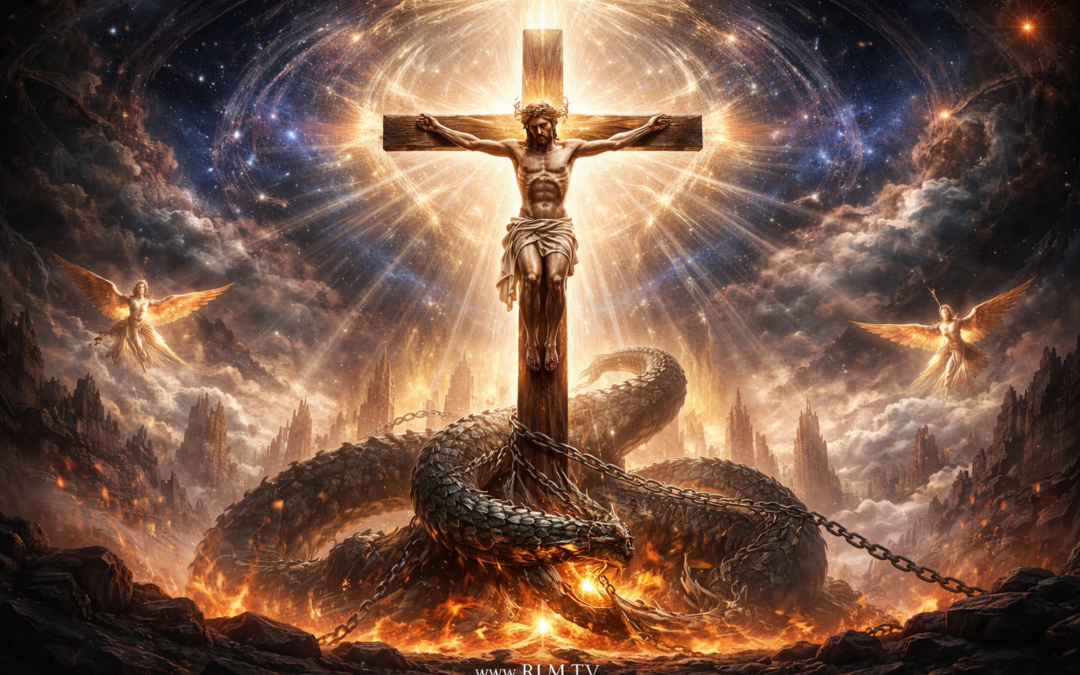
CRUCIFORM DRACO
From the Dominion of the Ayin Hara to the Government of the Mind of Christ
A Torah-Scholarly Treatise in Cruciform Kabbalah Orthodoxy
Author:
Brandon Barthrop
Affiliation:
Cruciform Academy
Red Letter Ministries (RLM TV)
Press:
RLM TV Press
Date:
February 2026
Abstract
This paper advances a Cruciform Kabbalistic thesis concerning the constellation Draco—identified in classical Jewish cosmology as Teli—as the primordial axis of serpentine angelic governance over fallen human perception. Within this framework, the Ayin Hara (Evil Eye) is presented not merely as a moral defect or folkloric superstition, but as a structured mode of perception imposed upon humanity through fallen seraphic authority. The study argues that Draco functioned as the celestial pole of this dominion, regulating sight, desire, imagination, and fear within the nefesh of Adamic man.
Drawing from Torah, Prophets, and Writings, alongside Second Temple literature and classical Kabbalistic cosmology, this work demonstrates that the fall of humanity was fundamentally perceptual before it was behavioral. Corrupted seeing preceded corrupted doing. The serpent’s authority was exercised not through overt force but through the governance of vision, desire, and interpretation—what Scripture repeatedly identifies as “the eyes of the heart” and “the sight of man.”
The paper then presents what is here termed the Cruciform Reversal: the crucifixion of the Teli through the Messiah’s Crown of Thorns as a cosmic, anthropological, and governmental act. This event is interpreted as the piercing and nullification of serpentine authority at its seat—the forehead, the throne of perception—thereby transforming Draco from a celestial throne of fallen governance into a prison of fallen seraphim. In this act, Satan is not merely defeated but judicially confined within the very axis through which he once ruled.
Through this cruciform act, the Mind of Christ (Ayin Yehoshua) is established as the new government of human perception. The Eye of God replaces the Evil Eye; divine sight supplants serpentine distortion. Salvation is therefore redefined not as a merely juridical transaction, but as an ontological re-governing of the human mind and vision. Redemption is shown to be the restoration of sight under the authority of Christ, resulting in the believer’s liberation from serpent-rule and entrance into the Kingdom of God as a realm of redeemed perception.
Note on Methodology and Orthodoxy
This paper is written within the boundaries of Torah-faithful Cruciform Kabbalah Orthodoxy, rejecting syncretism, astrology, and sorcerous misuse of mystical knowledge. All cosmological and anthropological claims are subordinated to Scripture and interpreted through the completed work of the Jewish Messiah, Jesus Christ (Yehoshua HaMashiach). Classical Kabbalistic concepts are employed descriptively and critically, not ritually, and are re-governed by the Cross as the final and absolute axis of truth.
Chapter I — The Ayin as the Seat of Dominion
Ontology of Sight in Torah and Kabbalah
1. The Ayin (עין) as the Locus of Perception, Desire, and Governance
In Torah thought, the Ayin (עין), commonly translated as “eye,” signifies far more than a physiological organ. It is the primary interface between the inner life of man and the external world, functioning as the locus where perception, desire, interpretation, and will converge. The eye does not merely receive information; it governs the manner in which reality is apprehended, valued, and pursued. As such, the Ayin operates as a governing faculty of the soul.
Classical Hebrew anthropology does not locate dominion primarily in the intellect alone, but in the faculty that directs desire and intention. The eye precedes the heart in this chain of influence. What is seen becomes desired; what is desired becomes chosen; what is chosen becomes action. The Ayin therefore stands at the headwaters of human behavior, determining the direction of the nefesh before the will ever moves the body.
This ontological role of sight is reflected linguistically in Hebrew, where the eye is frequently associated with appetite, envy, generosity, jealousy, and judgment. The Ayin is not passive. It is active, interpretive, and directive. To govern the eye is to govern the man.
2. Sight as Rulership: “As a Man Sees, So He Is Ruled”
Within the Torah worldview, rulership is inseparable from perception. Dominion is exercised not only through law or force, but through the shaping of how reality is seen. This principle undergirds both divine kingship and fallen tyranny. Whoever governs sight governs allegiance.
Scripture repeatedly associates moral direction with vision. The righteous are described as those whose eyes are lifted toward God, while the wicked are portrayed as those whose eyes are bent toward covetousness, violence, or illusion. The eye thus functions as a throne: what sits upon it rules the inner man.
This principle explains why idolatry, lust, and rebellion are consistently described in visual terms. Humanity does not first rebel by acting; it rebels by looking wrongly. The governance of the eye precedes the governance of the hands and feet. In this sense, the Ayin is the first battlefield of spiritual dominion.
To say “as a man sees, so he is ruled” is therefore not metaphorical but ontological. Sight establishes the ruler. If God governs the Ayin, the man walks in covenantal alignment. If a false image governs the Ayin, the man becomes subject to another dominion.
3. The Distinction Between Ayin Tovah and Ayin Hara
Torah and later Jewish wisdom distinguish sharply between two modes of sight: Ayin Tovah (the good eye) and Ayin Hara (the evil eye). These are not merely ethical categories but perceptual governments.
The Ayin Tovah perceives reality through generosity, humility, gratitude, and alignment with divine order. It sees creation as gift rather than object, as entrusted rather than seized. The good eye produces life, peace, and communion because it is aligned with the Creator’s own seeing.
By contrast, the Ayin Hara is not merely envy or malice; it is a fallen mode of perception rooted in lack, distortion, and grasping. The evil eye does not see reality as it is but as it can be consumed, controlled, or exploited. It fractures unity, multiplies desire, and generates rivalry. Where the good eye unites, the evil eye divides.
Crucially, the Ayin Hara is a system of governance. It imposes a way of seeing that enslaves the beholder. The one who looks through the evil eye becomes ruled by what he sees. Desire becomes master; fear becomes compass; comparison becomes law. Thus, the Ayin Hara is not merely sin—it is enslavement through perception.
4. The Eye as Throne, Not Merely Organ
The consistent biblical and Kabbalistic testimony is that the eye functions as a throne within the human being. Just as a king rules from his seat, so perception rules from the Ayin. This is why Scripture speaks of eyes being “lifted,” “darkened,” “opened,” or “sealed.” These are governmental metaphors, not optical ones.
The forehead—where sight, thought, and identity converge—becomes the seat of allegiance. Later apocalyptic imagery will describe foreheads as marked, sealed, or claimed, precisely because this is where dominion is established. To claim the eye is to claim the person.
This understanding reframes spiritual warfare. The primary struggle is not over behavior but over vision. Whoever enthrones themselves in the Ayin determines the trajectory of the soul. Thus, the serpent does not initially command Adam to act; it first reinterprets what is seen. A new image is introduced, and with it, a new ruler.
5. Early Torah Foundations: Genesis 3 and Numbers 15:39
The Torah explicitly grounds this ontology of sight in its earliest narratives. In Genesis 3, the fall of humanity begins with vision:
The woman sees that the tree is desirable to the eyes. Only afterward does she take and eat. The sequence is precise and deliberate. Sight precedes desire; desire precedes action. The serpent’s victory is secured the moment perception is corrupted.
This same structure is reaffirmed later in Numbers 15:39, where Israel is warned not to “stray after your heart and after your eyes.” Here, the eyes are explicitly identified as agents of spiritual infidelity. Israel’s covenant faithfulness depends upon disciplined sight.
These passages demonstrate that the Torah does not treat the eye as neutral. It is either governed by God or it governs against Him. There is no third state.
6. Thesis Restated: The Fall Begins with Corrupted Seeing
The cumulative witness of Torah and Kabbalah leads to a singular conclusion: the fall of man does not begin with action but with corrupted seeing. Sin is downstream from perception. Dominion is lost when vision is surrendered.
This principle establishes the foundation for the entire Cruciform argument of this paper. If the fall begins with the Ayin, then redemption must also address the Ayin. Any soteriology that neglects perception remains incomplete. Salvation must re-govern sight, enthrone divine vision, and displace the serpent from the throne of the eye.
Only when sight is restored can obedience follow. Only when the eye is healed can the man walk upright. Thus, the Ayin stands revealed as the original seat of dominion—and the first target of both serpent and Messiah.
Chapter II — The Teli (Draco) in Classical Jewish Cosmology
Axis of Serpentine Power
1. The Teli in Classical Jewish Cosmology
Within classical Jewish cosmological thought, the Teli occupies a unique and often misunderstood position. Far from being a mythic embellishment or astrological superstition, the Teli is presented as a structural element of cosmic order—an axial regulator within the created heavens. The term itself denotes a suspended or hung form, suggestive of something stretched across or governing from above, rather than merely inhabiting a location.
The earliest and most concise articulation of this concept appears in Sefer Yetzirah, where the Teli is described alongside the cycle of the year and the rotation of the heart. These three—cosmic, temporal, and anthropological—are presented as parallel systems of governance, each influencing the other. The Teli functions as the axial principle of the heavens, just as the heart governs the body and the year governs time.
This triadic structure immediately signals that the Teli is not decorative or symbolic but functional. It regulates movement, orientation, and relational order. To misunderstand the Teli as mere constellation imagery is to read Jewish cosmology through a modern, desacralized lens foreign to the Torah worldview.
2. Draco as Cosmic Pole and Ruling Axis
Astronomically, the constellation known as Draco coils around the northern celestial pole, occupying a position of remarkable stability and permanence. Long before the modern identification of Polaris, Draco marked the pivot around which the heavens appeared to turn. This physical reality undergirds its theological significance.
In classical cosmology, the pole is not simply a point of rotation; it is the anchor of order. Whatever occupies the pole governs orientation. Movement is measured in relation to it. Direction is defined by proximity or distance from it. Thus, the entity associated with the cosmic pole is, by definition, a regulator of order.
Draco’s location as the pole-encircling constellation made it uniquely suited to function as an axis of governance. Its symbolism as a serpent or dragon is not arbitrary but reflects its role as a coiling, encircling authority—one that surrounds, constrains, and directs. This is not chaos imagery. It is administrative imagery.
The serpent at the pole does not disrupt order; it enforces a particular order. Fallen order is still order—merely inverted and oppressive.
3. The Relationship Between Teli, Mazalot, and Celestial Governance
In Jewish cosmology, the Mazalot—often translated inadequately as constellations or influences—are understood as channels through which celestial administration operates. They govern seasons, patterns, and tendencies within the created order. However, the Mazalot themselves are not autonomous. They operate within a hierarchical structure.
The Teli stands above or behind this system as its axial regulator. It does not replace the Mazalot but orients them. As the heart sets rhythm for the body without performing each function, so the Teli establishes the directional framework within which celestial influences operate.
This relationship explains why later Jewish wisdom warns against subjection to Mazal while simultaneously affirming divine sovereignty above all. The danger is not acknowledging cosmic order but submitting to it as ultimate. The Teli represents the danger point of this system: when the axis itself becomes corrupted, the entire structure below operates in fallen alignment.
Thus, Draco’s dominion does not negate divine creation; it parasitizes it. Fallen seraphic governance hijacks legitimate cosmic structures and bends them toward domination through perception, fear, and desire.
4. Seraphic Origins of Serpentine Beings
The serpent imagery associated with Draco is not zoological but angelological. In Torah and prophetic literature, serpentine and draconic forms are consistently associated with high-order angelic beings—specifically seraphic entities. The seraphim are described as fiery, winged beings associated with the divine throne, not with the dust of the earth.
The fall of such beings does not strip them of their original magnitude; it corrupts their function. A fallen seraph does not become weak—it becomes tyrannical. The serpent, therefore, is not a creature of chaos but of perverted order, retaining administrative capacity while lacking righteousness.
This distinction is crucial. Satanic power is not anarchic; it is bureaucratic. It governs systems, perceptions, hierarchies, and allegiances. The serpent rules by structure, not randomness. Draco’s imagery reflects this reality: a coiling, encircling intelligence that governs through enclosure and orientation rather than brute destruction.
5. The Dragon as Regulator of Fallen Order, Not Chaos
Modern interpretations often mistake the dragon as a symbol of chaos opposing divine order. Classical Jewish and early Christian cosmology present a more disturbing reality: the dragon is a regulator of fallen order. It maintains stability, predictability, and control within a corrupted system.
This explains why fallen empires, sorcerous systems, and idolatrous civilizations exhibit remarkable longevity and internal coherence. They are not chaotic; they are enslaving. The serpent does not seek to destroy the world outright but to rule it through distorted perception.
Draco, as cosmic axis, embodies this principle. It is not the enemy of order but the enforcer of inverted order. Its dominion thrives on predictability, fear, and cyclical enslavement. It is the perfect throne for the governance of the Ayin Hara, where perception is bent but not broken—kept functional enough to serve domination.
6. Thesis Restated: Draco as Juridical, Not Mythological
The evidence compels a decisive conclusion: Draco is not mythological—it is juridical within fallen cosmic administration. Its role is not symbolic but governmental. It functions as an axis of authority through which fallen seraphic intelligences regulate perception, influence, and allegiance within the created order.
This understanding dismantles both secular dismissal and occult romanticism. Draco is neither imaginary nor to be venerated. It is an occupied structure within a fallen hierarchy—one that will later be shown to be crucified, imprisoned, and rendered powerless by the Cross of Messiah.
Having established the Ayin as the seat of human dominion and the Teli as the axis of cosmic dominion, the next chapter will unite these two realms by exposing how Draco governs through the Ayin Hara itself.
Chapter III — The Dominion of the Ayin Hara
Serpentine Perception and the Governance of the Nefesh
1. Fallen Seraphim and the Governance of Distorted Perception
Fallen seraphic beings do not govern humanity primarily through force, possession, or overt command. Their authority is exercised through the manipulation of perception. As former administrators of divine order, these beings retain profound intelligences capable of structuring reality as it is seen. Their dominion is therefore subtle, systemic, and internal.
The Ayin Hara functions as the primary interface through which fallen seraphim exert influence over the human nefesh. Rather than replacing human agency, they redirect it. Rather than eliminating choice, they corrupt its inputs. By distorting perception, they ensure that human decisions—though freely made—are consistently misaligned with divine truth.
This method of governance mirrors their own fall. The rebellion of the serpent did not begin with violence but with reinterpretation. Truth was not denied outright; it was reframed. The same strategy governs humanity: perception is bent just enough to redirect desire while preserving the illusion of autonomy.
Thus, fallen seraphim rule not as tyrants shouting commands, but as administrators shaping vision.
2. Desire, Imagination, and Fear as Instruments of Draco
Desire, imagination, and fear are not inherently fallen faculties. In their redeemed form, they serve creativity, worship, and love. Under serpentine governance, however, these faculties are weaponized.
Desire becomes endless appetite rather than covenantal longing. Imagination becomes illusion rather than creative insight. Fear becomes orientation rather than warning. These three together form a closed circuit of control, ensuring that the nefesh remains reactive rather than responsive.
Draco’s dominion thrives on this triad. By controlling what is seen, it determines what is desired. By amplifying desire, it fuels imagination. By destabilizing imagination, it cultivates fear. Fear then narrows vision further, completing the cycle. The Ayin Hara is therefore not a static condition but a self-reinforcing system.
This explains why fallen systems do not require constant enforcement. Once perception is governed, behavior follows automatically. The enslaved do not need chains when their sight is already captive.
3. The Ayin Hara as the Engine of Sorcery, Idolatry, and False Wisdom
Sorcery, idolatry, and false wisdom share a common root: corrupted perception. Before any ritual is performed, an image is enthroned. Before any false god is worshiped, a false vision is accepted. The Ayin Hara is therefore the engine that powers all counterfeit spirituality.
Sorcery operates by attempting to manipulate reality through altered perception—seeing forces where there are none, or assigning agency where God has not placed it. Idolatry arises when perception fixates upon created forms and attributes to them ultimate authority. False wisdom emerges when interpretation is divorced from divine revelation and anchored instead in appearance, intuition, or esoteric novelty.
In each case, the serpent does not invent new realities; it reassigns meaning to existing ones. The Ayin Hara excels at this task. It does not blind completely; it refracts. Truth is bent through desire, producing systems that appear enlightened while leading deeper into bondage.
This is why Scripture consistently associates deception with sight. The false prophet “shows signs.” The idol is “seen.” The sorcerer promises “hidden knowledge.” The Ayin Hara is always the gateway.
4. The Forehead as the Battlefield of Rulership
The forehead represents the convergence of sight, thought, and identity. It is the site where perception is interpreted and allegiance is formed. For this reason, it becomes the primary battlefield of spiritual governance.
Biblical and apocalyptic imagery consistently locates dominion at the forehead because this is where rule is established. A mark upon the forehead is not cosmetic; it is governmental. It signifies who governs perception and, by extension, action.
Fallen seraphic powers seek not merely obedience but agreement. They desire the human mind to interpret reality through their framework. Once the forehead is claimed, the rest follows effortlessly. The body becomes an executor of a vision it did not generate.
This is why the struggle over the Ayin is so intense. Whoever governs the forehead governs the man.
5. Babylon as a Perceptual Empire
Babylon must be understood not merely as a political or economic entity, but as a perceptual empire. Its power lies in shaping how reality is seen, valued, and pursued. Babylon does not rule primarily by law or force, but by narrative, imagery, and desire.
The prophetic critique of Babylon consistently emphasizes deception, intoxication, and enchantment. These are perceptual tools. Babylon intoxicates the nations not with wine alone, but with vision—what appears desirable, powerful, successful, or enlightened.
This is why Babylon can exist across cultures, epochs, and systems. It is not bound to geography. Wherever perception is governed by the Ayin Hara, Babylon is present. Its temples are minds; its altars are eyes.
The empire endures because it governs sight. Remove its armies and it adapts. Remove its leaders and it persists. Only when perception is redeemed does Babylon truly fall.
6. Thesis Restated: All Sorcery Is Eye-Based Before It Is Ritual-Based
The cumulative evidence leads to a decisive conclusion: all sorcery is eye-based before it is ritual-based. Rituals merely formalize what perception has already accepted. Systems of deception succeed not because of their complexity, but because of their visual plausibility.
Fallen seraphic governance operates by enthroning distorted sight within the human Ayin. Once this throne is secured, desire, imagination, fear, and action align automatically. The nefesh becomes a willing participant in its own captivity.
This chapter therefore establishes the necessity of a redemptive act that does not merely forgive sin but re-governs perception. Without the liberation of the Ayin, no victory over Babylon, sorcery, or serpent-rule can be complete.
The next chapter will demonstrate that such a re-governing act has already occurred—through the crucifixion of the Teli itself.
Chapter IV — The Prison of Satan in the Teli
From Throne to Incarceration
1. Scriptural Foundations for Satanic Imprisonment
Scripture consistently testifies that Satan’s judgment is not merely moral condemnation but enforced limitation. The adversary is portrayed not as an equal rival to God, but as a created intelligence whose activity is progressively restricted by divine decree. This pattern appears from the earliest biblical texts, where the serpent is cursed yet constrained, and continues through prophetic and apocalyptic literature.
The decisive articulation of this theme emerges in Book of Revelation, where the dragon is described as “cast down,” “bound,” and ultimately “confined.” These are juridical terms. They indicate loss of jurisdiction rather than annihilation. Satan is not erased; he is contained.
This containment reflects a consistent divine strategy: fallen powers are judged by relocation and restriction. Their authority is curtailed not by erasing their existence but by removing their freedom to operate beyond assigned bounds. Judgment, therefore, is spatial and functional before it is terminal.
2. The Dragon Cast Down Yet Still Bound to the Axis
The language of being “cast down” does not imply that Satan becomes cosmically irrelevant. Rather, it signifies displacement from a position of unrestrained governance. Importantly, Scripture never depicts Satan as expelled from all structure; he is expelled into structure.
This distinction is critical. The dragon is cast down from access to divine counsel and unrestricted heavenly authority, yet he remains bound to the created order he once governed. His activity becomes circumscribed, reactive, and ultimately self-defeating.
Within the framework established in previous chapters, this means that the serpent’s fall is not into chaos but into confinement. He is tethered to the axis he once ruled. The Teli, formerly a throne of governance, becomes the structure of his imprisonment.
Thus, Satan is neither free nor omnipresent. He is bound to the very system through which he once exercised dominion.
3. The Transformation of Draco from Throne to Cage
The crucifixion of the Messiah marks a decisive transformation in the function of the Teli. What once served as an axis of serpentine governance is converted into a mechanism of restraint. The throne becomes a cage.
This transformation does not require the destruction of Draco’s structure. Rather, it requires the removal of its governing legitimacy. Authority is stripped; location remains. The serpent retains proximity to the axis but loses the right to rule through it.
This explains why post-crucifixion history reveals a paradox: Satan remains active yet increasingly exposed, influential yet fundamentally defeated. His operations persist, but his dominion does not expand. He operates within diminishing margins, bound to a system that no longer serves his ultimate aims.
The Teli thus becomes a cosmic holding structure—a place of incarceration rather than command.
4. Fallen Seraphim as Incarcerated Intelligences
Fallen seraphic beings, including Satan, do not lose their intelligence, memory, or awareness upon judgment. What they lose is freedom of operation. They become incarcerated intelligences—aware, strategic, but confined.
This state of incarceration explains both the persistence and the desperation of fallen powers. They retain the capacity to influence perception but lack the authority to establish new dominions. They can deceive but not enthrone. They can tempt but not govern.
Their confinement within the Teli renders them reactive rather than creative. They no longer shape cosmic order; they exploit residual distortions within human perception. Their power depends entirely on consent gained through deception, not on jurisdiction granted by heaven.
Thus, fallen seraphim exist as prisoners who seek accomplices rather than rulers who command subjects.
5. The Cosmic Irony: The Serpent Impaled Upon His Own Pole
The most profound irony of divine judgment is that the serpent is not merely defeated but impaled upon the very structure of his former dominion. The axis he used to govern becomes the instrument of his restraint.
This inversion reflects a recurring biblical pattern: the weapon of the wicked becomes the means of their downfall. The serpent, who once coiled around the pole of heaven, finds himself fixed to it, unable to escape its constraints.
The Cross intensifies this irony. As the Messiah is lifted up, the true axis of heaven and earth is revealed. The false axis is exposed as empty of authority. Draco is not destroyed; it is nullified as a throne and repurposed as a prison.
The serpent remains visible, active, and vocal—but no longer sovereign.
6. Thesis Restated: Judgment Is Relocation—Authority Without Freedom
This chapter establishes a critical juridical principle: judgment is relocation—authority without freedom. Satan’s punishment is not immediate annihilation but enforced limitation. He is stripped of rulership and confined within a structure he can no longer command.
Understanding this principle prevents two errors: underestimating the serpent’s ongoing activity or overestimating his authority. He is neither omnipotent nor irrelevant. He is incarcerated.
This reality prepares the ground for the next and decisive movement of the paper: the mechanism by which this incarceration was enacted—not merely cosmically, but anthropologically—through the Messiah’s Crown of Thorns.
Chapter V — The Crown of Thorns
Crucifying the Serpent in the Forehead
1. Thorns as Covenantal Curse
The appearance of thorns in Scripture is not incidental, nor merely agricultural. Thorns enter the biblical narrative as a direct consequence of the fall. In Genesis 3, the ground is cursed “for your sake,” and thorns and thistles emerge as the sign of fractured dominion. Creation no longer yields freely; it resists. The thorn becomes the physical manifestation of cursed mediation between humanity and the earth.
Importantly, thorns are not introduced as punishment for animals or soil alone, but as a visible sign of disrupted authority. They mark the breakdown of Adamic kingship. The crown of creation is replaced with resistance; the steward becomes a struggler. Thorns therefore signify cursed rulership—the inversion of dominion.
From this point onward, thorns function as covenantal markers. Where thorns appear, fallen authority is present. They testify that governance has shifted from divine alignment to adversarial resistance.
2. The Crown as Inversion of Serpentine Coronation
In ancient symbolic language, the head is the seat of rule. To crown the head is to confer authority. Serpentine imagery throughout Scripture and ancient cosmology consistently associates rulership with encircling forms—coils, rings, crowns. The serpent rules by surrounding, constricting, and orienting perception.
The Crown of Thorns represents a deliberate inversion of this serpentine coronation. What once crowned fallen kings through domination is taken up by the Messiah as an instrument of judgment. The thorn—symbol of cursed rule—is placed upon the true King, not to enthrone the curse, but to absorb and terminate it.
This inversion is not mockery alone; it is juridical theater. Fallen authority is exposed by being placed where it claims power—upon the head. The Messiah submits to the symbol of cursed dominion in order to dismantle it from within.
Thus, the Crown of Thorns is not incidental suffering; it is targeted confrontation.
3. The Messiah’s Head as the Cosmic Altar
In Torah theology, atonement requires an altar. An altar is the site where judgment, sacrifice, and reconciliation converge. In the crucifixion, the Messiah’s body becomes the locus of cosmic reconciliation, but His head—specifically—functions as the altar of perception.
The forehead, where sight, thought, and identity converge, is the seat of the Ayin. By placing the Crown of Thorns upon the Messiah’s head, fallen authority is brought into direct contact with divine holiness. This is not symbolic violence but covenantal surgery.
The Messiah’s head becomes the meeting place between heaven and fallen perception. The curse borne in the thorns is neutralized not by removal, but by fulfillment. The altar sanctifies what it consumes. Thus, cursed authority is not merely rejected; it is rendered obsolete.
4. Piercing the Seat of the Ayin Hara
The Ayin Hara governs through the forehead because this is where perception becomes allegiance. To rule the eye is to rule the man. The Crown of Thorns pierces this seat directly.
This piercing is not arbitrary. It targets the precise locus of serpentine dominion. The serpent rules through corrupted seeing; therefore, redemption must address the eye. The thorns penetrate the place where false images reign, dismantling their authority through sacrificial substitution.
In this act, the Messiah assumes the full burden of fallen perception. Every distortion, lie, fear, and false desire generated through the Ayin Hara is gathered and judged at its source. The serpent’s claim is broken not by force, but by exposure and nullification.
The Eye of God confronts the Evil Eye—and prevails.
5. The Cross as Vertical Axis Replacing Draco
With the piercing of the forehead and the lifting up of the Messiah, a new axis is established. The Cross functions as the true vertical alignment between heaven and earth. Where Draco once served as a fallen cosmic pole, the Cross becomes the redeemed axis of governance.
This replacement is not metaphorical. Axis determines orientation. What one looks to defines direction. The Cross reorients all perception away from serpentine encirclement and toward sacrificial love and divine truth.
The serpent’s axis is circular, enclosing and trapping. The Cross is vertical, opening and reconciling. One governs through fear and repetition; the other through revelation and ascent. By being lifted up, the Messiah displaces Draco’s claim to orientation entirely.
The cosmos now turns around the Cross.
6. Thesis Restated: The Crown of Thorns as Surgical Act
The Crown of Thorns must therefore be understood as a surgical act upon cosmic perception. It targets the precise locus of fallen dominion—the Ayin—and executes judgment with perfect specificity.
This act accomplishes what no ritual, law, or discipline could achieve. It removes the serpent’s authority not merely from heaven, but from the human mind. Perception itself is redeemed. Sight is restored. Governance is transferred.
The serpent is crucified at the forehead. The Eye of God is enthroned. And the Kingdom of Christ advances not first through behavior, but through healed vision.
Chapter VI — Cruciform Draco
The Government of the Mind of Christ
1. From Serpent-Axis to Cross-Axis
Every system of governance requires an axis—an orienting principle around which perception, meaning, and action turn. Fallen cosmic order was oriented around the serpent-axis: circular, enclosing, repetitive, and fear-driven. This axis governed through distortion of sight, maintaining control by endless return to desire, lack, and self-reference.
The crucifixion establishes a decisive transition. The Cross replaces the serpent-axis as the orienting structure of reality. Where the serpent coils inward, the Cross opens upward and outward. Where Draco governed through enclosure and recursion, the Cross governs through revelation and ascent.
This transition is not merely symbolic or historical; it is ontological. Axis determines alignment. When the axis shifts, the entire system reorients. Human perception, once curved inward upon itself, is straightened—realigned to heaven. The Cross becomes the new pole by which truth is measured and direction discerned.
Thus, Cruciform Draco does not mean the destruction of cosmic order, but its re-governing. The axis remains, but the ruler changes.
2. The Mind of Christ (Nous Christou) as Ruling Faculty
The apostolic witness introduces a radical claim: believers are given the Mind of Christ. This is not metaphorical encouragement but a declaration of governmental transfer. Nous in classical thought refers to the highest faculty of perception—the capacity to apprehend truth directly, beyond sensory distortion.
The Nous Christou is therefore the redeemed Ayin. It is perception governed by self-giving love rather than self-preserving fear. Under this government, sight is no longer driven by appetite or anxiety, but by alignment with divine will.
This mind does not negate intellect or reason; it orders them. It does not abolish desire; it purifies it. The Mind of Christ functions as a ruling faculty, setting the interpretive frame through which all reality is seen. Under its governance, truth is no longer negotiated—it is received.
Thus, redemption is not the suppression of thought but the enthronement of a new ruler within thought itself.
3. The Eye of God Replacing the Evil Eye
The transition from Ayin Hara to redeemed sight is best described as the replacement of the Evil Eye with the Eye of God. The Evil Eye perceives reality through scarcity, rivalry, and control. The Eye of God perceives reality through abundance, communion, and purpose.
This replacement is not gradual coexistence but decisive displacement. Two eyes cannot rule simultaneously. Either perception is governed by fear or by love; by distortion or by truth. The enthronement of divine sight nullifies the serpent’s claim entirely.
Under the Eye of God, creation is no longer an object to be consumed but a gift to be stewarded. Others are no longer threats but neighbors. God is no longer distant but present. This transformed perception produces a transformed world, not because circumstances change, but because governance does.
The Eye of God restores unity where the Evil Eye produced fragmentation.
4. The Lamb Enthroned Above the Dragon
Apocalyptic Scripture presents a clear image: the Lamb enthroned while the dragon is cast down. This is not merely eschatological drama; it is a statement of present cosmic order. Authority is relocated. The dragon remains, but beneath—not above.
The enthronement of the Lamb signifies that sacrificial love, not coercive power, now governs reality. The Cross is revealed as the true axis of authority, and the dragon’s former claim is exposed as illegitimate.
Importantly, the Lamb does not rule by replacing one tyranny with another. His government operates through voluntary alignment, truth, and illumination. Those who see rightly follow freely. The dragon demanded submission through fear; the Lamb invites allegiance through revelation.
Thus, Cruciform Draco names the reality that the axis once occupied by serpentine authority is now governed by the Lamb.
5. Believers as Citizens of a New Perceptual Government
Redemption entails citizenship. Those who receive the Mind of Christ are transferred into a new polity—a kingdom defined not by borders but by perception. Believers are no longer subjects of serpent-rule but citizens of a cruciform order.
This citizenship manifests first in sight. What believers value, pursue, fear, and love reveals their governing axis. The cruciform citizen sees through the Cross and therefore lives differently—not by external compulsion, but by internal alignment.
This new government is apostolic in nature. It advances through teaching, witness, and formation of perception rather than coercion. Its power lies not in force but in truth made visible.
Thus, the Church is not merely a moral community but an embassy of redeemed perception within a fallen world.
6. Thesis Restated: Redemption as Enthronement
The thesis of this chapter can be stated plainly: redemption is the enthronement of Christ within the human mind. Salvation is not complete until governance changes. Forgiveness without re-governed perception leaves the throne vacant—and vacancy invites occupation.
The Cross does not merely pardon; it installs a King. The Mind of Christ does not merely inform; it rules. The Eye of God does not merely observe; it governs.
In Cruciform Draco, the serpent’s axis is nullified, the dragon is subordinated, and the Lamb reigns—first in the heavens, then in the mind of the redeemed.
Chapter VII — Apostolic Orthodoxy and the New Dominion
Living Above the Serpent
1. Cruciform Discipleship as Perceptual Warfare
Cruciform discipleship must be understood not primarily as moral training or behavioral modification, but as perceptual warfare. The central contest of the Christian life is not between competing actions, but between competing ways of seeing. Whoever governs perception governs obedience.
Discipleship, therefore, involves the continual submission of sight to the Cross. The believer learns to interpret reality through cruciform alignment rather than through fallen instinct. This includes the renunciation of self-generated interpretation in favor of revelation received through Christ.
Such warfare is neither theatrical nor mystical in a sensational sense. It is disciplined, sober, and sustained. The disciple does not chase demons; he crucifies false sight. He does not negotiate with fear; he replaces it with truth. Victory is achieved not through intensity of experience, but through clarity of vision.
To live above the serpent is to refuse to see as the serpent sees.
2. Renunciation of Astrology, Sorcery, and False Mysticism
Apostolic Orthodoxy requires explicit renunciation of all systems that attempt to interpret or manipulate reality apart from Christic governance. Astrology, sorcery, divination, and speculative mysticism all share a common error: they seek knowledge or power without submission to the Cross.
These practices are not rejected because they are irrational, but because they are mis-governed. They appeal to the Ayin Hara by promising insight without obedience, power without sacrifice, and vision without purification. Even when clothed in religious language, they operate from a fallen axis.
Cruciform Orthodoxy does not deny the existence of cosmic order or spiritual realities; it denies their authority over redeemed humanity. The believer does not ascend by aligning with celestial systems, but by dying with Christ. Any system that bypasses this death is, by definition, serpentine.
Renunciation is therefore not loss but liberation—the refusal to submit perception to any throne other than Christ.
3. The Forehead Sealed by Christ, Not Marked by the Beast
The imagery of sealing and marking the forehead represents competing claims of governance. To be marked is to be governed; to be sealed is to be preserved under rightful authority. Apostolic teaching consistently frames the Christian life as a matter of allegiance rather than mere belief.
The seal of Christ upon the forehead signifies that perception itself has been claimed and guarded. Sight is no longer open to occupation by fear, desire, or deception. Interpretation is no longer negotiated with the world, the flesh, or fallen powers.
By contrast, the mark of the beast represents submission to a fallen perceptual system—one that measures worth, truth, and survival through domination and conformity. The conflict is not technological or speculative; it is perceptual and governmental.
Thus, the battle over the forehead is the battle over who rules reality for the individual. Apostolic Orthodoxy exists to ensure that this seal remains intact.
4. Apostolic Teaching as Preservation of Ayin Purity
Apostolic teaching functions as custodial authority over redeemed perception. Its role is not innovation but preservation. Truth does not evolve; vision must be protected.
From the earliest Church, apostles understood that false teaching corrupts sight before it corrupts behavior. Therefore, doctrine is not abstraction; it is spiritual hygiene. Teaching guards the Ayin from distortion, dilution, and re-occupation.
This is why Apostolic Orthodoxy emphasizes continuity, discipline, and submission. Innovation that bypasses the Cross inevitably reintroduces serpentine perception, even when clothed in spiritual language. Orthodoxy preserves not tradition for its own sake, but vision for the sake of freedom.
To abandon apostolic teaching is not to gain insight, but to surrender the eye.
5. The Church as the Administration of Restored Sight
The Church, properly understood, is not merely a social body or moral institution. It is the administrative extension of restored perception within history. Its primary task is not governance of behavior, but guardianship of vision.
Through teaching, sacrament, discipline, and witness, the Church maintains the axis established by the Cross. It trains believers to see rightly, to interpret faithfully, and to live freely under Christ’s government.
Where the Church abandons this role, Babylon advances. Where vision is compromised, tyranny returns. The health of the Church is therefore measured not by size or influence, but by clarity of sight.
The Church stands as an embassy of the Kingdom precisely because it sees differently.
6. Thesis Restated: Orthodoxy as Maintained Vision
The concluding thesis of this work can now be stated with precision: Orthodoxy is not belief alone—it is maintained vision. Faith that does not govern perception remains vulnerable. Doctrine that does not protect sight becomes abstraction.
Cruciform Orthodoxy preserves the government of the Mind of Christ within the believer and within the Church. It ensures that the serpent remains beneath, the Cross remains central, and the Eye of God remains enthroned.
To live above the serpent is not triumphalism; it is fidelity. It is the quiet, disciplined refusal to see through any eye but Christ’s.
Conclusion of the Treatise
With this chapter, the argument of Cruciform Draco reaches completion. The Ayin is restored, the axis is replaced, the serpent is confined, and the Lamb reigns. What remains is not speculation but obedience—obedience of sight.
Conclusion
The fall of humanity was never merely moral; it was perceptual. Before transgression manifested in action, it was first enthroned in vision. Through the dominion of the Ayin Hara, fallen seraphic powers—enthroned upon the Teli—governed mankind by ruling what humanity saw, desired, and feared. The serpent did not reign through chaos, but through corrupted order. Draco functioned not as myth, but as an administrative axis of fallen perception, regulating orientation within a distorted cosmic hierarchy.
The crucifixion of the Messiah, crowned with thorns, enacted a decisive cosmic inversion. The serpent was impaled upon his own axis. The Teli was crucified—not destroyed, but judicially nullified as a throne. Satan was imprisoned within the very structure he once ruled, stripped of jurisdiction yet confined within limitation. What had functioned as an axis of serpentine governance was transformed into a site of incarceration.
In the place of fallen dominion arose Cruciform Draco: the Cross revealed as the true axis of heaven and earth. The Messiah’s head—pierced at the seat of perception—became the altar upon which the curse of corrupted sight was judged and terminated. The Crown of Thorns, bearing the covenantal curse, performed a surgical act upon cosmic perception, dismantling the authority of the Evil Eye at its source.
Salvation, therefore, must be understood as the restoration of sight. The Eye of God replaces the Evil Eye. The Mind of Christ governs the forehead. Redemption is not merely forensic acquittal but ontological re-governing. The Kingdom of God advances not first through coercion, power, or spectacle, but through redeemed perception—through men and women who see as Christ sees and therefore live as Christ lives.
Orthodoxy, in this light, is not the preservation of belief alone, but the maintenance of vision. Where sight remains cruciform, the serpent remains beneath. Where perception is governed by Christ, Babylon loses its power. And where the Church preserves redeemed sight through apostolic teaching, the Lamb continues to reign—above the dragon, within the mind, and across the nations.
Select Bibliography
Primary Scriptural Sources
- Genesis
- Numbers
- Deuteronomy
- Isaiah
- Ezekiel
- Daniel
- Psalms
- Job
- Matthew
- John
- 1 Corinthians
- Ephesians
- Book of Revelation
Classical Jewish Mystical Texts
- Sefer Yetzirah
- Zohar
- Tikkunei Zohar
- Heichalot Literature (Merkavah and palace ascent traditions)
Second Temple Literature
- 1 Enoch
- Book of Jubilees
Theological and Philosophical Sources
- Patristic Christology (Logos and Nous theology)
- Apostolic anthropology and ecclesiology
- Cruciform theology of perception and governance
- Temple-centric cosmology and axis-theology
- Anti-astrological polemics in Jewish and early Christian thought
Final Note
This work is submitted as a Torah-scholarly contribution to Cruciform Kabbalah Orthodoxy, affirming the absolute supremacy of Jesus Christ as the governing axis of perception, cosmos, and covenant. All mystical categories herein are subordinated to the Cross and interpreted through the completed work of the Jewish Messiah.
