
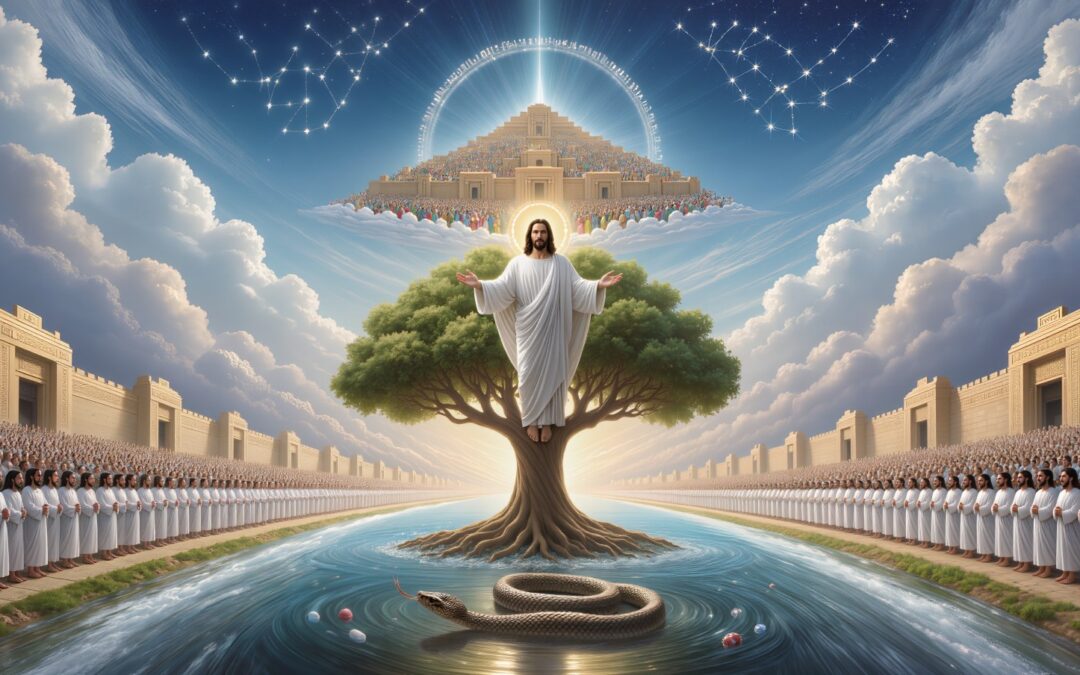
A New Second Heaven Where Righteousness Dwells
From Fallen Seraphim Nature to the Children of the Resurrection
The Uprighting of Draco, the Healing of the Mazalot, and the Formation of a New Second Heaven in Cruciform Messianic Cosmology
An Angelic Anthropology of Serpentine Sin and Holiness
Author:
Brandon Barthrop
RLM TV Press
Abstract
This paper advances an Orthodox Messianic Kosher Kabbalah framework for the theological and ontological understanding of the removal of the sinful nature, grounded in the cruciform reordering of the heavens accomplished through the redemptive work of Moshiach Yehoshua. Contrary to reductionist moral or psychological interpretations of sin, this study argues that sin is fundamentally governmental and cosmological in origin, arising from a fallen seraphic administration embedded within an inverted celestial order. Specifically, it locates the transmission of the sinful nature in a corrupted second-heaven structure associated with the fallen Draco constellation and the inverted operation of the Mazalot, understood within kosher Kabbalistic cosmology as angelic instruments of temporal and national governance.
Drawing upon the Hebrew Scriptures, the Apostolic Writings, and classical Jewish cosmological categories, this paper contends that the Cross of Yehoshua HaMoshiach functions not only as atonement for transgression but as a decisive cosmic judgment upon fallen seraphic authority. Through the crucifixion, resurrection, and ascension of the Jewish Messiah, the serpent axis of governance is pierced, disarmed, and uprighted, resulting in the healing of the Mazalot and the establishment of a renewed heavenly administration. This transformation constitutes the formation of a “new second heaven,” characterized not by sin, accusation, and death, but by righteousness, life, and direct divine rule.
The study further proposes that this cruciform cosmic reordering defines the operative function of the last-days apostolic office, understood not merely as ecclesial leadership but as participation in the manifestation of new heavens “where righteousness dwells.” Within this framework, the New Covenant overcomers—those co-crucified and co-resurrected with Christ—are presented as active participants in the formation of New Jerusalem, understood ontologically rather than symbolically. Engrafted into the One Tree of Life, the Olive Tree of Israel as articulated in Romans 11, these believers embody a resurrection anthropology that transcends fallen angelic governance and restores humanity to its intended role as the dwelling place of God.
Ultimately, this paper situates the Book of Revelation not as speculative eschatology but as a systematic unveiling of cruciform cosmology, in which the old serpent government is rendered obsolete, the heavens are made new, and creation itself is reordered through the victorious reign of Moshiach Yehoshua.
1. Introduction: Sin as Ontological Governance
The phenomenon traditionally termed “the sinful nature” cannot be sufficiently explained through behavioral analysis, moral psychology, or sociological conditioning alone. While such frameworks may describe the manifestations of sin, they fail to account for its universality, persistence, transmissibility, and supra-individual coherence across cultures and epochs. Scripture itself resists reductionist explanations by consistently presenting sin not merely as action (ḥeṭ’), inclination, or weakness, but as dominion, reign, and enslavement (Romans 5:21; 6:12–14). These juridical and governmental terms indicate that sin functions as an operative authority rather than as an isolated moral failure.
Romans 6:14 is therefore foundational to any ontological treatment of sin: “For sin shall not have dominion over you.” The apostolic claim presupposes that sin once exercised dominion—an authority capable of ruling, commanding, and structuring human existence. Dominion language implies governance, and governance necessarily implies an administrative source. Sin, in this framework, is not self-generated within humanity but imposed through an external order under which humanity came to exist.
This study advances the thesis that the sinful nature originates in fallen seraphic administration, transmitted cosmically through a corrupted heavenly order. Within Orthodox Messianic Kosher Kabbalah, the heavens are not neutral space but structured realms of delegated authority. Angelic beings—when aligned with divine order—mediate life, illumination, and governance; when fallen, they transmit corruption, distortion, and death. The persistence of sin across generations, nations, and civilizations therefore points not merely to human weakness but to a cosmological disorder sustained above humanity.
The inverted Draco constellation functions within this framework as a symbolic and ontological representation of fallen seraphic governance. In biblical cosmology, the serpent is not merely a zoological or psychological symbol but an emblem of throne-based authority exercised in rebellion against God (Genesis 3; Revelation 12). The “dragon” language of Scripture consistently denotes governing power, not isolated temptation. The fallen Draco thus represents an inverted axis of authority—a corrupted throne-path through which serpentine influence flowed into creation.
Consequently, the fall of humanity must be understood as cosmological rather than merely ethical. Adam’s transgression did not occur within a neutral cosmos but beneath a heaven already compromised by rebellion. Humanity did not simply disobey; it came under a different administration. This shift subjected both the nefesh (the animating, instinctual life of the body) and the ruach (the animating spirit of perception and intention) to serpentine governance. Deception replaced truth, lust displaced ordered desire, fear supplanted trust, and death became normative rather than anomalous.
The nations that emerged from Adam inherited not only biological life but ontological placement beneath a fallen heaven. This explains why Scripture repeatedly depicts the world as “lying in the power of the wicked one” and why the Law, though holy and righteous, could diagnose sin without eradicating it. The problem was not insufficient moral instruction but corrupted governance. Humanity lived under a throne not aligned with life.
Accordingly, any theology that seeks to address sin exclusively at the level of behavior or internal inclination fails to engage its true source. Sin cannot be reformed, managed, or psychologically integrated; it must be deposed. The removal of the sinful nature therefore requires not moral improvement but cosmic reordering—a transformation of the governing heavens themselves. This reordering, as this paper will demonstrate, is accomplished exclusively through the crucifixion, resurrection, and ascension of Moshiach Yehoshua, who confronts and overturns fallen seraphic authority at its source.
2. Seraphim: Holy and Fallen
Seraphim occupy a distinct and elevated position within the biblical hierarchy of heavenly beings. In the canonical vision of Isaiah 6, the seraphim are explicitly depicted as throne-adjacent intelligences, stationed above the divine throne and actively participating in the transmission of holiness. Their defining characteristics—fire, voice, and motion—identify them not merely as worshippers but as agents of purification and governance. The burning coal applied to the prophet’s mouth demonstrates that seraphic activity effects ontological transformation rather than symbolic gesture; holiness is imparted, not merely declared.
Within this framework, seraphim function as conduits of divine order. Their fire is not destructive but refining; their proximity to the throne positions them as executors of heavenly administration. When aligned with divine will, seraphim mediate life, clarity, and righteousness into creation. Their holiness is therefore functional and governmental, not merely cultic.
However, Scripture and Second Temple tradition consistently attest that not all heavenly beings retained their appointed alignment. The fall of angelic powers introduced not merely rebellion but administrative corruption. In this context, fallen seraphim represent a catastrophic inversion of function: beings created to transmit holiness instead became vectors of distortion. Fire that once purified became consuming; governance that once ordered creation became exploitative and enslaving.
Second Temple literature and later Jewish mystical tradition associate this fallen seraphic order with the serpent lineage, identifying the serpent not as a zoological creature but as a throne-symbol—a signifier of wisdom, authority, and governance corrupted through rebellion. The serpent’s role in Genesis 3 is therefore not incidental; it represents a fallen seraphic intelligence exercising unauthorized authority over humanity. The serpent does not merely tempt; it governs through deception.
The fall of the seraphim thus resulted in a profound inversion of heavenly order. Authority once oriented toward divine life was redirected toward self-exalting dominion. This inversion produced a corrupted second-heaven structure, sustained by fallen intelligences and characterized by accusation, domination, and death. Scripture later names this structure “Babylon,” a designation that encompasses both earthly systems and their heavenly counterparts.
Revelation 18:2 explicitly describes Babylon as “the habitation of demons, the hold of every foul spirit, and a cage of every unclean and hateful bird.” This description is ontological rather than metaphorical. Babylon is not merely a city or empire but a cosmic habitation—a second-heaven construct formed by fallen seraphic governance and expressed through political, economic, and spiritual systems on earth. It is the architectural manifestation of inverted authority.
Within this fallen order, the seraphic function of governance is preserved but corrupted. Fallen seraphim continue to administer—but what they administer is sin, deception, and fragmentation. This explains the systemic nature of evil: injustice becomes normalized, immorality institutionalized, and death commodified. The fallen seraphim do not merely influence individuals; they shape civilizations.
Theologically, this distinction between holy and fallen seraphim is essential for understanding the nature of redemption. Salvation does not involve the annihilation of seraphic function but its restoration. Governance itself is not abolished; it is redeemed. The fire of the seraphim must be purified, not extinguished. As this paper will demonstrate, the redemptive work of Moshiach Yehoshua addresses fallen seraphic authority not by bypassing it but by confronting, judging, and reordering it at its source.
Thus, the fall of the seraphim establishes the backdrop for the necessity of a cruciform cosmology. Only a redemptive act capable of addressing throne-level corruption—rather than merely human behavior—can remove the sinful nature at its origin. The next section will examine how this fallen seraphic governance expresses itself as global dominion over the nations, shaping both human consciousness and collective structures of sin.
3. The Fallen Seraphim Nature as Global Government
The universality of sin across cultures, epochs, and civilizations provides decisive evidence that its origin is governing rather than merely personal. Human societies separated by geography, language, and historical development nonetheless exhibit strikingly consistent moral, spiritual, and psychological patterns of corruption. Such uniformity cannot be adequately explained by environmental conditioning, cultural evolution, or biological impulse alone. Instead, Scripture presents sin as a reigning power—a transpersonal authority that exerts dominion over humanity (Romans 5:21).
This dominion is expressed through patterned manifestations that recur wherever fallen governance is operative. Among these are deception and the normalization of falsehood, the distortion of sexuality into perversion and exploitation, the proliferation of sorcery and false spirituality, the cultivation of fear and cowardice as social controls, the widespread addiction to substances and altered states of consciousness, and the elevation of sensation, power, and death as objects of devotion. These manifestations are not accidental moral deviations; they are administrative outputs—the fruits of a throne operating contrary to divine order.
Deception, for example, functions as the primary instrument of fallen governance. Scripture repeatedly identifies deception as the serpent’s defining characteristic, indicating that falsehood is not merely a moral lapse but a mechanism of rule. Lies reorder perception, fracture truth, and destabilize relational reality, rendering humanity governable through confusion. Sexual immorality likewise transcends private behavior, functioning instead as a systematic corruption of covenantal order, identity, and generational continuity. Where sexuality is disordered, societies become spiritually porous and politically unstable.
Sorcery and false spirituality emerge wherever humanity seeks access to power apart from obedience. These practices represent attempts to negotiate with fallen administrations rather than submit to divine authority. Their persistence across civilizations underscores the presence of an underlying spiritual economy sustained by fallen seraphic intelligence. Cowardice and fear, similarly, are not merely emotional states but instruments of compliance, ensuring submission to illegitimate authority through intimidation and threat. Fear governs where righteousness does not reign.
Addiction—whether to substances, sensory stimulation, or altered consciousness—further illustrates the administrative nature of sin. Addiction enslaves the will, fragments agency, and mimics worship through compulsive devotion. It functions as a counterfeit sacrament, binding individuals to systems of death while promising transcendence. Finally, the worship of sensation, power, and death reflects the ultimate aim of fallen governance: the redirection of human reverence away from life and toward consumption, domination, and annihilation.
These patterns are consistent because they originate from a singular governing source. Sin spreads not horizontally through imitation alone, but vertically through authority. As Scripture repeatedly affirms, corruption flows from the throne downward, shaping laws, cultures, economies, and spiritual norms. Flesh participates in sin, but flesh does not author it. Humanity manifests what it is governed by.
This understanding reframes the sinful nature as an ontological condition imposed by placement beneath a fallen heaven. Humanity lives, thinks, and desires within an atmosphere structured by corrupted authority. The nations are therefore not merely morally misguided but administratively enslaved. This is why Scripture describes the world as being under “the rulers, authorities, and powers of this present darkness” and why liberation requires more than ethical reform.
Consequently, the removal of the sinful nature necessitates the dismantling of fallen governance itself. Sin cannot be cured by education, legislation, or religious observance alone, because its source lies above humanity, not within it. Only a redemptive act capable of confronting throne-level corruption can depose the authority that generates sin. As the following sections will demonstrate, this confrontation occurs decisively through the Cross of Moshiach Yehoshua, which judges fallen seraphic governance and initiates the reordering of the heavens.
4. Inverted Mazalot and the City of Wickedness
Within kosher Kabbalistic cosmology, the Mazalot are not autonomous forces nor objects of veneration, but servant-lights—appointed heavenly instruments designed to regulate times, seasons, and processes of life under the direct sovereignty of God. Scripture itself affirms this ordering, describing the luminaries as created “for signs and for seasons, and for days and years” (Genesis 1:14). Their purpose is administrative rather than determinative: they serve life, but do not govern destiny independently of divine will.
In their original orientation, the Mazalot functioned as channels of order, synchronizing earthly rhythms with heavenly harmony. They mediated continuity rather than coercion, guidance rather than control, illumination rather than domination. Crucially, they were never intended to rule humanity, but to serve a creation aligned with divine authority.
However, when the seraphic axis represented by Draco fell into rebellion, the Mazalot did not cease to function; rather, they inverted in purpose. The fall did not destroy heavenly administration—it corrupted it. What had been life-oriented became death-oriented; what had served became exploitative. The inversion of Draco thus produced a systemic distortion across the entire celestial administration.
As a result, life-bearing cycles became death-harvesting systems. Seasons intended to nurture growth were weaponized to extract labor, resources, and vitality. Time itself became oppressive, no longer a gift but a tyrant—marked by decay, anxiety, and exhaustion. Human existence under this inverted system became increasingly consumptive, measured not by flourishing but by productivity and loss.
Similarly, guidance devolved into enslavement. Instead of orienting humanity toward divine order, celestial governance was experienced as fate, inevitability, and compulsion. This gave rise to deterministic worldviews in which human agency was subordinated to impersonal cosmic forces. Such frameworks erode moral responsibility while simultaneously reinforcing submission to illegitimate authority.
Illumination, once intended to reveal divine wisdom, transformed into occult domination. Knowledge became detached from obedience and humility, producing systems of hidden power accessible only through manipulation, ritual, or altered consciousness. This occultization of the Mazalot fostered false spirituality—forms of transcendence divorced from righteousness and covenant fidelity.
Collectively, this inversion generated what Scripture identifies as Babylon—not merely a historical empire, but a second-heaven construct sustained by fallen governance. Babylon is both spiritual and material, heavenly and earthly, functioning as a comprehensive system that integrates corrupted authority with economic exploitation. Revelation 18 presents Babylon as a city whose merchants traffic not only in commodities but in “the souls of men” (Revelation 18:13), indicating that the ultimate currency of this system is human life itself.
Babylon thus represents the architectural expression of inverted Mazalot governance. It is a city built upon corrupted cycles, enforced enslavement, and occultized illumination. Its power lies not solely in coercion but in administration—structuring societies, economies, and spiritual expectations according to fallen patterns. This explains why Babylon persists across political forms and historical periods; it is sustained by a cosmic order, not merely human ambition.
Theologically, the City of Wickedness cannot be dismantled through moral reform or political resistance alone. Its foundations lie in the heavens. As long as the Mazalot remain inverted, Babylon retains legitimacy within the fallen order. Therefore, the judgment pronounced upon Babylon in Revelation is inseparable from the judgment of the heavens themselves. The fall of the city follows the collapse of its governing administration.
This analysis establishes the necessity of a redemptive act capable of addressing celestial inversion at its source. The healing of the Mazalot requires the uprighting of the seraphic axis itself—a task accomplished not through force or negotiation, but through cruciform judgment. The next section will examine how the Cross of Moshiach Yehoshua functions as the only viable means of ascending and redeeming the serpent axis, thereby initiating the reordering of the heavens.
5. The Path of the Cross: The Only Way Up the Serpent Axis
The ascension of Moshiach Yehoshua must be understood not as a circumvention of fallen heavenly structures, but as a deliberate and redemptive traversal through them. Scripture consistently portrays the Messiah’s victory not as an evasion of hostile powers, but as their public judgment and displacement (Colossians 2:15). Yehoshua did not bypass the fallen axis of authority represented by the serpent; He ascended along the very throne-path once occupied by it, thereby confronting and overturning its legitimacy at its source.
This ascent was accomplished not through force, esoteric knowledge, or angelic mediation, but through cruciform obedience. Yehoshua ascended as the Crucified One—righteous, obedient unto death, and bearing the sanctified blood of the Jewish Messiah. His blood is not treated here as a metaphor for sacrifice alone, but as the covenantal medium through which corrupted authority was judged and replaced. The Cross thus functions as the decisive instrument by which fallen governance was exposed, condemned, and rendered obsolete.
Within this framework, the Cross is rightly understood as Jacob’s Ladder—the true ladder between heaven and earth—now revealed in its cruciform form. In John 1:51, Yehoshua explicitly identifies Himself as the locus of ascent and descent: “You will see heaven opened, and the angels of God ascending and descending upon the Son of Man.” This declaration reframes Jacob’s vision not as a passive mystical image, but as a prophetic anticipation of a cruciform axis established in the Messiah. The ladder is not a technique; it is a Person. It is not accessed through spiritual ambition; it is entered through death and resurrection.
Critically, this ladder pierces what this study identifies as the serpent pole—the fallen axis of authority through which seraphic rebellion once governed the nations. Yehoshua’s ascent does not erase the axis; it redeems and reorders it. The serpent is not negotiated with or appeased; it is judged and displaced by obedience, humility, and sacrificial righteousness. The throne-path once used to transmit sin becomes, through the Cross, the pathway by which righteousness now reigns.
This understanding categorically excludes all alternative modes of ascent. Mysticism, angelic techniques, ritual manipulation, and human power structures represent attempts to access heavenly authority without crucifixion. Such approaches inevitably reinforce fallen governance, because they seek authority apart from obedience and life apart from death. Scripture offers no model of legitimate ascent that bypasses the Cross. Any attempt to do so constitutes a re-engagement with the inverted Mazalot rather than their healing.
Accordingly, ascent is reserved exclusively for the children of the Resurrection—those who are co-crucified and co-raised with Christ. Participation in Yehoshua’s ascent is not automatic nor symbolic; it is ontological and participatory. As the Apostle Paul insists, believers ascend only insofar as they share in His death and resurrection (Romans 6:5; Ephesians 2:6). To carry one’s cross is not devotional language but a prerequisite for entering the cruciform order of the renewed heavens.
Theologically, this establishes a decisive boundary between apostolic authority and all forms of spiritual ambition. Authority in the new creation flows downward from resurrection life, not upward from human striving. The Cross remains the only lawful path through which fallen governance can be judged and replaced. Any cosmology, spirituality, or theology that neglects or minimizes the necessity of crucifixion necessarily fails to address the serpent axis and therefore cannot effect the removal of the sinful nature.
The next section will demonstrate the consequences of this cruciform ascent: the uprighting of Draco, the healing of the Mazalot, and the replacement of the City of Wickedness with the City of Holiness—New Jerusalem itself.
6. Upright Draco and the City of Holiness
The crucifixion and resurrection of Moshiach Yehoshua do not merely resolve individual guilt; they initiate a cosmic reordering in which redeemed humanity actively participates. Scripture consistently presents salvation as participatory rather than observational: believers are not only forgiven by Christ but are co-crucified and co-resurrected with Him (Romans 6:5; Galatians 2:20). This participation extends beyond anthropology into cosmology, producing measurable effects within the heavenly order itself.
Through co-crucifixion and co-resurrection with Christ, believers are repositioned within creation. They no longer exist beneath an inverted celestial administration but are seated with Christ in heavenly places (Ephesians 2:6). This repositioning constitutes the uprighting of Draco—the restoration of the corrupted axis of governance once occupied by fallen seraphic authority. The serpent axis, formerly transmitting sin and death, is rendered illegitimate and reoriented through cruciform judgment.
As the axis is healed, the Mazalot are likewise restored to their intended function. No longer operating as instruments of fate, coercion, or occult domination, they are reordered as servant-lights under righteousness. This healing does not abolish celestial administration but redeems it, reintegrating it into divine order where governance flows from life rather than corruption. Time, seasons, and processes once weaponized against humanity are reclaimed as instruments of blessing.
Central to this transformation is the conversion of the serpent axis into a Tree of Life axis. In biblical theology, the Tree of Life represents direct participation in divine vitality, unmediated by death or deception. The replacement of the serpent pole with the Tree of Life signifies the end of sin as a governing power. Authority now flows through life, truth, and covenantal fidelity rather than accusation and fear. The axis that once transmitted corruption now transmits righteousness.
This cosmic reordering results in the replacement of the City of Wickedness with the City of Holiness. Scripture consistently presents cities as embodiments of governance rather than mere population centers. Babylon represents the crystallization of fallen authority, while New Jerusalem embodies redeemed administration. The fall of one necessarily entails the rise of the other. Importantly, this transition is not achieved through reform or coexistence, but through replacement. The City of Wickedness is not purified; it is rendered obsolete.
This process must be understood as Revelation ontology, not metaphorical imagery. Hebrews 12:22 explicitly states: “You have come to Mount Zion, to the city of the living God, the heavenly Jerusalem.” The verb tense indicates present ontological reality rather than future abstraction. The City of Holiness is not merely anticipated; it is already accessible to those positioned in Christ.
The descent of the City is therefore not spatial but governmental. New Jerusalem descends because the axis has been healed. Where fallen governance once occupied the throne-path, righteousness now reigns. The City appears not because humanity ascends by ambition, but because heaven is reordered by obedience. As the cruciform order establishes itself within redeemed humanity, the City manifests as the natural expression of restored governance.
Theologically, this establishes a decisive principle: cities follow thrones. When the throne changes, the city changes. The uprighting of Draco is inseparable from the manifestation of New Jerusalem, because both arise from the same cruciform judgment. The City of Holiness is not imposed externally; it emerges where resurrection life governs.
This section thus completes the transition from judgment to new creation. The serpent is displaced, the heavens are healed, and the City of God becomes the operative environment of redeemed humanity. The following section will examine the anthropological implications of this transformation, articulating the identity and function of the redeemed as “seraphim men” within the resurrection order.
7. Seraphim Men: Resurrection Anthropology
The identification of the redeemed as “seraphim men” must be carefully situated within the boundaries of Orthodox Messianic theology. This designation does not imply angel worship, angelic aspiration, or the erosion of the Creator–creature distinction. Rather, it articulates a resurrection anthropology grounded explicitly in the teaching of Moshiach Yehoshua Himself. In Luke 20:36, Yehoshua declares that the children of the Resurrection are “equal to angels” (isangeloi), not in origin or essence, but in immortality, authority, and freedom from death-governed structures.
Resurrection anthropology begins with the assertion that redeemed humanity is no longer defined by Adamic mortality or by placement beneath fallen heavenly administrations. Through union with Christ, believers undergo not merely moral renewal but ontological repositioning. The Resurrection introduces humanity into a new mode of existence, one in which death no longer functions as a governing reality and fallen angelic authority no longer exercises jurisdiction.
Within this framework, the redeemed are described as above fallen administrations. This does not signify domination through force, but authority through placement. Scripture repeatedly emphasizes that believers are seated with Christ “far above all rule and authority and power and dominion” (Ephesians 1:21; 2:6). Authority here is spatial and ontological rather than confrontational. Fallen powers are not overthrown by combat but rendered irrelevant by displacement. Once humanity is restored to its intended position in Christ, fallen administrations lose the capacity to govern.
Central to this transformation is the indwelling of the Ruach Hakodesh. The Spirit does not merely empower behavior; He reconstitutes being. The indwelling Spirit replaces external governance with internal life, fulfilling the prophetic promise that the law would be written upon the heart rather than imposed from above (Jeremiah 31:33). This internalization of divine authority marks a decisive break from the serpent-based model of control, which operates through fear, deception, and compulsion.
As Spirit-indwelt beings, the children of the Resurrection function as living sanctuaries of divine presence. Governance no longer flows downward from corrupted heavens but outward from resurrected humanity aligned with Christ. This is the precise sense in which the redeemed may be described as seraphim men: not as angelic beings by nature, but as throne-aligned vessels of holy fire, transmitting life rather than corruption. Fire that once consumed now purifies; authority that once enslaved now liberates.
Crucially, this anthropology redefines the manner in which fallen powers are overcome. The reign of figures traditionally associated with serpentine governance—such as Samael and Lilith—does not end through direct warfare or ritual confrontation. Scripture offers no mandate for believers to engage fallen powers on their own terms. Instead, their reign ends through obsolescence. When governance changes, the structures dependent upon the old order collapse naturally.
This principle mirrors the biblical pattern in which kingdoms fall not merely because they are attacked, but because they lose legitimacy. When righteousness replaces sin as the governing principle of creation, fallen administrations find themselves without jurisdiction. Their “cities”—systems, economies, ideologies, and spiritual strongholds—can no longer sustain themselves. They dissolve because the axis that supported them has been removed.
Thus, resurrection anthropology is inseparable from cosmological renewal. To be a child of the Resurrection is to participate in the replacement of fallen governance with cruciform righteousness. The redeemed do not conquer by force; they govern by life. Their existence itself testifies that the old order has passed away and that a new creation has begun.
This section establishes the human dimension of the cosmic reordering already described. The next section will extend this analysis to its eschatological and structural consequence: the obliteration of the City of Wickedness and the formation of a new second heaven where righteousness dwells.
8. Obliteration by Replacement: The Fall of Babylon
The Book of Revelation reaches its theological climax not in annihilation alone, but in replacement. While judgment language is present and decisive, the ultimate movement of the text is constructive rather than merely destructive. Babylon does not simply fall as an act of retribution; it collapses because it is rendered obsolete by the establishment of a new and superior order. This distinction is critical for understanding Revelation not as catastrophic pessimism, but as cruciform cosmology.
Babylon, as previously demonstrated, represents more than a political or economic system. It is the structural embodiment of inverted heavenly governance—a second-heaven construct sustained by fallen seraphic administration and expressed through earthly institutions. Consequently, the fall of Babylon necessarily entails more than the destruction of cities, empires, or ideologies; it requires the dissolution of the heavenly authority that legitimates them.
Revelation portrays this dissolution with precision. As Babylon falls, the old second heaven that sustained it likewise disintegrates. This is not a collapse into chaos, but the removal of a corrupted administrative layer that no longer has a rightful place within creation. The heavens are not abandoned; they are cleansed. The old order, characterized by accusation, deception, and death, gives way to a renewed order in which righteousness is no longer contested.
This transition results in the formation of a new second heaven, distinct in nature and function from the former. Where the old second heaven mediated sin downward into humanity, the new second heaven mediates righteousness, life, and divine presence. Authority is no longer exercised through fear, coercion, or manipulation, but through alignment with the Throne of God and the Lamb. Governance flows from life rather than domination.
The replacement of sin with righteousness is therefore ontological rather than merely juridical. Sin does not retreat; it is displaced. Its authority dissolves because the conditions that sustained it no longer exist. Revelation 21:5 articulates this principle succinctly: “Behold, I make all things new.” The text does not say that darkness is negotiated with, reformed, or rehabilitated. It is replaced. Light does not debate darkness; it renders it irrelevant. Life does not manage death; it overcomes it by existing.
This logic explains why Babylon is described as falling “in one hour” (Revelation 18:10). Systems sustained by illegitimate authority can appear permanent, yet they collapse instantly once their governing axis is removed. The City of Wickedness falls not because it is attacked from without, but because it is hollowed out from above. Its merchants weep, its kings lament, and its spiritual inhabitants flee—not because force is applied, but because the system can no longer sustain itself.
Theologically, this establishes a decisive principle: judgment is accomplished through enthronement. When the Lamb takes His place openly, competing administrations lose coherence. The old second heaven dissolves because there is no longer a throne to support it. In its place emerges a new heaven where righteousness dwells—not as an abstract ideal, but as a governing reality.
This replacement is the necessary precondition for the descent of New Jerusalem. A city cannot descend into a corrupted heaven. Only once Babylon is removed and the heavens are made new can the City of God appear as the operative environment of creation. Revelation therefore presents eschatology not as escape from the world, but as the restructuring of the world from its governing heights downward.
This section completes the judgment-replacement arc of the paper. What remains is to articulate the positive structure of the new order: the nature of the new second heaven, the healing of the nations, and the consummation of the Tree of Life. The next section will address this directly, examining the character of a renewed heaven where righteousness dwells and creation is restored to its intended harmony.
9. The Twelve Tribes as Mazalot in the New Jerusalem Ontology
The correspondence between the Twelve Tribes of Israel and the Twelve Mazalot occupies a central place in Hebrew cosmology and classical Jewish thought, yet it must be approached with rigorous theological precision. Within Orthodox Messianic Kosher Kabbalah, this correspondence is not astrological in the pagan or deterministic sense, but archetypal and governmental. The Mazalot are not forces that determine fate; they are structured expressions of divine administration. Likewise, the Twelve Tribes are not merely ethnic lineages but covenantal archetypes through which governance is mediated within creation.
In the Torah, Israel is deliberately structured as a twelvefold unity. The tribes encamp around the Tabernacle in ordered formation (Numbers 2), mirroring the ordered heavens with the divine Presence at the center. This arrangement is not incidental; it reflects a cosmological pattern in which earthly governance corresponds to heavenly order. The tribes function as terrestrial counterparts to the Mazalot, embodying distinct modalities of service, authority, and identity under the sovereignty of God.
This correspondence reaches its definitive fulfillment in the Book of Revelation. Revelation does not abolish the tribal structure of Israel; it transfigures it. The New Jerusalem is presented with twelve gates, each bearing the name of a tribe of Israel, and twelve foundations, each bearing the name of an apostle of the Lamb (Revelation 21:12–14). This dual inscription signifies the unification of Israel and the apostolic witness into a single redeemed administration. The tribes no longer function beneath the heavens; they are integrated into the architecture of the renewed heavens themselves.
The city’s structure is explicitly cruciform in implication. Though described as a cube—symbolizing perfection and completeness—the city unfolds cosmologically as a cross-shaped governance, oriented to the four directions of creation. The twelve gates are distributed across this structure, indicating that access to divine life is now mediated through redeemed archetypes rather than fallen cosmic forces. The Mazalot, once inverted and weaponized through fallen governance, are here redeemed and subordinated within the City of God.
This redeemed cosmology is further illuminated by the sealing of the 144,000 in Revelation 7. The text specifies twelve thousand from each tribe, emphasizing order, intentionality, and fullness. The number itself is symbolic of governance rather than arithmetic limitation: twelve tribes multiplied by twelve (apostolic completeness) and intensified by a thousand (a biblical marker of fullness and permanence). The 144,000 thus represent the totality of restored humanity, ordered, sealed, and aligned under the Lamb.
Importantly, the sealing precedes the outpouring of judgment, indicating that the restoration of governance is a prerequisite for the cleansing of creation. Those sealed are not removed from the world; they are positioned within it as agents of restored authority. Their sealing signifies not escape, but readiness to govern in righteousness. The tribes, once scattered among the nations, are here gathered into a single ontological structure—the New Jerusalem itself.
This framework decisively rejects astrological determinism. Fate is not written in the stars; rather, the stars themselves are healed and reordered through redeemed humanity. The Mazalot no longer govern Israel or the nations; they are governed through Israel fulfilled in Christ. Authority flows from the Lamb through the City, not from celestial cycles into human destiny.
Theologically, this establishes a radical inversion of the old order. Where once humanity lived beneath the heavens, subject to corrupted cycles, it now lives within the heavens, integrated into their redeemed structure. The Twelve Tribes as Mazalot signify the restoration of rightful governance, where creation is ordered through covenant, obedience, and resurrection life rather than through fallen administration.
Thus, the New Jerusalem Ontology presents the consummation of cruciform cosmology. The heavens are no longer external rulers; they are internalized within redeemed humanity. The City of God becomes the governing environment of creation, and the Lamb reigns at its center. In this city, the Mazalot shine not as instruments of fate, but as testimonies to the triumph of righteousness over corruption and life over death.
10. Change in Law and Priesthood
The transformation of cosmic governance articulated in the preceding sections necessitates a corresponding transformation in law and priesthood. Scripture explicitly affirms this principle: “For when the priesthood is changed, there is necessarily a change in the law as well” (Hebrews 7:12). This statement is not a marginal doctrinal observation but a juridical axiom. Law derives its authority from priesthood, and priesthood derives its legitimacy from the throne it serves. When the throne changes, the law that proceeds from it must also change.
The Levitical priesthood, established through Moses and mediated by angelic administration, functioned within the parameters of the old heavenly order. It was provisional, repetitive, and external, designed to operate beneath a fallen heaven while restraining sin and preserving covenant identity until the arrival of the Messiah. Scripture testifies that the Law was “ordained through angels” (Galatians 3:19), indicating that its administration was inseparable from celestial governance structures that had not yet been judged or reordered.
While the Levitical system was holy, righteous, and good, it could not perfect the conscience nor remove the sinful nature at its source. Its sacrifices addressed transgression but did not dismantle the governing structures that generated transgression. The Law functioned diagnostically and pedagogically, exposing sin without abolishing the authority under which sin reigned. This limitation was not a flaw in the Law itself but a function of the heavenly order within which it operated.
The advent of Moshiach Yehoshua inaugurates a fundamentally different priesthood: the priesthood according to the order of Melchizedek. This priesthood is not genealogical, territorial, or temporal, but direct, eternal, and indestructible (Hebrews 7:16). It does not depend upon angelic mediation, nor does it operate beneath a corrupted second heaven. Rather, it proceeds directly from the Throne of God, established through resurrection life rather than sacrificial repetition.
The Melchizedek priesthood therefore effects a corresponding change in law. This change does not abolish righteousness, nor does it negate the moral will of God. Instead, it relocates law from external administration to internal embodiment. The law is no longer imposed from above through mediated command; it is written within through the indwelling Ruach Hakodesh (Jeremiah 31:33). Authority is internalized because governance has been restored.
Within this renewed legal framework, astrological fate is rendered obsolete. Under the old order, the nations existed beneath celestial administrations that exerted influence through cycles, seasons, and perceived inevitabilities. Human destiny appeared bound to forces beyond human reach, fostering fatalism and submission to impersonal power. This condition was tolerated under the Law because the governing heavens had not yet been judged.
However, with the establishment of the Melchizedek priesthood and the cruciform reordering of the heavens, such determinism loses all juridical standing. The heavens no longer govern humanity; they are governed with and through redeemed humanity aligned with Christ. Authority flows downward from the Throne of the Lamb through resurrected sons and daughters, not upward from celestial cycles into human fate.
This shift represents a decisive liberation from all forms of cosmological bondage. Time, seasons, and heavenly signs are restored to their servant function, no longer determining identity or destiny. The believer’s life is no longer interpreted through the movement of the stars but through union with the Son. The question is no longer “under which sign was one born,” but “into whom has one been baptized.”
Theologically, this marks the end of angelic mediation as a governing necessity. Angels remain ministering spirits, but they no longer serve as intermediaries of law or destiny. The priesthood of Christ establishes direct access to God and direct participation in His governance. Humanity is restored to its intended role as a priestly people, bearing divine authority within creation rather than submitting to fallen administrations above it.
Thus, the change in priesthood and law completes the legal foundation of cruciform cosmology. Sin loses its authority because the law that once sustained its governance has been fulfilled and surpassed. Fate dissolves because the heavens that once enforced it have been healed. What remains is a new order in which righteousness reigns through life, and governance proceeds from the Lamb through the City of God.
11. Romans 11 and the One Tree of Life
Romans 11 provides the apostolic framework necessary to integrate cosmology, covenant, and redemption without collapsing into supersessionism or fragmentation. The Apostle Paul’s Olive Tree metaphor is not a rhetorical device but an ontological declaration concerning the structure of divine governance in the New Covenant. Gentile believers are explicitly described as being engrafted into the existing Olive Tree of Israel, not as a replacement of Israel, but as participants in her promised fulfillment.
This distinction is decisive. Replacement theology dissolves covenantal continuity and reduces redemption to abstraction, while ethnic exclusivism denies the universal scope of Messiah’s reign. Paul rejects both extremes. The Olive Tree remains one, its root unchanged, its life-source intact. What changes is not the Tree, but the branches and their alignment to the root. Israel remains the covenantal root, and the nations are joined to that root through faith in Moshiach Yehoshua.
The Olive Tree thus functions as the Tree of Life restored, replacing what this study has identified as the corrupted cosmic tree of fate. Under fallen seraphic governance, humanity lived beneath an inverted celestial administration in which destiny appeared fixed, cyclic, and inescapable. The serpent’s economy trafficked in inevitability—binding identity to birth, season, lineage, and fear. This system operated as a counterfeit Tree of Life, offering knowledge without obedience and power without righteousness.
Romans 11 declares the collapse of that system. Through engraftation into the Olive Tree, believers no longer derive life, identity, or destiny from celestial cycles or fallen administrations. Instead, they partake of the sap of the root, which Paul identifies as the covenantal life flowing from the patriarchal promises now fulfilled in Messiah. This sap is not information but grace—living power transmitted through union with Christ.
Grace, in this framework, is not a juridical abstraction but an ontological substance. It flows where serpent venom once reigned. Where death was transmitted downward through fallen governance, life now flows outward through the Tree of Life. The contrast is deliberate: venom kills, sap heals. The Olive Tree does not merely neutralize corruption; it overcomes it by replacement.
Paul’s warning to Gentile believers further reinforces this ontology. Engrafted branches do not sustain the root; the root sustains them (Romans 11:18). This statement safeguards humility and preserves divine order. Authority does not originate in human inclusion but in divine election. Gentiles participate by grace, not by entitlement. Yet participation is real, not symbolic. Engrafted branches share fully in the nourishment, authority, and destiny of the Tree.
Within the cosmological argument of this paper, Romans 11 establishes that the healing of the heavens proceeds through covenantal continuity, not cosmic reset. The Tree of Life does not bypass Israel; it fulfills her vocation as the light to the nations. The restored Mazalot, the uprighting of Draco, and the descent of New Jerusalem all operate through this single Tree, rooted in the promises of God and culminating in the reign of the Lamb.
Theologically, this engraftation abolishes every form of fatalism. Destiny is no longer read from the stars but received from the Root. Identity is no longer imposed by fallen systems but formed through covenantal life. The nations are healed not by escaping creation, but by being reinserted into its rightful order through Israel’s Messiah.
Thus, Romans 11 functions as the covenantal anchor of cruciform cosmology. It ensures that the renewal of the heavens does not sever the promises of God, and that the restoration of humanity remains grounded in historical revelation rather than abstract mysticism. The One Tree of Life stands at the center of the New Jerusalem, bearing fruit for all nations, and its leaves heal what serpent governance once corrupted.
This section completes the covenantal integration of the paper. The final section will draw these threads together into a conclusive apostolic witness, articulating the theological and eschatological implications of a new second heaven where righteousness dwells.
12. Conclusion: A New Second Heaven Where Righteousness Dwells
The Book of Revelation, when read through the lens of Orthodox Messianic Kosher Kabbalah and apostolic testimony, is revealed not as an escapist eschatology but as a systematic unveiling of healed cosmology. Revelation does not announce the abandonment of creation; it proclaims its restoration. At its core, the text describes the formation of a new second heaven—a renewed governing realm in which righteousness, rather than sin, exercises dominion.
This new heaven is irreducibly cruciform. Its order is not established through power, coercion, or mystical ascent, but through the Cross of Moshiach Yehoshua. The Cross functions as the axis of cosmic judgment and renewal, confronting fallen seraphic governance at its source and reordering the heavens from within. What was inverted is uprighted; what was corrupted is healed; what was enslaving is rendered obsolete.
In this renewed order, the serpent is judged—not merely restrained, but displaced. The authority that once transmitted deception, fear, lust, and death loses its jurisdiction. The Mazalot, long weaponized under fallen administration, are healed and restored to their servant function. Time, seasons, and heavenly signs no longer dictate fate but testify to divine faithfulness. Draco itself is made new—not erased, but transfigured—its former role as a serpent axis replaced by a Tree of Life axis through which righteousness flows.
The culmination of this transformation is the rise of New Jerusalem. This City does not emerge as a distant ideal or symbolic aspiration, but as an ontological reality grounded in resurrected life. New Jerusalem descends because the heavens are healed; it manifests because governance has changed. Where Babylon once stood as the architectural expression of fallen authority, the City of Holiness now stands as the dwelling place of God with redeemed humanity.
Crucially, this City is indwelt. Resurrection is not an abstract promise but a present participation. The children of the Resurrection—co-crucified, co-resurrected, and indwelt by the Ruach Hakodesh—are not passive inhabitants but active bearers of restored governance. In them, heaven and earth meet. Through them, righteousness reigns. The new second heaven is therefore not populated by angels alone, but by humanity restored to its intended vocation as the dwelling place of God.
This vision decisively rejects all notions of fantasy, myth, or speculative mysticism. The cosmology presented here is anchored in Scripture, confirmed by apostolic teaching, and disciplined by Orthodox theological boundaries. It affirms that salvation is not merely personal, that sin is not merely behavioral, and that redemption is not merely future. Rather, redemption is cosmic, present, and operative, reshaping the heavens and the earth through the finished work of Moshiach Yehoshua.
The serpent is judged.
The Mazalot are healed.
Draco is made new.
New Jerusalem rises.
This is not allegory.
This is not speculation.
This is Orthodox Cruciform Cosmology fulfilled in Moshiach Yehoshua.
– Apostle Brandon Barthrop
RLM TV Press
December 29, 2025
References
(Selected – Scriptural Primary Sources)
Primary Canonical Sources
The Holy Scriptures
Tanakh and Apostolic Writings (Hebrew Bible and New Covenant Scriptures).
All scriptural citations are drawn from the canonical Hebrew Scriptures and the Apostolic Writings, read through an Orthodox Messianic lens with attention to covenantal continuity, priestly transition, and cosmological governance.
Torah and Writings
Genesis
Genesis 1:14
– Establishes the luminaries as servant-lights appointed for signs, seasons, days, and years, forming the foundation for kosher cosmological administration.
Genesis 3
– Records the entrance of serpentine deception and the disruption of heavenly–earthly governance.
Genesis 28:10–22
– Jacob’s Ladder vision, revealing the axis of ascent and descent between heaven and earth, later fulfilled and reinterpreted in Moshiach Yehoshua.
Prophets
Isaiah
Isaiah 6:1–7
– Vision of the seraphim as throne-adjacent beings, transmitting holiness through purifying fire and establishing the ontological role of seraphic governance.
Isaiah 27:1
– Prophetic declaration of the judgment of Leviathan, the fleeing serpent and twisting serpent, establishing the eschatological defeat of serpentine authority.
Gospels
Luke
Luke 20:34–36
– Yehoshua’s teaching on the children of the Resurrection, identifying their angel-like immortality and establishing resurrection anthropology.
John
John 1:51
– Yehoshua’s self-identification as the locus of Jacob’s Ladder, where angels ascend and descend upon the Son of Man, grounding cruciform ascent.
Apostolic Writings (Pauline Epistles)
Romans
Romans 5:12–21
– Sin presented as reigning power and dominion, establishing the governmental nature of sin and the superior reign of righteousness in Messiah.
Romans 6:1–14
– Sin explicitly defined as a former dominion rendered powerless through union with Christ’s death and resurrection.
Romans 8:18–23
– Creation subjected to corruption under governance, awaiting liberation through the revealing of the sons of God.
Romans 11:11–36
– The Olive Tree metaphor, establishing engraftation of the nations into Israel’s covenantal root and defining the One Tree of Life.
General Epistles
Hebrews
Hebrews 7:11–28
– The change of priesthood from Levitical to Melchizedek, necessitating a change in law and governance.
Hebrews 12:18–29
– Contrast between Mount Sinai and Mount Zion, affirming present access to the heavenly Jerusalem and the shaking of created orders.
Pauline Prison Epistles
Colossians
Colossians 2:13–15
– The public disarming of principalities and powers through the Cross, foundational for cruciform cosmology and throne-level judgment.
Apocalyptic Literature
Revelation
Revelation 7
– The sealing of the 144,000 from the Twelve Tribes, representing restored governance and covenantal completeness.
Revelation 12
– The woman, the dragon, and the casting down of serpentine authority, central to the uprighting of Draco.
Revelation 18
– The fall of Babylon as a second-heaven construct and marketplace of human souls.
Revelation 21
– The descent of New Jerusalem, the healing of the heavens, and the replacement of Babylon with the City of Holiness.
Revelation 22
– The Tree of Life restored, bearing fruit for the healing of the nations and signaling the end of the curse.
Note on Methodology
Scripture is treated herein not merely as devotional literature but as ontological revelation, unveiling the structure of divine governance, covenantal authority, and cosmological restoration. Citations are integrated contextually rather than proof-texted, preserving the internal coherence of biblical theology across Torah, Prophets, Gospels, and Apocalypse.
